Texas Letter from Landlord to Tenant as Notice of Default on Commercial Lease
Overview of this form
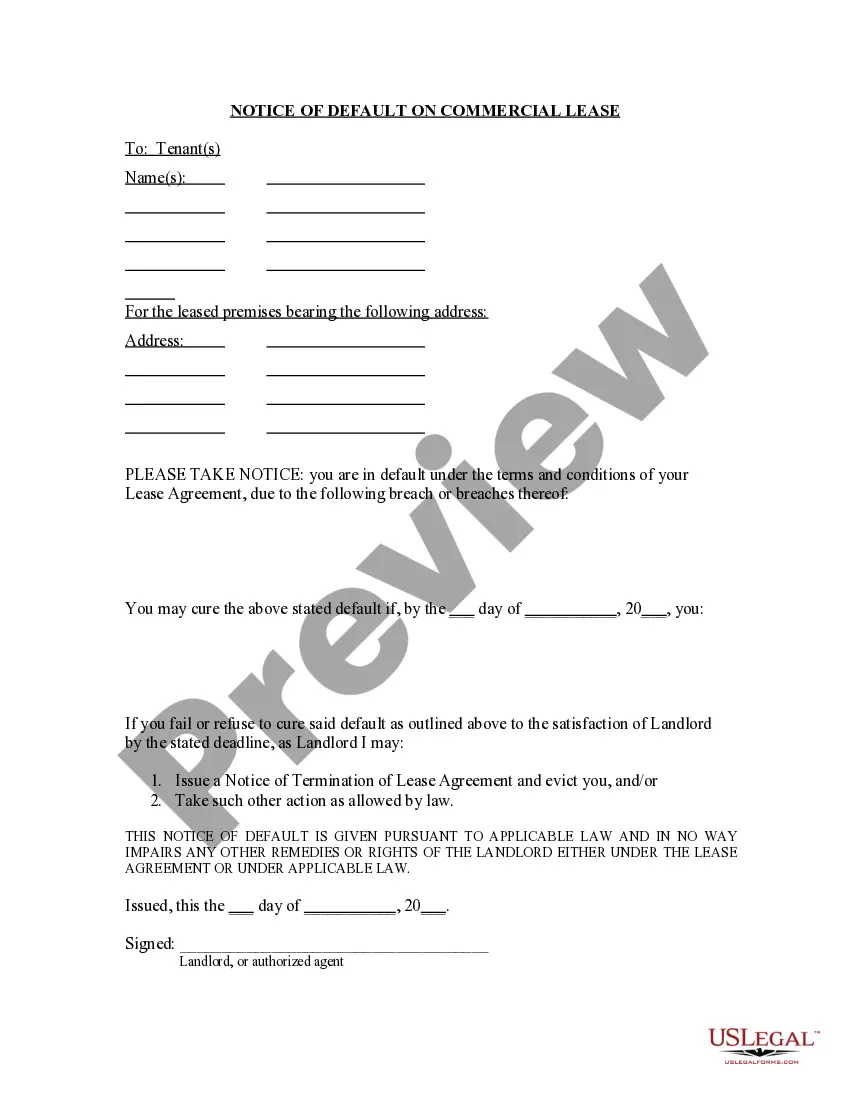
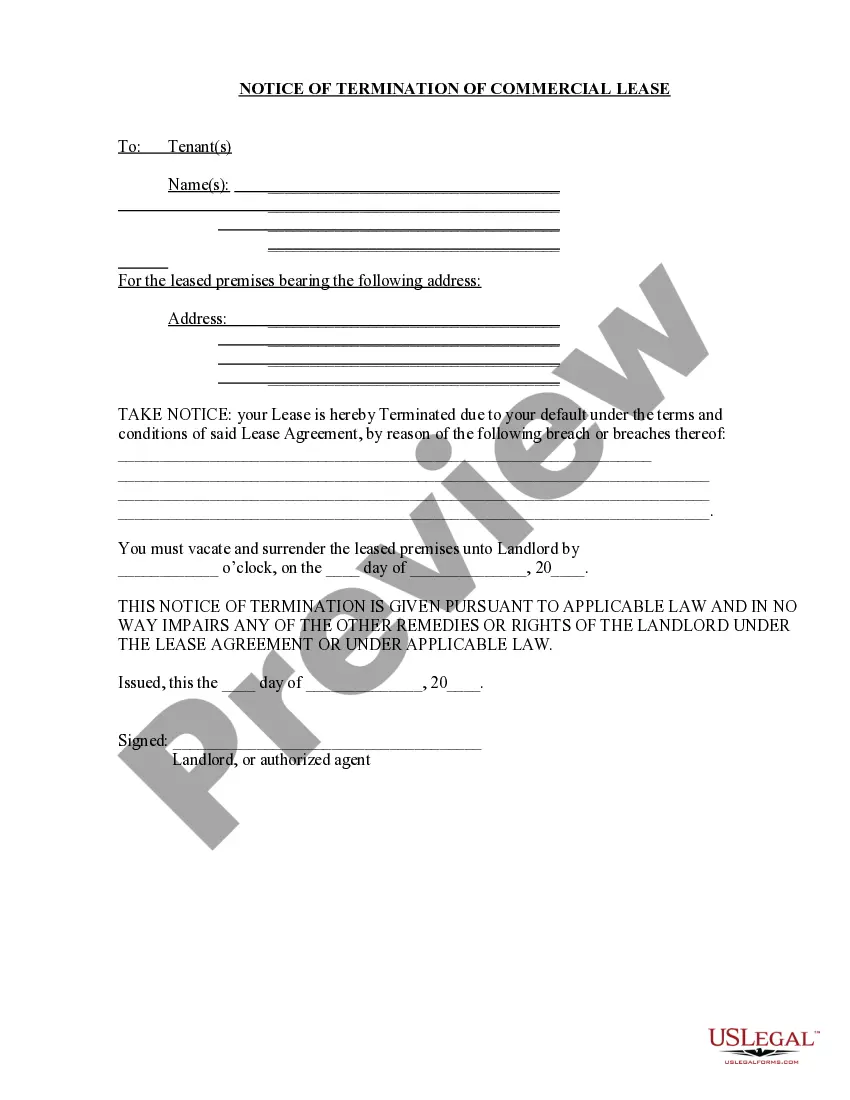
This form is a Letter from Landlord to Tenant as a Notice of Default on Commercial Lease. It serves to inform the tenant of specific breaches of the lease agreement, along with a deadline to remedy these breaches. This notice is critical as it provides the tenant an opportunity to correct the default before the landlord can pursue eviction or other legal remedies. Unlike similar forms, this notice details particular defaults and lays out the landlordâs rights under applicable law.
Form components explained
- Identification of the landlord and tenant.
- A clear statement of the default, outlining the specific breaches of contract.
- A deadline for the tenant to address the issues specified.
- Information about potential actions the landlord may take if the default is not cured.
- Signature line for the landlord or authorized agent.


When to use this document
Who should use this form
- Landlords of commercial properties who need to notify tenants of lease defaults.
- Property managers acting on behalf of landlords.
- Landlords who seek to document breaches and require a formal notice before proceeding with eviction attempts.
Instructions for completing this form
- Identify the parties involved: include the full names of both the landlord and tenant.
- Specify the property: provide the address of the leased commercial property.
- Detail the specific breaches: clearly outline what defaults have occurred as per the lease agreement.
- Set the deadline for cure: indicate the date by which the tenant must rectify the default.
- Sign the document: have the landlord or authorized agent sign and date the notice at the bottom.
Is notarization required?
This form does not typically require notarization unless specified by local law. It is essential to check jurisdiction-specific regulations to ensure compliance and validity of the notice.
Get your form ready online
Our built-in tools help you complete, sign, share, and store your documents in one place.
Make edits, fill in missing information, and update formatting in US Legal Forms—just like you would in MS Word.
Download a copy, print it, send it by email, or mail it via USPS—whatever works best for your next step.
Sign and collect signatures with our SignNow integration. Send to multiple recipients, set reminders, and more. Go Premium to unlock E-Sign.
If this form requires notarization, complete it online through a secure video call—no need to meet a notary in person or wait for an appointment.
We protect your documents and personal data by following strict security and privacy standards.

Make edits, fill in missing information, and update formatting in US Legal Forms—just like you would in MS Word.

Download a copy, print it, send it by email, or mail it via USPS—whatever works best for your next step.

Sign and collect signatures with our SignNow integration. Send to multiple recipients, set reminders, and more. Go Premium to unlock E-Sign.

If this form requires notarization, complete it online through a secure video call—no need to meet a notary in person or wait for an appointment.

We protect your documents and personal data by following strict security and privacy standards.
Avoid these common issues
- Failing to provide a specific deadline for the tenant to remedy the default.
- Not outlining all relevant breaches clearly, which can lead to disputes.
- Neglecting to send or deliver the notice according to state requirements.
Why use this form online
- Convenience of accessing the form anytime from anywhere.
- Editable fields allow customization to fit specific situations quickly.
- Instant availability ensures fast delivery, which is crucial in legal matters.
Legal use & context
- This notice is a crucial part of the eviction process for landlords.
- Failure to issue a notice of default may affect the landlord's right to evict.
- Compliance with state laws is necessary to enforce the notice legally.
Main things to remember
- This form is essential for landlords facing tenant defaults on commercial leases.
- Providing clear details in the notice can prevent legal complications later.
- Consult state laws to ensure compliance and avoid issues during the eviction process.
Looking for another form?
Form popularity
FAQ
Be in writing, Say the full name of the tenant or tenants, Have the address the notice is about, Say everything that the tenant did to break the lease or deserve a 3 day notice to leave, and include details and dates, Say clearly that the tenant has to move out as soon as the 3 days are up, and.
In most cases the landlord will ask that you remain secondarily responsible for paying the lease if the new tenant defaults. In both cases, there will likely be some charge by the landlord to cover their time and expense in reviewing and approving the arrangement.
Write the title for your pay or quit notice across the top of the letter. If not included in the title, the number of days for the notice must be specified. Include the names of each of the tenants. Specify the address of the rental property.
Whether it is expressly stated under the lease or not, the Texas Property Code allows a landlord to prevent a commercial tenant from entering the leased premises by changing the door locks of a tenant who is delinquent in paying at least part of the rent.The decision to lock a tenant out should not be made lightly.
A break-early fee is a lump sum payment. The amount of the break-early fee will vary greatly depending upon the commercial tenant's specific circumstances. In exchange for the break-early fee, the landlord will agree to release the commercial tenant from all of its obligations under the commercial lease.
The landlord must also strictly follow the lease as well as statutory requirements contained in the Texas Property Code, which typically include delivering a notice to vacate to the tenant providing tenant with at least three (3) days to vacate the premises, filing a forcible detainer lawsuit in the proper justice
Dear (Name of landlord or manager), This letter constitutes my written (number of days' notice that you need to give based on your lease agreement)-day notice that I will be moving out of my apartment on (date), the end of my current lease. I am leaving because (new job, rent increase, etc.)
Dear (Name of landlord or manager), This letter constitutes my written (number of days' notice that you need to give based on your lease agreement)-day notice that I will be moving out of my apartment on (date), the end of my current lease. I am leaving because (new job, rent increase, etc.)
Step 1: Mention the Reason for Giving a Notice. Step 2: Use Formal Language. Step 3: Mention the Date for Vacating. Step 4: Address the Formalities to Be Taken Care Of. Step 5: Proofread the Letter.