South Dakota Statement of Account by Corporation
Understanding this form
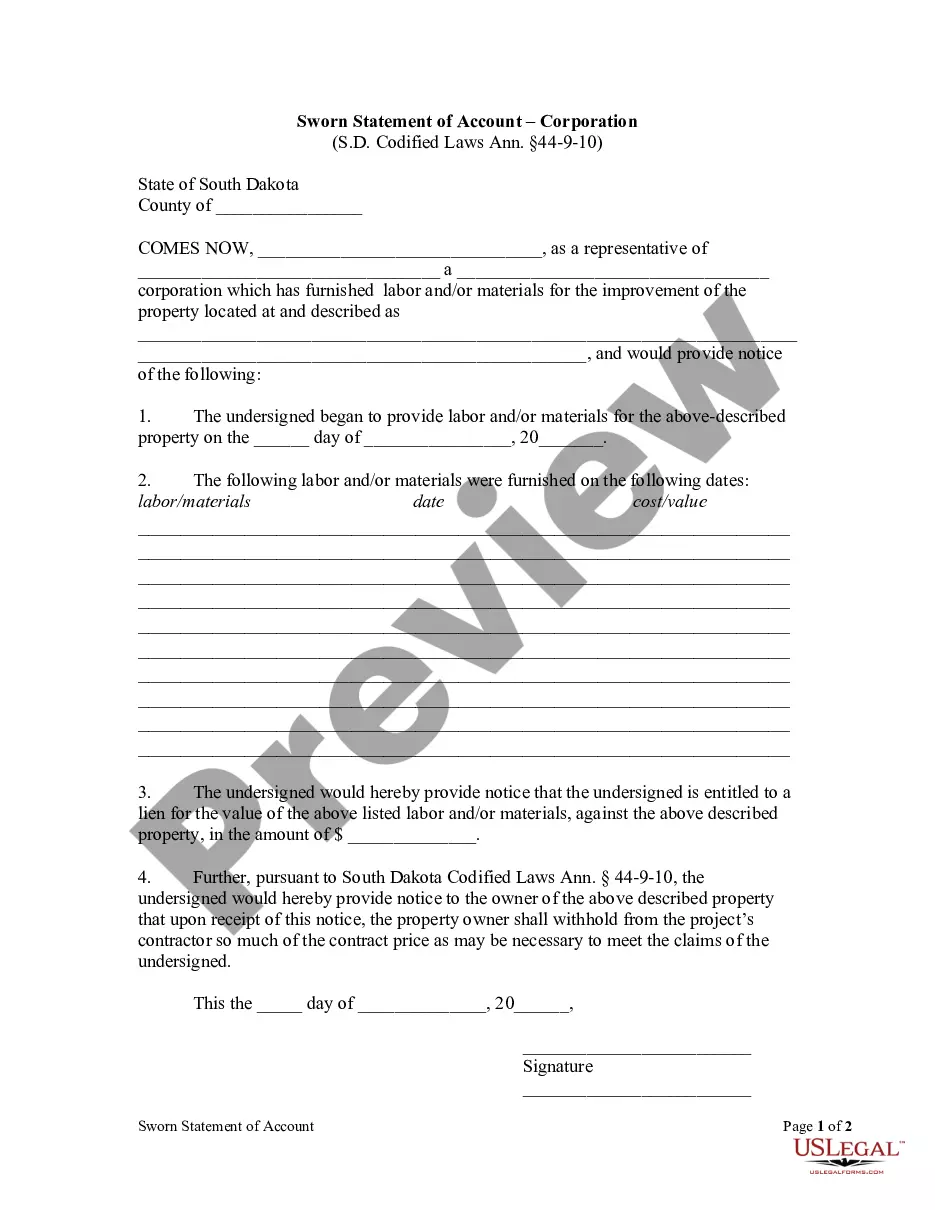
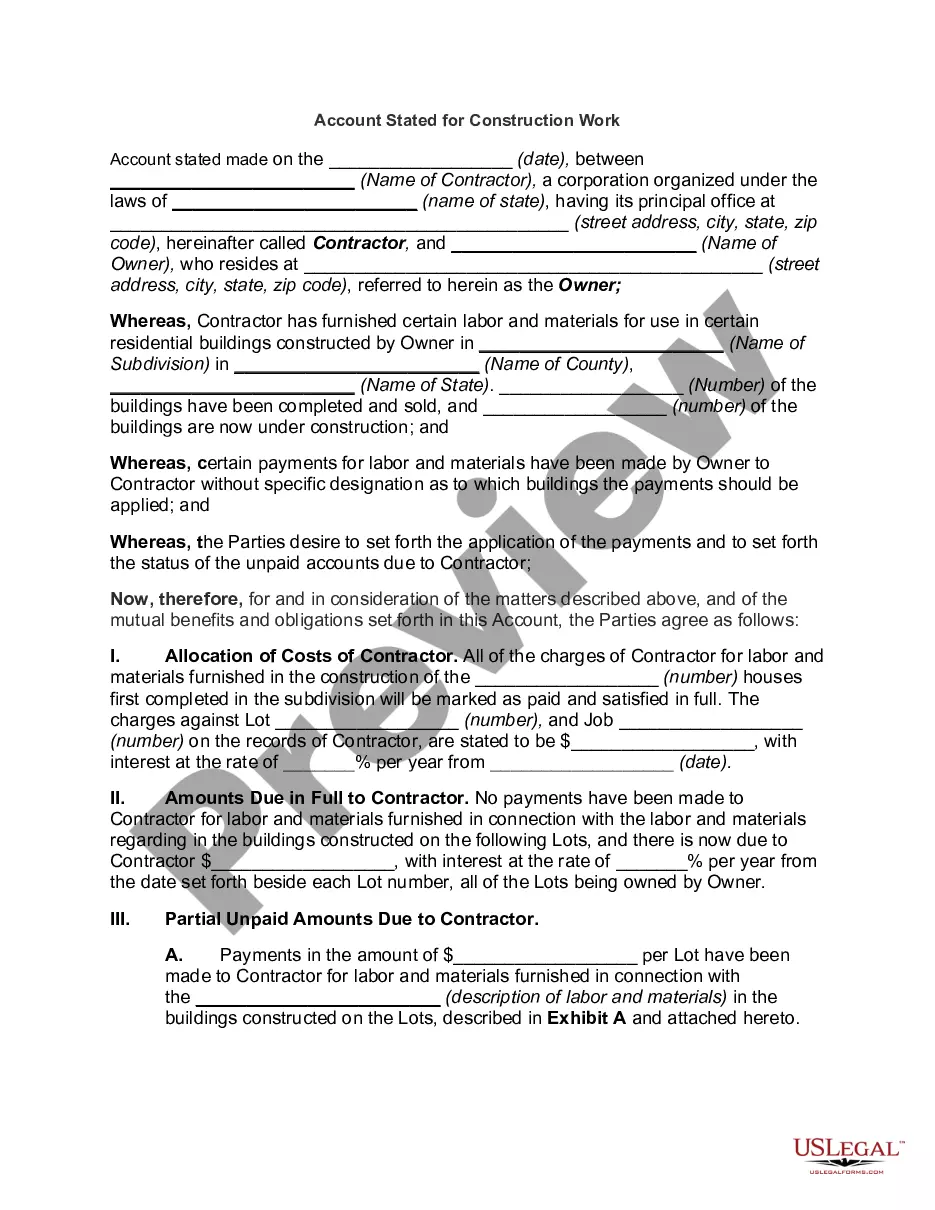
The Statement of Account by Corporation is a legal document used by corporations to formally notify property owners of any labor or materials provided for property improvement or construction. This form serves as an official account statement, detailing the services rendered and associated costs. It differs from other forms by specifically addressing lien claims under South Dakota law, ensuring that contractors can secure their interests efficiently.
What’s included in this form
- Identifying information for the corporation and property.
- Start date of the labor or materials provided.
- Detailed list of labor and/or materials with corresponding dates and costs.
- Notice of the total amount due for the services provided.
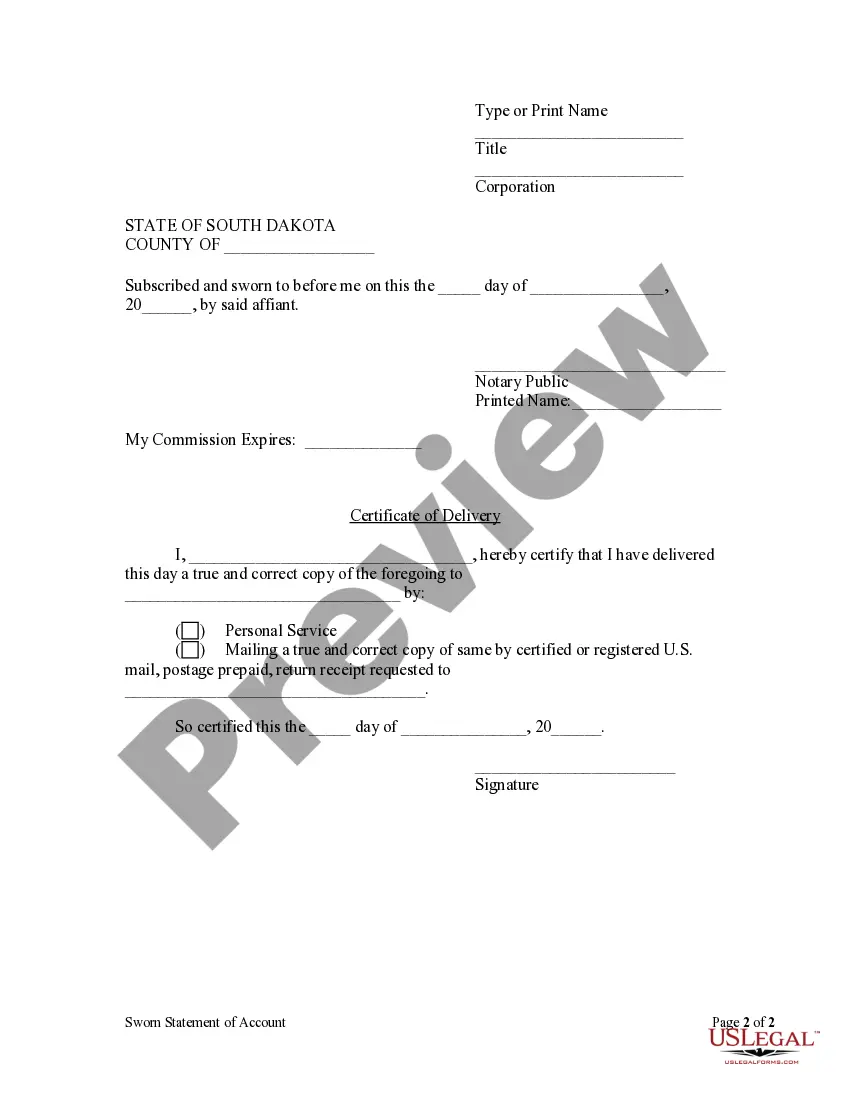
- Signature of the representative and notarization section.
Common use cases
This form should be used when a corporation has supplied labor or materials for the improvement of a property and intends to assert a lien for payment. It is commonly utilized in construction situations where contractors or suppliers need to ensure that they are compensated for their contributions before the full contract price is paid to the contractor by the property owner.
Who should use this form
- Corporations that provide labor or materials for property improvement.
- Representatives acting on behalf of a corporation in contract claims.
- Contractors looking to secure payment under liens in accordance with South Dakota law.
Steps to complete this form
- Identify and fill in the corporation's name and the property location.
- Specify the start date when labor or materials were first provided.
- List each item of labor or materials along with its delivery date and cost.
- Calculate and enter the total amount due for the services rendered.
- Sign the document and have it notarized, if required.
Notarization requirements for this form
Yes, this form must be notarized to be legally valid. US Legal Forms offers integrated online notarization services, available twenty-four hours a day, ensuring a secure video call process that maintains legal equivalence without the need for travel.
Get your form ready online
Our built-in tools help you complete, sign, share, and store your documents in one place.
Make edits, fill in missing information, and update formatting in US Legal Forms—just like you would in MS Word.
Download a copy, print it, send it by email, or mail it via USPS—whatever works best for your next step.
Sign and collect signatures with our SignNow integration. Send to multiple recipients, set reminders, and more. Go Premium to unlock E-Sign.
If this form requires notarization, complete it online through a secure video call—no need to meet a notary in person or wait for an appointment.
We protect your documents and personal data by following strict security and privacy standards.

Make edits, fill in missing information, and update formatting in US Legal Forms—just like you would in MS Word.

Download a copy, print it, send it by email, or mail it via USPS—whatever works best for your next step.

Sign and collect signatures with our SignNow integration. Send to multiple recipients, set reminders, and more. Go Premium to unlock E-Sign.

If this form requires notarization, complete it online through a secure video call—no need to meet a notary in person or wait for an appointment.

We protect your documents and personal data by following strict security and privacy standards.
Mistakes to watch out for
- Failing to include all relevant labor and materials in the account statement.
- Omitting the start date of service.
- Not obtaining proper notarization when required.
- Providing an inaccurate total amount due.
Why complete this form online
- Convenience of downloading and completing the form at your own pace.
- Editable fields allow for easy customization to fit your specific needs.
- Access to reliable templates drafted by licensed attorneys, ensuring compliance with the law.
Summary of main points
- The Statement of Account by Corporation is essential for asserting lien rights in South Dakota.
- Proper completion requires accurate details regarding services and notarization.
- This form protects the financial interests of corporations involved in property improvement or construction.
Looking for another form?




Form popularity
FAQ
LLCs are not corporations and do not use articles of incorporation. Instead, LLCs form by filing articles of organization.
Choose a Name for Your LLC. Appoint a Registered Agent. File Articles of Organization. Prepare an Operating Agreement. Obtain an EIN. File Annual Reports.
Not every state requires annual reports.
Annual reports became a regulatory requirement for public companies following the stock market crash of 1929, when lawmakers mandated standardized corporate financial reporting. The intent of the required annual report is to provide public disclosure of a company's operating and financial activities over the past year.
Business Licenses The state of South Dakota doesn't have a general business license; however, many cities require a business license in order to operate. Sales Tax License Businesses selling products and certain services will need to register for a Sales Tax License with the South Dakota Department of Revenue.
If you've incorporated as a business As an LLC, LLP, S-Corp or C-Corp, you must file an annual report, normally with your state's Secretary of State. This applies no matter how big or small your business is. Typically, sole proprietors and partnerships do not have to file an annual report.
STEP 1: Name your South Dakota LLC. STEP 2: Choose a South Dakota Registered Agent. STEP 3: File the South Dakota LLC Articles of Organization. STEP 4: Create Your South Dakota LLC Operating Agreement. STEP 5: Get an EIN for Your South Dakota LLC.
Key Things to Know About Annual Reports Currently, all states, except Ohio, require some sort of annual report filing. Specific filing requirements and deadlines vary by state. Some states also require an initial report when first starting a business.
After a certain amount of time past the due date, if the report still isn't filed, the jurisdiction will revoke your company's good standing or put it into a forfeited status.Most states require the past due annual report as well as an additional certificate of reinstatement and more fees.