Boundary Line Agreement Between Adjacent Land Owners
Understanding this form
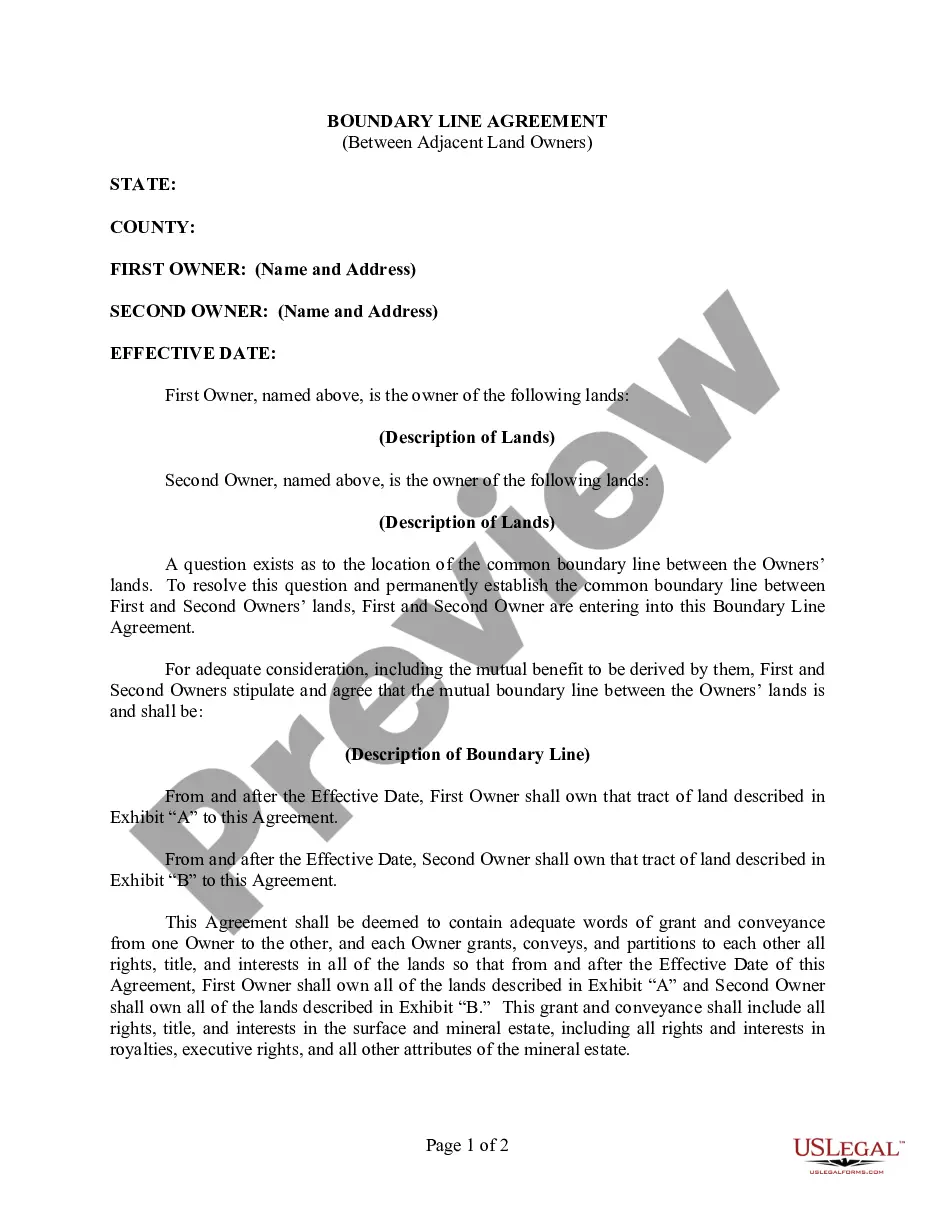
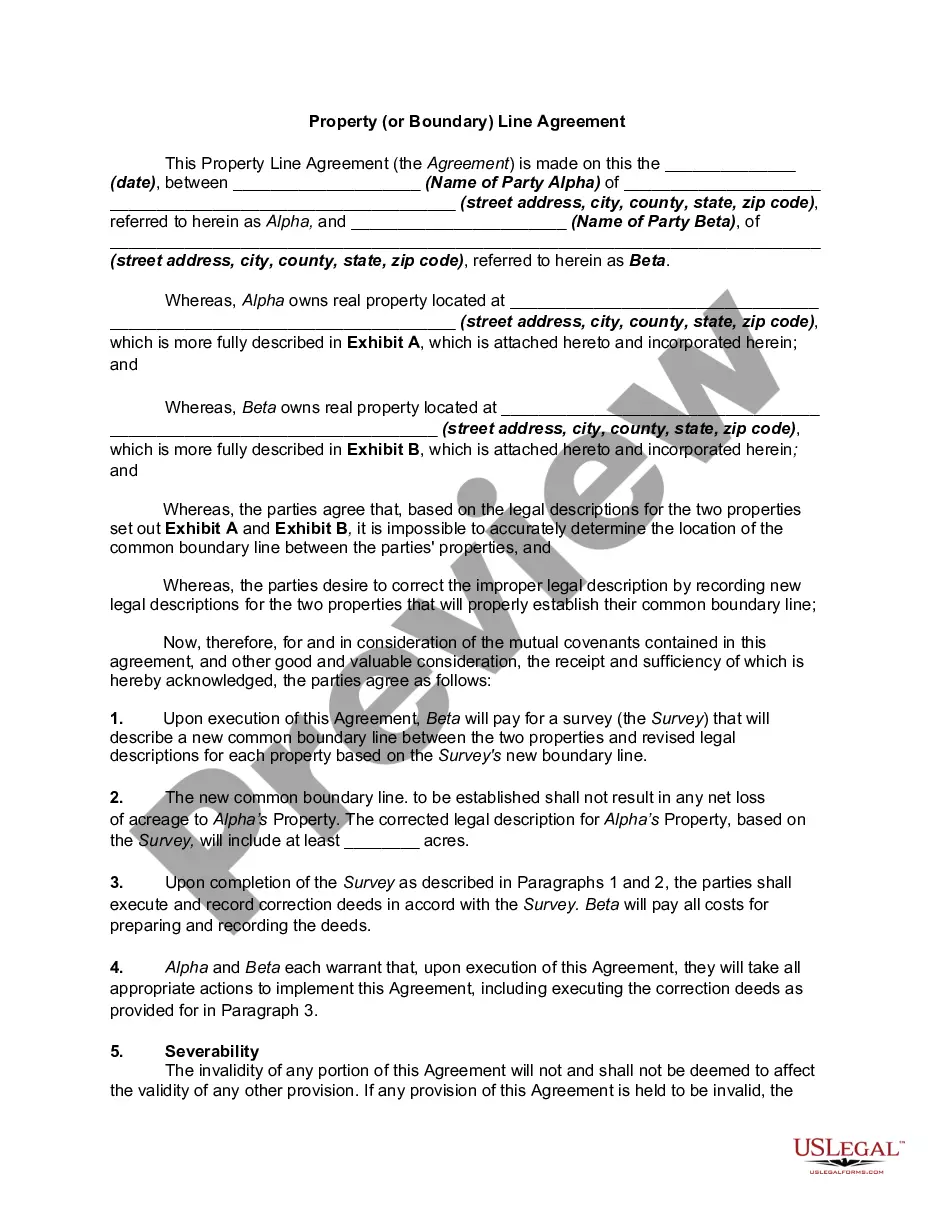
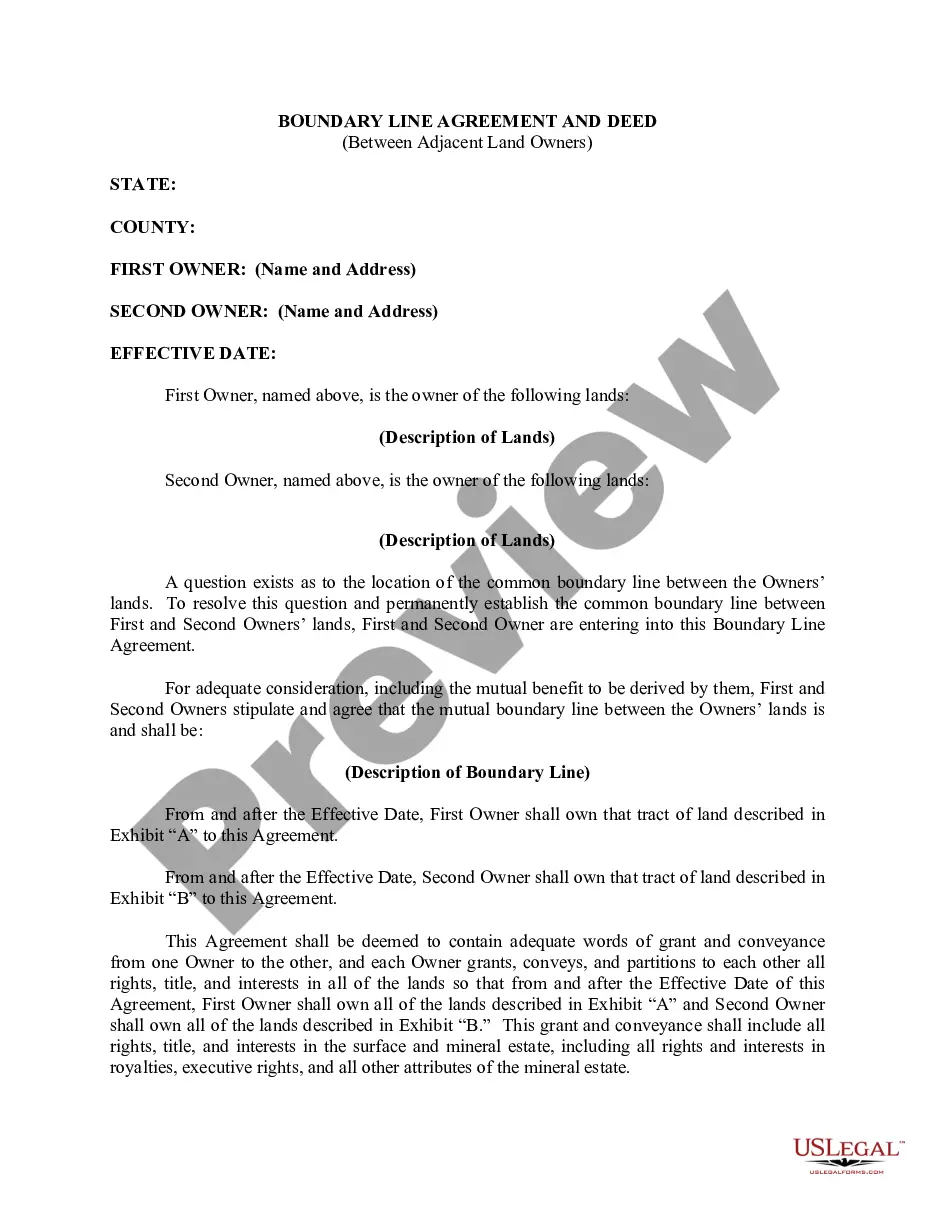
The Boundary Line Agreement Between Adjacent Land Owners is a legal document designed to clarify and permanently establish the boundary line separating two parcels of land owned by different individuals. This form is particularly useful when there is uncertainty regarding the exact location of the boundary. Unlike other property agreements, this form specifically addresses boundary disputes and helps prevent future conflicts between neighbors over land ownership and usage.
What’s included in this form
- Identification of the First and Second Owners, including names and addresses.
- Description of the lands owned by both parties.
- Statement of the common boundary line that the owners agree upon.
- Effective date of the agreement.
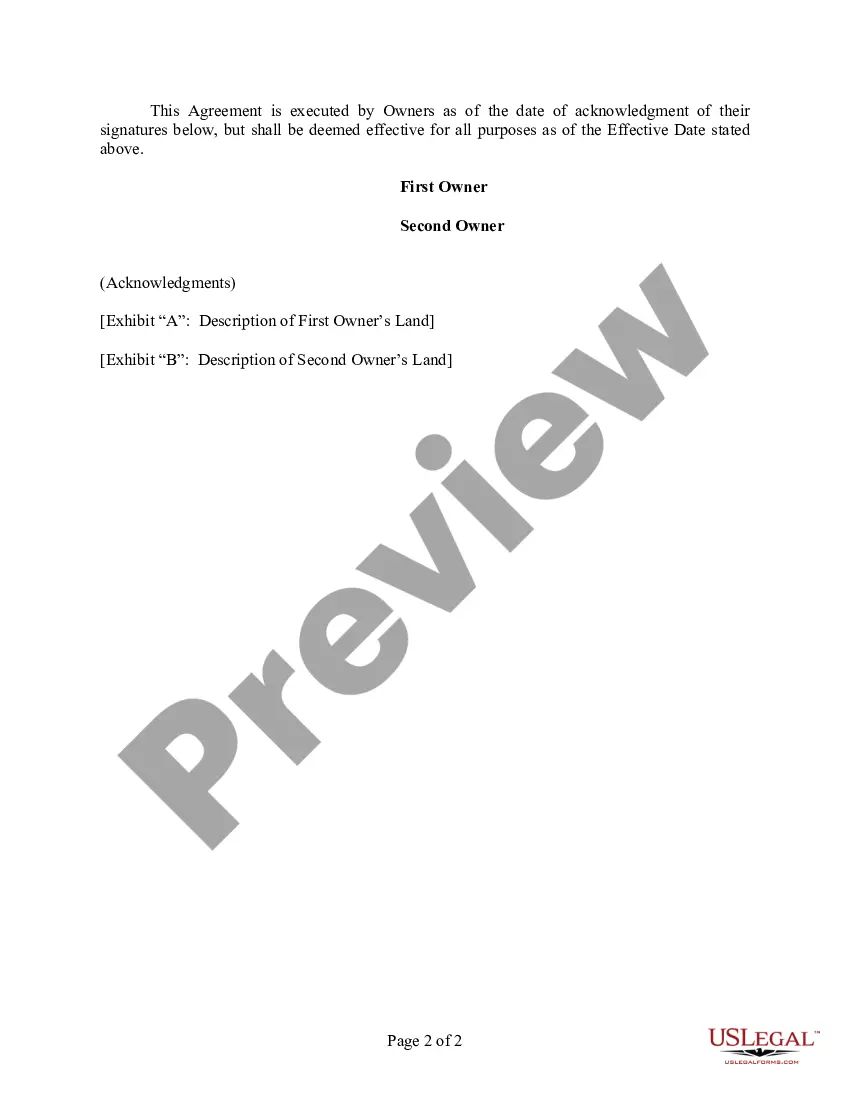
- Exhibits detailing the specific descriptions of First Owner's and Second Owner's lands.

When to use this document
This form should be used when neighboring landowners are uncertain about the location of their boundary line and wish to clarify and legally establish it. Scenarios may include disputes arising from changes in property use, grading, fencing, or other activities that could affect property boundaries. Having a Boundary Line Agreement helps to prevent potential legal issues in the future and can enhance neighborly relations by ensuring both parties are on the same page regarding property lines.
Intended users of this form
- Adjacent landowners who have a mutual concern about property boundaries.
- Individuals seeking to clarify the legal boundaries of their property to avoid disputes.
- Property developers or surveyors involved in land transactions or boundary disputes.
How to prepare this document
- Identify the First and Second Owners by entering their names and addresses.
- Clearly describe the lands owned by both parties, including property addresses or parcel identification numbers.
- State the location of the disputed common boundary line and describe it in detail.
- Enter the effective date for when this agreement will commence.
- Complete the exhibits providing detailed descriptions of both properties.
- Have both owners sign and date the agreement to make it legally binding.
Notarization guidance
This form needs to be notarized to ensure legal validity. US Legal Forms provides secure online notarization powered by Notarize, allowing you to complete the process through a verified video call, available anytime.
Get your form ready online
Our built-in tools help you complete, sign, share, and store your documents in one place.
Make edits, fill in missing information, and update formatting in US Legal Forms—just like you would in MS Word.
Download a copy, print it, send it by email, or mail it via USPS—whatever works best for your next step.
Sign and collect signatures with our SignNow integration. Send to multiple recipients, set reminders, and more. Go Premium to unlock E-Sign.
If this form requires notarization, complete it online through a secure video call—no need to meet a notary in person or wait for an appointment.
We protect your documents and personal data by following strict security and privacy standards.

Make edits, fill in missing information, and update formatting in US Legal Forms—just like you would in MS Word.

Download a copy, print it, send it by email, or mail it via USPS—whatever works best for your next step.

Sign and collect signatures with our SignNow integration. Send to multiple recipients, set reminders, and more. Go Premium to unlock E-Sign.

If this form requires notarization, complete it online through a secure video call—no need to meet a notary in person or wait for an appointment.

We protect your documents and personal data by following strict security and privacy standards.
Common mistakes
- Failing to accurately describe the boundary line can lead to further disputes.
- Not including full legal descriptions of the properties can invalidate the agreement.
- Omitting necessary signatures or dates, which can affect the enforceability of the agreement.
Benefits of completing this form online
- Convenience of downloading and printing the form at your own pace.
- Editability allows for customization based on specific property details.
- Access to legally vetted documents ensures that the agreement meets legal standards.
Looking for another form?



Form popularity
FAQ
Orange fencing. Orange fencing is used to mark the perimeter of the build site. Objective: Transfer drawings to real land. Establish basic location of the house. Establish the house orientation. Establish north wall position. Iterative process. Mark building edges and driveway with stakes. Join the stakes with colored string.
If you decide to hire a licensed land surveyor, he or she will come out to your land and place markers that mark the boundary lines of your property. You can find a listing of licensed land surveyors in your area by simply consulting your local phone book or the internet.
Negotiate directly with the neighbour to achieve a settlement of the dispute that has arisen; or. Agree with the neighbour to enter into a form of Alternative Dispute Resolution (ADR), and in the present conundrum I would recommend Mediation; or.
Taking the details from the legal description and plat map, a surveyor carefully measures the legal boundaries of your property. The surveyor will bury survey pins if they're not already there and often mark the spots with stakes or flags for easy use.
Property boundaries are often identified above ground with the use of stakes to mark the corner points. Years ago, wooden stakes were often used to mark property lines. More recently, long metal posts that are visible about 1 to 2 feet above ground have been used.
Red is the uniform color for electric power lines; orange for communications; yellow for gas, oil and steam; green for sewers and drain lines; and blue for water. White is used for proposed excavation limits or routes, and pink is used for temporary survey markings.
The doctrine provides that when two adjacent owners who are uncertain of the true position of the common boundary between the parcels agree to the true position of the common boundary, mark it on the ground or build it up, and occupy each side for a period equal to the statute of limitations, then such line becomes the
The three most commonly used markings are the simple stakes, flags and pins. These surveyor symbols are common to any construction project and guarantee that everything gets put in the right place.
A Land Survey Works Wonders for Boundary Disputes. If you feel like your neighbor has or is developing on top of your land, you may want to get a professional land survey. Talk it Over and Offer Concessions. Bring on a Neutral Third Party. Hire a Qualified Estate Attorney.