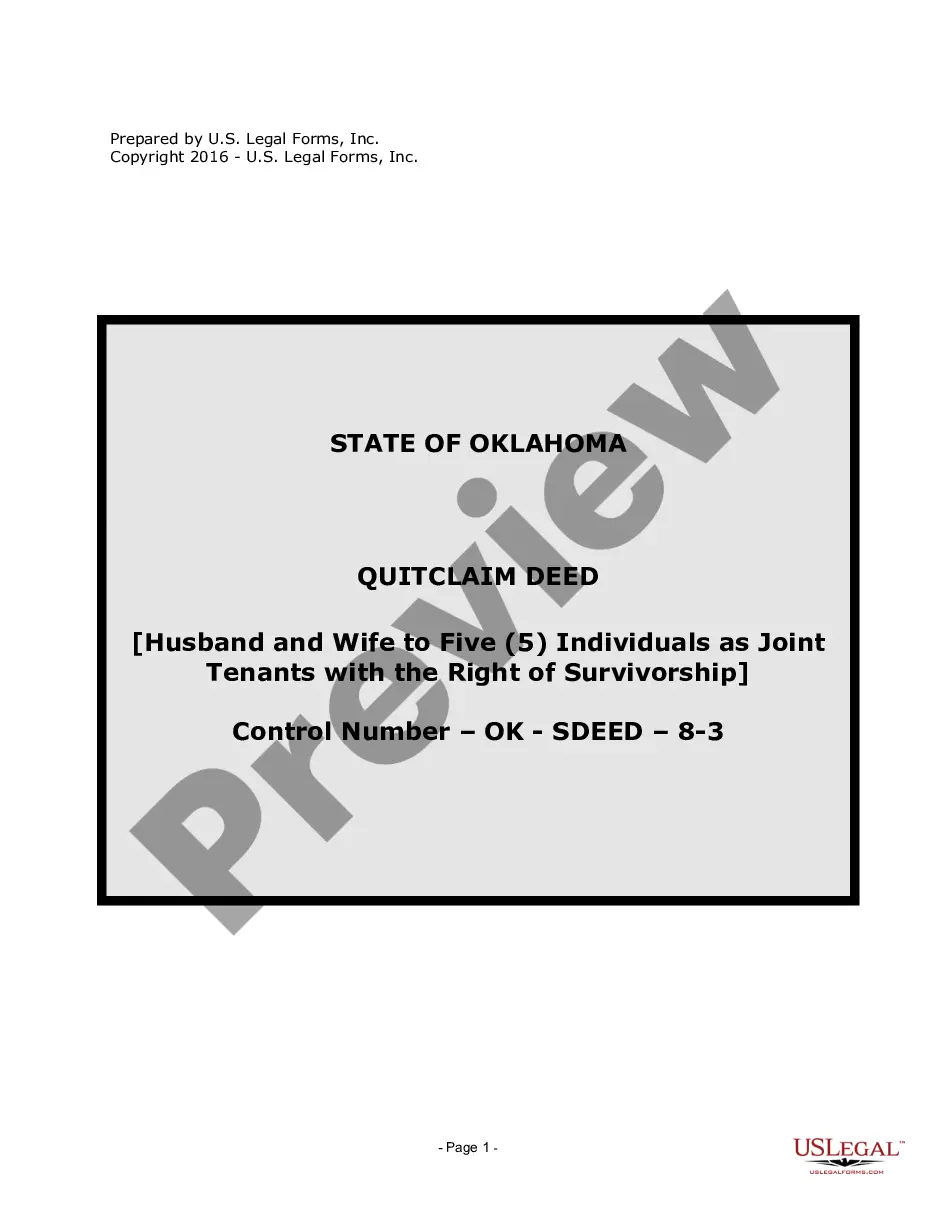
Oklahoma Quitclaim Deed from Husband and Wife to Five Individuals as Joint Tenants with Right of Survivorship
About this form
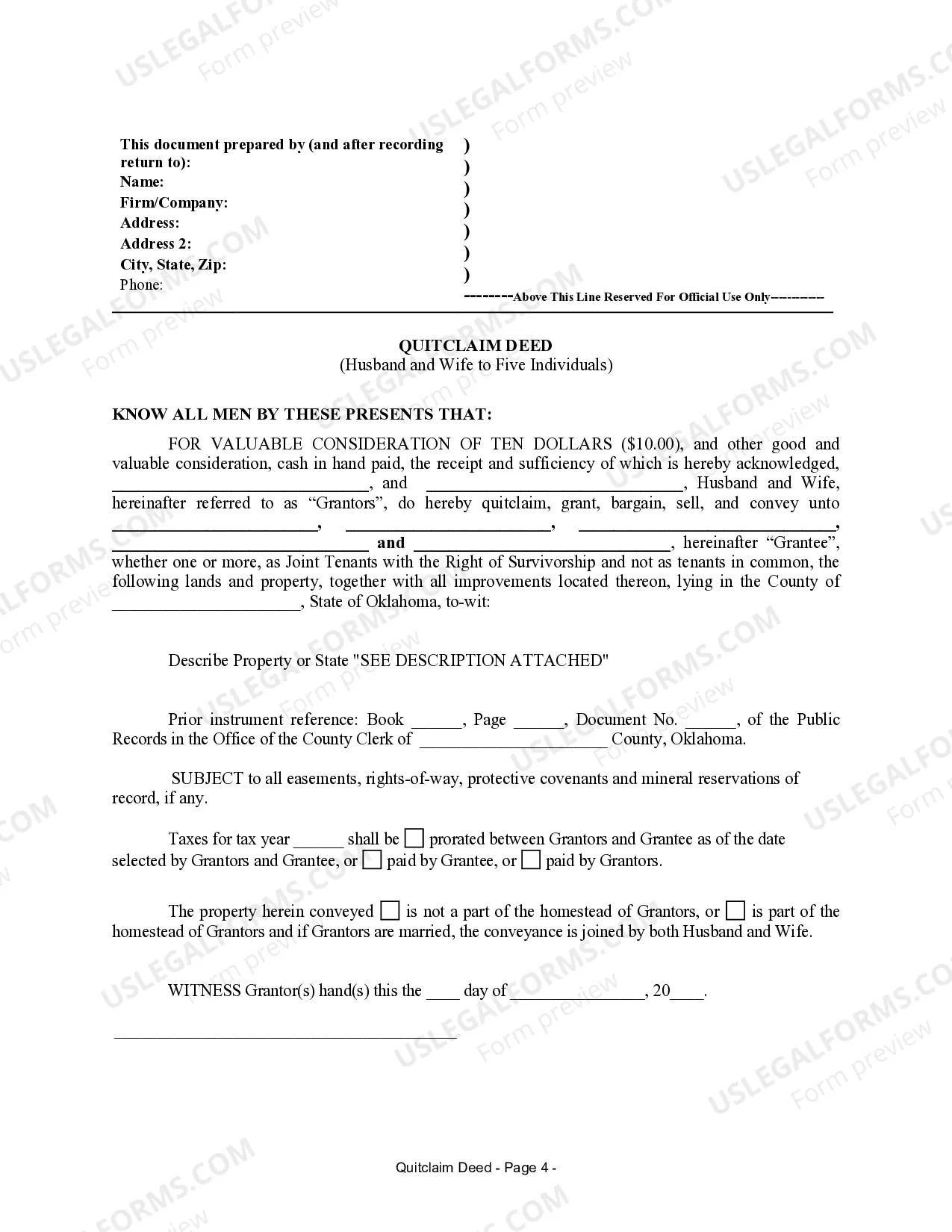
The Quitclaim Deed from Husband and Wife to Five Individuals as Joint Tenants with Right of Survivorship is a legal document that allows a married couple to transfer their ownership interest in a property to five individuals. This form is particularly useful for establishing joint tenancy, which ensures that upon the death of one party, the remaining joint tenants automatically inherit the deceased's share of the property. Unlike other deeds, a quitclaim deed does not guarantee the granters' ownership rights, making it essential to understand the implications of the transfer before using this form.
Key parts of this document
- Identification of grantors (husband and wife) and grantees (five individuals).
- Description of the property being transferred.
- Specification of the joint tenancy with right of survivorship status.
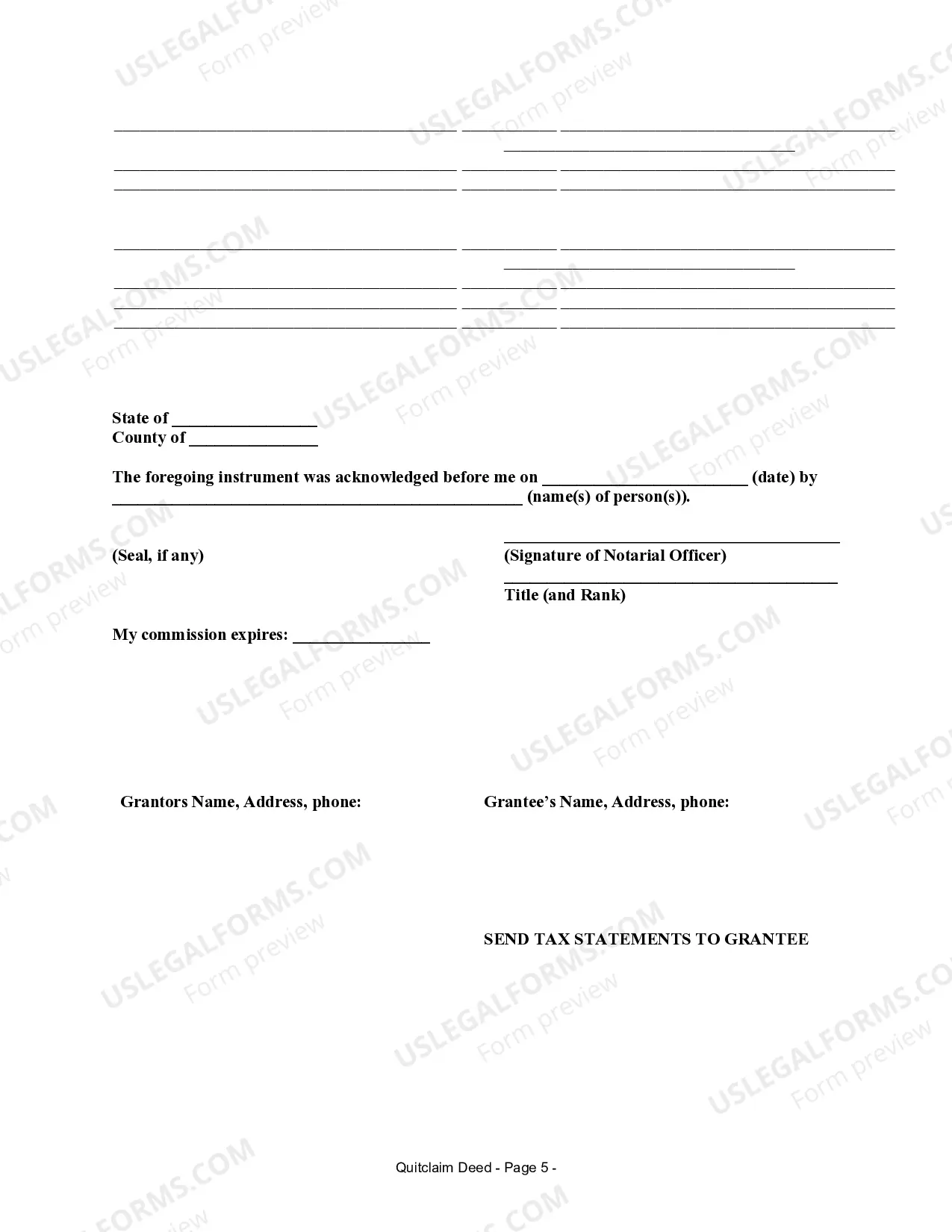
- Details on tax proration between the grantors and grantees.
- Acknowledgment of the deed before a notary public.




Common use cases
This form is appropriate when a married couple wishes to transfer their property ownership to multiple individuals, ensuring that these individuals hold the title as joint tenants with rights to the property upon the death of one tenant. Typical scenarios include estate planning, transferring family property, or providing a gift of property to loved ones in a structured way.
Who this form is for
- Married couples wanting to transfer property to multiple individuals.
- Individuals seeking to establish a joint tenancy with right of survivorship arrangement.
- Anyone needing a straightforward process for property transfer without warranties of title.
How to prepare this document
- Identify the grantors (husband and wife) and the five grantees.
- Provide a detailed description of the property being transferred.
- Specify if the transfer is part of the grantors' homestead and any related tax arrangements.
- Complete the form fields with the necessary information.
- Have the form acknowledged before a notary public to ensure legal validity.
Is notarization required?
To make this form legally binding, it must be notarized. Our online notarization service, powered by Notarize, lets you verify and sign documents remotely through an encrypted video session.
Get your form ready online
Our built-in tools help you complete, sign, share, and store your documents in one place.
Make edits, fill in missing information, and update formatting in US Legal Forms—just like you would in MS Word.
Download a copy, print it, send it by email, or mail it via USPS—whatever works best for your next step.
Sign and collect signatures with our SignNow integration. Send to multiple recipients, set reminders, and more. Go Premium to unlock E-Sign.
If this form requires notarization, complete it online through a secure video call—no need to meet a notary in person or wait for an appointment.
We protect your documents and personal data by following strict security and privacy standards.

Make edits, fill in missing information, and update formatting in US Legal Forms—just like you would in MS Word.

Download a copy, print it, send it by email, or mail it via USPS—whatever works best for your next step.

Sign and collect signatures with our SignNow integration. Send to multiple recipients, set reminders, and more. Go Premium to unlock E-Sign.

If this form requires notarization, complete it online through a secure video call—no need to meet a notary in person or wait for an appointment.

We protect your documents and personal data by following strict security and privacy standards.
Avoid these common issues
- Failing to have the deed notarized, which may invalidate the transfer.
- Omitting key information about the property, which can lead to disputes.
- Not checking for existing encumbrances or liens on the property before transferring ownership.
Advantages of online completion
- Convenient access to frequently used legal forms from anywhere with an internet connection.
- Editable fields allow for easy data entry and customization of the document.
- Reliable templates prepared by licensed attorneys to ensure compliance with local laws.
Looking for another form?

Form popularity
FAQ
' Spouses typically acquire title as tenants by the entireties, which only applies to spouses. Sometimes you will see a couple who acquired the property before marriage. In some states, a premarital joint tenancy automatically becomes tenants by the entireties upon marriage.
It is also crucial that a spouse know about the loan, even if he or she is not on the mortgage. In general, the spouse must sign a deed of trust, the Truth in Lending and Right to Cancel documents. By signing these documents, they are simply acknowledging the existence of the mortgage.
For example, joint tenants must all take title simultaneously from the same deed while tenants in common can come into ownership at different times. Another difference is that joint tenants all own equal shares of the property, proportionate to the number of joint tenants involved.
One of the main differences between the two types of shared ownership is what happens to the property when one of the owners dies. When a property is owned by joint tenants with survivorship, the interest of a deceased owner automatically gets transferred to the remaining surviving owners.
In order to transfer ownership of the marital home pursuant to a divorce, one spouse is going to need to sign a quitclaim deed, interspousal transfer deed, or a grant deed, in order to convey the title to the property.
In estate law, joint tenancy is a special form of ownership by two or more persons of the same property. The individuals, who are called joint tenants, share equal ownership of the property and have the equal, undivided right to keep or dispose of the property. Joint tenancy creates a Right of Survivorship.
If you look at the registered title to your own jointly owned property and the text isn't shown on it, you own it as joint tenants. If it is there, you own it as tenants-in-common.
To create a joint tenancy, all you need to do is put the right words on the title document, such as a deed to real estate, a car's title slip, or the signature card establishing a bank account.