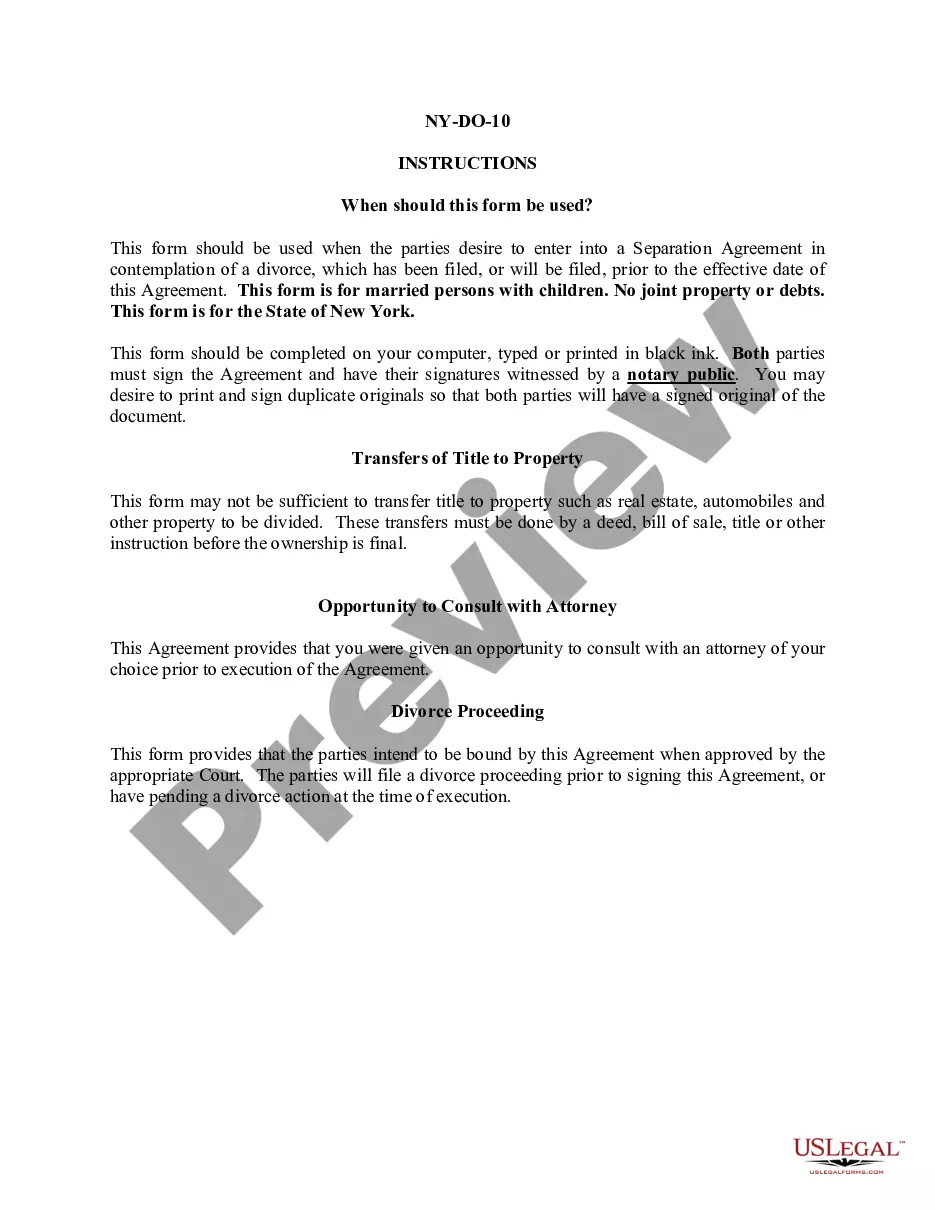
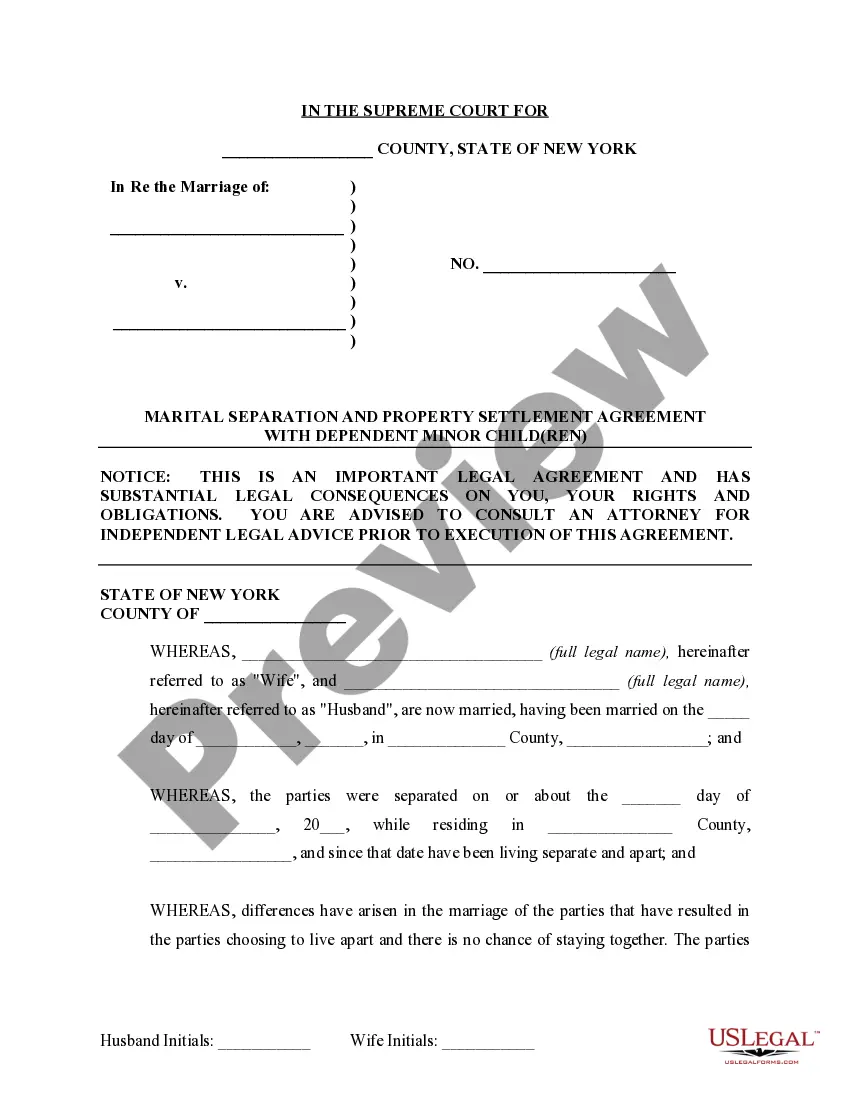
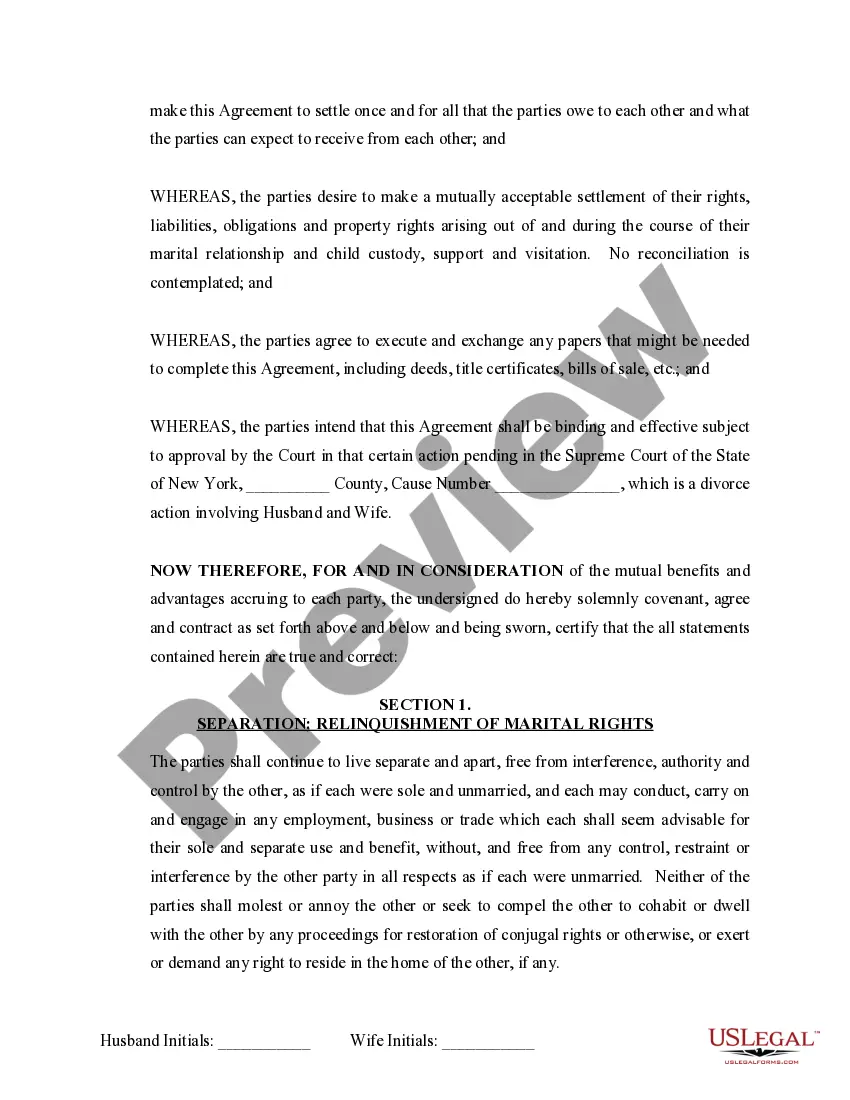
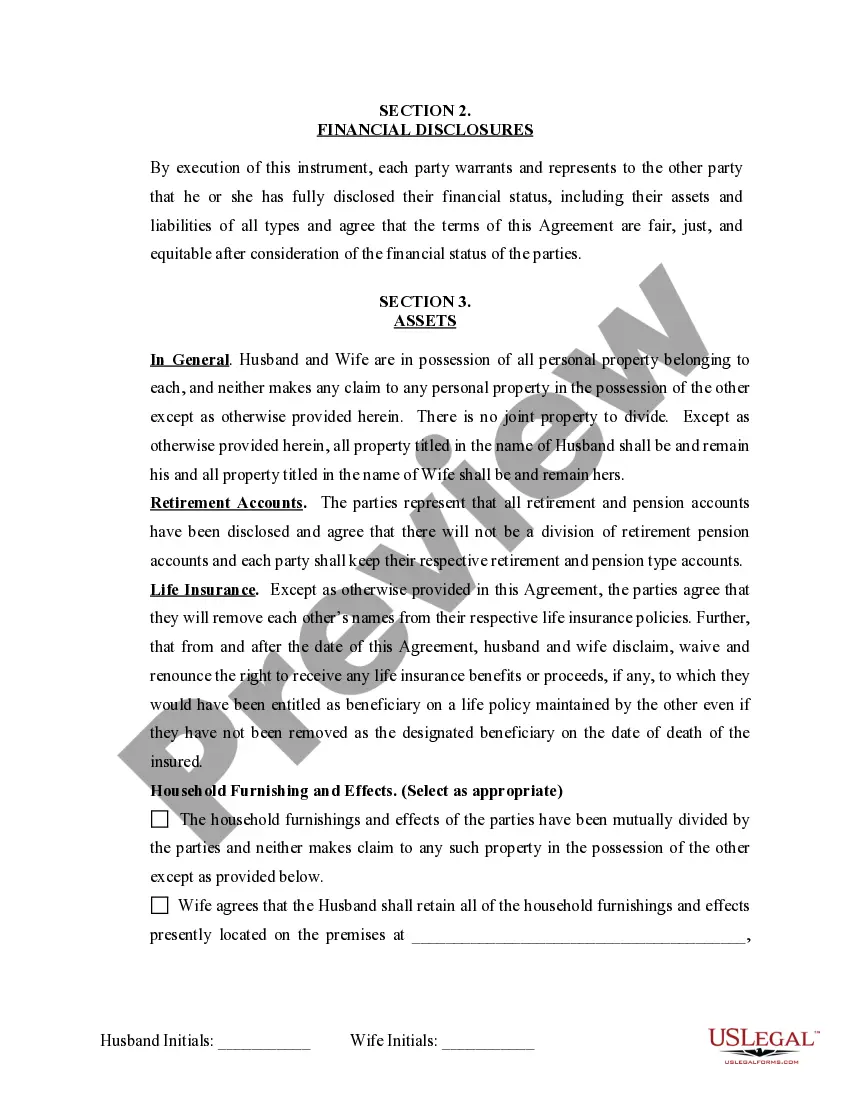
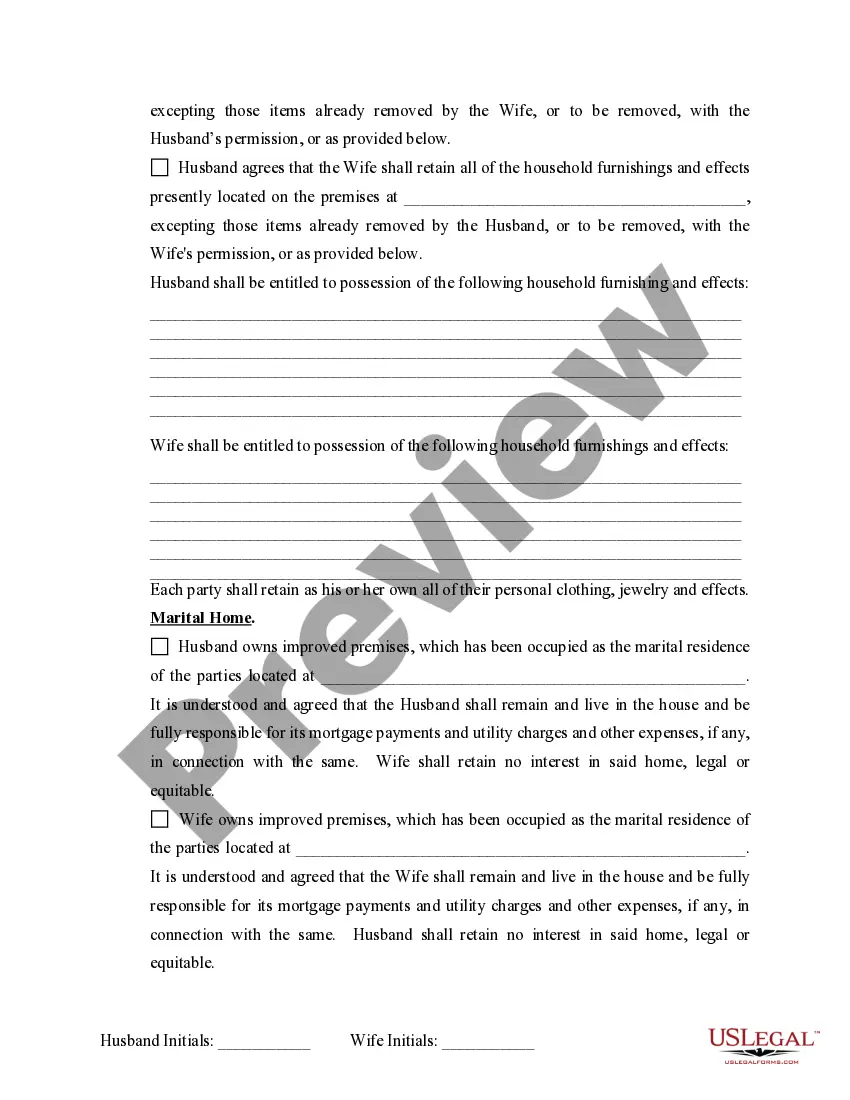
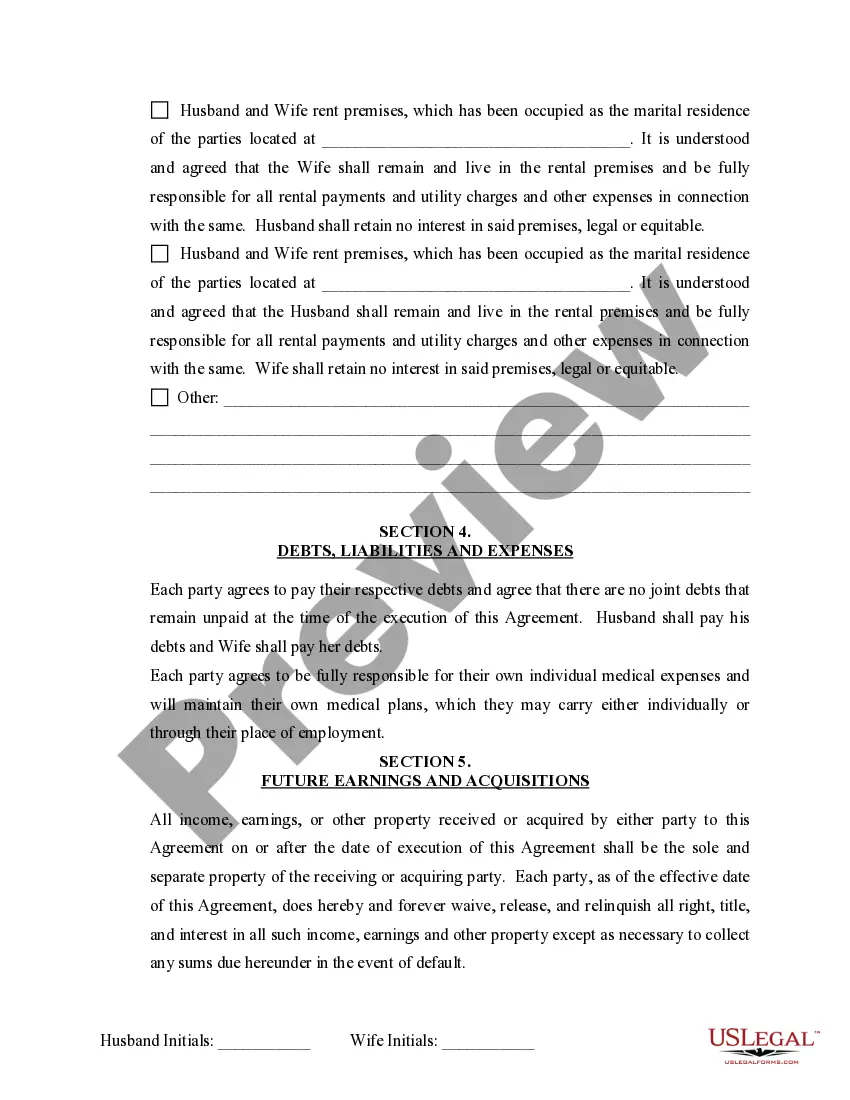
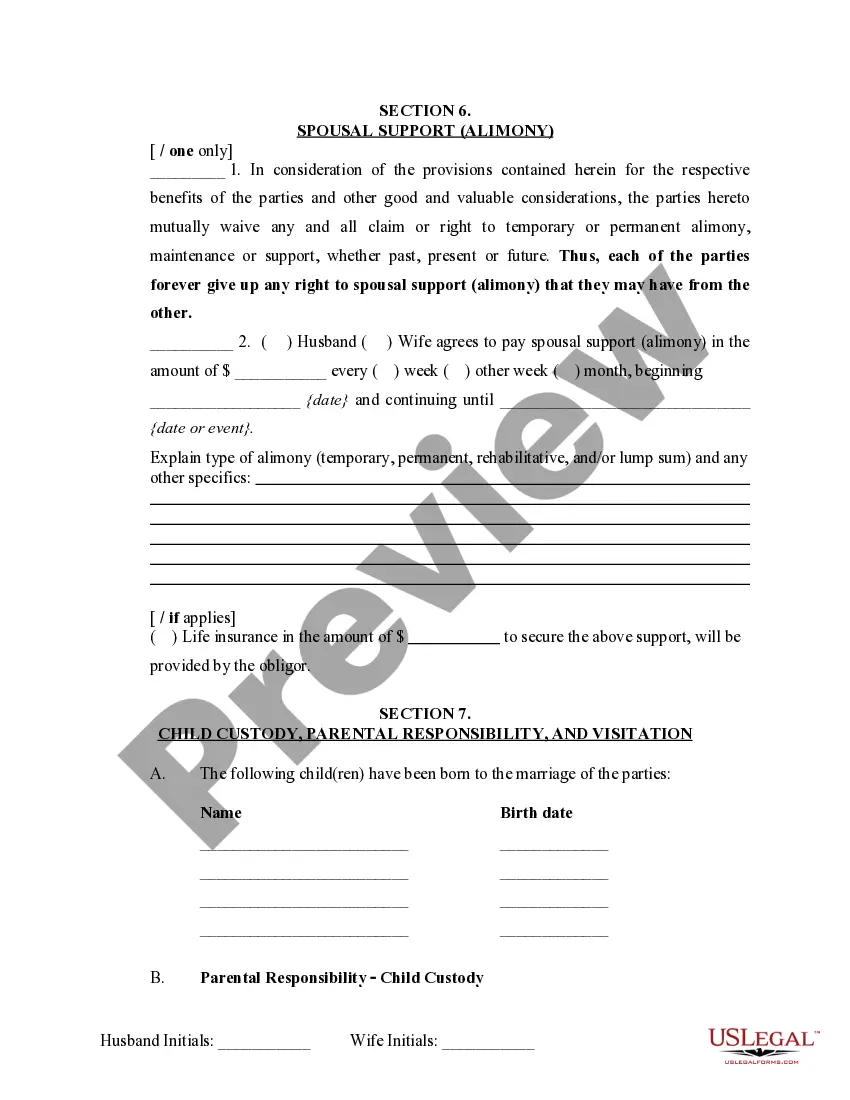
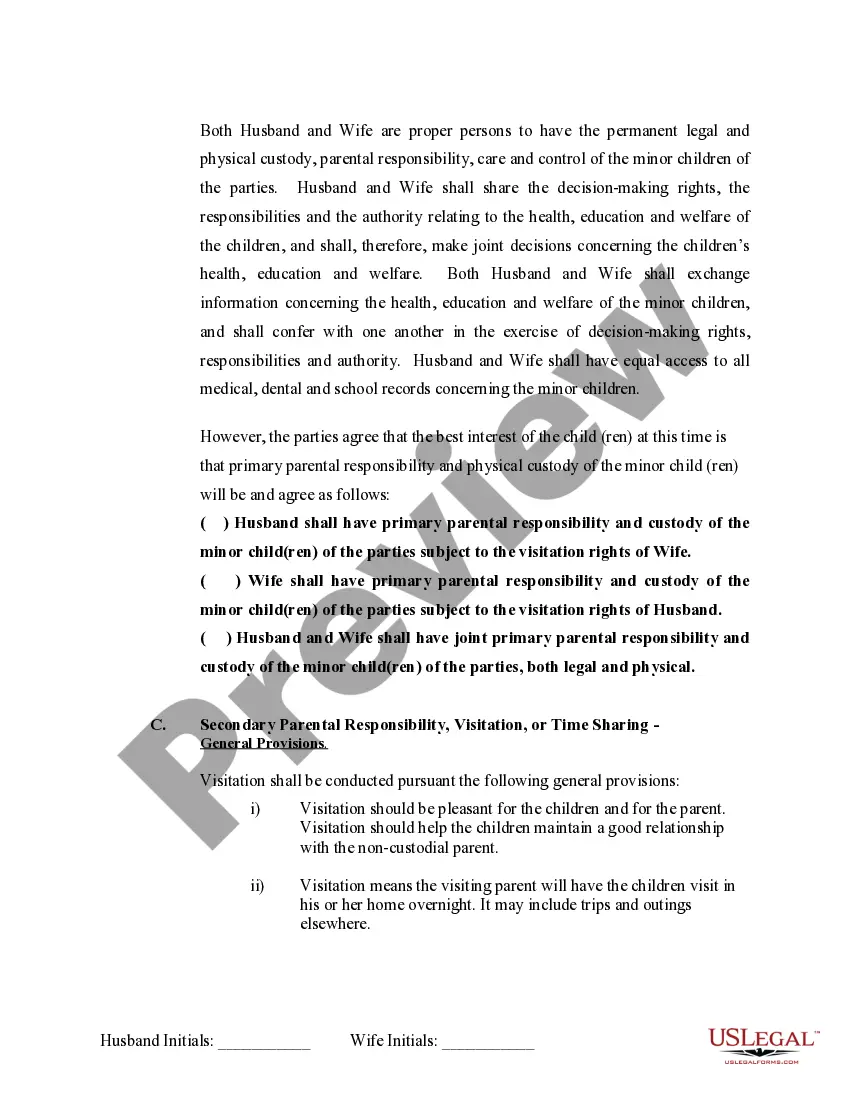
Marital Domestic Separation and Property Settlement Agreement Minor Children no Joint Property or Debts where Divorce Action Filed
Note: This summary is not intended to be an all inclusive
discussion of the law of separation agreements in New York State, but does
include basic and other provisions.
General Summary: Separation and Property Agreements may
be entered into before a divorce is filed to be effective.
Statutes:
New York State Consolidated Laws
ARTICLE 13
PROVISIONS APPLICABLE TO MORE THAN ONE TYPE OF MATRIMONIAL ACTION
S 236. Special controlling provisions; prior
actions or proceedings; new actions or proceedings.
PART B
NEW ACTIONS OR PROCEEDINGS
Maintenance and distributive award.
1. Definitions. Whenever used in this part, the following terms shall have the respective
meanings hereinafter set forth or indicated:
a. The term "maintenance" shall mean payments provided for
in a valid agreement between the parties or awarded by the court in accordance
with the provisions of subdivision six of this part, to be
paid at fixed intervals for a definite or indefinite
period of time, but an award of maintenance shall terminate upon the death
of either party or upon the recipient's valid or invalid
marriage, or upon modification pursuant to paragraph (b) of subdivision
nine of section two hundred thirty-six of this part or section
two hundred forty-eight of this chapter.
b. The term "distributive award" shall mean payments provided for
in a valid agreement between the parties or awarded by the court,
in lieu of or to supplement, facilitate or effectuate the division or
distribution of property where authorized in a matrimonial action, and
payable either in a lump sum or over a period of time
in fixed amounts. Distributive awards shall not include payments which
are treated as ordinary income to the recipient
under the provisions of the United States Internal Revenue
Code.
c. The term "marital property" shall mean all property acquired
by either or both spouses during the marriage and before the execution
of a separation agreement or the commencement of a matrimonial action,
regardless of the form in which title is held, except as otherwise provided
in agreement pursuant to subdivision three of this part. Marital
property shall not include separate property as hereinafter defined.
(1) property acquired before marriage or property acquired by bequest,
devise, or descent, or gift from a party other than the spouse;
e. The term "custodial parent" shall mean a parent to whom
custody of a child or children is granted by a valid agreement between
the parties or by an order or decree of a court.
f. The term "child support" shall mean a sum
paid pursuant to court order or decree by either or both parents or pursuant
to a valid agreement between the parties
for care, maintenance and education of any unemancipated child under
the age of twenty-one years.
2. Matrimonial actions. Except as provided in subdivision five
of this part, the provisions of this part shall be applicable to actions
for an annulment or dissolution of a marriage, for a divorce, for
a separation, for a declaration of the nullity of a void marriage, for
a declaration of the validity or nullity of a foreign judgment of divorce,
for a declaration of the validity or nullity of a marriage, and to proceedings
to obtain maintenance or a distribution of marital property following
a foreign judgment of divorce, commenced on and after the effective
date of this part. Any application which seeks a modification of a judgment,
order or decree made in an action commenced prior to the effective
date of this part shall be heard and determined in accordance with the
provisions of part A of this section.
3. Agreement of the parties. An agreement by the parties, made
before or during the marriage, shall be valid and enforceable in
a matrimonial action if such agreement is in writing, subscribed by the
parties, and acknowledged or proven in the manner
required to entitle a deed to be recorded. Such an agreement may include
(1) a contract to make a testamentary provision of any kind, or a
waiver of any right to elect against the provisions of a will;
(2) provision for the ownership, division or distribution of separate and
marital property; (3) provision for the amount
and duration of maintenance or other terms and conditions of the marriage
relationship, subject to the provisions of section 5-311 of the general
obligations law, and provided that such terms were fair and reasonable
at the time of the making of the agreement and are not unconscionable at
the time of entry of final judgment; and (4) provision for the custody,
care, education and maintenance of any child of the parties,
subject to the provisions of section two hundred forty of this chapter.
Nothing in this subdivision shall be deemed to affect the validity
of any agreement made prior to the effective date of this subdivision.
4. Compulsory financial disclosure.
a. In all matrimonial
actions and proceedings in which alimony, maintenance or support is in
issue, there shall be compulsory disclosure
by both parties of their respective financial states. No showing
of special circumstances shall be required before such disclosure
is ordered. A sworn statement of net worth shall be provided upon receipt
of a notice in writing demanding the same,
within twenty days after the receipt thereof. In the event
said statement is not demanded, it shall be filed with the clerk of the
court by each party, within ten days
after joinder of issue, in the court in which the proceeding is pending.
As used in this part, the term "net worth" shall
mean the amount by which total assets including income
exceed total liabilities including fixed financial obligations. It shall
include all income and assets of whatsoever kind and nature and wherever
situated and shall include a list of
all assets transferred in any manner during the preceding three years,
or the length of the marriage, whichever is shorter;
provided, however that transfers in the routine course of business which
resulted in an exchange of assets of substantially equivalent
value need not be specifically disclosed where such assets are otherwise
identified in the statement of net worth. All such sworn statements
of net worth shall be accompanied by a current and representative
paycheck stub and the most recently filed
state and federal income tax returns including a copy
of the W-2(s) wage and tax statement(s) submitted with the returns. In
addition, both parties shall provide information relating to any and all
group health plans available to them for the provision of care or other
medical benefits by insurance or otherwise for the benefit of the child
or children for whom support is sought, including
all such information as may be required to be included
in a qualified medical child support order
as defined in section six hundred nine of the employee
retirement income security act of 1974 (29 USC 1169) including, but not
limited to: (i) the name and last known mailing
address of each party and of each dependent to be covered by the
order; (ii) the identification and a description of each group
health plan available for the benefit or coverage of the disclosing party
and the child or children for whom support is sought; (iii) a detailed
description of the type of coverage available from each group health
plan for the potential benefit of each such dependent; (iv)
the identification of the plan administrator for each such group health
plan and the address of such administrator; (v) the identification
numbers for each such group health plan; and (vi) such other information
as may be required by the court. Noncompliance
shall be punishable by any or all of the penalties prescribed in section
thirty-one hundred twenty-six of the civil practice law and rules, in
examination before or during trial.
b. As soon as practicable after
a matrimonial action has been commenced, the court shall
set the date or dates the parties shall use for the
valuation of each asset. The valuation date or dates
may be anytime from the date of commencement of the action
to the date of trial.
5. Disposition of property in certain matrimonial actions.
a. Except where the parties have provided in an agreement for the
disposition of their property pursuant to subdivision three of this
part, the court, in an action wherein all or part of the relief
granted is divorce, or the dissolution, annulment or declaration of the
nullity of a marriage, and in proceedings to obtain a distribution
of marital property following a foreign judgment of divorce, shall determine the respective
rights of the parties in their separate or marital property, and
shall provide for the disposition thereof in the final judgment.
c. Marital property shall be distributed
equitably between the parties, considering the circumstances
of the case and of the respective parties.
d. In determining an equitable disposition of property under paragraph
c, the court shall consider:
(6) any equitable claim to, interest in, or
direct or indirect contribution made to the acquisition of such marital
property by the party not having title, including joint
efforts or expenditures and contributions and services as a spouse, parent,
wage earner and homemaker, and to the career or career potential of the
other party;
(9) the impossibility or difficulty of evaluating any component
asset or any interest in a business,
corporation or profession, and the economic desirability of retaining
such asset or interest intact and free from any
claim or interference by the other party;
e. In any action in which the court shall determine that an
equitable distribution is appropriate but would be impractical
or burdensome or where the distribution of an interest in a
business, corporation or profession would be contrary to law,
the court in lieu of such equitable distribution shall make a distributive
award in order to achieve equity between the parties. The court in
its discretion, also may make a distributive
award to supplement, facilitate or effectuate a distribution
of marital property.
f. In addition to the disposition of property as set forth above,
the court may make such order regarding the use and occupancy of the marital
home and its household effects as provided in section two hundred
thirty-four of this chapter, without regard to the form of ownership of
such property.
g. In any decision made pursuant to this subdivision, the court
shall set forth the factors it considered and the reasons for its decision
and such may not be waived by either party or counsel.
h. In any decision made pursuant to this subdivision the
court shall, where appropriate, consider the effect of a barrier
to remarriage, as defined in subdivision
six of section two hundred fifty-three of this article, on the factors
enumerated in paragraph d of this subdivision.
6. Maintenance.
a. Except where the parties have
entered into an agreement pursuant to subdivision three of
this part providing for maintenance, in any matrimonial action the court
may order temporary maintenance or maintenance in such amount
as justice requires, having regard for the standard of living
of the parties established during the marriage, whether the party in whose favor maintenance is
granted lacks sufficient property and income to provide for
his or her reasonable needs and whether the
other party has sufficient property or income to provide for the reasonable
needs of the other and the circumstances of the case and of
the respective parties. Such order shall be effective as of the
date of the application therefor, and any retroactive amount of maintenance
due shall be paid in one sum or periodic sums, as the court shall
direct, taking into account any amount of temporary maintenance
which has been paid. In determining the amount and duration of
maintenance the court shall consider:
(5) reduced or lost lifetime earning capacity of the
party seeking maintenance as a result of having foregone or
delayed education, training, employment, or career opportunities during
the marriage;
(8) contributions and services of the party seeking
maintenance as a spouse, parent, wage earner and homemaker, and to the
career or career potential of the other party;
b. In any decision made pursuant to this subdivision, the court
shall set forth the factors it considered and the reasons for its decision
and such may not be waived by either party or counsel.
c. The court may award permanent maintenance, but an award
of maintenance shall terminate upon the death of either party or upon the
recipient's valid or invalid marriage, or upon modification pursuant to
paragraph (b) of subdivision nine of section two hundred thirty-six
of this part or section two hundred forty-eight of this chapter.
d. In any decision made pursuant to this subdivision the court
shall, where appropriate, consider the effect of a barrier
to remarriage, as defined in subdivision six of section two hundred
fifty-three of this article, on the factors enumerated in paragraph
a of this subdivision.
7. Child support.
a. In any matrimonial action, or
in an independent action for child support, the court as provided
in section two hundred forty of this chapter shall order
either or both parents to pay temporary child support or child support
without requiring a showing of immediate or emergency need. The court shall
make an order for temporary child support
notwithstanding that information with respect to income and assets
of either or both parents may be unavailable. Where such information
is available, the court may make an order for temporary child support
pursuant to section two hundred forty of this article. Such order
shall, except as provided for herein, be effective as of the date of the
application therefor, and any retroactive amount of child support
due shall be support arrears/past due support and shall be paid in one
sum or periodic sums, as the court shall direct,
taking into account any amount of temporary child
support which has been paid. In addition, such retroactive child support
shall be enforceable in any manner provided
by law including, but not limited to, an execution for support enforcement
pursuant to subdivision (b) of section fifty-two
hundred forty-one of the civil practice law
and rules. When a child receiving support is a public assistance
recipient, or the order of support is
being enforced or is to be enforced pursuant to section one hundred eleven-g
of the social services law, the court shall establish the amount
of retroactive child support and notify the parties that such amount
shall be enforced by the support collection unit pursuant to an execution
for support enforcement as provided for in subdivision (b) of section
fifty-two hundred forty-one of the civil practice law and rules, or
in such periodic payments as would have been authorized had such
an execution been issued. In such case, the court shall
not direct the schedule of repayment of
retroactive support. The court shall not consider the
misconduct of either party but shall make its award
for child support pursuant to section two hundred forty of this article.
b. Notwithstanding any other provision of law, any written application
or motion to the court for the establishment of a child
support obligation for persons not in receipt of family
assistance must contain either a request
for child support enforcement services which would authorize
the collection of the support obligation by the
immediate issuance of an income execution for support enforcement
as provided for by this chapter, completed in the manner
specified in section one hundred eleven-g
of the social services law; or a statement that the applicant
has applied for or is in receipt of such services; or a statement that
the applicant knows of the availability of such services, has declined
them at this time and where support enforcement services pursuant to section
one hundred eleven-g of the social services law have been declined
that the applicant understands that an income deduction order may
be issued pursuant to subdivision (c) of section five thousand
two hundred forty-two of the civil practice
law and rules without other child support enforcement services and that
payment of an administrative fee may be required. The court shall provide
a copy of any such request for child support enforcement services
to the support collection unit of the appropriate social services district
any time it directs payments to be made to such support collection
unit. Additionally, the copy of any such request shall be accompanied by
the name, address and social security number of the parties; the
date and place of the parties' marriage; the name and
date of birth of the child or children; and the name and address of the
employers and income payors of the party from whom child support
is sought. Unless the party receiving child support has applied for or
is receiving such services, the court shall not
direct such payments to be made to the support
collection unit, as established in section one hundred eleven-h of the
social services law.
c. The court shall direct that a copy of any child support or combined
child and spousal support order issued by the court on
or after the first day of October, nineteen hundred
ninety-eight, in any proceeding under this section be provided promptly
to the state case registry established pursuant
to subdivision four-a of section one hundred
eleven-b of the social services law.
8. Special relief in matrimonial actions.
a. In any matrimonial action the court
may order a party to purchase, maintain or assign a policy of insurance
providing benefits for health and hospital care and related
services for either spouse or children of the marriage not
to exceed such period of time as such party shall be obligated to
provide maintenance, child support or make payments of a distributive award.
The court may also order a party to purchase, maintain or assign a policy
of accident insurance or insurance on the life
of either spouse, and to designate in the case of life insurance, either
spouse or children of the marriage, or in
the case of accident insurance, the insured spouse as irrevocable beneficiaries
during a period of time fixed by the court. The obligation to provide such
insurance shall cease upon the termination
of the spouse's duty to provide maintenance, child support or a distributive
award. A copy of such order shall be served, by registered mail,
on the home office of the insurer specifying the name and mailing address
of the spouse or children, provided that failure to so serve the insurer
shall not affect the validity of the order.
b. In any action where the court has ordered temporary
maintenance, maintenance, distributive award or child support,
the court may direct that a payment be made directly to the other spouse
or a third person for real and personal
property and services furnished to the other spouse, or for
the rental or mortgage amortization or interest payments, insurances,
taxes, repairs or other carrying charges on premises occupied by
the other spouse, or for both payments to the other spouse
and to such third persons. Such direction may be made notwithstanding
that the parties continue to reside in the same abode
and notwithstanding that the court refuses
to grant the relief requested by the other spouse.
c. Any order or judgment made as in this section provided may
combine any amount payable to either spouse under this section
with any amount payable to such spouse as child support or under
section two hundred forty of this chapter.
9. Enforcement and modification of orders and judgments in matrimonial
actions.
a. All orders or judgments entered in matrimonial actions shall
be enforceable pursuant to section fifty-two
hundred forty-one or fifty-two hundred forty-two of the civil practice
law and rules, or in any other manner provided by law. Orders
or judgments for child support, alimony and maintenance
shall also be enforceable pursuant to article fifty-two of the civil practice
law and rules upon a debtor's default as such term is defined in paragraph0
seven of subdivision (a) of section fifty-two hundred
forty-one of the civil practice law and rules. The establishment
of a default shall be subject to the procedures
established for the determination of a mistake of fact for income
executions pursuant to subdivision (e) of section fifty-two hundred
forty-one of the civil practice law and rules.
For the purposes of enforcement of child support orders or combined spousal
and child support orders pursuant to section five thousand two hundred
forty-one of the civil practice law and rules, a "default" shall be deemed
to include amounts arising from retroactive
support. The court may, and if a party shall fail or refuse to pay
maintenance, distributive award or child support the court shall, upon
notice and an opportunity to the defaulting party
to be heard, require the party to furnish a surety,
or the sequestering and sale of assets for the purpose of enforcing any
award for maintenance, distributive award or
child support and for the payment of reasonable and necessary attorney's
fees and disbursements.
b. Upon application by either party, the court may annul or modify
any prior order or judgment as to maintenance or child support, upon a
showing of the recipient's inability to be self-supporting or a substantial
change in circumstance or termination of child support awarded pursuant
to section two hundred forty of this article, including financial
hardship. Where, after the effective date of this part, a separation
agreement remains in force no modification of a prior
order or judgment incorporating the terms of said agreement
shall be made as to maintenance without a showing of extreme hardship on
either party, in which event the judgment or order as
modified shall supersede the terms of the prior agreement and
judgment for such period of time and under such circumstances
as the court determines. Provided, however, that
no modification or annulment shall reduce or annul any arrears
of child support which have accrued prior to the date of application to
annul or modify any prior order or judgment as to child support.
The court shall not reduce or annul any arrears of maintenance which have
been reduced to final judgment pursuant to
section two hundred forty-four of this chapter. No other arrears of maintenance
which have accrued prior to the making of such application shall be subject
to modification or annulment unless the defaulting party shows good cause
for failure to make application for relief from
the judgment or order directing such payment prior to the accrual
of such arrears and the facts and circumstances
constituting good cause are set forth in a written memorandum
of decision. Such modification may increase maintenance or
child support nunc pro tunc as of the date of application
based on newly discovered evidence. Any retroactive
amount of maintenance, or child support due shall, except as provided for
herein, be paid in one sum or periodic sums, as
the court directs, taking into account any temporary or partial payments
which have been made. Any retroactive amount of child support due
shall be support arrears/past due support. In addition, such retroactive
child support shall be enforceable in any manner provided by law including,
but not limited to, an execution for support
enforcement pursuant to subdivision (b) of section fifty-two
hundred forty-one of the civil practice law and rules. When a child receiving
support is a public assistance recipient, or the
order of support is being enforced or is to be enforced pursuant to section
one hundred eleven-g of the social services law,
the court shall establish the amount of retroactive child support
and notify the parties that such amount shall be enforced by the support
collection unit pursuant to an execution for
support enforcement as provided for in subdivision
(b) of section fifty-two hundred forty-one of the civil practice law and
rules, or in such periodic payments as would have been
authorized had such an execution been issued. In such case, the court shall
not direct the schedule of repayment of retroactive
support. The provisions of this subdivision shall not apply to a separation
agreement made prior to the effective date of this part.
c. Notwithstanding any other provision of law, any written application
or motion to the court for the modification or enforcement
of a child support or combined maintenance and child support order for
persons not in receipt of family assistance must contain either
a request for child support enforcement services which would authorize
the collection of the support obligation by the immediate issuance of an
income execution for support enforcement as provided for by this
chapter, completed in the manner specified in section one hundred eleven-g
of the social services law; or a statement that the applicant
has applied for or is in receipt of such services; or a statement that
the applicant knows of the availability of such
services, has declined them at this time and where support
enforcement services pursuant to section one hundred eleven-g of the social
services law have been declined that the applicant understands
that an income deduction order may be issued pursuant to subdivision
(c) of section five thousand two hundred forty-two of
the civil practice law and rules without other child support enforcement
services and that payment of an administrative fee may be required.
The court shall provide a copy of any such request for child support enforcement
services to the support collection unit of the appropriate
social services district any time it directs payments to be made to such
support collection unit. Additionally, the copy of such request shall be
accompanied by the name, address and social security number
of the parties; the date and place of the parties' marriage; the name and
date of birth of the child or children; and the name and address of the
employers and income payors of the party ordered to pay child support to
the other party. Unless the party receiving child support or combined maintenance
and child support has applied for or is receiving such services,
the court shall not direct such payments to be made to the
support collection unit, as established in section one hundred eleven-h
of the social services law.
d. The court shall direct that a copy of any child support or combined
child and spousal support order issued by the court on or after the first
day of October, nineteen hundred ninety-eight, in any proceeding under
this section be provided promptly to the state case registry established
pursuant to subdivision four-a of section one hundred eleven-b
of the social services law.
Case Law:
The property settlement agreement is an independent contract that
is subject to the principles of contract interpretation. Rainbow
v. Swisher, 72 N.Y.2d 106, 109.