Nevada Quitclaim Deed from Individual to Two Individuals in Joint Tenancy
Overview of this form
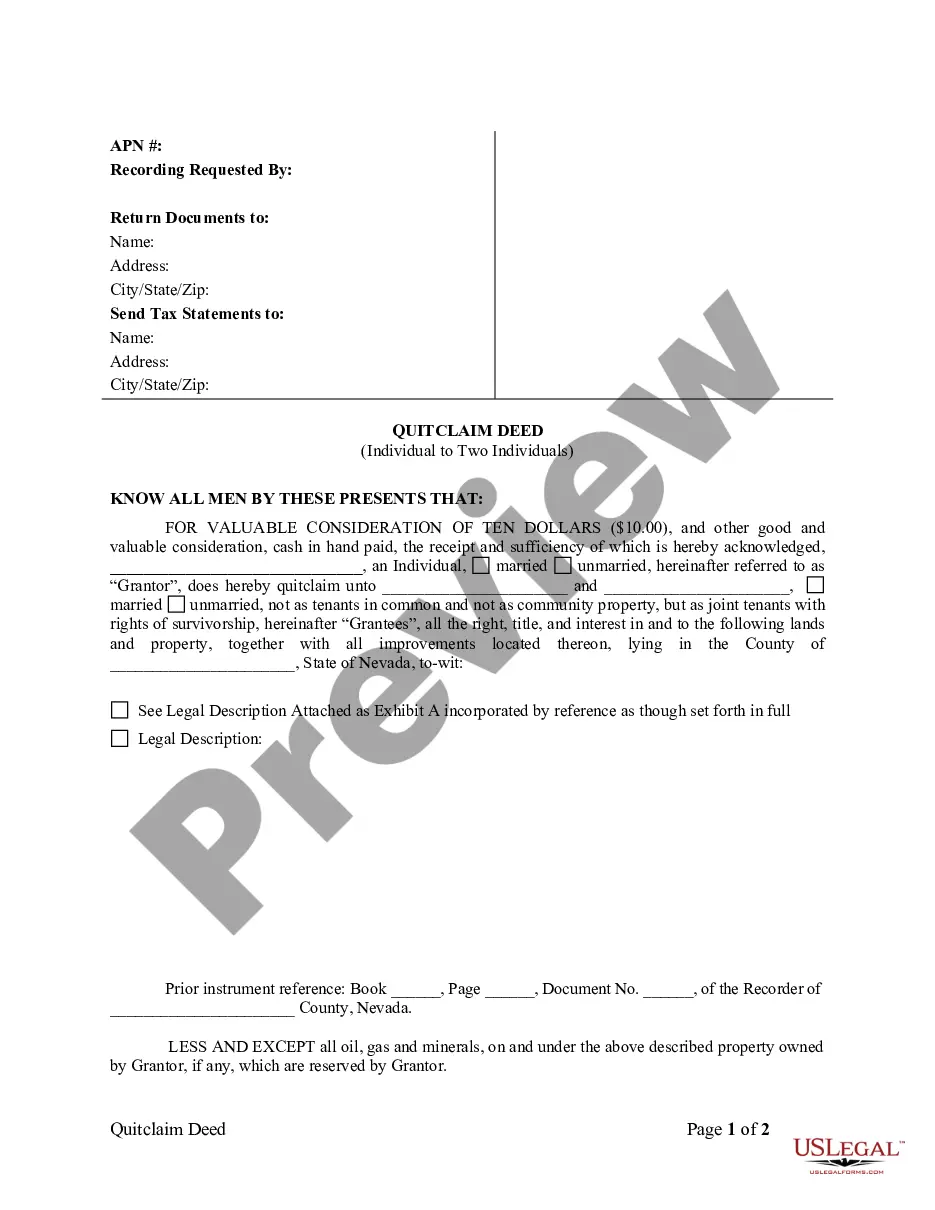
The Quitclaim Deed from Individual to Two Individuals in Joint Tenancy is a legal document used to transfer property ownership from one person (the Grantor) to two individuals (the Grantees) who will hold the property as joint tenants. This form is distinct because it includes specific provisions related to joint tenancy, allowing surviving Grantees to inherit the entire property automatically upon the death of one owner. Unlike other deeds, this quitclaim deed does not guarantee the title of the property but simply conveys whatever interest the Grantor has.
Key parts of this document
- Identifies the Grantor and Grantees involved in the transfer.
- Legal description of the property being conveyed.
- Details regarding the reservation of oil, gas, and minerals by the Grantor.
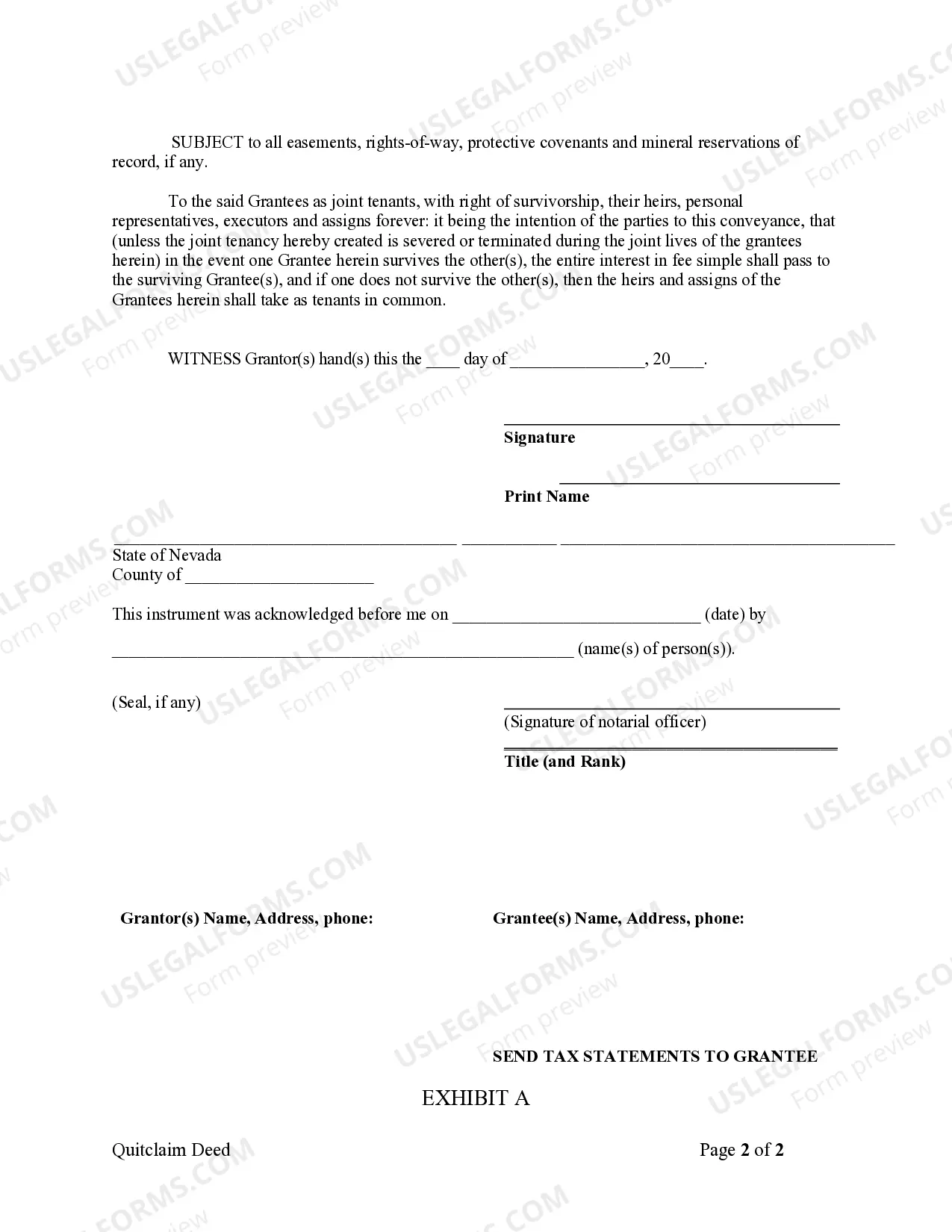
- Terms of joint tenancy and right of survivorship for Grantees.
- Signature and date fields for the Grantor's execution.





When to use this document
This quitclaim deed is used when an individual wishes to transfer property ownership to two people who will co-own the property together as joint tenants. This scenario is commonly applicable in situations such as transferring a family home to spouses or partners, or when parents wish to convey property to two children equally. It is also useful in estate planning where survivorship rights are essential for the beneficiaries.
Who needs this form
- Individuals looking to transfer property ownership to two co-owners.
- Spouses or partners who are acquiring property together.
- Parents transferring property to their children as joint tenants.
- Anyone involved in estate planning who prefers to establish joint tenancy arrangements.
Instructions for completing this form
- Identify the parties: Enter the full names and addresses of the Grantor and Grantees.
- Specify the property: Provide a legal description of the property being transferred.
- Detail mineral rights: Note any reservations of oil, gas, or minerals by the Grantor, if applicable.
- Check joint tenancy terms: Confirm the terms regarding joint tenancy and the rights of survivorship.
- Sign and date the form: Have the Grantor sign and date the document in the specified area.
Is notarization required?
This form must be notarized to be legally valid. US Legal Forms provides secure online notarization powered by Notarize, allowing you to complete the process through a verified video call.
Get your form ready online
Our built-in tools help you complete, sign, share, and store your documents in one place.
Make edits, fill in missing information, and update formatting in US Legal Forms—just like you would in MS Word.
Download a copy, print it, send it by email, or mail it via USPS—whatever works best for your next step.
Sign and collect signatures with our SignNow integration. Send to multiple recipients, set reminders, and more. Go Premium to unlock E-Sign.
If this form requires notarization, complete it online through a secure video call—no need to meet a notary in person or wait for an appointment.
We protect your documents and personal data by following strict security and privacy standards.

Make edits, fill in missing information, and update formatting in US Legal Forms—just like you would in MS Word.

Download a copy, print it, send it by email, or mail it via USPS—whatever works best for your next step.

Sign and collect signatures with our SignNow integration. Send to multiple recipients, set reminders, and more. Go Premium to unlock E-Sign.

If this form requires notarization, complete it online through a secure video call—no need to meet a notary in person or wait for an appointment.

We protect your documents and personal data by following strict security and privacy standards.
Common mistakes
- Failing to provide a complete legal description of the property.
- Not correctly identifying all parties involved in the transaction.
- Overlooking the reservation of mineral rights which may impact ownership.
- Not signing the document in the presence of a witness if required in your state.
Why use this form online
- Convenience of accessing and completing the form from anywhere.
- Editability allows you to customize the document to meet specific needs.
- Reliable templates drafted by licensed attorneys ensure legal compliance.
- Immediate availability for download, saving you time in the legal process.
Looking for another form?
Form popularity
FAQ
Once you sign a quitclaim deed and it has been filed and recorded with the County Clerks Office, the title has been officially transferred and cannot be easily reversed. In order to reverse this type of transfer, it would require your spouse to cooperate and assist in adding your name back to the title.
A signed quit claim deed overrides a will, because the property covered by the deed is not part of the estate at your mother's death.The deed needed to be notarized to be valid.
The term 'deed' refers to an instrument, like a written document that is signed by all the parties to a contract, in this case, the seller and buyer. It is a binding contract that is enforceable in a court of law. A conveyance deed is, therefore, a contract in which, the seller transfers all rights to the legal owner.
The grantor must sign the deed according to the law in every state and county. The grantor's signature finalizes the transfer of ownership, and quitclaim deeds aren't considered valid unless the grantor signs them. A certified notary public must typically be present as the grantor signs.
A quitclaim deed is dangerous if you don't know anything about the person giving you the property. You should be sure that a person actually has rights to a property before signing it over with a quitclaim deed.
Contesting A Quitclaim Deed Contesting the validity of a quitclaim deed must prove that one of the stipulations described above is invalid, that the deed was filed under false pretenses (e.g., the grantor's signature was forged) or that the grantor signed the deed under duress.
The drawback, quite simply, is that quitclaim deeds offer the grantee/recipient no protection or guarantees whatsoever about the property or their ownership of it. Maybe the grantor did not own the property at all, or maybe they only had partial ownership.
A quitclaim deed transfers title but makes no promises at all about the owner's title.A person who signs a quitclaim deed to transfer property they do not own results in no title at all being transferred since there is no actual ownership interest. The quitclaim deed only transfers the type of title you own.