Michigan Warranty Deed from two Individuals to Husband and Wife
Understanding this form
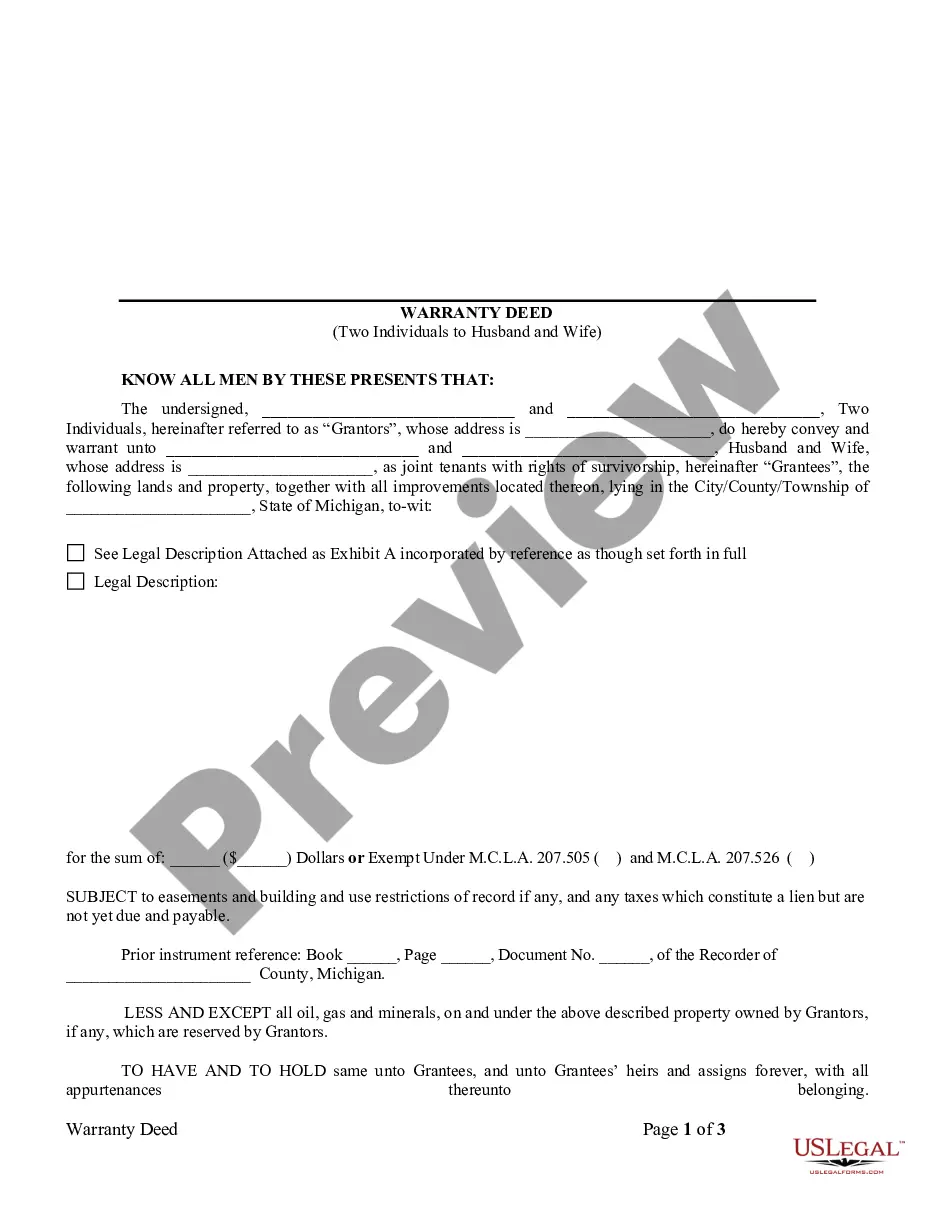
The Warranty Deed from two Individuals to Husband and Wife is a legal document that facilitates the transfer of property ownership from two individuals (Grantors) to a married couple (Grantees). This deed ensures that the Grantees hold title as joint tenants with rights of survivorship, meaning that if one spouse passes away, the other automatically inherits full ownership. The deed also explicitly excludes any oil, gas, or mineral rights retained by the Grantors, distinguishing it from other property transfer forms.
Key parts of this document
- Names and addresses of the Grantors and Grantees
- Description of the property being transferred
- Legal description of the property as an attachment
- Statement regarding the retention of oil, gas, and mineral rights
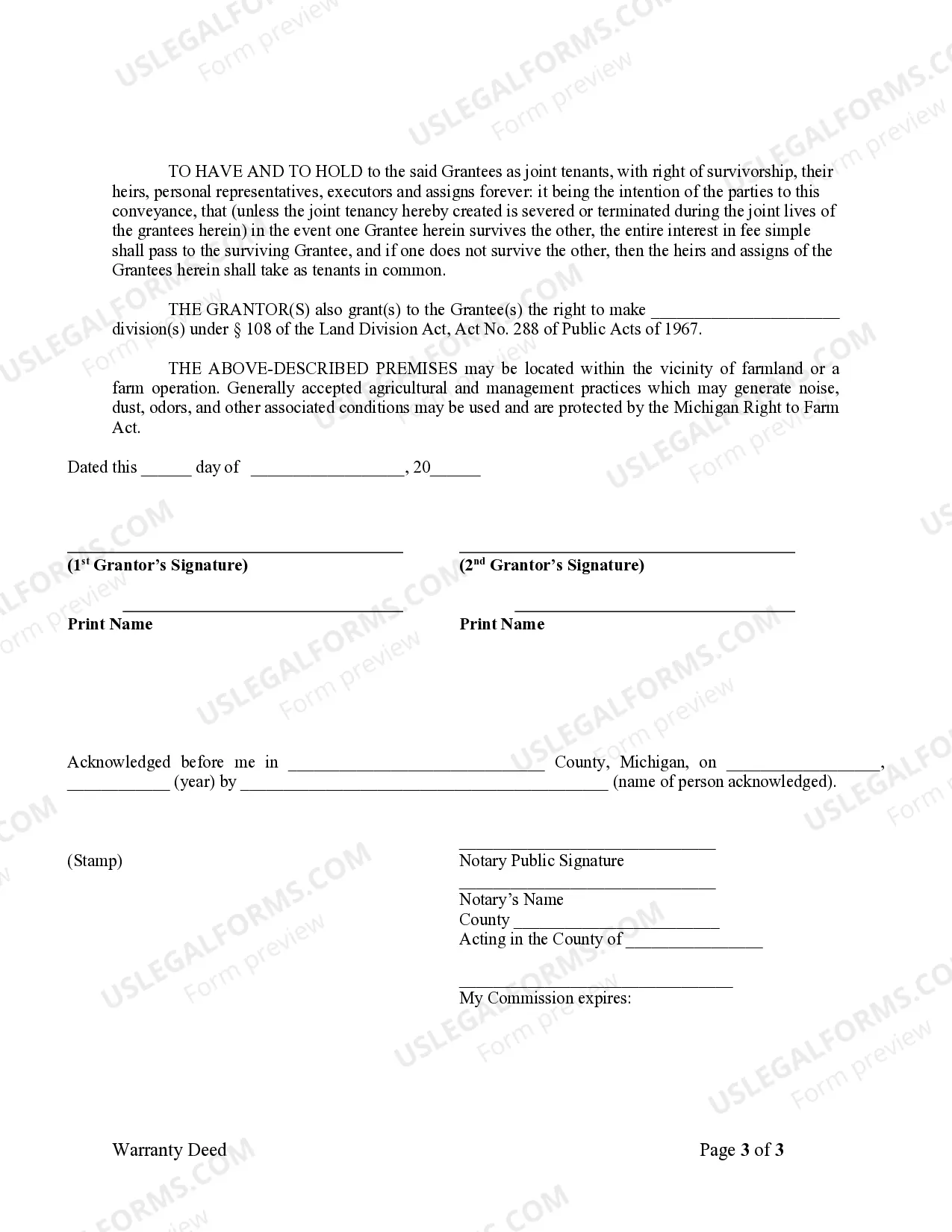
- Provisions for joint tenancy with rights of survivorship
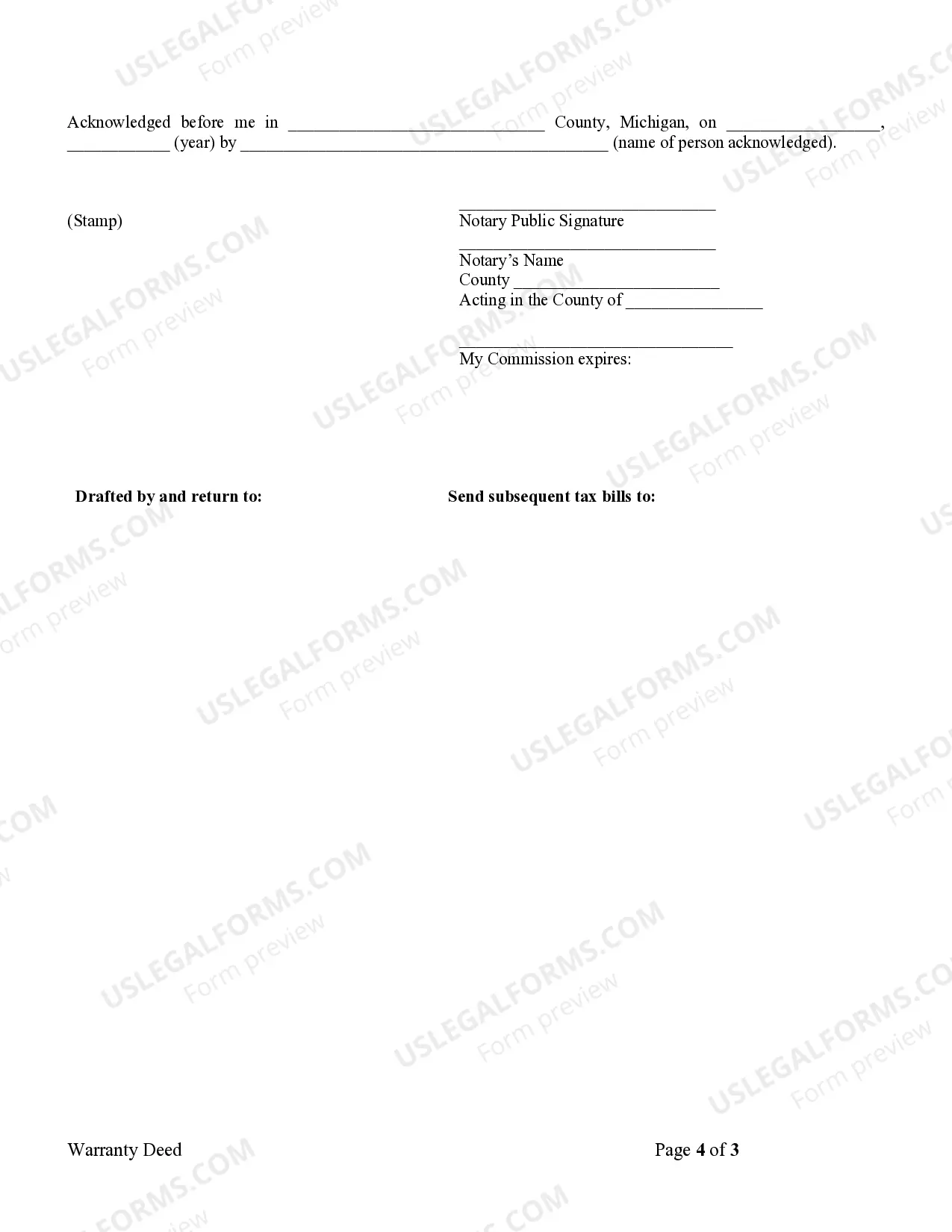
- Notary public acknowledgment section for legal validation






Common use cases
This form is typically used when two individuals wish to transfer ownership of real property to a husband and wife. It is often employed in situations involving gifts or intra-family property transfers, ensuring that both spouses have equal rights to the property and providing for the continuity of ownership upon one spouse's death.
Who this form is for
This form is suitable for:
- Two individuals looking to convey property to a married couple
- Couples wanting to ensure joint ownership with rights of survivorship
- Families transferring property for estate planning purposes
Instructions for completing this form
- Identify the names and addresses of the two Grantors and the Husband and Wife as Grantees.
- Provide a detailed description of the property being transferred, including a legal description as an attachment.
- Specify any reservations regarding oil, gas, and mineral rights that the Grantors wish to retain.
- Include a statement regarding the joint tenancy and rights of survivorship.
- Have the form signed in the presence of a notary public to finalize the transaction.
Notarization guidance
To make this form legally binding, it must be notarized. Our online notarization service, powered by Notarize, lets you verify and sign documents remotely through an encrypted video session.
Get your form ready online
Our built-in tools help you complete, sign, share, and store your documents in one place.
Make edits, fill in missing information, and update formatting in US Legal Forms—just like you would in MS Word.
Download a copy, print it, send it by email, or mail it via USPS—whatever works best for your next step.
Sign and collect signatures with our SignNow integration. Send to multiple recipients, set reminders, and more. Go Premium to unlock E-Sign.
If this form requires notarization, complete it online through a secure video call—no need to meet a notary in person or wait for an appointment.
We protect your documents and personal data by following strict security and privacy standards.

Make edits, fill in missing information, and update formatting in US Legal Forms—just like you would in MS Word.

Download a copy, print it, send it by email, or mail it via USPS—whatever works best for your next step.

Sign and collect signatures with our SignNow integration. Send to multiple recipients, set reminders, and more. Go Premium to unlock E-Sign.

If this form requires notarization, complete it online through a secure video call—no need to meet a notary in person or wait for an appointment.

We protect your documents and personal data by following strict security and privacy standards.
Avoid these common issues
- Failing to include or incorrectly describing the legal property description.
- Omitting the notarization step, which can lead to issues with the validity of the deed.
- Not specifying the reservations for mineral rights, which may lead to future disputes.
Benefits of using this form online
- Convenience of immediate download and customization.
- Access to legally compliant templates drafted by licensed attorneys.
- Ease of printing and sharing with relevant parties.
Summary of main points
- The Warranty Deed from two Individuals to Husband and Wife facilitates property transfer while ensuring joint tenancy.
- Notarization is a necessary step for legal validity.
- Properly complete the form to prevent future legal challenges related to property rights.
Looking for another form?
Form popularity
FAQ
The most recognized form for a married couple is to own their home as Tenants by the Entirety. A tenancy by the entirety is ownership in real estate under the fictional assumption that a husband and wife are considered one person for legal purposes. This method of ownership conveys the property to them as one person.
To add your spouse to your property deed: Have your lawyer do a Michigan Quit Claim Deed for you and then record it with your County's Register of Deeds. If you croak before you get it recorded, your property goes into probate, instead of to your spouse.
In estate law, joint tenancy is a special form of ownership by two or more persons of the same property. The individuals, who are called joint tenants, share equal ownership of the property and have the equal, undivided right to keep or dispose of the property. Joint tenancy creates a Right of Survivorship.
Joint Tenancy Two or more people, including spouses, may hold title to their jointly owned real estate as joint tenants. There is a so-called right of survivorship, which means that when one dies, the property automatically transfers to the survivor without the necessity of probating the estate.
Both names can be on the title of the home without being on the mortgage. Generally, it's best to add a spouse or partner to the title of the home at the time of closing if you want to avoid extra steps and potential hassle.The person who signed the mortgage, however, is the one obligated to pay off the loan.
In California, all property bought during the marriage with income that was earned during the marriage is deemed "community property." The law implies that both spouses own this property equally, regardless of which name is on the title deed.
Yes you can. This is called a transfer of equity but you will need the permission of your lender. If you are not married or in a civil partnership you may wish to consider creating a deed of trust and a living together agreement which we can explain to you.
Discuss property ownership interests. Access a copy of your title deed. Complete, review and sign the quitclaim or warranty form. Submit the quitclaim or warranty form. Request a certified copy of your quitclaim or warranty deed.
If you live in a common-law state, you can keep your spouse's name off the title the document that says who owns the property.You can put your spouse on the title without putting them on the mortgage; this would mean that they share ownership of the home but aren't legally responsible for making mortgage payments.