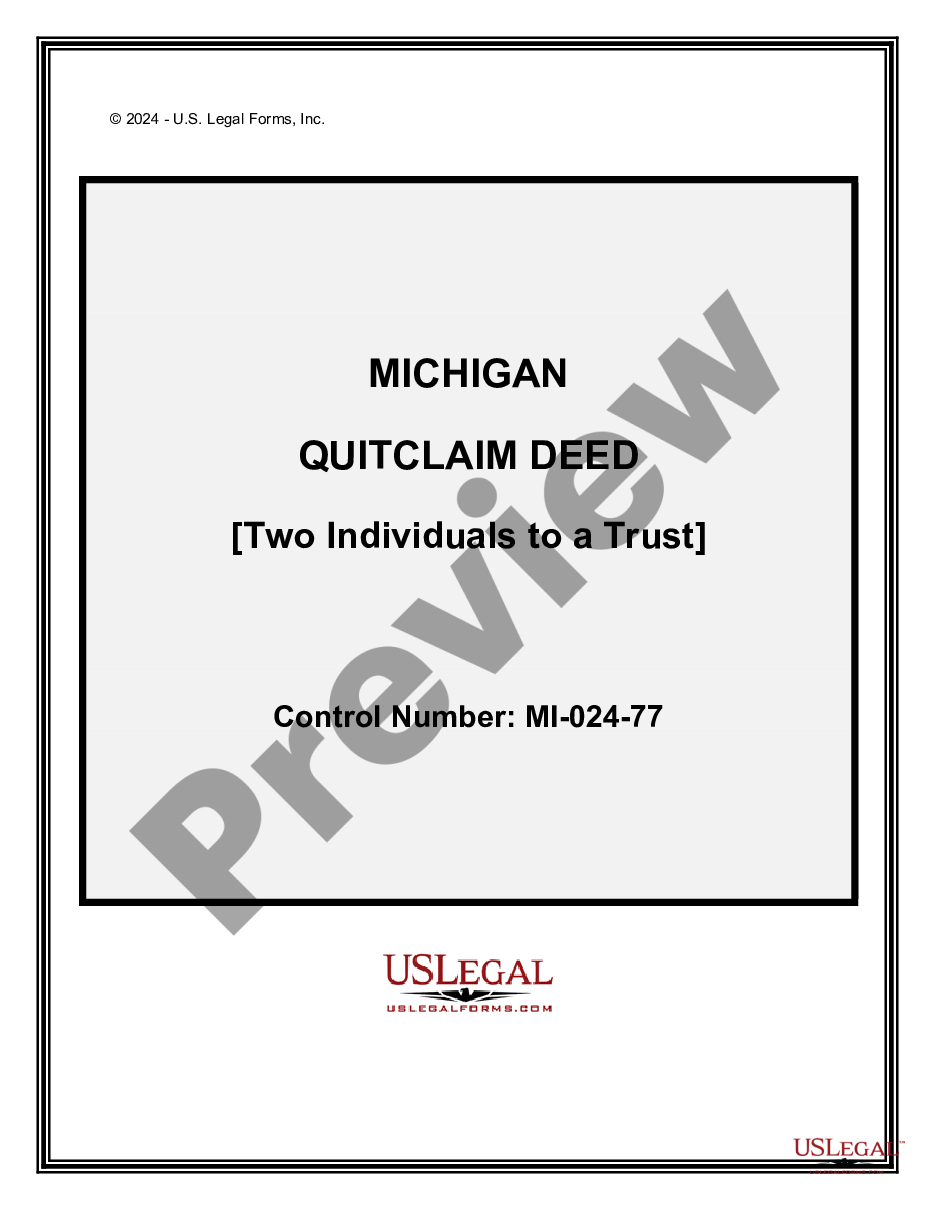
Michigan Quitclaim Deed - Two Individuals to a Trust
Understanding this form
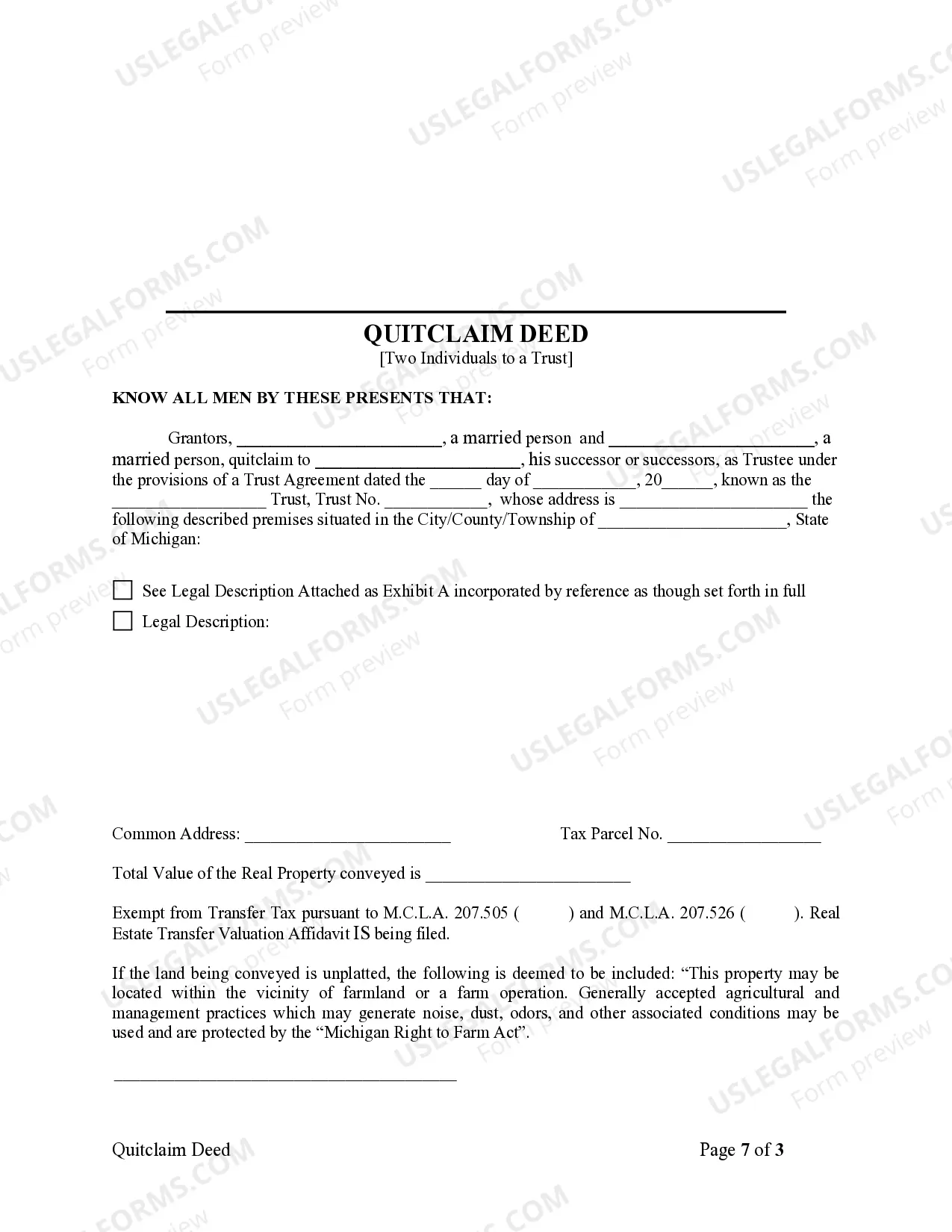
The Quitclaim Deed - Two Individuals to a Trust is a legal document that allows two individuals, referred to as grantors, to transfer their property rights to a trust. Unlike other types of deeds, a quitclaim deed does not guarantee that the grantors own the property outright or have clear title; it simply conveys whatever interest the grantors have in the property to the trust. This form is particularly useful for estate planning and property transfers that involve trusts.
Form components explained
- Grantor details: Information about the two individuals transferring the property.
- Grantee details: Information about the trust that will receive the property.
- Property description: An accurate legal description of the property being transferred.
- Execution date: The date when the deed is signed.
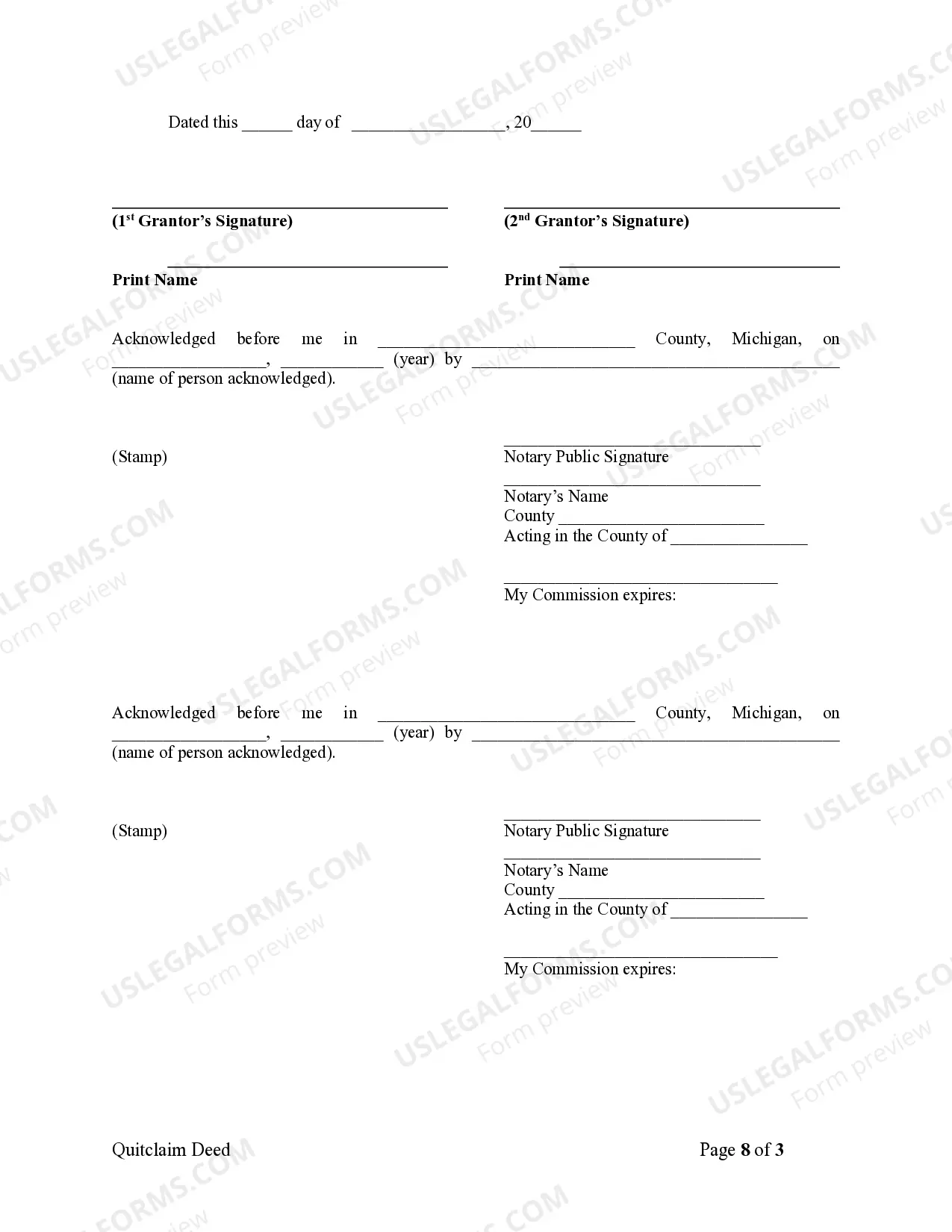
- Signatures: Signatures of both grantors to validate the transfer.






Common use cases
This quitclaim deed should be used when two individuals wish to transfer their property rights to a trust, which may be part of an estate planning strategy. It is particularly appropriate when the exact nature of the property ownership is unclear or when the grantors want to simplify the transfer process without guaranteeing title. Situations include transferring a family property into a trust for estate management or passing on property interests without formal title assurance.
Who can use this document
- Two individuals who jointly own property and want to transfer it to a trust.
- Individuals preparing for estate planning who wish to include their property in a trust.
- Anyone needing to clarify or simplify the transfer of property rights.
- Individuals who prefer a straightforward method of property transfer without title warranties.
How to complete this form
- Identify the parties: Enter the names of the two individuals who are the grantors.
- Specify the grantee: Fill in the name of the trust and its trustee.
- Enter the property description: Provide a detailed legal description of the property being transferred.
- Sign the deed: Both grantors must sign the document to make it valid.
- Include the date: Clearly note the date of the transfer.
Does this document require notarization?
This form does not typically require notarization unless specified by local law. However, having the signatures notarized may add an extra layer of verification and could be beneficial when filing the deed.
Get your form ready online
Our built-in tools help you complete, sign, share, and store your documents in one place.
Make edits, fill in missing information, and update formatting in US Legal Forms—just like you would in MS Word.
Download a copy, print it, send it by email, or mail it via USPS—whatever works best for your next step.
Sign and collect signatures with our SignNow integration. Send to multiple recipients, set reminders, and more. Go Premium to unlock E-Sign.
If this form requires notarization, complete it online through a secure video call—no need to meet a notary in person or wait for an appointment.
We protect your documents and personal data by following strict security and privacy standards.

Make edits, fill in missing information, and update formatting in US Legal Forms—just like you would in MS Word.

Download a copy, print it, send it by email, or mail it via USPS—whatever works best for your next step.

Sign and collect signatures with our SignNow integration. Send to multiple recipients, set reminders, and more. Go Premium to unlock E-Sign.

If this form requires notarization, complete it online through a secure video call—no need to meet a notary in person or wait for an appointment.

We protect your documents and personal data by following strict security and privacy standards.
Typical mistakes to avoid
- Failing to include a complete legal description of the property.
- Not having both grantors sign the deed.
- Omitting the date of the transfer.
- Using incorrect or outdated forms that do not meet legal requirements.
Advantages of online completion
- Convenience: Downloadable formats allow for easy access and completion from anywhere.
- Editability: Forms can be filled out electronically, making it easier to ensure all information is accurate.
- Reliability: Forms are drafted by licensed attorneys and comply with state laws.
Legal use & context
- This quitclaim deed allows for the transfer of property rights without the guarantee of a clear title.
- It is recognized as a legal document for property transactions in most jurisdictions, including Michigan.
- This form effectively simplifies the transfer process, especially in estate planning scenarios.
Looking for another form?
Form popularity
FAQ
Yes, a quit claim deed supercedes the trust. The only thing that can be done is to file a suit in court challenging the deed as the product of fraud and undue influence. A court action like that will cost thousands of dollars, but might be worth it if the house was owned free and clear.
Michigan laws allow an individual to add another person to their property deed through the use of a quitclaim deed. A quitclaim deed is used when a property owner wants to transfer ownership and all rights to a property to another individual or group of individuals.
Write the Deed Fill out the quit claim deed form, which can be obtained online, or write your own using the form as a guide. The person giving up the interest in the property is the grantor, and the person receiving the interest is the grantee.
Step 1: Download the MI quitclaim deed form. Step 2: Add the name and address of the preparer under Prepared By on the first line of the document. Step 3: Add the return address under After Recording Return To. This is typically the name and address of the grantee, but it could be a different party.
No. And unless the deed identifies the trust as an owner, then father is the owner of an interest. It is a common mistake to set up a trust and then fail to deed property into the trust. However, you cannot force him to make the changes you are...
The Quit Claim Deed form uses the terms of Grantor (Seller or Owner of said property) and Grantee (Buyer of said property) for the two parties involved. First, the parties must fill in the date. Then, write in the name of the county and state in which the property is located.
It's usually a very straightforward transaction, but it's possible for a quitclaim deed to be challenged. If a quitclaim deed is challenged in court, the issue becomes whether the property was legally transferred and if the grantor had the legal right to transfer the property.
In Michigan, a quit claim deed must be signed by a witness, in addition to the notary, to make it legal.After all required signatures are collected and notarized, file the document with your local register of deeds to complete the transaction.