Massachusetts Warranty Deed for Separate or Joint Property to Joint Tenancy
What this document covers
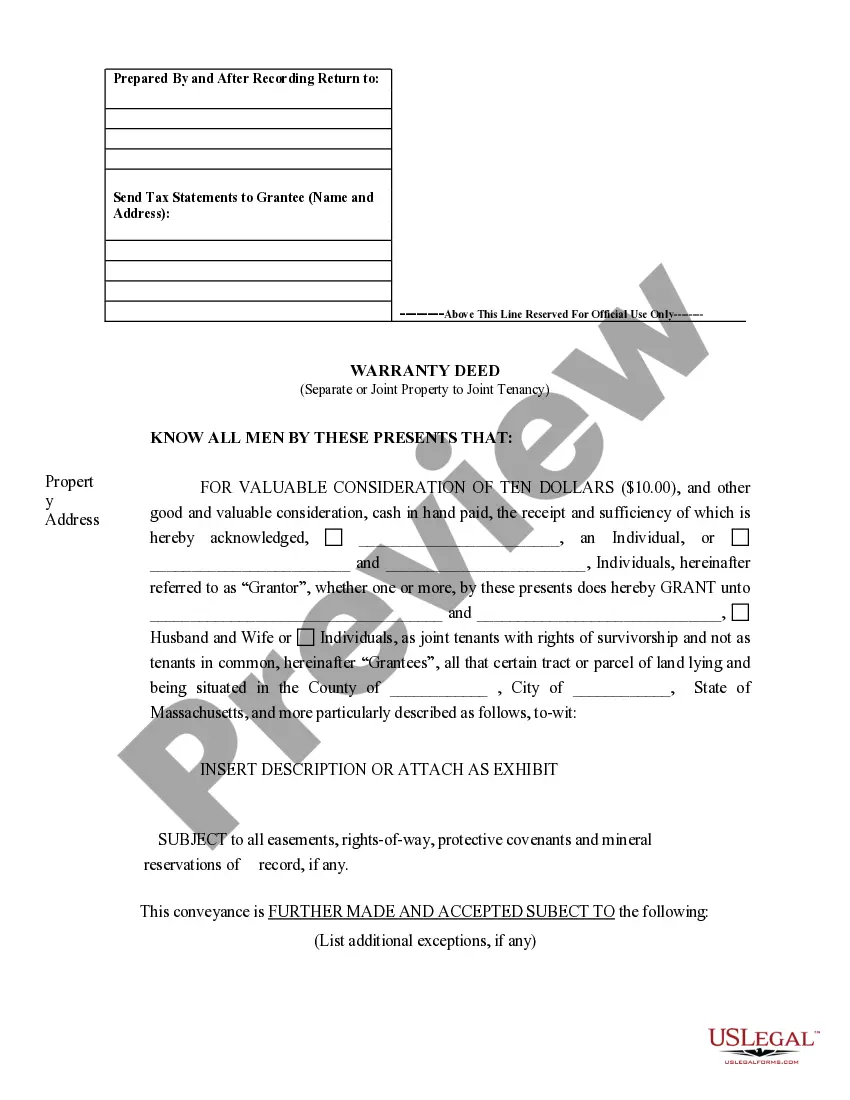
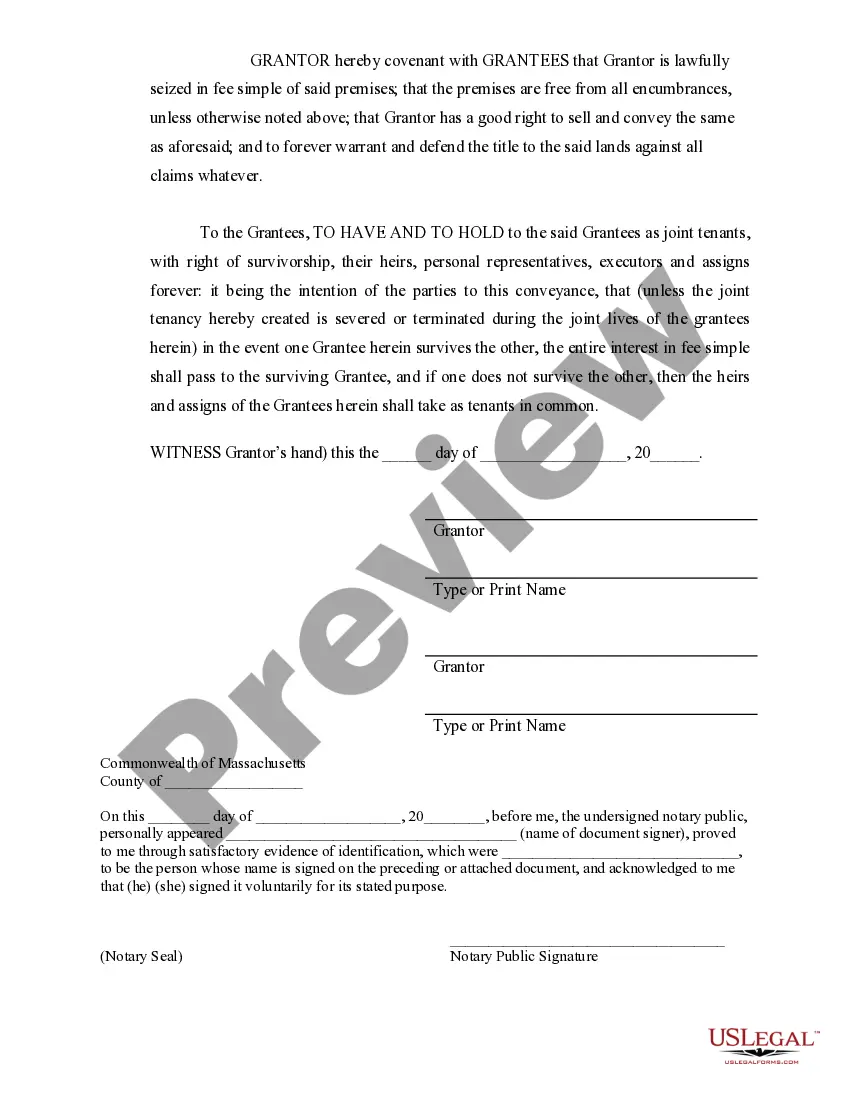
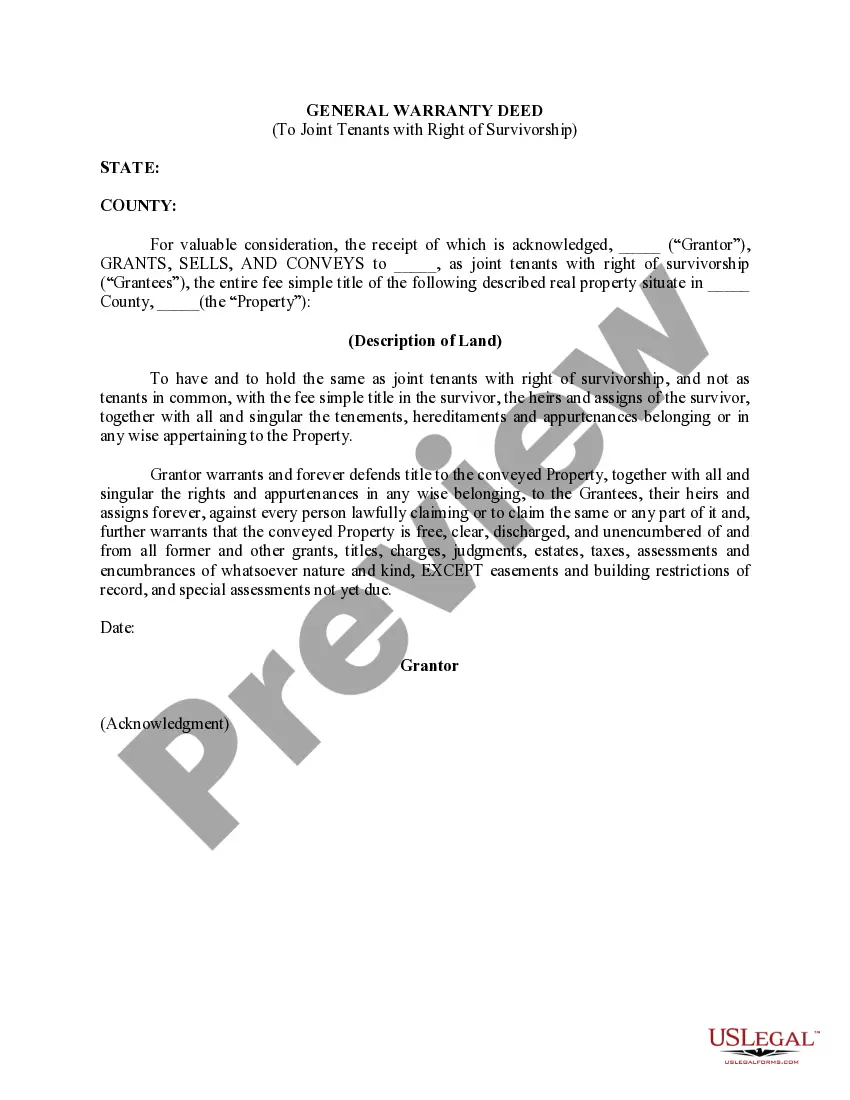
The Warranty Deed for Separate or Joint Property to Joint Tenancy is a legal document that facilitates the transfer of property ownership from one or more individuals (the grantors) to another party or parties (the grantees), establishing a joint tenancy with rights of survivorship. This legal form is essential for converting separate or jointly owned property into a joint tenancy arrangement, ensuring that if one owner passes away, the surviving owner automatically inherits the entire interest in the property. This differs from a tenancy in common, where ownership interest could pass to heirs rather than the surviving co-owner.
Key components of this form
- Grantor(s) and Grantee(s) identification
- Property description for the parcel being conveyed
- Recital of consideration exchanged
- Joint tenancy establishment clause
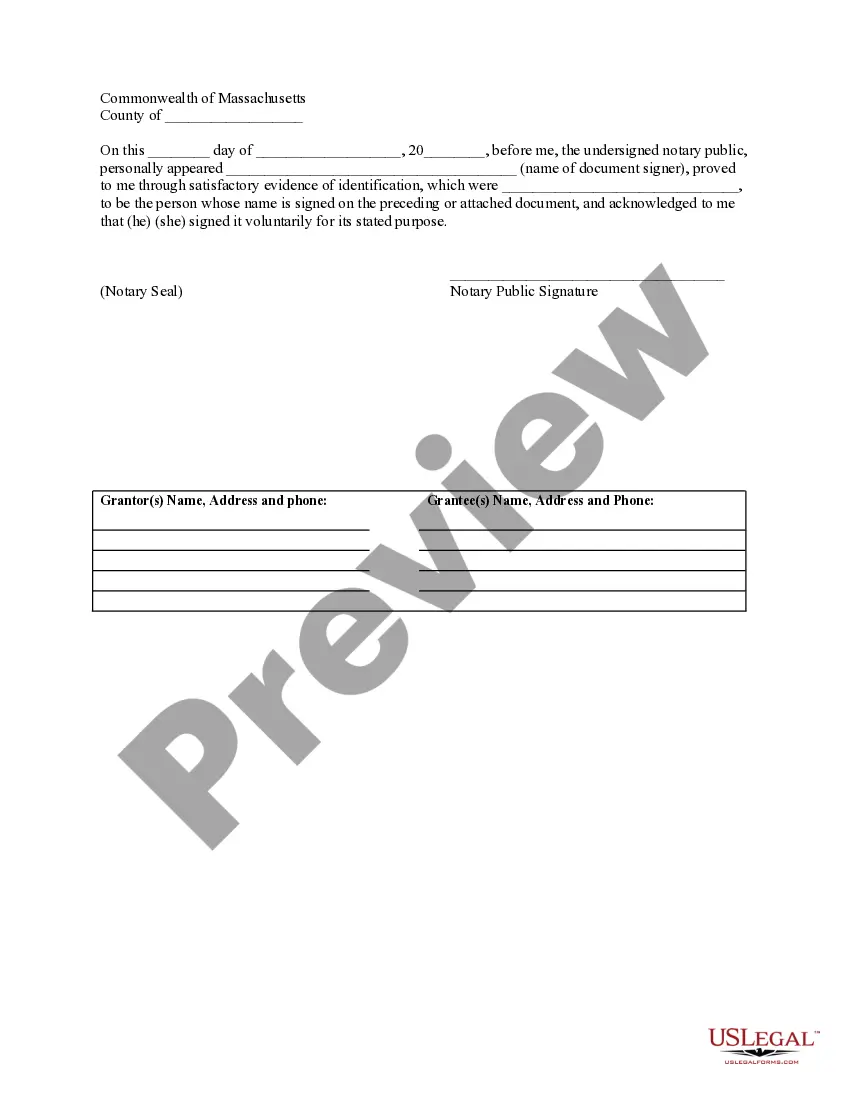
- Execution requirements including notarization section


Situations where this form applies
This Warranty Deed form should be used when individuals wish to convert their ownership of property into a joint tenancy arrangement, which may be beneficial for couples, family members, or partners seeking equal rights of ownership with survivorship benefits. Situations such as marriage, joining property ownership for investment purposes, or estate planning may prompt the use of this form.
Who should use this form
- Property owners wishing to add another person as a joint tenant
- Couples looking for legal security in property ownership
- Individuals who want to ensure seamless transfer of property upon death
- Anyone involved in joint property ownership arrangements
Completing this form step by step
- Identify the parties involved as Grantor(s) and Grantee(s).
- Provide a clear, legal description of the property to be conveyed.
- Indicate the consideration exchanged, typically a nominal amount.
- Specify that the property is being transferred as joint tenants with rights of survivorship.
- Ensure all parties sign the document in the presence of a notary public.
Does this form need to be notarized?
Yes, this form must be notarized to be legally valid. Proper notarization confirms the identity of the parties signing the deed and ensures that all entries are made willingly and free of coercion. US Legal Forms offers integrated online notarization services that are accessible 24/7, providing a secure video call experience that complies with legal standards without the need for travel.
Get your form ready online
Our built-in tools help you complete, sign, share, and store your documents in one place.
Make edits, fill in missing information, and update formatting in US Legal Forms—just like you would in MS Word.
Download a copy, print it, send it by email, or mail it via USPS—whatever works best for your next step.
Sign and collect signatures with our SignNow integration. Send to multiple recipients, set reminders, and more. Go Premium to unlock E-Sign.
If this form requires notarization, complete it online through a secure video call—no need to meet a notary in person or wait for an appointment.
We protect your documents and personal data by following strict security and privacy standards.

Make edits, fill in missing information, and update formatting in US Legal Forms—just like you would in MS Word.

Download a copy, print it, send it by email, or mail it via USPS—whatever works best for your next step.

Sign and collect signatures with our SignNow integration. Send to multiple recipients, set reminders, and more. Go Premium to unlock E-Sign.

If this form requires notarization, complete it online through a secure video call—no need to meet a notary in person or wait for an appointment.

We protect your documents and personal data by following strict security and privacy standards.
Avoid these common issues
- Failing to accurately describe the property being transferred.
- Not including necessary signatures from all parties involved.
- Overlooking the need for notarization, which is essential for the document's validity.
- Confusing joint tenancy with tenancy in common, which have different ownership implications.
Benefits of using this form online
- Quick and easy access to professionally drafted legal forms.
- Ability to fill out the form electronically, ensuring no missing fields.
- Convenience of having the form available for download at any time.
- Elimination of unnecessary delays often associated with traditional legal services.
Legal use & context
- This Warranty Deed is enforceable under Massachusetts law when properly executed and notarized.
- It effectively establishes joint tenancy, assuring rights of survivorship for property owners.
- Users are advised to understand additional implications and potential tax liabilities associated with property transfer and ownership.
What to keep in mind
- The Warranty Deed creates a joint tenancy arrangement, offering significant inheritance benefits.
- Correctly identifying parties and properly executing the document is critical for its validity.
- Notarization is a necessary step for legal enforceability.
- This form is specifically tailored for use in Massachusetts, highlighting state-specific legal requirements.
Looking for another form?
Form popularity
FAQ
In Massachusetts, 'joint tenants' refers to co-ownership of property where each owner has an equal share and rights to the whole property. This arrangement includes the right of survivorship, which ensures that if one owner passes away, the other owner automatically inherits their share. This structure can be beneficial for couples or partners looking to secure their shared investment. Using a Massachusetts Warranty Deed for Separate or Joint Property to Joint Tenancy helps formalize this ownership arrangement effectively.
The best way to obtain a quitclaim deed is to use an online legal service that offers reliable templates. Services like US Legal Forms provide customized quitclaim deed forms tailored to Massachusetts laws. This approach ensures that your years of ownership are documented properly and legally. When creating a Massachusetts Warranty Deed for Separate or Joint Property to Joint Tenancy, using authentic resources eases the process.
If you look at the registered title to your own jointly owned property and the text isn't shown on it, you own it as joint tenants. If it is there, you own it as tenants-in-common.
Survivorship rights take precedence over any contrary terms in a person's will because property subject to rights of survivorship is not legally part of their estate at death and so cannot be distributed through a will.
What Is the Difference Between a Warranty Deed & a Survivorship Deed?A warranty deed is the most comprehensive and provides the most guarantees. Survivorship isn't so much a deed as a title. It's a way to co-own property where, upon the death of one owner, ownership automatically passes to the survivor.
For example, joint tenants must all take title simultaneously from the same deed while tenants in common can come into ownership at different times. Another difference is that joint tenants all own equal shares of the property, proportionate to the number of joint tenants involved.
A joint tenant can indeed sever the right of survivorship WITHOUT the consent of the other joint tenants.In order to sever the right of survivorship, a tenant must only record a new deed showing that his or her interest in the title is now held in a Tenancy-in-Common or as Community Property.
In title law, when we talk about tenants, we're talking about people who own property.When joint tenants have right of survivorship, it means that the property shares of one co-tenant are transferred directly to the surviving co-tenant (or co-tenants) upon their death.
In that case, you simply divide your interest into equal parts. For example, if there are two of you, you would each agree to divide your shares 50/50. If you have a TIC, you have more options, because you don't have to divide your interests 50/50. Instead, you can divide the shares into fractional ownership.
With a Survivorship Deed in place, when one of the parties in a joint tenancy dies, the other party (or parties) takes over the deceased party's interest in the property instead of it passing to the deceased's heirs or beneficiaries.