Kansas Newly Divorced Individuals Package
Overview of this form package
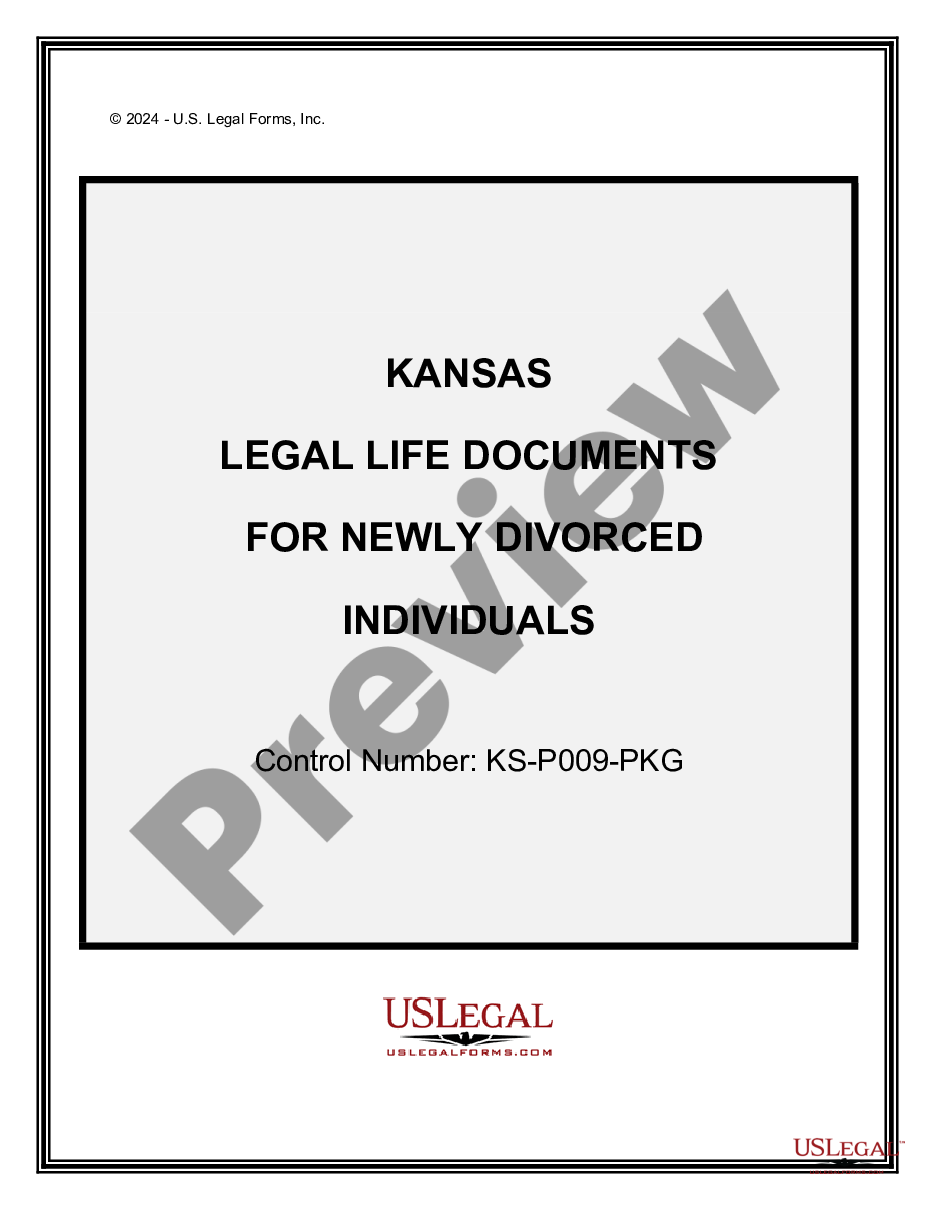
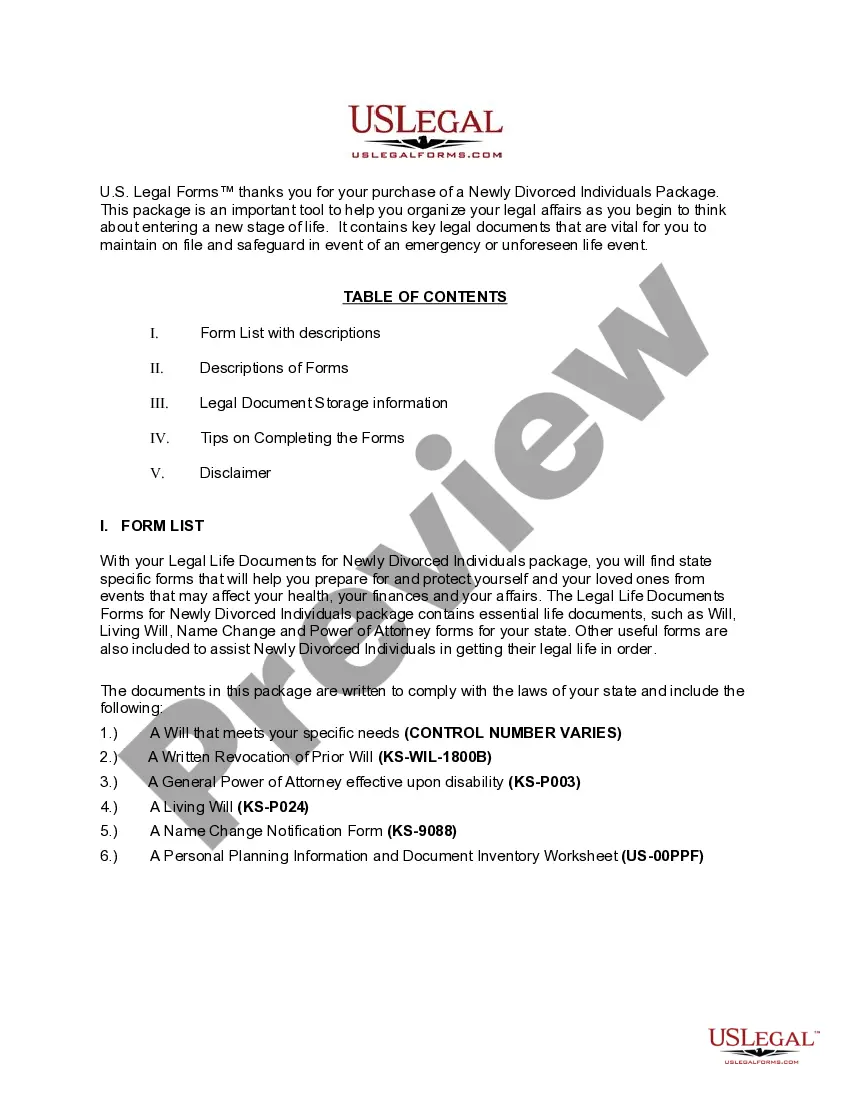
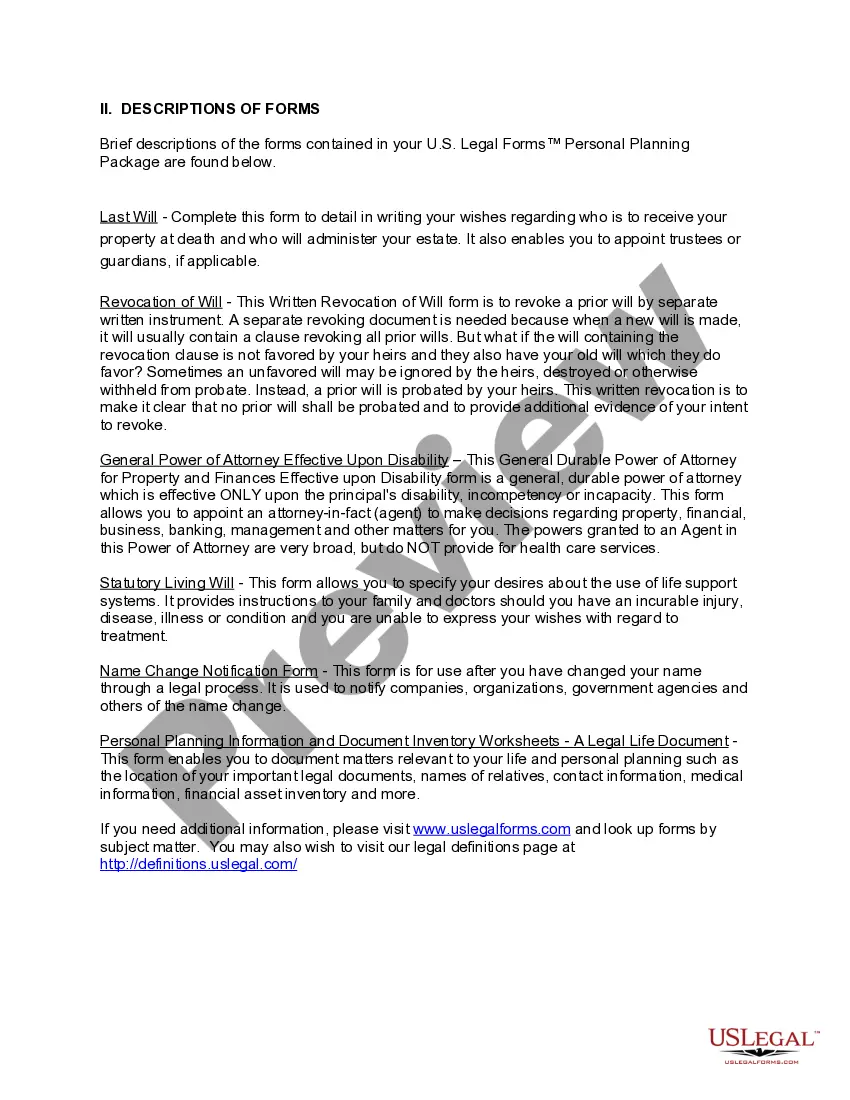
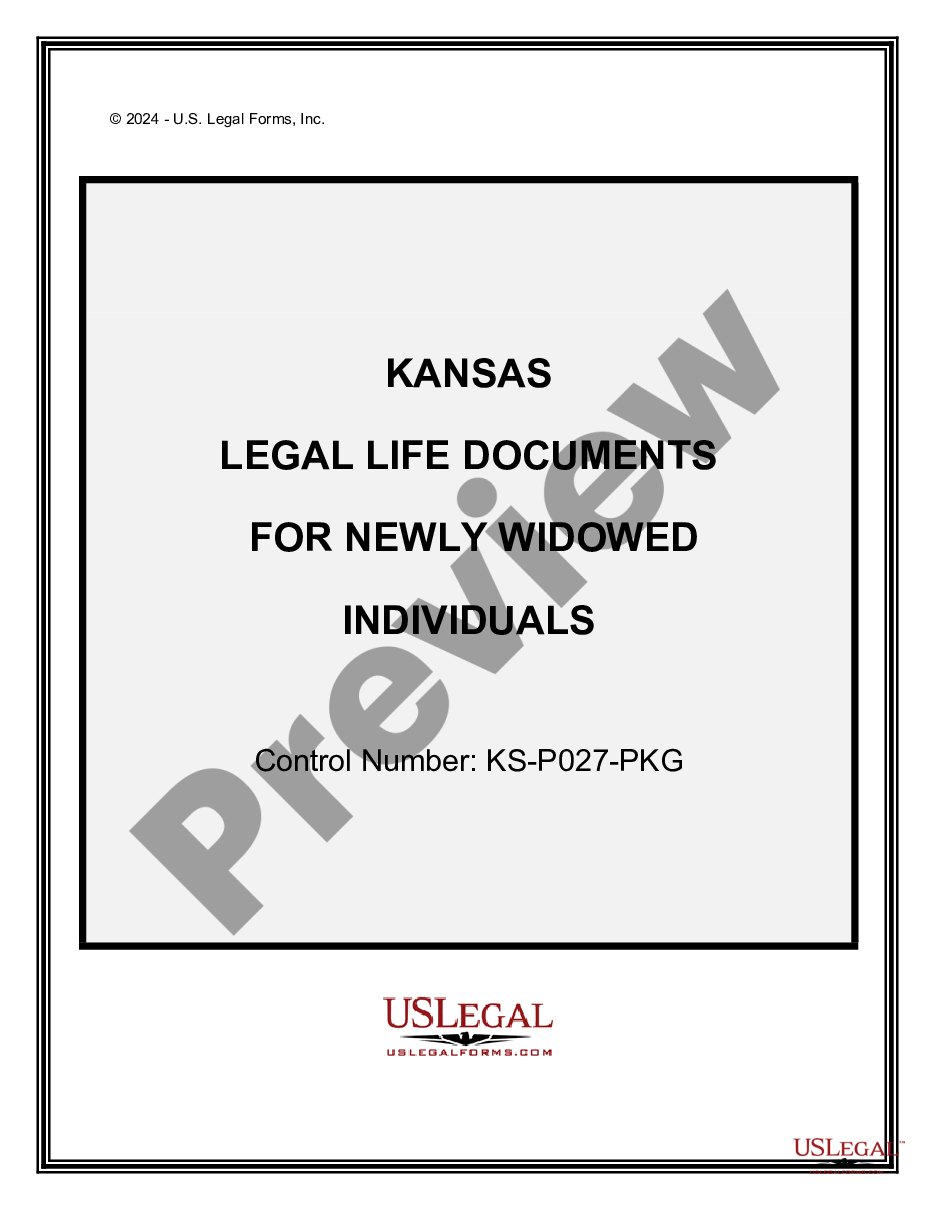
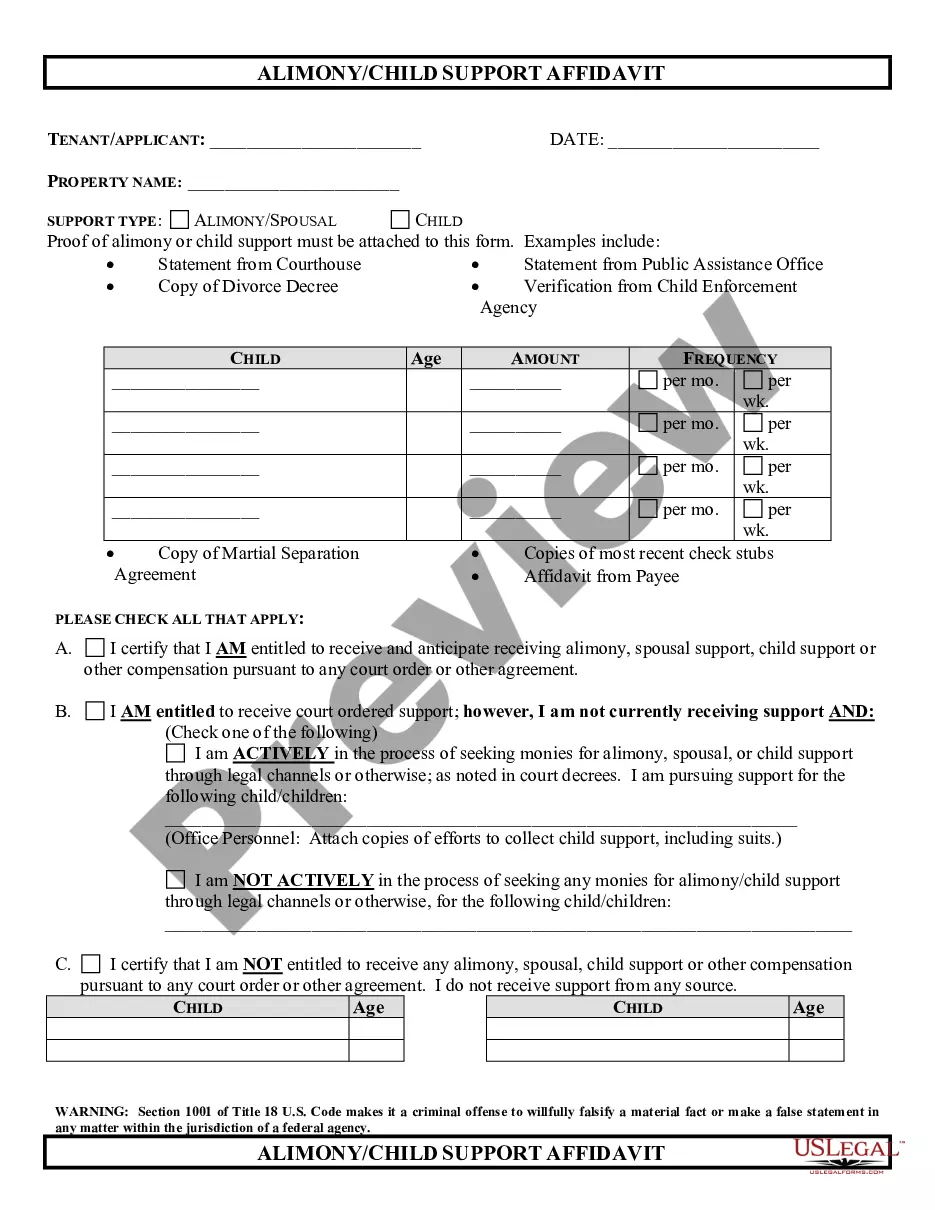
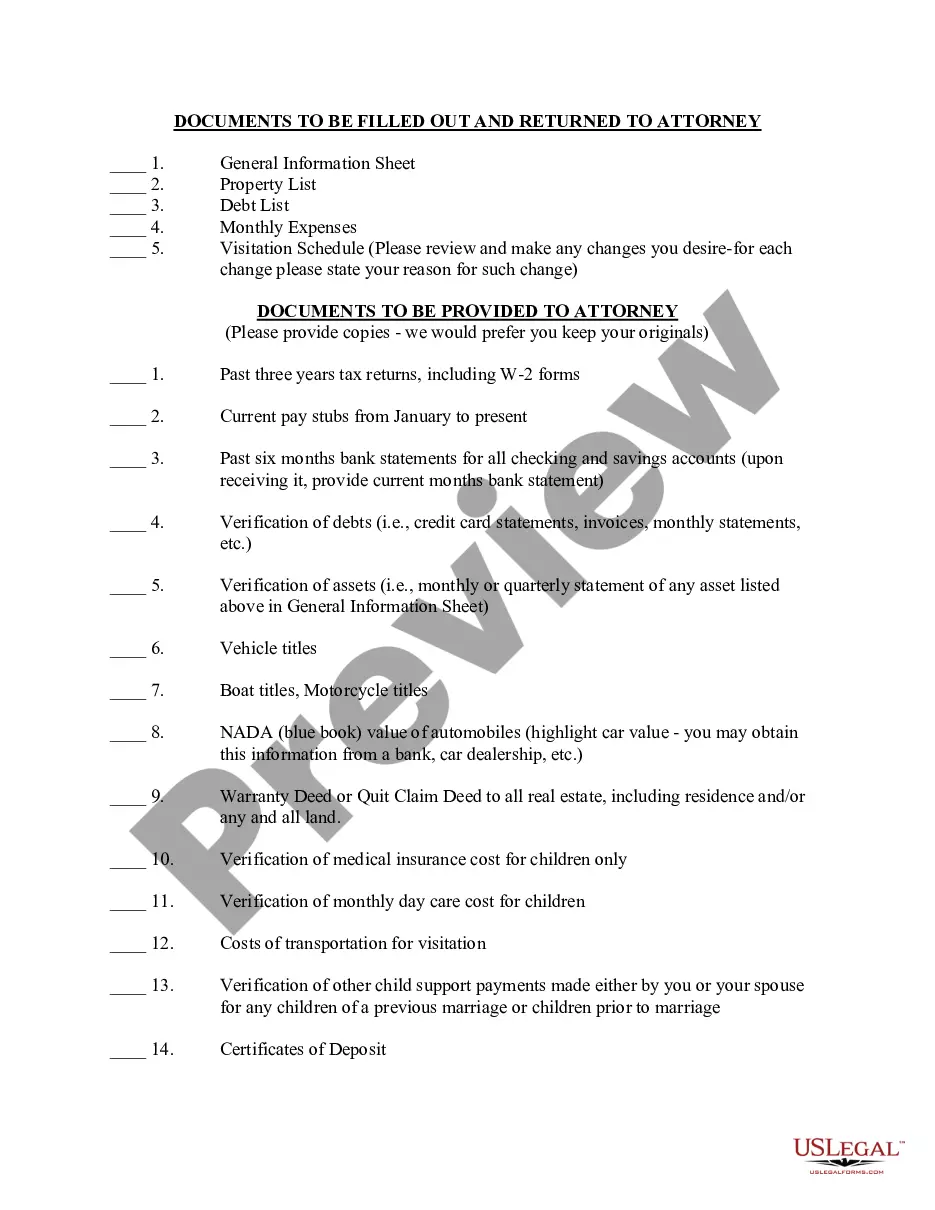
The Kansas Newly Divorced Individuals Package is a comprehensive collection of essential legal documents designed for individuals who have recently gone through a divorce. This package helps you organize your legal life and includes state-specific forms drafted by licensed attorneys. By opting for this package, you save money compared to purchasing each form separately while ensuring compliance with Kansas laws.
Forms provided in this package

When to use this document
This form package is ideal for you if:
- You have recently obtained a divorce and wish to update your legal documents.
- You need to revoke a prior will and create a new one reflecting your current wishes.
- You want to establish a power of attorney for financial matters in the event of disability.
- You need to document your healthcare preferences through a living will.
- You require a name change notification following a divorce.
Who this form package is for
- Recently divorced individuals looking to manage their legal affairs.
- People who want to ensure their medical and financial decisions are legally documented.
- Individuals in Kansas needing personalized legal forms tailored for their situation.
Instructions for completing these forms
- Review all included forms carefully to understand their purpose and requirements.
- Identify the necessary parties involved in each document.
- Fill in the required fields with accurate information, ensuring to double-check for correctness.
- Sign the documents where necessary, following the instructions provided.
- Store the completed forms in a secure location, such as a safe deposit box or personal home safe.
Do forms in this package need to be notarized?
Some forms in this package need notarization to be legally binding. Our online notarization service, powered by Notarize, lets you verify and sign documents remotely through an encrypted video session, available 24/7.
Get your form ready online
Our built-in tools help you complete, sign, share, and store your documents in one place.
Make edits, fill in missing information, and update formatting in US Legal Forms—just like you would in MS Word.
Download a copy, print it, send it by email, or mail it via USPS—whatever works best for your next step.
Sign and collect signatures with our SignNow integration. Send to multiple recipients, set reminders, and more. Go Premium to unlock E-Sign.
If this form requires notarization, complete it online through a secure video call—no need to meet a notary in person or wait for an appointment.
We protect your documents and personal data by following strict security and privacy standards.

Make edits, fill in missing information, and update formatting in US Legal Forms—just like you would in MS Word.

Download a copy, print it, send it by email, or mail it via USPS—whatever works best for your next step.

Sign and collect signatures with our SignNow integration. Send to multiple recipients, set reminders, and more. Go Premium to unlock E-Sign.

If this form requires notarization, complete it online through a secure video call—no need to meet a notary in person or wait for an appointment.

We protect your documents and personal data by following strict security and privacy standards.
Common mistakes to avoid
- Failing to revoke a prior will properly, leading to potential confusion among beneficiaries.
- Not providing clear instructions in the living will, which can lead to unwanted medical decisions.
- Incorrectly completing the power of attorney form, making it ineffective when needed.
- Neglecting to notify relevant parties about a name change, leading to complications with identification and documentation.
Benefits of completing this package online
- Convenience: Access and download your legal documents anytime, anywhere.
- Customization: Tailor forms to your specific needs with relevant state-specific content.
- Cost-effective: Save money by purchasing the package rather than individual forms.
- Drafted by professionals: Trust that your documents are compliant and up to date with legal standards.
Legal use & context
- Each form included in this package is designed to meet Kansas legal standards, making them enforceable in state courts.
- Documents such as wills and powers of attorney are critical for valid estate planning.
- Failure to complete these documents properly may lead to unintended legal consequences.
Quick recap
- The Kansas Newly Divorced Individuals Package provides critical legal documents post-divorce.
- It is tailored to comply with Kansas laws for added security and validity.
- Completing and properly storing these documents is essential for effective personal planning.
Looking for another form?

Form popularity
FAQ
If you post the divorce documents, your spouse must sign and return to you the Acknowledgement of Service (Divorce) as proof of service. You will need to file this document at the court. If you post the documents but do not get the Acknowledgement of Service (Divorce), you must try to serve your spouse in another way.
The court will give you a proof of written judgement that lets you know that your divorce is final. You can request a copy of this judgement from the court in your jurisdiction contact the courthouse or visit its website to see what its specific procedures are.
A detailed parenting-time scheduleincluding holidays! Specifics about support. Life insurance. Retirement accounts and how they will be divided. A plan for the sale of the house.
You answer the divorce petition to let the court know your position in the divorce case.If you don't answer the divorce petition and you don't go to a hearing, it's still possible that the judge can grant the divorce. If that happens, the judge also can make other decisions in the divorce.
One of the main legal advantages that a person gains by filing the divorce petition before his or her spouse does is that the filer can request a Standing Order from the court when filing the petition.If the matter should go to a hearing, the person who files the petition usually presents his or her case first.
A final decree of divorce is the court's formal order granting a termination of a marriage. If the case goes to trial and the judge issues a judgment, the judgment is confirmed when the decree is signed and dated by the judge and court clerk.
The how of the ways by which Kansas courts can divide property in a marriage dissolution proceeding is determined by the rule of 'equitable division. ' Equitable division: Kansas law provides that property in a divorce proceeding is distributed by the rule of 'equitable division.
How long does it take to get a divorce in Kansas? After filing the paperwork with the court, an uncontested divorce will take anywhere from 30 to 90 days to be finalized.
While divorce laws vary by state, here are the basic steps that a person may have to follow to obtain a divorce: First, you or your spouse must meet the residency requirements of the state you want to file in. Second, you must have grounds (a legally acceptable reason) to end your marriage.