Iowa Financial Account Transfer to Living Trust
Understanding this form
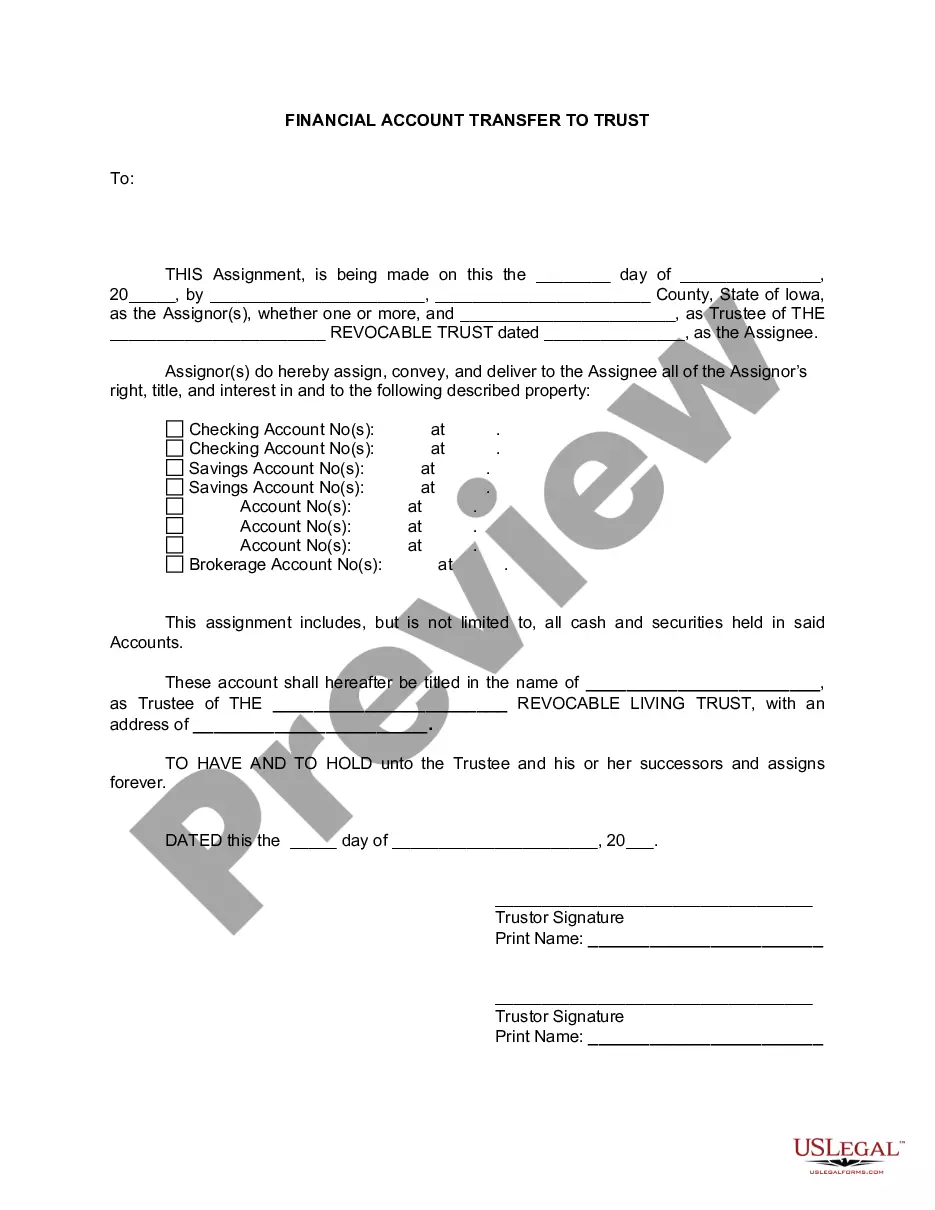
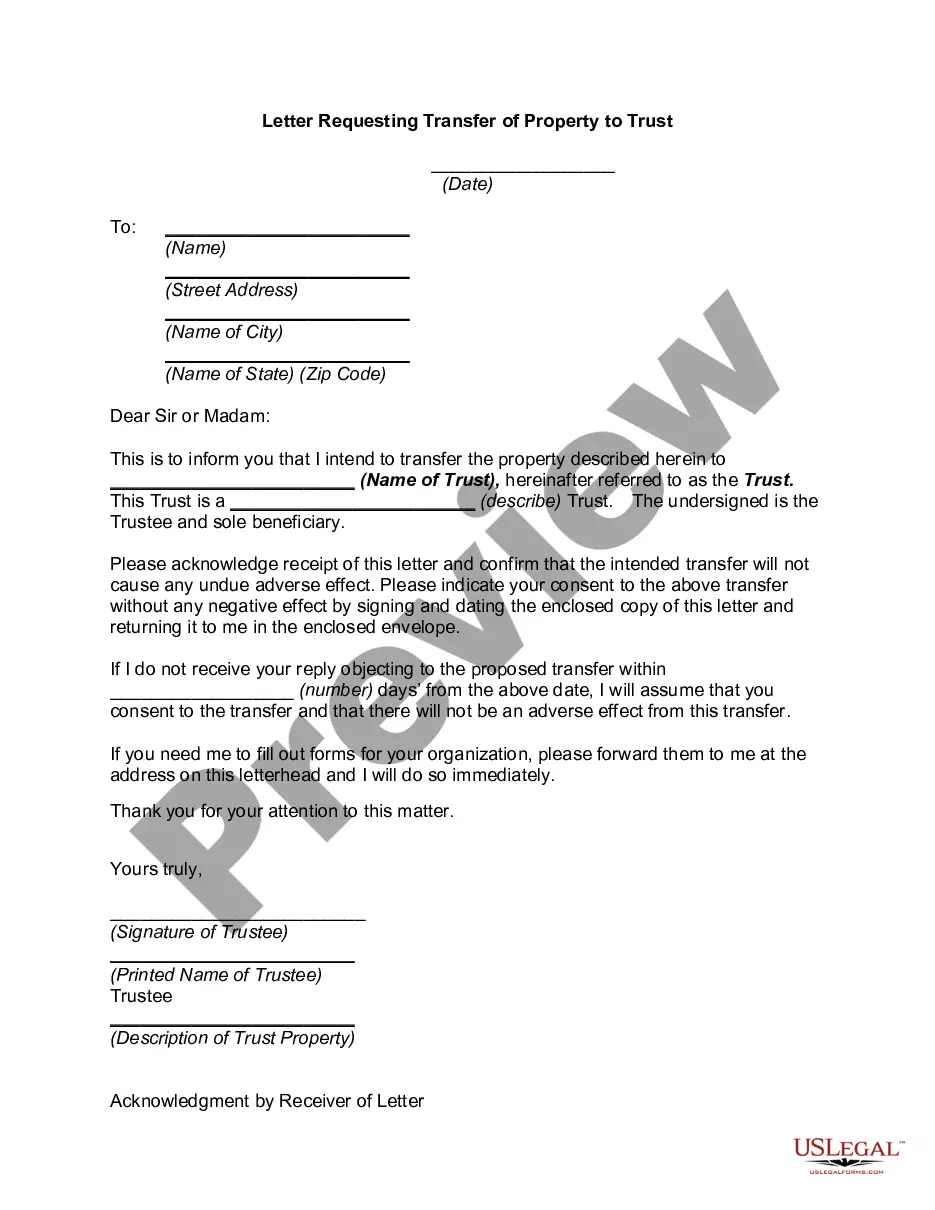
The Financial Account Transfer to Living Trust form is used to transfer ownership of bank and other financial accounts into a living trust. A living trust is created during a person's lifetime to manage and protect their assets, typically for estate planning purposes. This form enables the Assignor to legally assign their financial rights to the Assignee, solidifying the trust structure for estate management.
Key components of this form
- Assignor details: Name and signature of the person transferring the account.
- Assignee details: Name of the trustee responsible for the living trust.
- Property description: Specific financial accounts and assets being transferred.
- Notary acknowledgment: Required notarization to validate the transfer.
- Effective date: Date when the transfer takes effect.



When this form is needed
This form is essential when you want to transfer control of your financial accounts into a living trust, ensuring that your assets are managed according to your wishes during your lifetime and after your passing. It is typically used in estate planning to avoid probate and to provide a clear directive for asset distribution.
Who should use this form
- Individuals establishing a living trust to manage their assets.
- Trustors (the person creating the trust) who wish to transfer their financial accounts.
- Anyone looking to streamline their estate planning process by including financial accounts in a living trust.
Steps to complete this form
- Identify the parties: Fill in the names of the Assignor and Assignee.
- Specify the property: Clearly list all financial accounts and assets to be transferred.
- Enter trust details: Provide the full name of the living trust and the address of the trustee.
- Date the form: Insert the date of the signing.
- Sign in the presence of a notary: Ensure the signatures are witnessed and notarized for validity.
Notarization guidance
To make this form legally binding, it must be notarized. Our online notarization service, powered by Notarize, lets you verify and sign documents remotely through an encrypted video session.
Get your form ready online
Our built-in tools help you complete, sign, share, and store your documents in one place.
Make edits, fill in missing information, and update formatting in US Legal Forms—just like you would in MS Word.
Download a copy, print it, send it by email, or mail it via USPS—whatever works best for your next step.
Sign and collect signatures with our SignNow integration. Send to multiple recipients, set reminders, and more. Go Premium to unlock E-Sign.
If this form requires notarization, complete it online through a secure video call—no need to meet a notary in person or wait for an appointment.
We protect your documents and personal data by following strict security and privacy standards.

Make edits, fill in missing information, and update formatting in US Legal Forms—just like you would in MS Word.

Download a copy, print it, send it by email, or mail it via USPS—whatever works best for your next step.

Sign and collect signatures with our SignNow integration. Send to multiple recipients, set reminders, and more. Go Premium to unlock E-Sign.

If this form requires notarization, complete it online through a secure video call—no need to meet a notary in person or wait for an appointment.

We protect your documents and personal data by following strict security and privacy standards.
Common mistakes to avoid
- Failing to include all bank and account details, which could delay the transfer.
- Not having the document notarized when required, leading to potential invalidation.
- Inaccurate information about the living trust, which may cause legal issues during implementation.
Advantages of online completion
- Convenience: Download and complete the form at your own pace.
- Editability: Easily modify sections to fit your specific needs before printing.
- Reliability: Forms are drafted by licensed attorneys to ensure legal compliance.
What to keep in mind
- The Financial Account Transfer to Living Trust form is vital for estate planning.
- This form simplifies the transfer of financial accounts into a living trust.
- Ensuring notarization is a crucial step to validate the transfer legally.
Looking for another form?





Form popularity
FAQ
To create a living trust in Iowa, start by determining your assets and who you want to benefit from the trust. Next, draft the trust document, clearly outlining its terms, beneficiaries, and how assets will be managed. After establishing the trust, transfer your financial accounts to it, ensuring you follow Iowa's legal requirements for an effective Iowa Financial Account Transfer to Living Trust. For assistance, consider using US Legal Forms, which offers resources and templates to simplify the process.
Yes, it is advisable to put your checking account in a trust if you aim to manage your finances more effectively during and after your lifetime. By transferring the checking account into a living trust, you ensure that your funds are governed by the terms of the trust. This step is a key part of a smooth Iowa Financial Account Transfer to Living Trust.
Choosing between a bank account in trust or listing a beneficiary depends on your specific goals. A trust can provide more control over how assets are managed and distributed, while a beneficiary designation allows for simpler transfer. Evaluate your needs and consider the implications of each option during the Iowa Financial Account Transfer to Living Trust process.
One of the biggest mistakes parents make when setting up a trust fund is not funding the trust correctly. Many believe that just creating the trust document is enough, but assets must be transferred to the trust for it to function properly. This oversights can lead to complications regarding asset management after your passing, making it essential to understand the Iowa Financial Account Transfer to Living Trust.
To transfer your checking account to your living trust, start by visiting your bank with the trust document. You will need to request a change in ownership and complete any necessary paperwork. Make sure to inform the bank about your intention to include your checking account as part of the Iowa Financial Account Transfer to Living Trust, which can simplify the management of your assets.
Yes, you can put a brokerage account in a living trust. This move allows you to manage the account during your lifetime and ensures it is handled according to your wishes after your death. Contact your broker to understand the specific transfer process, which is an important part of the Iowa Financial Account Transfer to Living Trust.
To transfer bank accounts into a living trust, visit your bank and request to change the title of the account. Bring your trust document, as banks typically need to see it for verification. Complete any necessary forms provided by the bank, and ensure that your living trust is clearly listed as the new account holder. This action helps facilitate the Iowa Financial Account Transfer to Living Trust.
Transferring stock to a revocable trust generally does not create immediate tax consequences. The IRS states that a revocable trust is treated as a pass-through entity for tax purposes. This means that any income generated by the stock remains reportable by you even after the transfer. Understanding these implications is crucial during the Iowa Financial Account Transfer to Living Trust.
To transfer your brokerage account to a living trust, you will need to contact your brokerage firm. They usually require you to provide a copy of the trust document and fill out specific forms. Once the forms are completed and submitted, the brokerage will change the account registration to reflect the trust. This process is a key step in the Iowa Financial Account Transfer to Living Trust.