Florida Training Contract - Horse Equine Forms
About this form
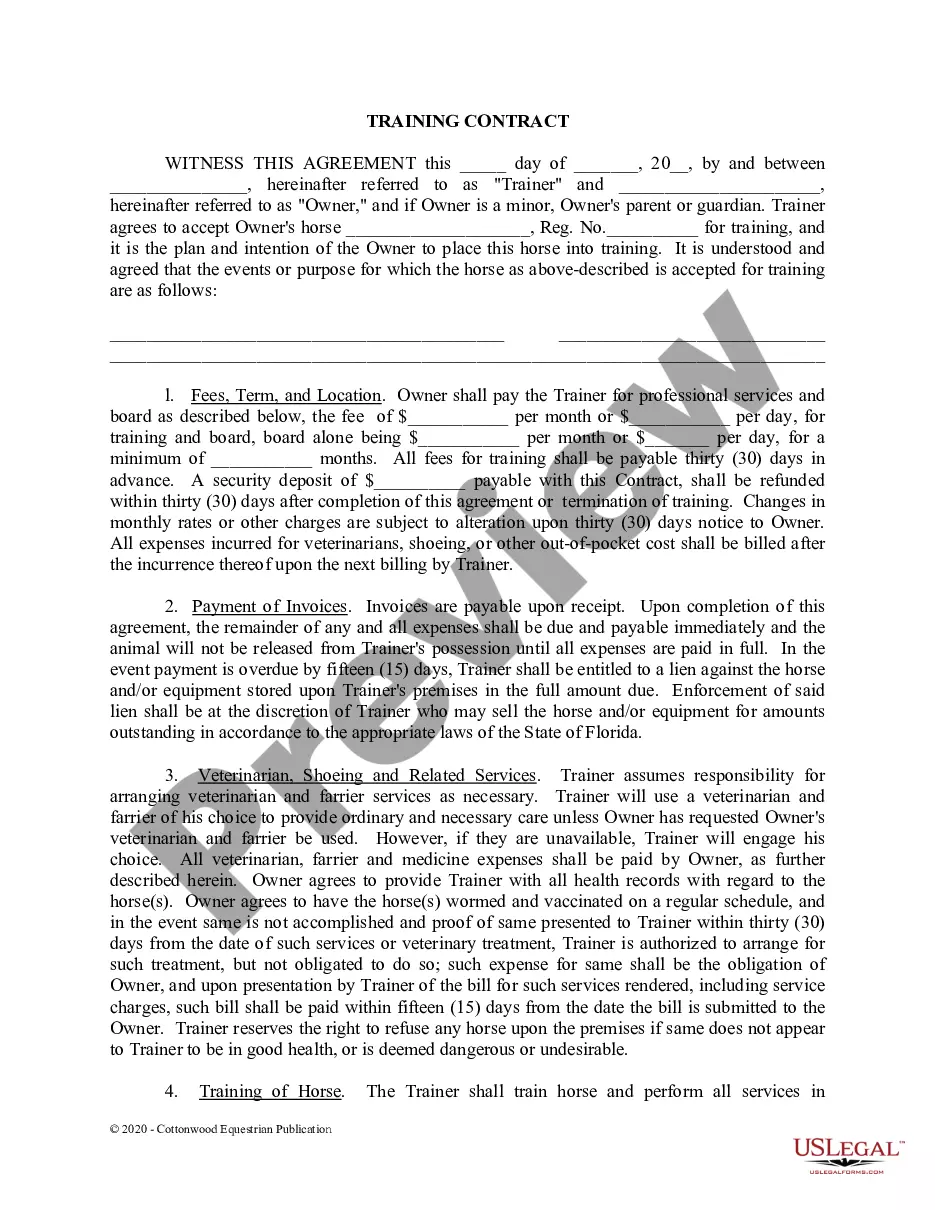
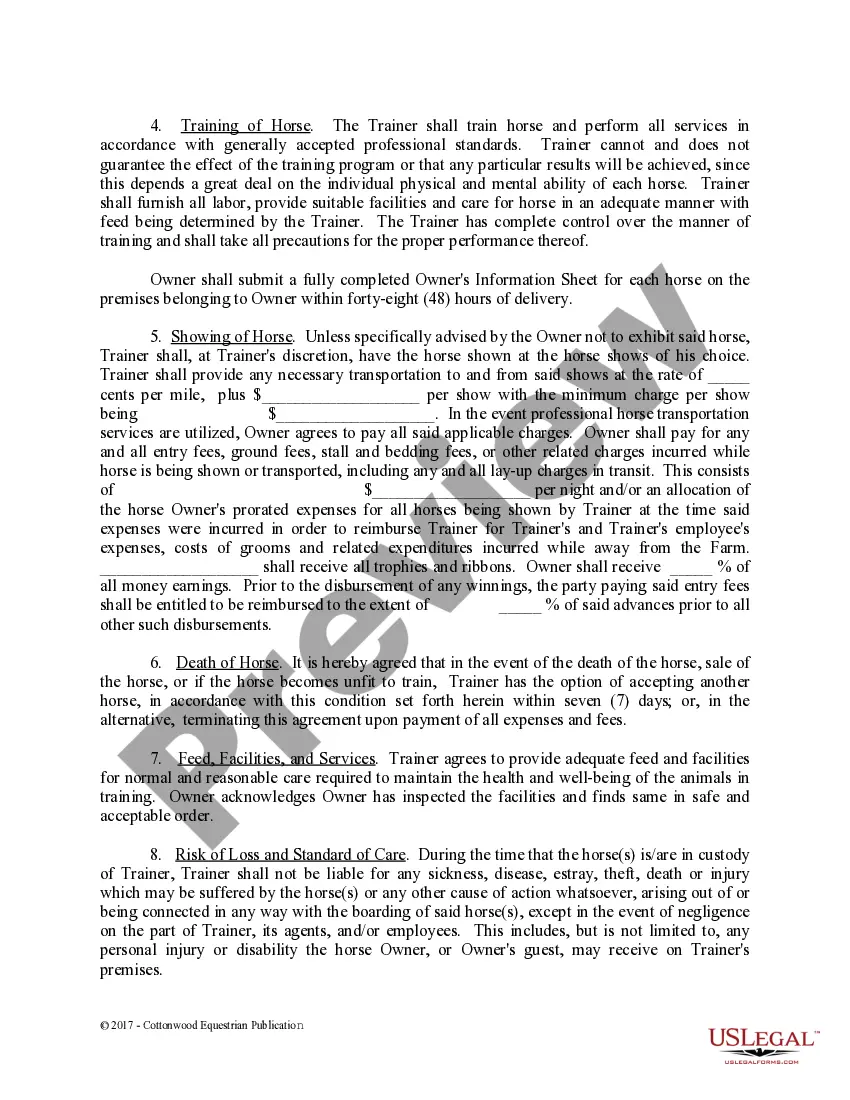
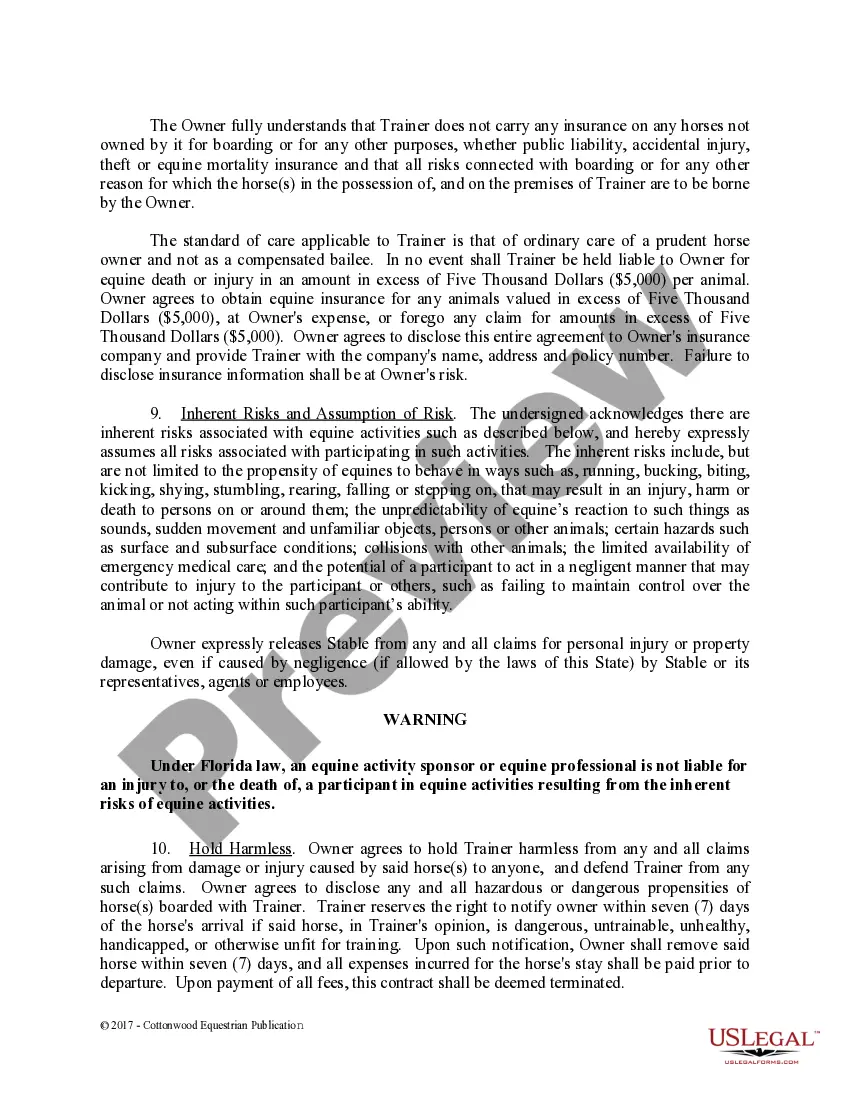
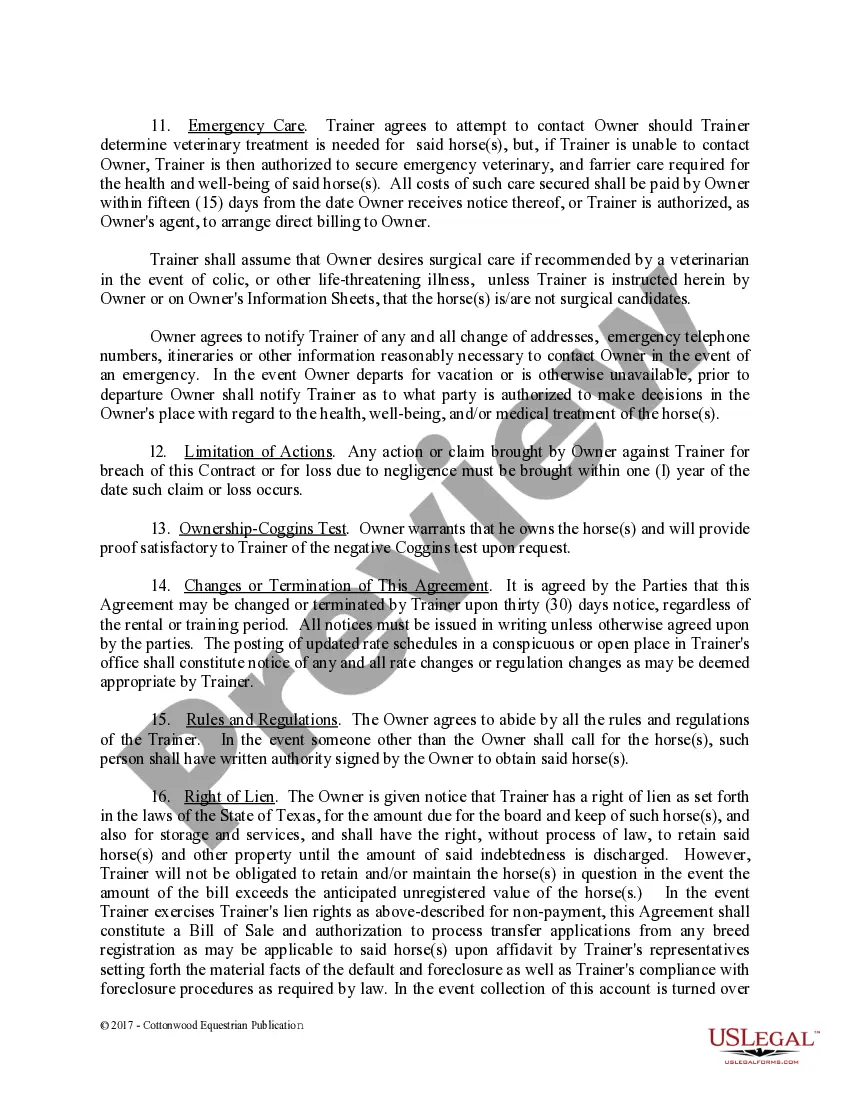
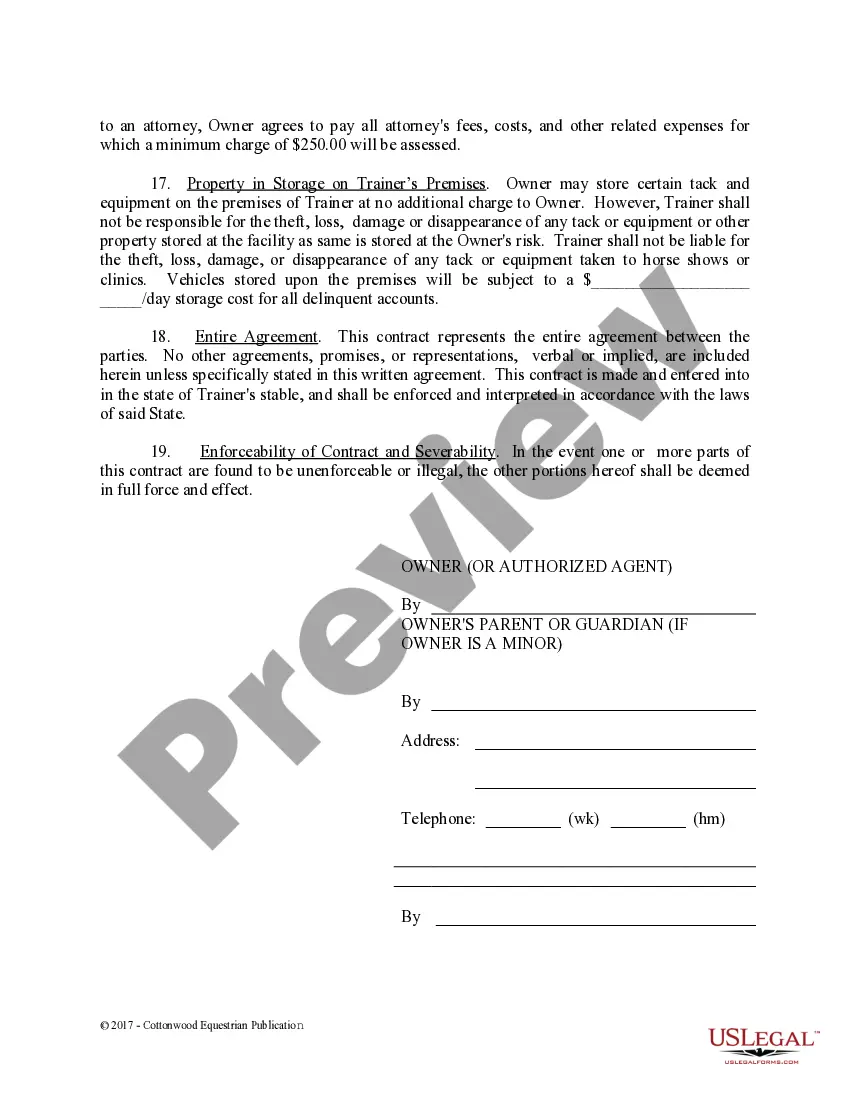
The Training Contract is a legal document designed for horse owners and trainers. This agreement outlines the responsibilities of both parties, including training services, boarding, veterinary care, and terms for showing the horse. Unlike other equine-related agreements, this contract focuses specifically on the training process and associated costs, ensuring clarity and protection for both the trainer and the owner.
Key components of this form
- Parties involved: Identifies the trainer and horse owner.
- Fees and payment schedule: Details monthly fees for training and boarding, as well as payment terms.
- Veterinarian care: Outlines the trainer's responsibility for arranging veterinary services.
- Training standards: Sets expectations for the trainer's conduct and care for the horse.
- Liabilities and risks: Covers the responsibilities and risks assumed by the owner regarding the horse's safety and health.
- Emergency care: Describes the trainer's authority to seek medical treatment for the horse if the owner cannot be reached.

Situations where this form applies
This form is essential when a horse owner engages a trainer to provide professional training services. Whether preparing a horse for competition, correcting behavioral issues, or enhancing training techniques, the Training Contract formalizes the arrangement, ensuring both parties are fully aware of their obligations and expectations.
Who should use this form
- Horse owners seeking professional training for their equines.
- Trainers looking to establish clear agreements with horse owners.
- Parents or guardians of minor horse owners needing to consent to training agreements.
Completing this form step by step
- Identify the trainer and horse owner by filling in their names and contact information.
- Specify the horse being trained, including its registration number, if applicable.
- Outline the training fees, payment schedule, and any required security deposits.
- Provide details about any veterinary or farrier care arrangements.
- Include any specific conditions or expectations regarding the training and showing of the horse.
- Ensure all parties sign the contract to validate the agreement.
Is notarization required?
This form does not typically require notarization unless specified by local law.
Get your form ready online
Our built-in tools help you complete, sign, share, and store your documents in one place.
Make edits, fill in missing information, and update formatting in US Legal Forms—just like you would in MS Word.
Download a copy, print it, send it by email, or mail it via USPS—whatever works best for your next step.
Sign and collect signatures with our SignNow integration. Send to multiple recipients, set reminders, and more. Go Premium to unlock E-Sign.
If this form requires notarization, complete it online through a secure video call—no need to meet a notary in person or wait for an appointment.
We protect your documents and personal data by following strict security and privacy standards.

Make edits, fill in missing information, and update formatting in US Legal Forms—just like you would in MS Word.

Download a copy, print it, send it by email, or mail it via USPS—whatever works best for your next step.

Sign and collect signatures with our SignNow integration. Send to multiple recipients, set reminders, and more. Go Premium to unlock E-Sign.

If this form requires notarization, complete it online through a secure video call—no need to meet a notary in person or wait for an appointment.

We protect your documents and personal data by following strict security and privacy standards.
Mistakes to watch out for
- Failing to clearly identify all parties involved.
- Not specifying the horse's registration details, which can lead to confusion.
- Neglecting to outline the payment terms and fee structure correctly.
- Overlooking the need for signatures from all parties, including a guardian if the owner is a minor.
- Ignoring local laws that may impose additional requirements for training contracts.
Benefits of completing this form online
- Convenience: Downloadable and easily accessible from any device.
- Editability: Customize the form to fit the specific needs of the training agreement.
- Reliability: Standardized format ensures compliance with legal standards.
Legal use & context
- This Training Contract serves as a legally binding document once signed by all parties.
- It outlines each party's rights and responsibilities, reducing the risk of disputes.
- Having this formal agreement can provide protection in case of claims regarding negligence or care standards.
Key takeaways
- The Training Contract is essential for clarifying the responsibilities of trainers and owners.
- Properly completing this form can protect against misunderstandings and legal issues.
- This form is specifically designed for horse training contexts, ensuring comprehensive coverage of relevant details.
Looking for another form?
Form popularity
FAQ
The steps to train a horse typically involve establishing trust, teaching basic commands, introducing riding, advancing to specific skills, and preparing for competition. This systematic approach ensures that each phase builds on the last, promoting effective learning. By incorporating the Florida Training Contract - Horse Equine Forms into your training regimen, you can streamline this process, resulting in a more efficient and consistent training experience.
The seven scales of training horses include rhythm, relaxation, contact, impulsion, straightness, collection, and self-carriage. These elements are crucial for developing a horse's overall performance and ensuring effective training. When following a structured framework, such as that provided by the Florida Training Contract - Horse Equine Forms, trainers can focus on each scale methodically, enhancing their training success.
The levels of training a horse generally progress through stages such as basic handling, novice training, intermediate schooling, and advanced competition preparation. Each level focuses on different skills and disciplines, tailored to meet the horse's development needs. Utilizing resources like the Florida Training Contract - Horse Equine Forms can guide trainers through each level, optimizing the training process.
The four quadrants of horse training consist of ground work, riding, competition preparation, and behavior modification. Each quadrant focuses on specific skills and objectives, enhancing the overall training process. By addressing all aspects through the lens of the Florida Training Contract - Horse Equine Forms, trainers can ensure a well-rounded approach to developing both the horse's abilities and the trainer’s techniques.
The business code for horse training is typically classified under the North American Industry Classification System (NAICS). The relevant code is 711219, which pertains to other similar animal training services. For professionals engaged in horse training, understanding this classification is essential for compliance and reporting, particularly when utilizing the Florida Training Contract - Horse Equine Forms.
The five stages of training horses include the groundwork, saddling, riding, advanced training, and competition preparation. Each stage builds on the previous one, allowing the horse to learn progressively. By using a structured approach, as highlighted in the Florida Training Contract - Horse Equine Forms, trainers can effectively prepare horses for various disciplines, ensuring their readiness for both leisure and competition.
The three-second rule for horses refers to the principle that when training, a horse should have an understanding of the command within three seconds. This rule helps to establish clear communication and ensures that the horse associates the command with the desired action quickly. This guideline is vital for creating a solid foundation in horse training, especially when applying techniques covered in the Florida Training Contract - Horse Equine Forms.
Many states require health certificates for horses, particularly those that emphasize equine health and safety. For instance, states like California, New York, and Florida enforce this requirement. If you're in Florida, leveraging Florida Training Contract - Horse Equine Forms ensures you have the correct documentation prepared, facilitating travel and compliance across state lines.
To obtain a horse trainer license, you usually need to fulfill several requirements, which can vary by state. Generally, this includes demonstrating your experience in horse training and possibly passing an exam. It's beneficial to have a strong understanding of the Florida Training Contract - Horse Equine Forms, as these can help you navigate the necessary paperwork for licensing in Florida.
When traveling with a horse, you typically need a health certificate and a proof of ownership. The health certificate must be issued by a licensed veterinarian and confirm that your horse is healthy and vaccinated. Additionally, utilizing Florida Training Contract - Horse Equine Forms simplifies the preparation of any necessary documents, making travel more straightforward and compliant.