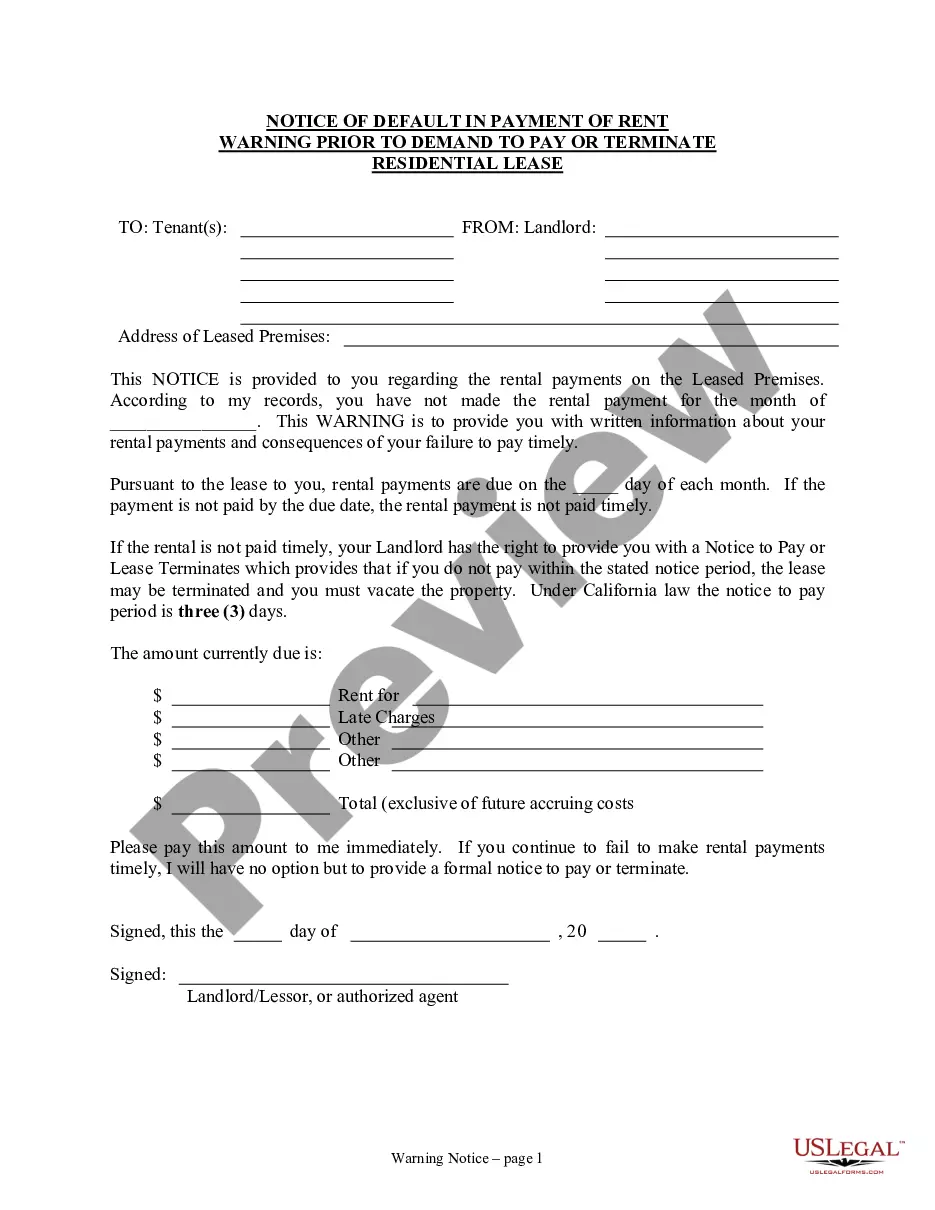
California Notice of Default in Payment of Rent as Warning Prior to Demand to Pay or Terminate for Residential Property
About this form
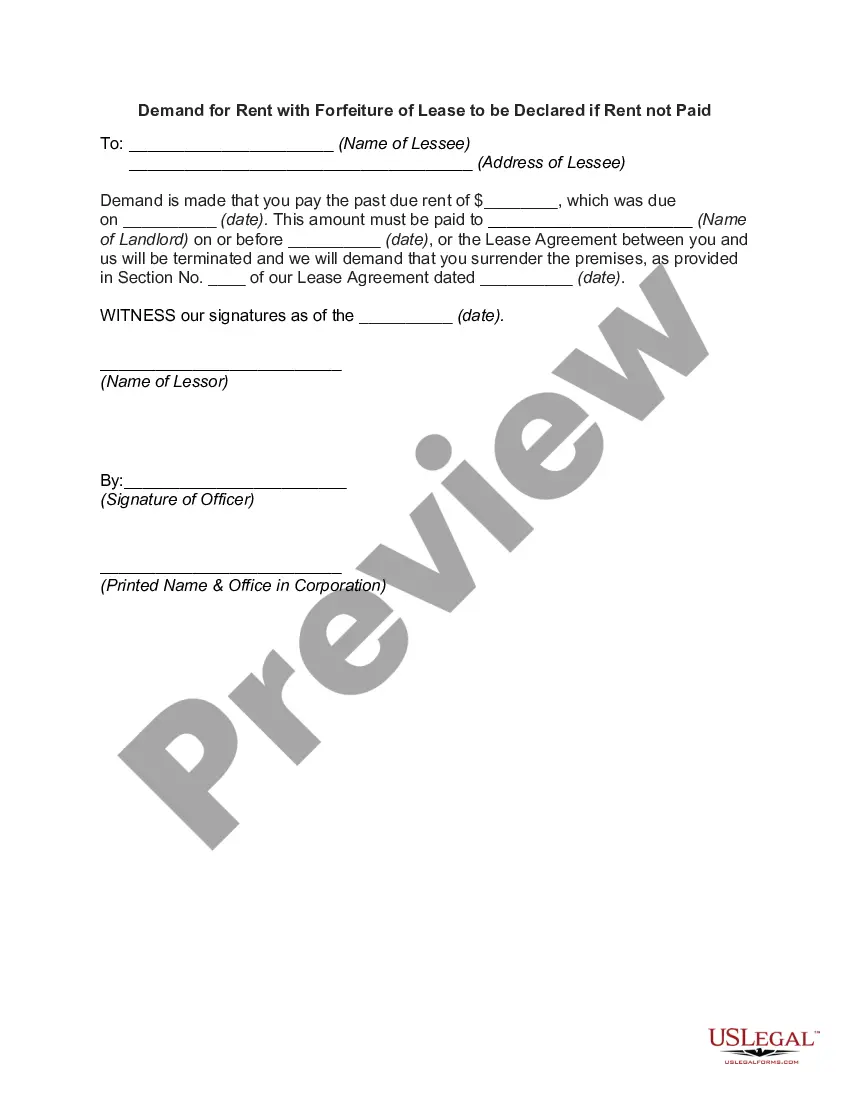
This Notice of Default in Payment of Rent as Warning Prior to Demand to Pay or Terminate for Residential Property is a legal document used by landlords to formally inform tenants of late rent payments. It serves as an official reminder of the tenant's obligation to pay rent and outlines the potential consequences of not doing so. This form is distinct from other notices because it acts as a preliminary warning before any further legal action is taken, providing tenants with a chance to rectify their default before facing lease termination.
What’s included in this form
- Identification of landlord and tenant, including their addresses.
- Notification of the specific rental payment that has not been made.
- Due date of rent as per the lease agreement.
- Consequences of failing to pay rent timely, including potential lease termination.
- Instructions for payment and acknowledgment of receipt by both parties.



When this form is needed
Who can use this document
- Landlords managing residential rental properties.
- Property managers acting on behalf of landlords.
- Tenants wishing to understand their obligations regarding rent payment.
Instructions for completing this form
- Identify the landlord and tenant by including their full names and addresses.
- Specify the month for which rent payment is overdue.
- Fill in the due date of the rent payment as stated in the lease.
- Calculate and enter the total amount due, including any late fees if applicable.
- Sign and date the notice to formalize it.
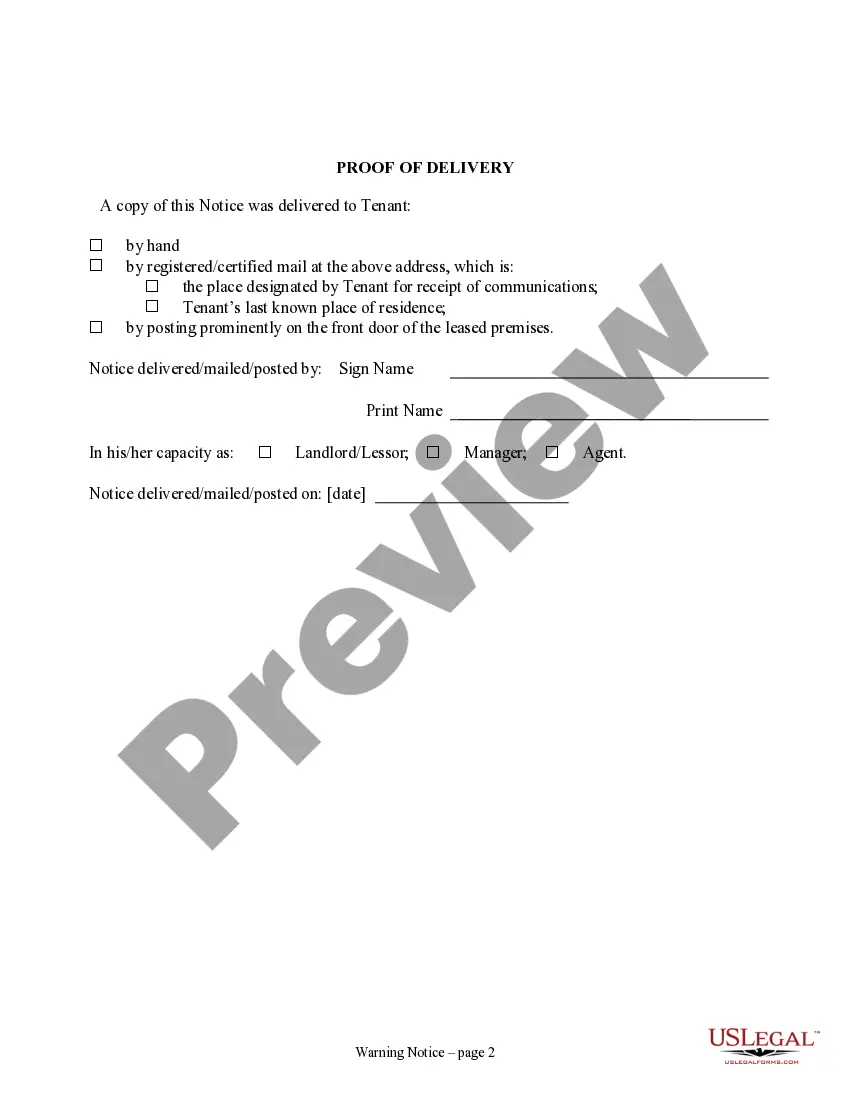
- Deliver the notice to the tenant using an appropriate method such as certified mail or personal delivery.
Notarization guidance
Notarization is not commonly needed for this form. However, certain documents or local rules may make it necessary. Our notarization service, powered by Notarize, allows you to finalize it securely online anytime, day or night.
Get your form ready online
Our built-in tools help you complete, sign, share, and store your documents in one place.
Make edits, fill in missing information, and update formatting in US Legal Forms—just like you would in MS Word.
Download a copy, print it, send it by email, or mail it via USPS—whatever works best for your next step.
Sign and collect signatures with our SignNow integration. Send to multiple recipients, set reminders, and more. Go Premium to unlock E-Sign.
If this form requires notarization, complete it online through a secure video call—no need to meet a notary in person or wait for an appointment.
We protect your documents and personal data by following strict security and privacy standards.

Make edits, fill in missing information, and update formatting in US Legal Forms—just like you would in MS Word.

Download a copy, print it, send it by email, or mail it via USPS—whatever works best for your next step.

Sign and collect signatures with our SignNow integration. Send to multiple recipients, set reminders, and more. Go Premium to unlock E-Sign.

If this form requires notarization, complete it online through a secure video call—no need to meet a notary in person or wait for an appointment.

We protect your documents and personal data by following strict security and privacy standards.
Common mistakes
- Failing to provide accurate dates and amounts due.
- Not signing the notice, which can render the document invalid.
- Delivering the notice incorrectly, which could affect legal enforceability.
- Neglecting to follow up or track the tenant's response to the notice.
Benefits of using this form online
- Convenient: Downloadable from any location at any time.
- Editability: Fields can be filled out electronically for accuracy.
- Reliable: Drafted by licensed attorneys to ensure legal compliance.
Legal use & context
- This notice serves as an important step in the eviction process, ensuring landlords have documented communication regarding rent defaults.
- Failure to issue this warning notice prior to eviction proceedings can impact a landlord's legal rights in some jurisdictions.
Summary of main points
- The notice of default is a formal warning for tenants who have not paid rent.
- It is a necessary step before initiating eviction proceedings.
- Landlords must keep accurate records of all communications with tenants.
Looking for another form?

Form popularity
FAQ
As soon as a tenant fails to pay rent, a landlord can give the tenant a three-day notice. This notice must inform the tenant that if the tenant does not pay rent within three days of receiving the notice, then the landlord will begin eviction proceedings against the tenant (see Cal. Code of Civ.
An estate at sufferance is one in which the tenant who has rightfully come into possession of the land retains possession after the expiration of the term. For example, a tenant who holds over after the expiration of a lease would be deemed to be holding an estate at sufferance.
This means that you have to continue to pay your rent and meet other obligations as specified in your rental agreement. Even if you've seen a Notice of Sale at your rental home, you have to pay rent to the old landlord. Once the property is sold through foreclosure, you have to start paying rent to the new owner.
Notice for Termination With Cause. A landlord can terminate a California tenancy early and evict the tenant for a variety of reasons, including failure to pay rent, violating the lease or rental agreement, or committing an illegal act. Before terminating the tenancy, the landlord must give the tenant written notice.
(1) The notice to quit must be in writing; oral notice is insufficient. (2) Provide a description of the property (i.e., address), (3) Specify the nature of the breach (e.g., nonpayment of rent), (4) Specify the amount of rent due and the period it's due (March 1, 2020 through March 31, 2020).
California law generally allows the owner to terminate a month-to month tenancy on 30 or 60 days notice, depending on how long the residents have lived there. By contrast, a fixed-term lease can only be terminated by the owner on three days' notice for cause.
Tenancy at sufferance is an agreement in which a property renter is legally permitted to live on a property after a lease term has expired but before the landlord demands the tenant vacate the property. If a tenancy at sufferance occurs, the original lease conditions must be met including the payment of any rents.
Notice Requirements for California Landlords A landlord can simply give you a written notice to move, allowing you 30 days (60 days if you've lived in the rental a year or more) as required by California law and specifying the date on which your tenancy will end.
If a tenant has lived in the rental for more than a year, landlords must give 60 days' notice. If a tenant gets 60-day notice and wants to move out sooner, they can deliver a 30-day notice to the landlord.