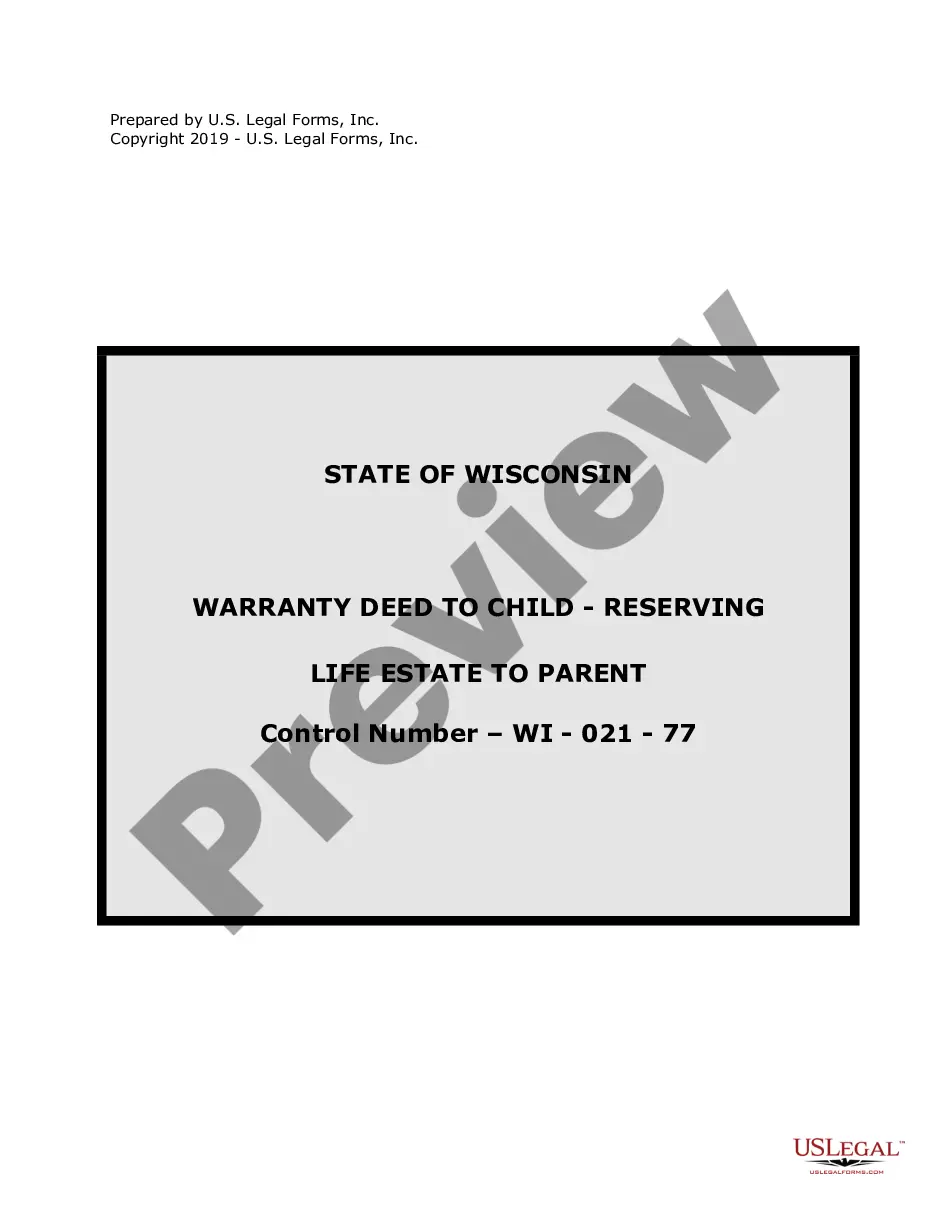
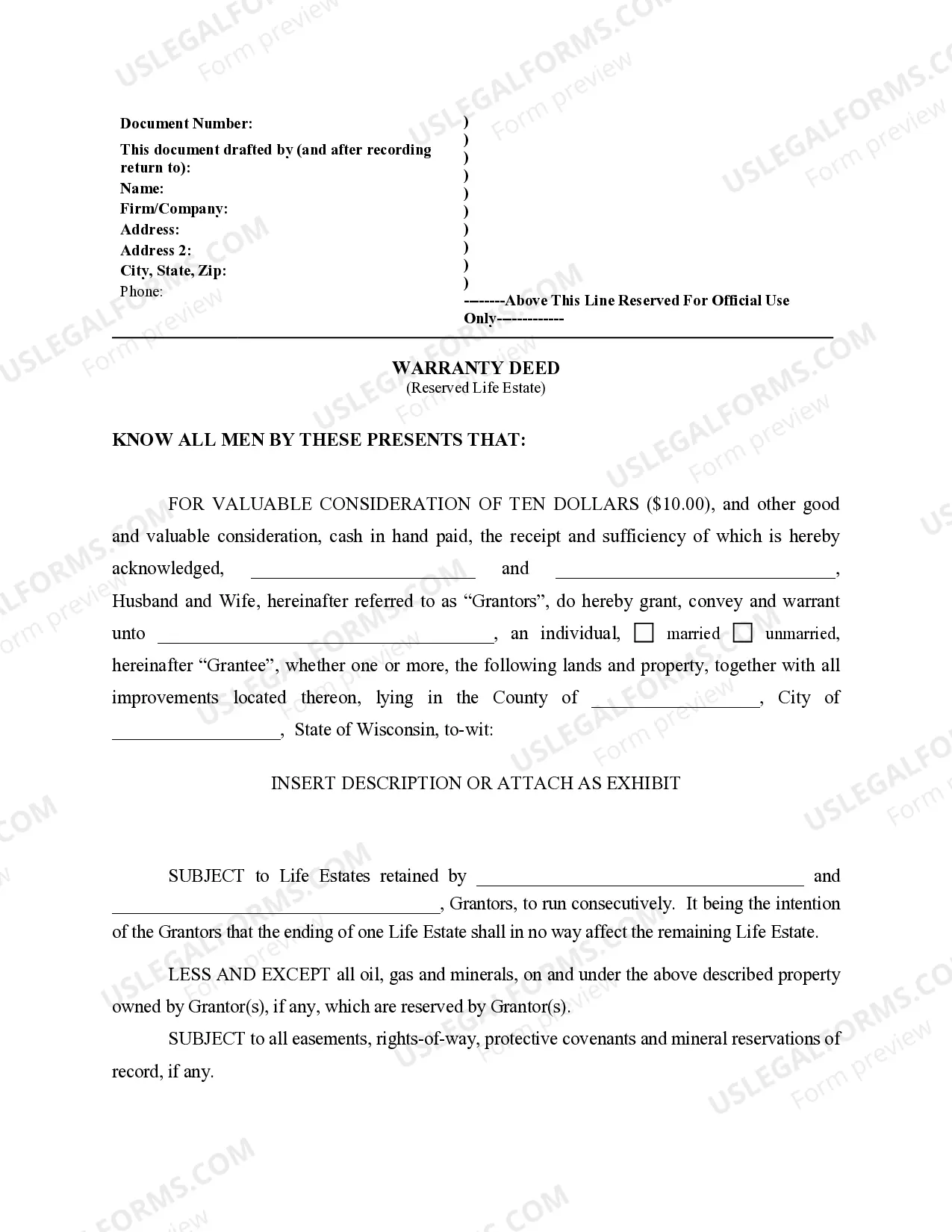
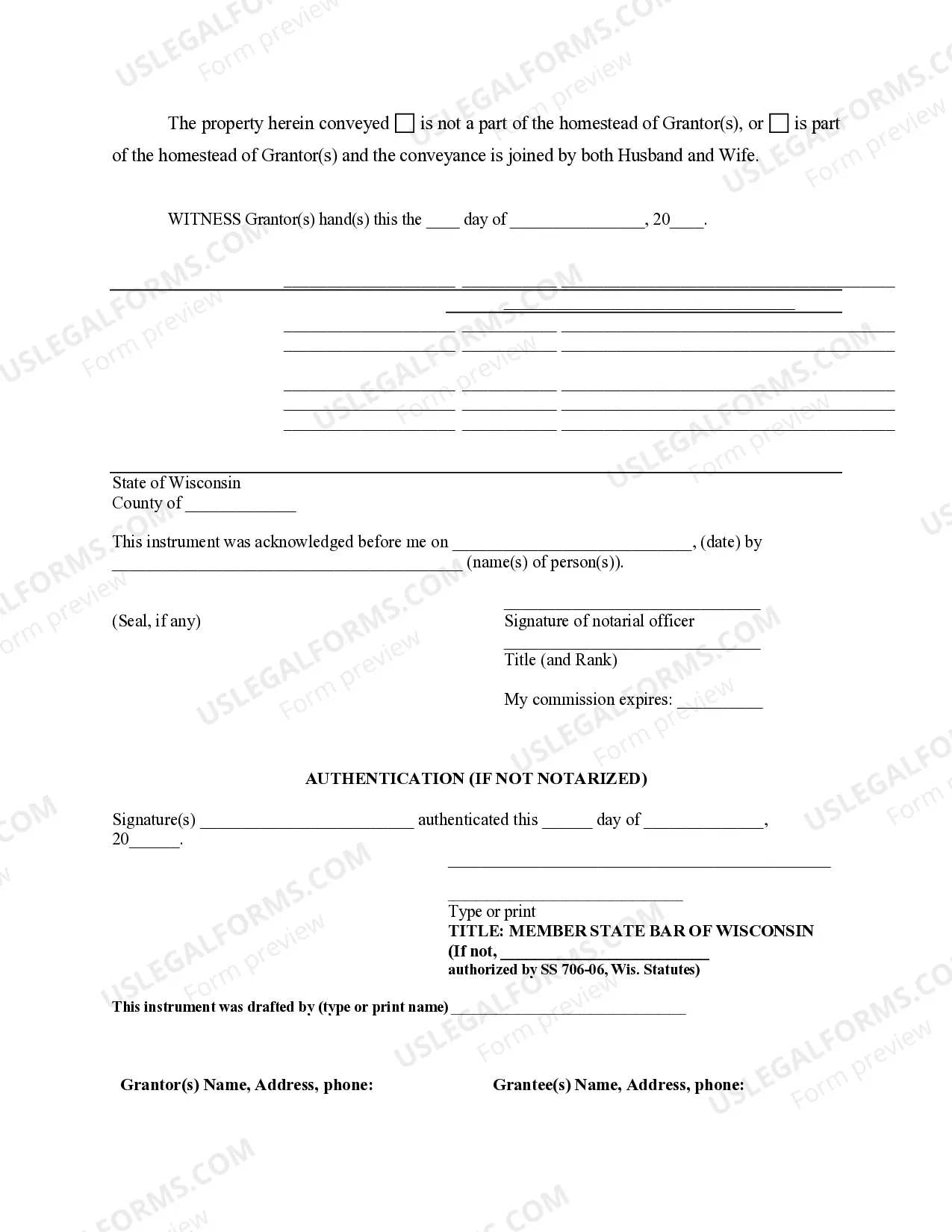
Life Estate Deed Wisconsin With Powers

Description

Get your form ready online
Our built-in tools help you complete, sign, share, and store your documents in one place.
Make edits, fill in missing information, and update formatting in US Legal Forms—just like you would in MS Word.
Download a copy, print it, send it by email, or mail it via USPS—whatever works best for your next step.
Sign and collect signatures with our SignNow integration. Send to multiple recipients, set reminders, and more. Go Premium to unlock E-Sign.
If this form requires notarization, complete it online through a secure video call—no need to meet a notary in person or wait for an appointment.
We protect your documents and personal data by following strict security and privacy standards.

Make edits, fill in missing information, and update formatting in US Legal Forms—just like you would in MS Word.

Download a copy, print it, send it by email, or mail it via USPS—whatever works best for your next step.

Sign and collect signatures with our SignNow integration. Send to multiple recipients, set reminders, and more. Go Premium to unlock E-Sign.

If this form requires notarization, complete it online through a secure video call—no need to meet a notary in person or wait for an appointment.

We protect your documents and personal data by following strict security and privacy standards.
Looking for another form?

How to fill out Wisconsin Warranty Deed To Child Reserving A Life Estate In The Parents?
Whether for commercial intentions or personal affairs, everyone must confront legal circumstances at some stage in their existence.
Filling out legal documents requires meticulous focus, starting with selecting the suitable form template. For instance, if you select an incorrect version of the Life Estate Deed Wisconsin With Powers, it will be denied upon submission. Hence, it is vital to obtain a reliable source of legal documents such as US Legal Forms.
With a comprehensive US Legal Forms catalog available, you will never need to waste time searching for the correct sample online. Utilize the library’s easy navigation to locate the right template for any situation.
- Locate the sample you require by using the search bar or catalog navigation.
- Review the form’s details to ensure it aligns with your situation, state, and locality.
- Click on the form’s preview to review it.
- If it is the incorrect document, return to the search feature to find the Life Estate Deed Wisconsin With Powers template you need.
- Obtain the template when it satisfies your criteria.
- If you possess a US Legal Forms account, simply click Log in to access previously saved templates in My documents.
- If you do not have an account yet, you can acquire the form by clicking Buy now.
- Select the appropriate pricing option.
- Fill out the account registration form.
- Choose your payment method: you can utilize a credit card or PayPal account.
- Select the desired file format and download the Life Estate Deed Wisconsin With Powers.
- Once it is saved, you can complete the form using editing software or print it and fill it out by hand.
Form popularity
FAQ
A life estate is created when a property holder transfers ownership of the property to someone else and retains the right to live on the property and the income from it. The new owner of the property is referred to as the remainder person.
An additional potential problem with a Life Estate is that it does not offer creditor protection to the beneficiary, so if the heir has a debt or is sued, the creditor or court can come after the house. As you can see, a traditional Life Estate has the potential to create major conflict within a family.
A life tenant does not have complete control over the property because they do not own the whole bundle of rights. The life tenant cannot sell, mortgage or in any way transfer or encumber the property. If either party wants to sell the property, both the life tenant and remainderman must agree.
There is no simple way to reverse a life estate because a life estate deed is a legal transfer of the title of a property. This is legally binding and the transaction is complete when the life estate is executed. Essentially, in order to reverse a life estate both parties would need to agree to make it happen.
After considering who you can legally disinherit and deciding that disinheritance is the correct decision, you can ensure that someone is removed as a beneficiary by updating or creating your Last Will and Testament. You may wish to include a reason in your Will.