Common Law Relationship In Ontario
Description
Get your form ready online
Our built-in tools help you complete, sign, share, and store your documents in one place.
Make edits, fill in missing information, and update formatting in US Legal Forms—just like you would in MS Word.
Download a copy, print it, send it by email, or mail it via USPS—whatever works best for your next step.
Sign and collect signatures with our SignNow integration. Send to multiple recipients, set reminders, and more. Go Premium to unlock E-Sign.
If this form requires notarization, complete it online through a secure video call—no need to meet a notary in person or wait for an appointment.
We protect your documents and personal data by following strict security and privacy standards.

Make edits, fill in missing information, and update formatting in US Legal Forms—just like you would in MS Word.

Download a copy, print it, send it by email, or mail it via USPS—whatever works best for your next step.

Sign and collect signatures with our SignNow integration. Send to multiple recipients, set reminders, and more. Go Premium to unlock E-Sign.

If this form requires notarization, complete it online through a secure video call—no need to meet a notary in person or wait for an appointment.

We protect your documents and personal data by following strict security and privacy standards.
Looking for another form?




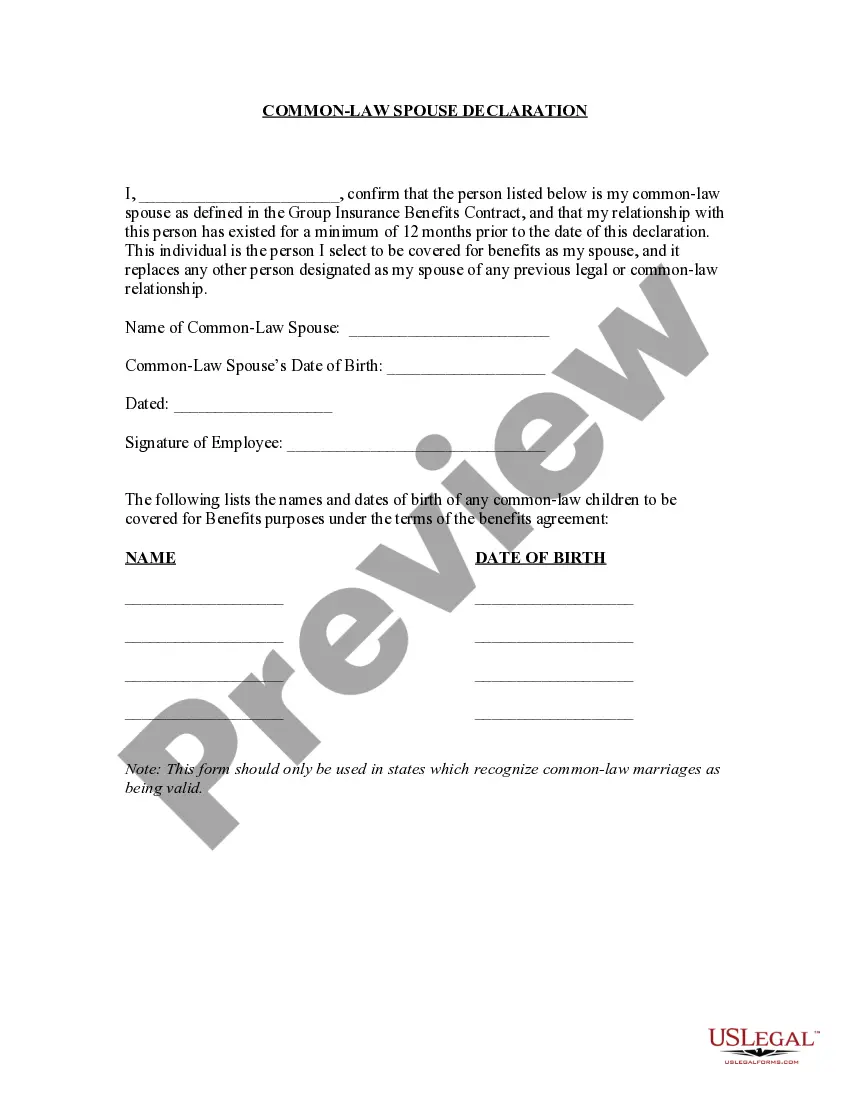
How to fill out Common Law Spouse Or Marriage Declaration Or Affidavit?
Managing legal documents and processes can be a lengthy addition to your schedule.
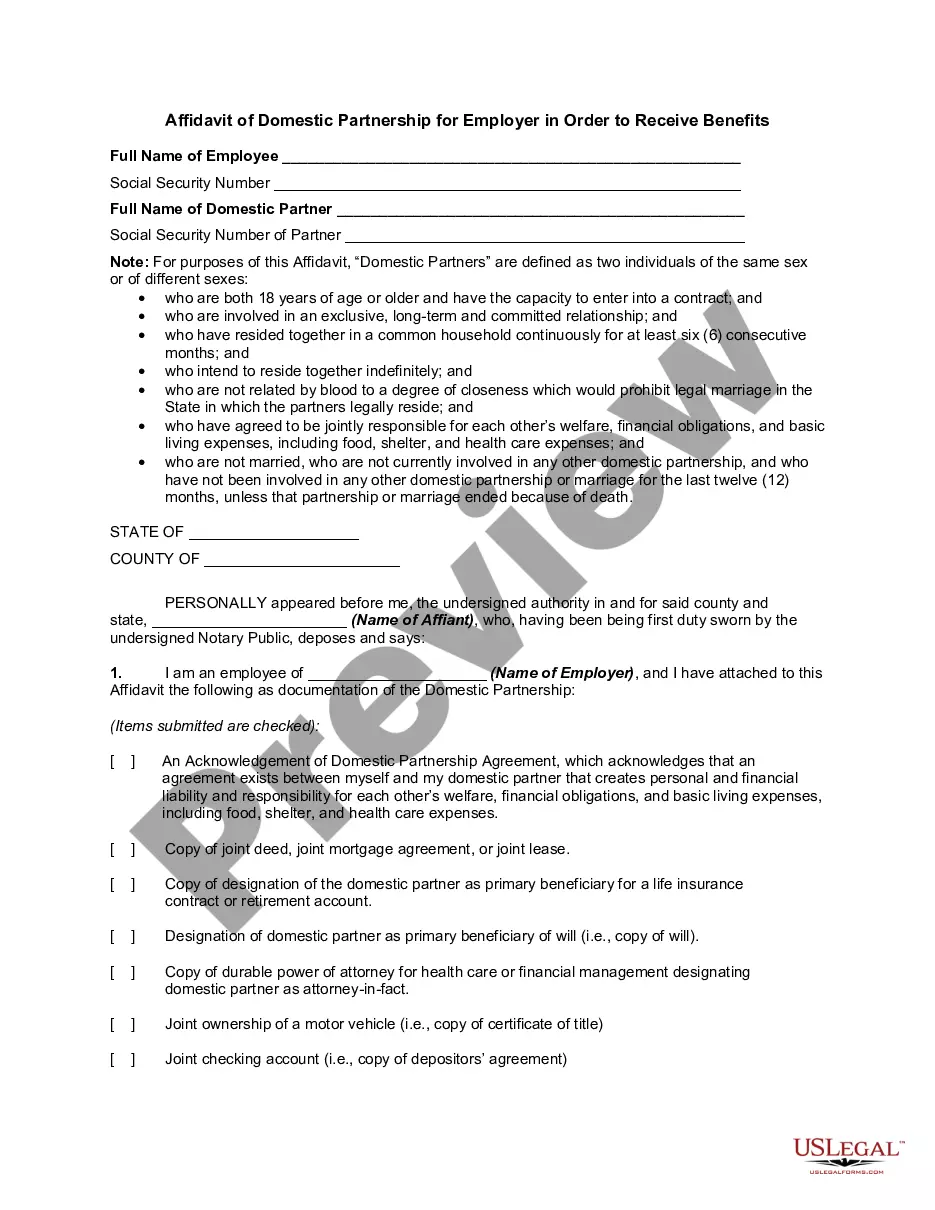
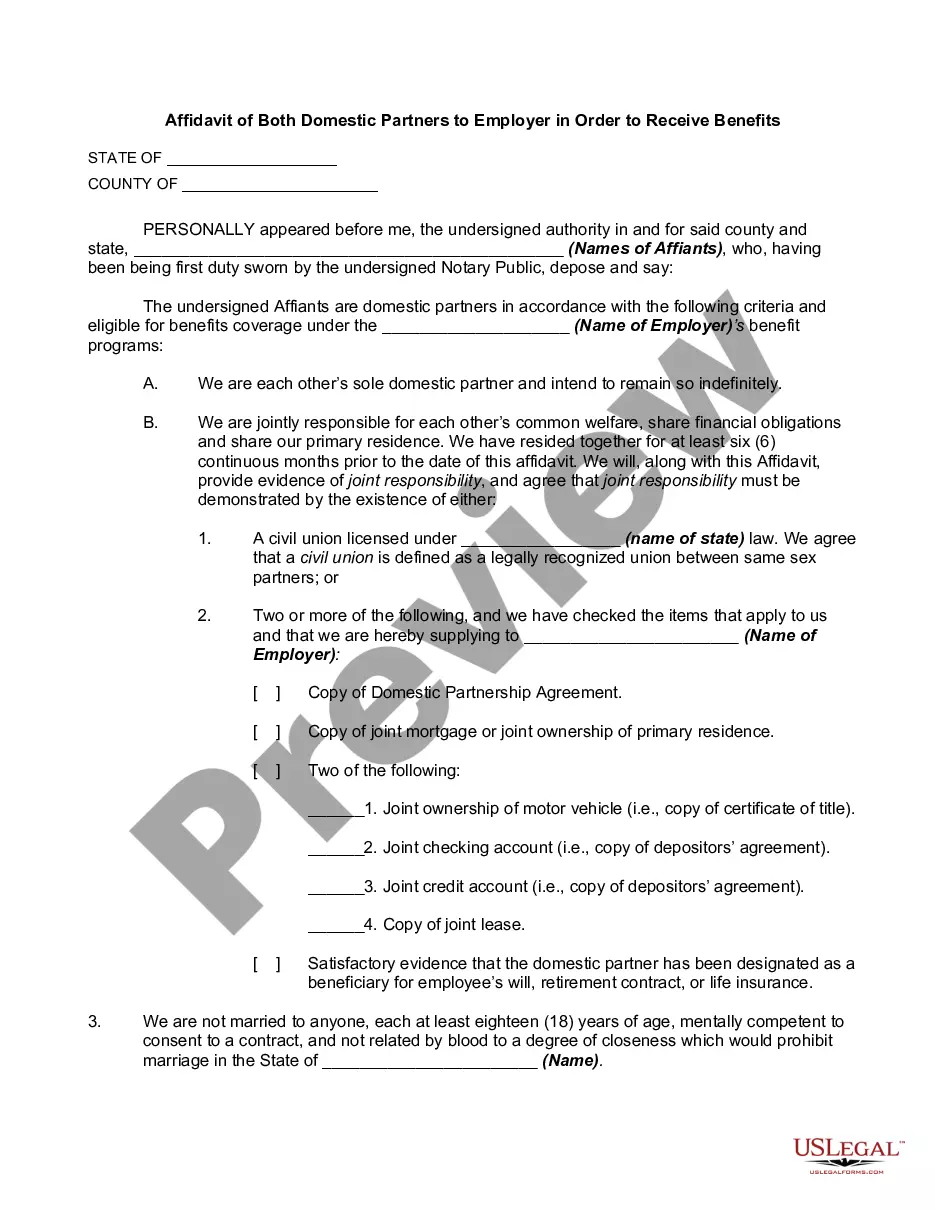
Common Law Partnership In Ontario and similar forms generally require you to locate them and understand how to fill them out accurately.
Thus, whether you are addressing financial, legal, or personal issues, having a comprehensive and efficient online directory of forms readily available will be extremely beneficial.
US Legal Forms is the premier online platform for legal templates, featuring over 85,000 state-specific forms and a range of tools to assist you in completing your documentation effortlessly.
Is this your first experience with US Legal Forms? Register and create an account in just a few minutes to gain access to the form directory and Common Law Partnership In Ontario. Then, follow the steps outlined below to fill out your form: Ensure you have found the correct form by using the Preview feature and reviewing the form description. Select Buy Now when ready, and choose the subscription plan that meets your needs. Click Download then fill out, eSign, and print the form. US Legal Forms has twenty-five years of experience assisting users in managing their legal documents. Find the form you need today and streamline any process without difficulty.
- Uncover the collection of relevant documents available to you with just one click.
- US Legal Forms provides you with state- and county-specific forms ready for download at any time.
- Protect your document management processes with a high-quality service that enables you to create any form in minutes with no extra or hidden charges.
- Simply Log In to your account, locate Common Law Partnership In Ontario, and download it immediately from the My documents section.
- You can also access previously downloaded forms.
Form popularity
FAQ
Living together for seven years does not automatically make you legally married in Ontario. However, it can support your claim as a common law partner if you meet the other criteria of cohabitation and mutual commitment. It’s essential to understand that common law partners have different legal rights compared to married couples, so consulting a legal expert is advisable.
A common law relationship in Ontario is characterized by two people living together in a conjugal relationship without being legally married. This typically requires cohabitation for at least three years, or one year if there is a child involved. Key factors include shared financial responsibilities and a commitment that resembles a traditional marriage.
To prove a common law relationship in Ontario, you should gather documents that demonstrate your shared life. This may include joint bank statements, shared lease agreements, and utility bills in both names. Additionally, having affidavits or letters from friends and family that attest to your relationship can strengthen your case, especially in legal matters.
In a common law relationship in Ontario, your girlfriend may have a claim to a portion of your assets, including your house, if you have lived together for a significant period and can demonstrate financial contribution or interdependence. However, the specifics can vary based on circumstances, such as duration of cohabitation and shared investments. Consulting with a legal expert can provide clarity on your individual situation.
To qualify as a common law partner in Canada, you must meet the same criteria as in Ontario, which includes living together in a committed relationship. This means cohabitating for a specified time, sharing financial responsibilities, and presenting yourselves as a couple to the public. It's important to gather documentation that proves your relationship, as it may be required in legal or immigration matters.
To establish a common law relationship in Ontario, you must live together in a conjugal relationship for at least three years, or for one year if you have a child together. This requires sharing a home and demonstrating a mutual commitment. Additionally, you should have financial interdependence, such as sharing bills or bank accounts, to support your status as common law partners.
Cohabitation can be classified into four main types: common law relationships, casual cohabitation, committed cohabitation, and cohabitation under a domestic partnership. A common law relationship in Ontario falls under the first category, where couples live together in a long-term partnership. Each type has its own legal implications, affecting everything from property rights to parental responsibilities. Knowing the differences can help you make informed decisions about your relationship.
In Ontario, to be considered in a common law relationship, you typically need to live together for at least three years. However, if you have a child together, this period can be shortened to just one year. This common law relationship in Ontario grants couples certain rights and responsibilities, similar to those of married couples. Understanding these requirements can help you navigate your rights and obligations effectively.
A couple is considered common law in Ontario if they have lived together for at least three years, or have a child together, regardless of the duration of cohabitation. The relationship must also be characterized by a commitment to a shared life. Understanding these criteria is vital for legal recognition.
Proof of common law in Ontario can consist of various forms of documentation that demonstrate your shared life. This may include joint purchases, travel together, and financial interdependence. It is important to gather as much evidence as possible to support your claim.