Marsden Hearing With Judge
Description
Get your form ready online
Our built-in tools help you complete, sign, share, and store your documents in one place.
Make edits, fill in missing information, and update formatting in US Legal Forms—just like you would in MS Word.
Download a copy, print it, send it by email, or mail it via USPS—whatever works best for your next step.
Sign and collect signatures with our SignNow integration. Send to multiple recipients, set reminders, and more. Go Premium to unlock E-Sign.
If this form requires notarization, complete it online through a secure video call—no need to meet a notary in person or wait for an appointment.
We protect your documents and personal data by following strict security and privacy standards.

Make edits, fill in missing information, and update formatting in US Legal Forms—just like you would in MS Word.

Download a copy, print it, send it by email, or mail it via USPS—whatever works best for your next step.

Sign and collect signatures with our SignNow integration. Send to multiple recipients, set reminders, and more. Go Premium to unlock E-Sign.

If this form requires notarization, complete it online through a secure video call—no need to meet a notary in person or wait for an appointment.

We protect your documents and personal data by following strict security and privacy standards.
Looking for another form?
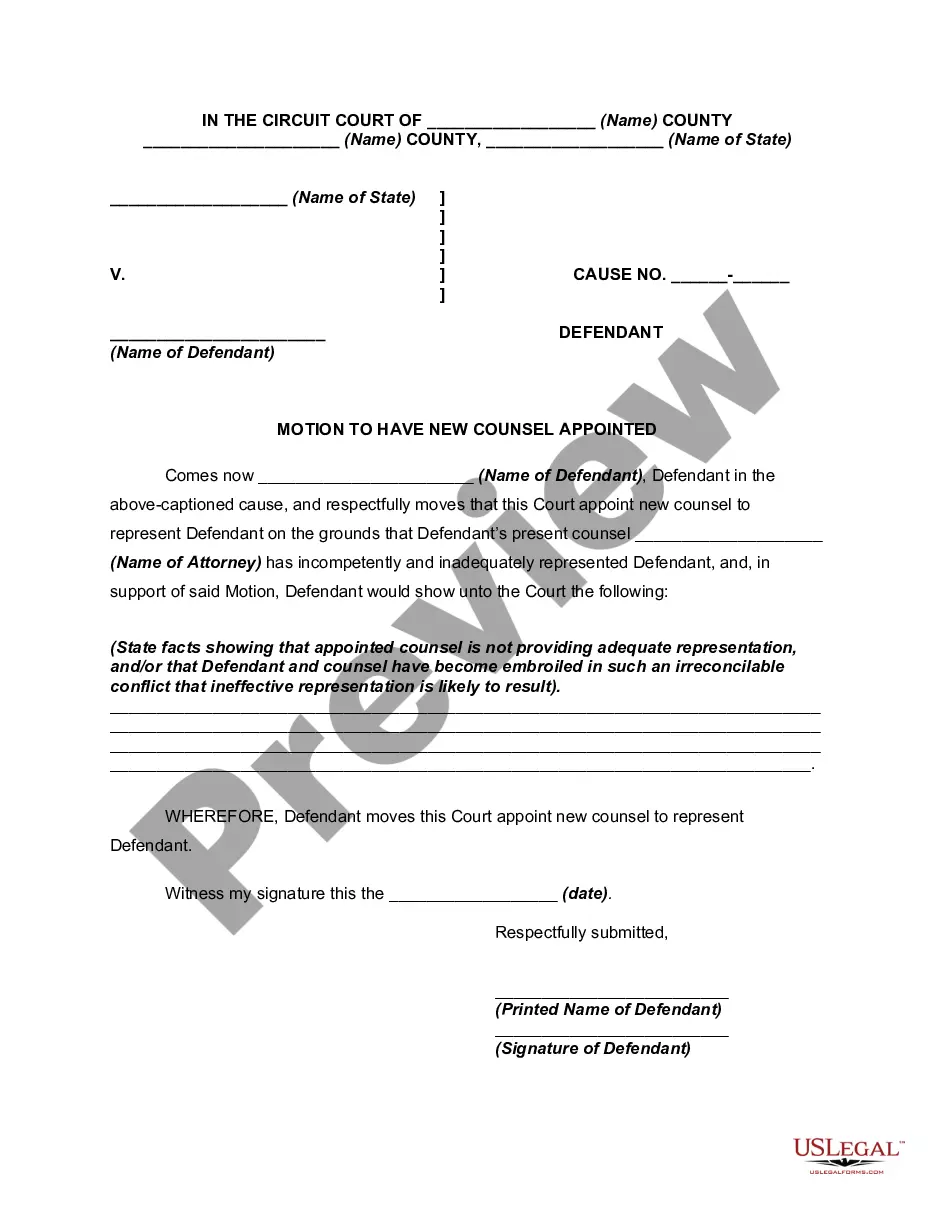
How to fill out Motion To Have New Counsel Appointed - Marsden Motion?
Legal documents handling can be exasperating, even for seasoned experts.
If you are interested in a Marsden Hearing With Judge and lack the time to dedicate to finding the suitable and updated version, the processes may be daunting.
US Legal Forms accommodates all your requirements, from personal to corporate documents, in a centralized location.
Utilize sophisticated tools to fill out and manage your Marsden Hearing With Judge.
After obtaining the necessary form, here are the actions to take into account: Validate that it is the correct form by previewing it and reviewing its details.
- Access a wealth of articles, guides, and materials pertinent to your circumstances and requirements.
- Invest less time and energy locating the forms you need, and take advantage of US Legal Forms' enhanced search and Preview function to find the Marsden Hearing With Judge and acquire it.
- If you have a monthly subscription, Log In to your US Legal Forms account, search for the necessary form, and access it.
- Examine your My documents section to review the documents you’ve previously downloaded and manage your folders as desired.
- If this is your initial experience with US Legal Forms, establish an account for unlimited access to all the advantages of the library.
- Utilize a comprehensive online form library that can significantly improve outcomes for anyone looking to manage these scenarios effectively.
- US Legal Forms stands out as a pioneer in online legal documentation, boasting over 85,000 state-specific legal forms accessible at any time.
- With US Legal Forms, you can benefit from a variety of legal and business templates specific to your state or county.
Form popularity
FAQ
A Marsden hearing with a judge is a legal process that allows a defendant to request a new attorney due to a lack of trust or ineffective representation from their current lawyer. During this hearing, the judge assesses the defendant's concerns about their attorney, ensuring that all parties have the opportunity to speak. It is an important step in maintaining the defendant's right to fair representation, as the court evaluates whether the relationship with the current attorney has irreparably broken down. If you feel uncomfortable with your legal representation, understanding the Marsden hearing process can help you navigate these challenging situations.
An assignment transfers all the original mortgagee's interest under the mortgage or deed of trust to the new bank. Generally, the mortgage or deed of trust is recorded shortly after the mortgagors sign it, and, if the mortgage is subsequently transferred, each assignment is recorded in the county land records.
The difference between assignment and transfer is that assign means it's legal to transfer property or a legal right from one person to another, while transfer means it's legal to arrange for something to be controlled by or officially belong to another person.
In real estate wholesaling, an assignment fee is a financial obligation from one party (the ?assignor?) who agrees to transfer their contractual obligations to another party (the ?assignee.?) In layman's terms, the assignment fee is the fee paid by the end buyer to the real estate wholesaler.
In a mortgage assignment, your original lender or servicer transfers your mortgage account to another loan servicer. When this occurs, the original mortgagee or lender's interests go to the next lender. Even if your mortgage gets transferred or assigned, your mortgage's terms should remain the same.
Definition of 'Master Mortgage' The Master Mortgage is a document created when a property is purchased for the first time. It is filed in the public land records and its purpose is to keep track of the initial mortgage and of any liens that might be associated with the property.
The most common example of an Assignment of Mortgage is when a mortgage lender transfers/sells the mortgage to another lender. This can be done more than once until the balance is paid. The lender does not have to inform the borrower that the mortgage is being assigned to another party.
Assignment fees are calculated by taking the difference between what the seller was promised and what the buyer is paying. For example, if a wholesaler has a contract to purchase a property for $100,000 and they assign that contract to a cash buyer for $120,000, then their assignment fee would be $20,000.
Mortgages are assigned using a document called an assignment of mortgage. This legally transfers the original lender's interest in the loan to the new company. After doing this, the original lender will no longer receive the payments of principal and interest.