Revocation Acknowledgment Trustee Withholding
Description
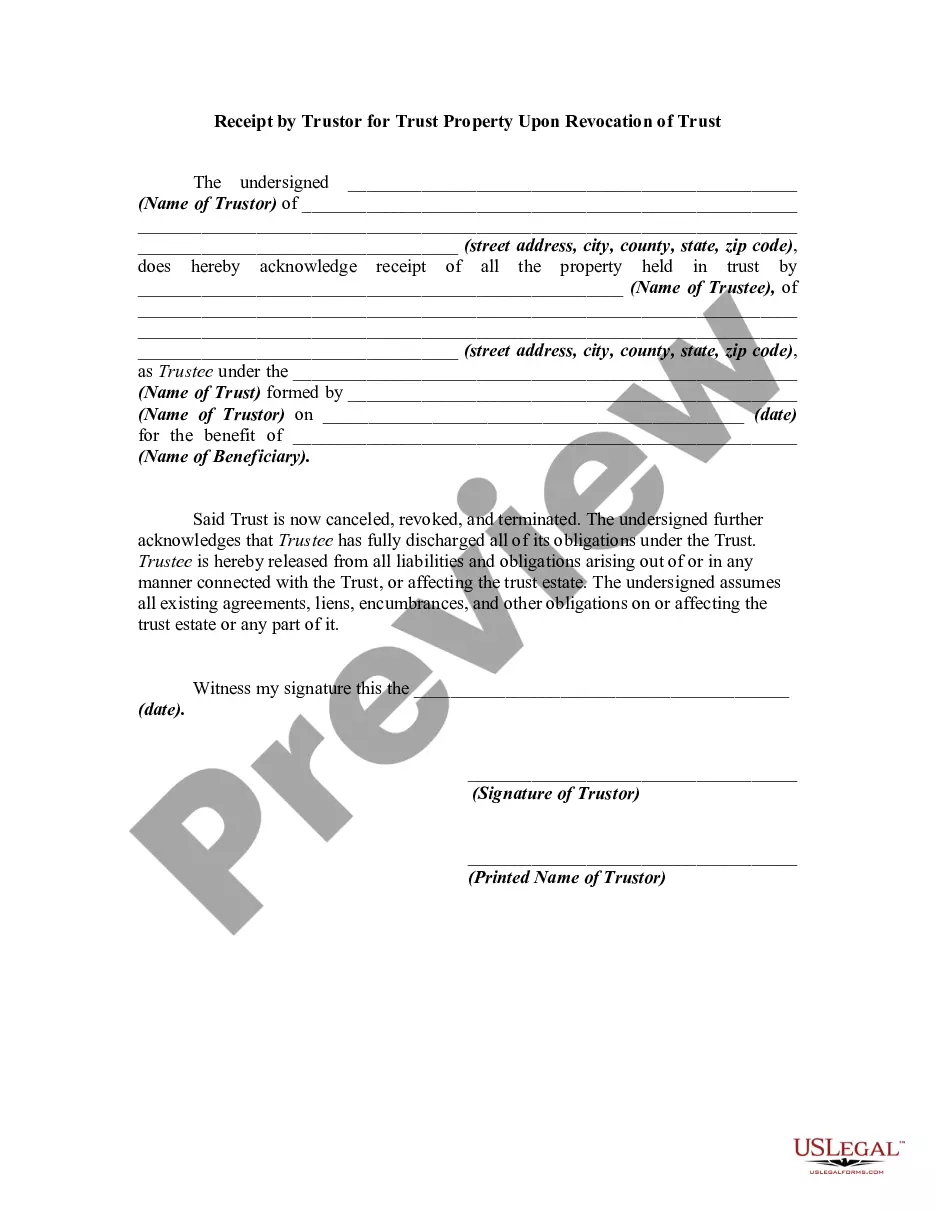
Get your form ready online
Our built-in tools help you complete, sign, share, and store your documents in one place.
Make edits, fill in missing information, and update formatting in US Legal Forms—just like you would in MS Word.
Download a copy, print it, send it by email, or mail it via USPS—whatever works best for your next step.
Sign and collect signatures with our SignNow integration. Send to multiple recipients, set reminders, and more. Go Premium to unlock E-Sign.
If this form requires notarization, complete it online through a secure video call—no need to meet a notary in person or wait for an appointment.
We protect your documents and personal data by following strict security and privacy standards.

Make edits, fill in missing information, and update formatting in US Legal Forms—just like you would in MS Word.

Download a copy, print it, send it by email, or mail it via USPS—whatever works best for your next step.

Sign and collect signatures with our SignNow integration. Send to multiple recipients, set reminders, and more. Go Premium to unlock E-Sign.

If this form requires notarization, complete it online through a secure video call—no need to meet a notary in person or wait for an appointment.

We protect your documents and personal data by following strict security and privacy standards.
Looking for another form?




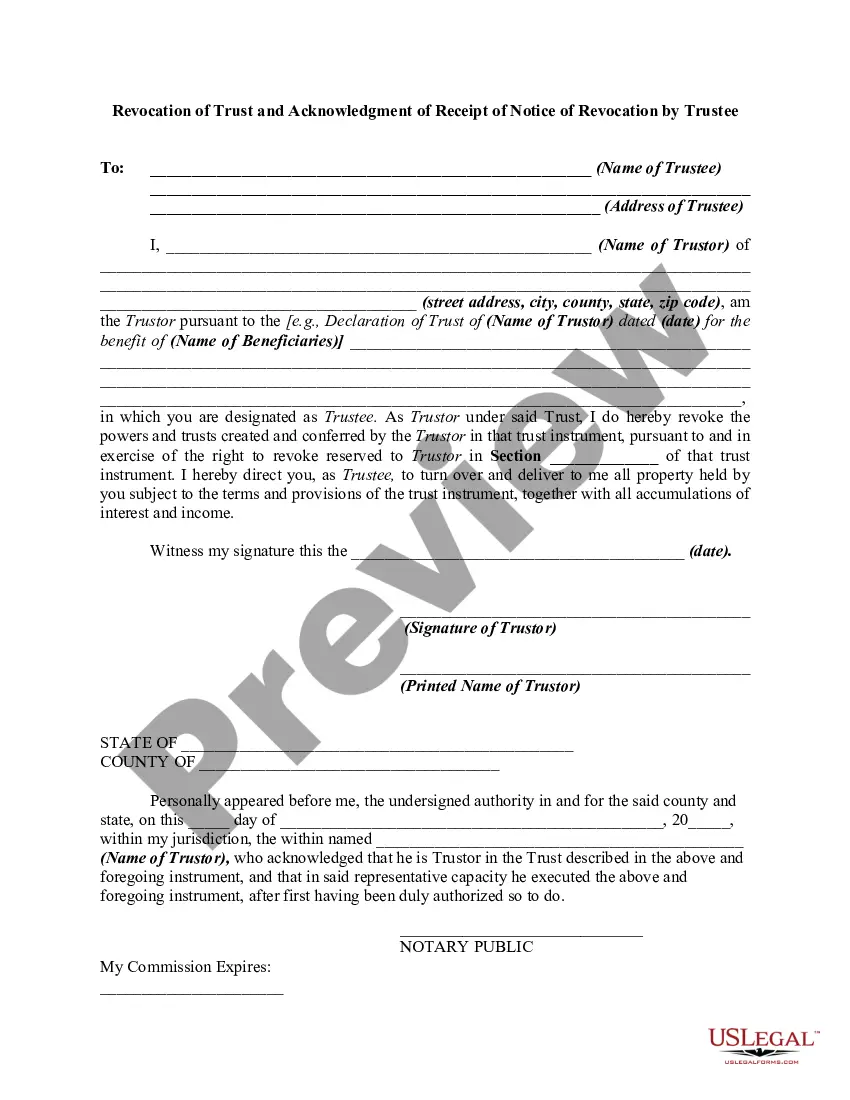
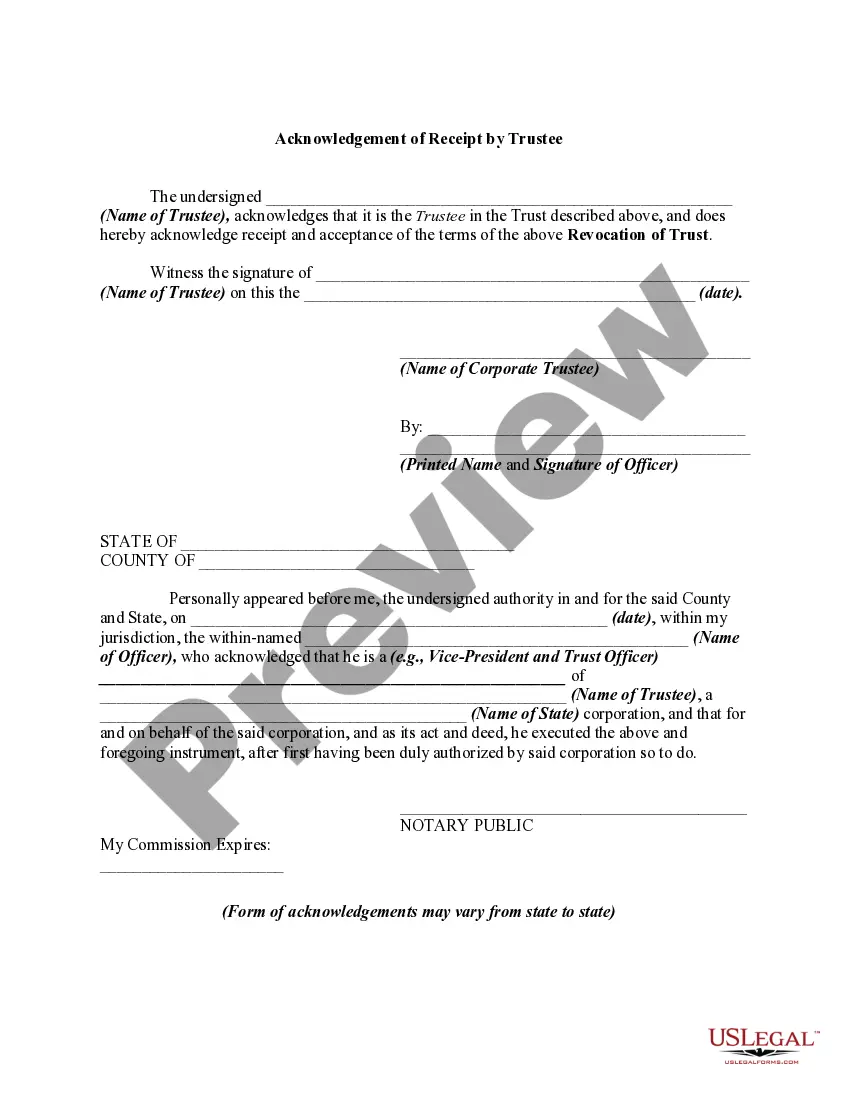
How to fill out Revocation Of Trust And Acknowledgment Of Receipt Of Notice Of Revocation By Trustee?
- If you're a returning user, log into your account and download the necessary form template by clicking the Download button. Confirm that your subscription is active; if not, renew it as per your plan.
- For first-time users, start by exploring the Preview mode and description of each form. Verify that you have selected one that aligns with your specific needs and complies with local jurisdiction requirements.
- If the chosen template does not meet your expectations, utilize the Search tab to find another document that may suit your requirements better.
- Once you find a suitable document, click on the Buy Now button. Select the subscription plan that suits you and create an account for access to our extensive library.
- Complete your purchase by entering your credit card information or using your PayPal account to finalize the subscription.
- Download your selected form and save it on your device. You can access your purchased documents later in the My Forms section of your account.
By following these straightforward steps, you can efficiently acquire and manage your legal documents with US Legal Forms.
Start your legal journey today and experience the ease of creating legally sound documents with US Legal Forms!
Form popularity
FAQ
Yes, if you manage the estate of a deceased person, filing Form 56 is essential. This notification informs the IRS about your authority to act on behalf of the deceased, which is critical for matters related to revocation acknowledgment trustee withholding. Ensuring that this form is submitted allows for proper handling of the estate’s tax responsibilities. Engaging with tools like uslegalforms can assist you in navigating these requirements effectively.
To submit Form 56 to the IRS, you can either mail it to the appropriate IRS address or fax it based on the instructions provided in the form's guidelines. Ensure that you keep copies of the submitted form for your records. Timely submission helps in gaining recognition of authority in matters concerning revocation acknowledgment trustee withholding. Using platforms like uslegalforms can simplify this submission process significantly.
Form 56 is mandatory when someone is acting on behalf of another individual or estate with the IRS. Executing this form notifies the IRS of the appointed representative's authority, particularly important in situations involving revocation acknowledgment trustee withholding. Failure to file this form can lead to complications with tax responsibilities and estate management. Therefore, it is good practice to ensure compliance with this requirement.
The best way to submit a Power of Attorney (POA) to the IRS is to send it via mail or fax, ensuring it meets all IRS specifications. It is important to double-check that all your details are correctly filled out on the form to prevent any delays. Submitting the POA properly ensures that the IRS accurately recognizes your authority, which aids in managing issues related to revocation acknowledgment trustee withholding. Consider using resources like uslegalforms for clear guidance.
Yes, an executor is required to file Form 56 to represent the estate before the IRS. This filing serves as an official notification of the executor's authority and helps with issues surrounding revocation acknowledgment trustee withholding. By ensuring this form is filed, executors can mitigate potential challenges when managing estate responsibilities. Staying informed about IRS requirements is essential for smooth estate administration.
The executor of an estate typically files Form 56 with the IRS to notify them of their authority to act on behalf of the deceased. Filing Form 56 helps the IRS recognize the executor's role, which is crucial in matters related to revocation acknowledgment trustee withholding. Additionally, this form integrates smoothly with estate tax returns. Familiarize yourself with the proper procedures to streamline the filing process.
To revoke a Power of Attorney (POA) with the IRS, you must submit a written notice to the IRS stating your desire to revoke the POA. Make sure you reference the original POA details clearly. By doing this, you can ensure proper revocation acknowledgment trustee withholding, facilitating a smoother transition. Consider using professional services to ensure that all necessary steps are correctly followed.
Yes, not filing Form 56 can lead to complications, especially in matters regarding revocation acknowledgment trustee withholding. If an executor fails to file Form 56, it may result in the IRS not recognizing their authority. This can hinder your ability to manage the estate effectively. To prevent potential penalties, it’s advisable to stay compliant with IRS requirements.
One significant mistake parents often make is failing to specify how assets should be distributed or managed after their passing. This lack of clarity can lead to misunderstandings and disputes among beneficiaries. Moreover, parents might neglect to address potential revocation acknowledgment or trustee withholding issues, complicating the administration of the trust. To avoid these pitfalls, US Legal Forms offers templates that help parents set clear guidelines for their trust funds.
A trust revocation declaration is typically a written statement where the grantor declares their intent to revoke the trust. This declaration might outline any conditions or stipulations associated with that revocation. Once signed and delivered, it serves as an official record for all parties involved, including the trustee, who must acknowledge this revocation clearly. For clarity and compliance, consider accessing resources on US Legal Forms.