Successor Trustee And Beneficiary
Description


Get your form ready online
Our built-in tools help you complete, sign, share, and store your documents in one place.
Make edits, fill in missing information, and update formatting in US Legal Forms—just like you would in MS Word.
Download a copy, print it, send it by email, or mail it via USPS—whatever works best for your next step.
Sign and collect signatures with our SignNow integration. Send to multiple recipients, set reminders, and more. Go Premium to unlock E-Sign.
If this form requires notarization, complete it online through a secure video call—no need to meet a notary in person or wait for an appointment.
We protect your documents and personal data by following strict security and privacy standards.

Make edits, fill in missing information, and update formatting in US Legal Forms—just like you would in MS Word.

Download a copy, print it, send it by email, or mail it via USPS—whatever works best for your next step.

Sign and collect signatures with our SignNow integration. Send to multiple recipients, set reminders, and more. Go Premium to unlock E-Sign.

If this form requires notarization, complete it online through a secure video call—no need to meet a notary in person or wait for an appointment.

We protect your documents and personal data by following strict security and privacy standards.
Looking for another form?








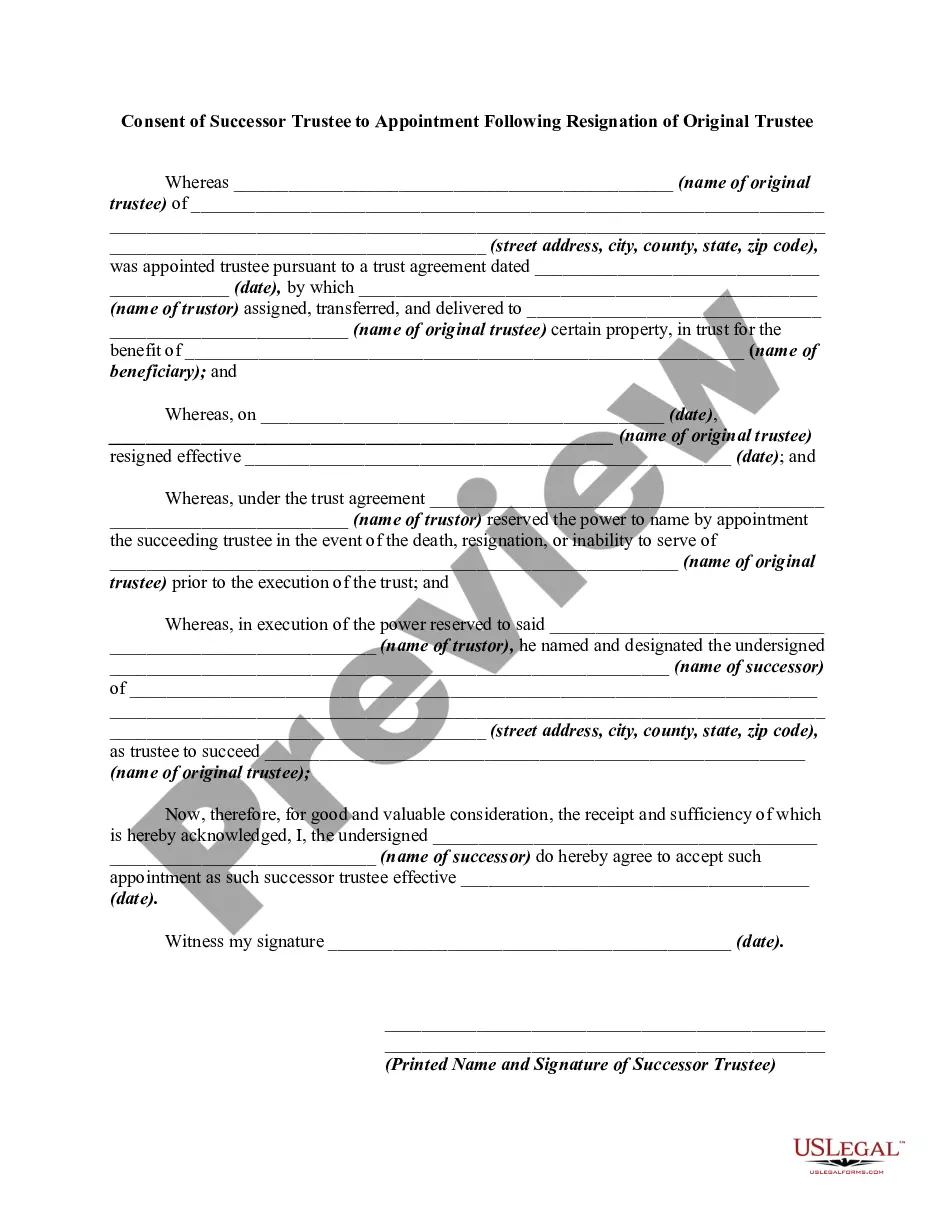
How to fill out Consent Of Successor Trustee To Appointment Following Resignation Of Original Trustee?
Creating legal documents from the beginning can occasionally be daunting. Some situations may require extensive research and significant financial investment.
If you’re looking for a more straightforward and cost-effective method of preparing Successor Trustee And Beneficiary or any other paperwork without the hassle, US Legal Forms is always available to assist you.
Our online repository of over 85,000 current legal documents encompasses nearly every aspect of your financial, legal, and personal matters. With just a few clicks, you can swiftly access state- and county-specific forms meticulously compiled for you by our legal professionals.
Utilize our website whenever you require dependable and trustworthy services through which you can easily find and download the Successor Trustee And Beneficiary. If you’re not new to our offerings and have already set up an account with us, simply Log In to your account, find the template, and download it or re-download it anytime in the My documents section.
Download the form, then complete it, sign it, and print it out. US Legal Forms has a flawless reputation and over 25 years of expertise. Join us today and make document processing straightforward and efficient!
- Do not have an account? No issue. Setting it up and navigating the library takes just a few minutes.
- However, before diving directly into downloading Successor Trustee And Beneficiary, consider these guidelines.
- Examine the form preview and descriptions to confirm you have located the document you need.
- Ensure the template you select meets the standards of your state and county.
- Choose the most suitable subscription plan to purchase the Successor Trustee And Beneficiary.
Form popularity
FAQ
No, a successor trustee is not the same as a beneficiary. The successor trustee takes over the management of the trust when the original trustee can no longer fulfill their duties. In contrast, a beneficiary is the recipient of the trust's benefits. Educating yourself on the differences between a successor trustee and beneficiary can lead to better outcomes in your estate planning process.
No, trustees and beneficiaries serve distinct functions within the trust structure. The trustee oversees the management and distribution of the trust's assets, ensuring that they align with the trust's terms. Conversely, beneficiaries are the individuals or entities who benefit from these assets. Clarity on these roles helps to navigate estate issues more effectively.
No, successor trustees and beneficiaries have different roles in estate management. A successor trustee is responsible for administering a trust after the original trustee is unable to do so. On the other hand, a beneficiary is the individual or entity that receives the assets held in the trust. Understanding the roles of both successor trustee and beneficiary is essential for effective estate planning.
To add a successor trustee, you can amend your trust document to include the new individual. It’s critical to communicate with the person you wish to appoint, ensuring they agree to take on this responsibility. Platforms like USLegalForms offer templates that simplify the amendment process, allowing you to easily update your trust and keep your beneficiary informed.
The notarization requirement for appointing a successor trustee varies by state, but it often adds a layer of authenticity to your documents. Notarizing the trust helps ensure that your successor trustee and beneficiary are recognized by banks, financial institutions, and courts. It’s wise to consult with legal resources, like USLegalForms, to understand your state's regulations regarding notarization.
If you do not name a successor trustee, the court will appoint one when the time comes. This process can lead to delays and uncertainty, potentially impacting your beneficiaries. By choosing a successor trustee and beneficiary in advance, you help ensure a smoother transition of your assets and peace of mind for your loved ones.
To appoint a successor trustee, you need to clearly designate the individual in your trust document. It’s essential to follow the specific requirements of your state, ensuring that your successor trustee and beneficiary understand their roles. You can use online resources like USLegalForms to create or modify your trust, making the appointment process straightforward and accessible.
When the trustee passes away, the successor trustee takes over by following the instructions laid out in the trust document. This process often begins with the successor trustee providing a death certificate and any required legal filings. Once these steps are complete, the successor can manage the trust’s assets according to your wishes. Using platforms like USLegalForms can ensure the process runs smoothly and legally.
A successor trustee is appointed in the trust document, specifying who will assume the role in the event of the original trustee's death or incapacity. It is wise to choose someone responsible and trustworthy. Clear instructions should be communicated to the successor to ensure they understand their responsibilities. Utilizing USLegalForms can help simplify this process and provide the right legal documents.
A trustee manages the trust during your lifetime, while a successor trustee steps in after your death or if you become incapacitated. The primary role of the trustee is to handle the trust’s day-to-day operations, ensuring your wishes are fulfilled. Understanding these roles, especially between a trustee and a successor trustee, is crucial for effective estate planning.