Generation Skipping Trust Sample With Trust
Description








Get your form ready online
Our built-in tools help you complete, sign, share, and store your documents in one place.
Make edits, fill in missing information, and update formatting in US Legal Forms—just like you would in MS Word.
Download a copy, print it, send it by email, or mail it via USPS—whatever works best for your next step.
Sign and collect signatures with our SignNow integration. Send to multiple recipients, set reminders, and more. Go Premium to unlock E-Sign.
If this form requires notarization, complete it online through a secure video call—no need to meet a notary in person or wait for an appointment.
We protect your documents and personal data by following strict security and privacy standards.

Make edits, fill in missing information, and update formatting in US Legal Forms—just like you would in MS Word.

Download a copy, print it, send it by email, or mail it via USPS—whatever works best for your next step.

Sign and collect signatures with our SignNow integration. Send to multiple recipients, set reminders, and more. Go Premium to unlock E-Sign.

If this form requires notarization, complete it online through a secure video call—no need to meet a notary in person or wait for an appointment.

We protect your documents and personal data by following strict security and privacy standards.
Looking for another form?





How to fill out Irrevocable Generation Skipping Or Dynasty Trust Agreement For Benefit Of Trustor's Children And Grandchildren?
Securing a reliable source for obtaining the latest and suitable legal templates is part of the challenge of navigating bureaucracy.
Finding the appropriate legal documents requires precision and meticulousness, which is why it is crucial to acquire samples of Generation Skipping Trust Sample With Trust exclusively from trustworthy providers, such as US Legal Forms. An incorrect template will squander your time and delay your current situation. With US Legal Forms, you have minimal concerns. You can view and access all the information regarding the document’s applicability and significance for your circumstance and in your state or locality.
Once you have the form saved on your device, you can modify it using the editor or print it out and fill it in by hand. Eliminate the stress that comes with your legal documentation. Browse the extensive US Legal Forms collection where you can find legal templates, evaluate their suitability for your situation, and download them instantly.
- Use the library navigation or search box to locate your sample.
- Review the form’s description to determine if it aligns with the requirements of your state and locality.
- Check the form preview, if available, to confirm that the template is indeed the one you need.
- Return to the search and find the appropriate document if the Generation Skipping Trust Sample With Trust does not meet your requirements.
- Once you are confident about the form’s applicability, download it.
- If you are a registered user, click Log in to verify your identity and access your selected templates in My documents.
- If you have not created an account yet, click Buy now to acquire the template.
- Choose the pricing option that suits your needs.
- Proceed with the registration to complete your purchase.
- Finalize your acquisition by selecting a payment method (credit card or PayPal).
- Choose the file format for downloading Generation Skipping Trust Sample With Trust.
Form popularity
FAQ
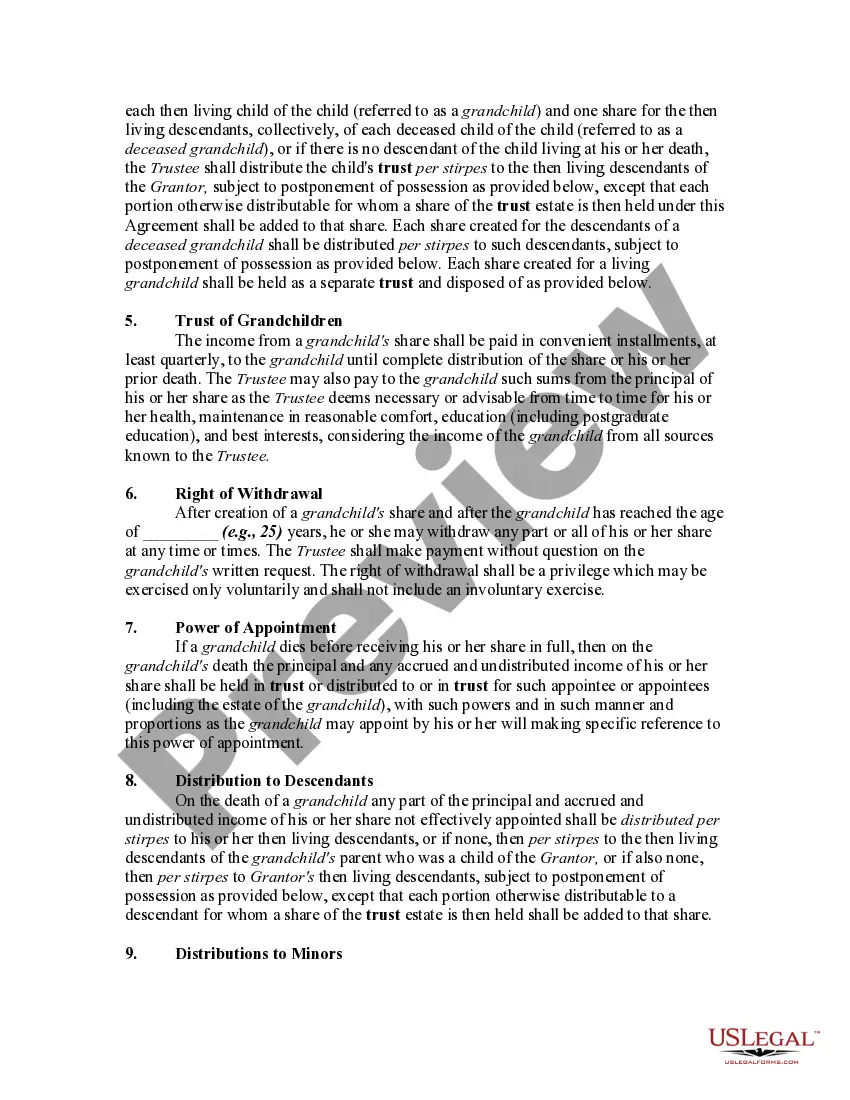
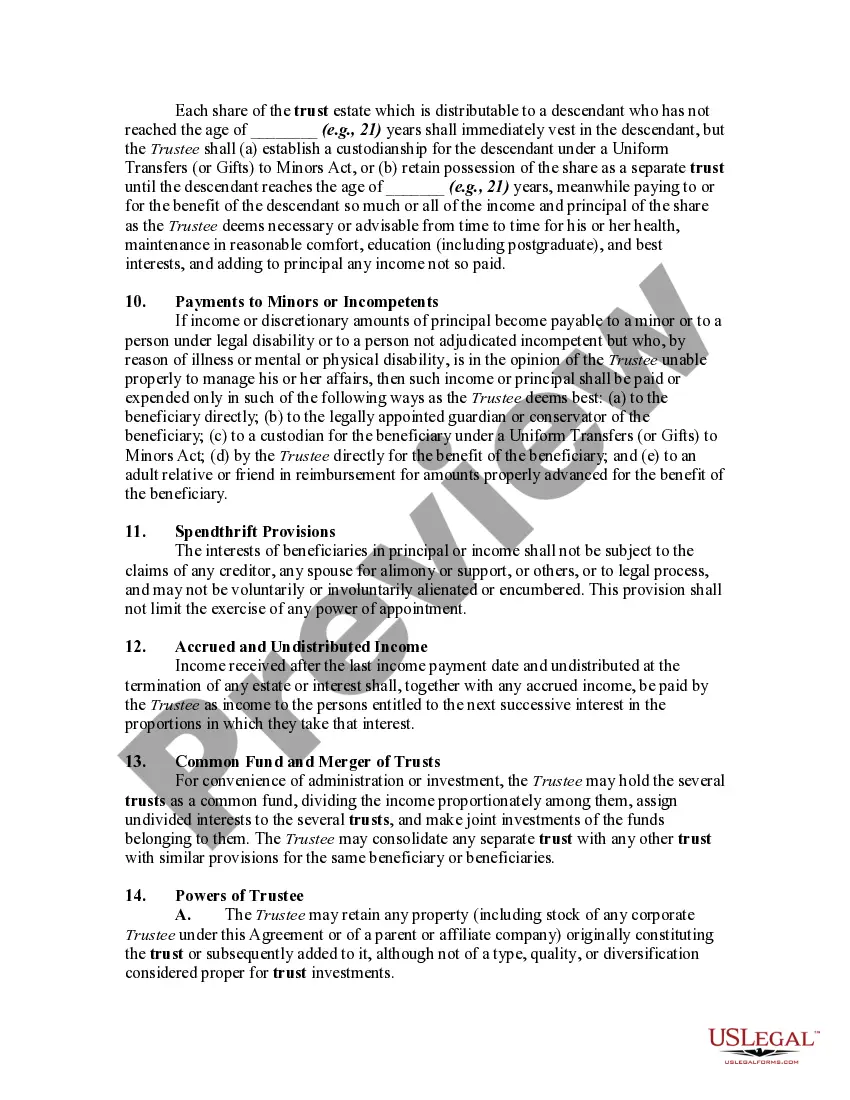
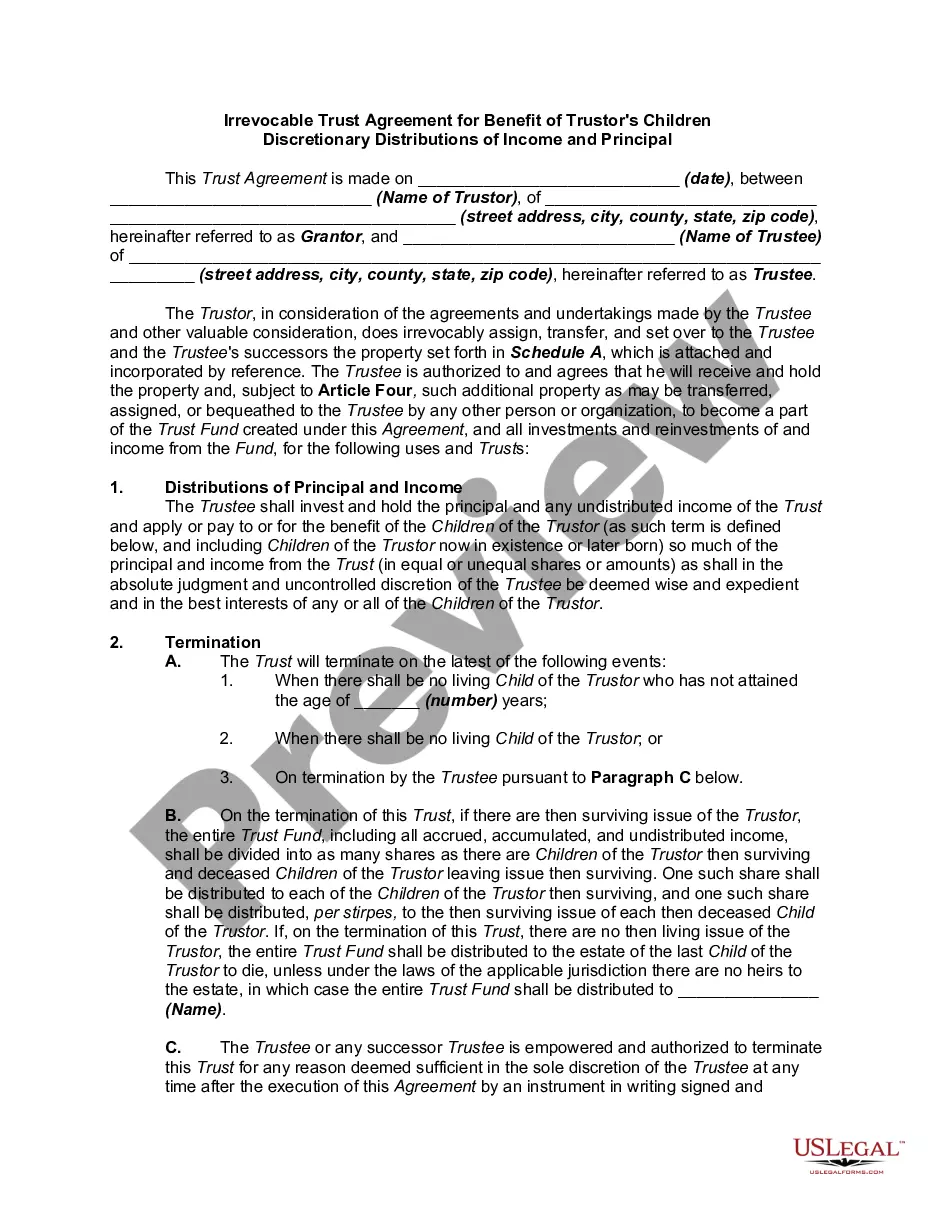
A generation-skipping trust allows you to transfer assets directly to your grandchildren, bypassing your children to reduce estate taxes. For example, if a grandparent places $3 million into a trust for their grandchildren, the assets grow without being taxed until the grandchildren withdraw funds. This strategy can significantly increase the wealth available to future generations. To see how this works in practice, check out a generation skipping trust sample with trust that illustrates real-life applications.
To calculate the GSTT, you first determine the value of the property transferred to the generation-skipping trust and then apply the current GSTT exemption. For example, if you transfer $5 million and the exemption is $12 million, no GSTT applies. However, if the transfer exceeds the exemption, the excess amount may incur taxes. Utilizing a generation skipping trust sample with trust can help clarify this calculation process.
The amount you can place in a generation-skipping trust is subject to the generation-skipping transfer tax (GSTT) exemption, which is adjusted annually. As of 2023, the exemption allows you to transfer a significant sum, exceeding millions without incurring taxes. This feature makes a generation-skipping trust an effective tool for wealth preservation across generations. For a clearer understanding, refer to a generation skipping trust sample with trust that outlines these financial limits.
A Bypass Trust, also known as a credit shelter trust, allows one spouse to leave assets to the trust upon their death. This setup helps in avoiding estate taxes for the surviving spouse. For instance, when the first spouse passes, the trust can hold assets up to the estate tax exemption limit, ensuring that these funds do not get taxed again when the surviving spouse dies. You can find a generation skipping trust sample with trust to better understand how this works.
Skipping a Generation For example, if you skip the living parent (your child) and leave an inheritance directly to your grandchild. It can happen unintentionally, as when an inheritance is in a trust for your child, and your child dies after you, but before receiving the full amount in the trust.
A generation-skipping trust (GST) is a type of legally binding trust agreement in which the contributed assets are passed down to the grantor's grandchildren, thus "skipping" the next generation, the grantor's children.
A generation skipping trust is a fiduciary arrangement that is used to pass down assets and property to a later generation. The trustor, also called the settlor or grantor, skips over their own children to pass the inheritance to their grandchildren. The trust skips a generation, thus earning its name.
A generation-skipping trust (GST) is a type of legally binding trust agreement in which the contributed assets are passed down to the grantor's grandchildren, thus "skipping" the next generation, the grantor's children.
A generation-skipping trust (GST) is a legal arrangement that skips one generation. It passes assets to the grantor's grandchildren, or someone else who is at least 37½ years younger. GTSs can reduce taxes and protect legacies, which is vital in estate planning.