Construction Fee Plus Form With Two Points In Wayne
Description

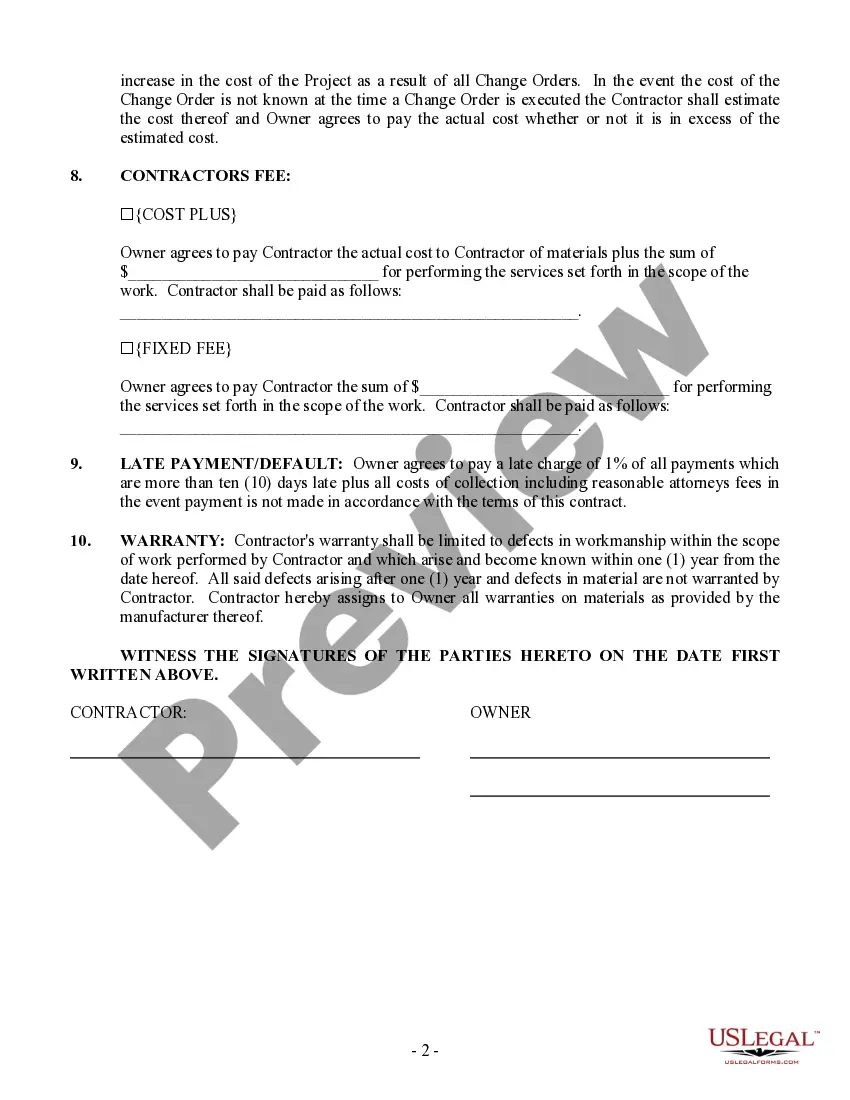
Get your form ready online
Our built-in tools help you complete, sign, share, and store your documents in one place.
Make edits, fill in missing information, and update formatting in US Legal Forms—just like you would in MS Word.
Download a copy, print it, send it by email, or mail it via USPS—whatever works best for your next step.
Sign and collect signatures with our SignNow integration. Send to multiple recipients, set reminders, and more. Go Premium to unlock E-Sign.
If this form requires notarization, complete it online through a secure video call—no need to meet a notary in person or wait for an appointment.
We protect your documents and personal data by following strict security and privacy standards.

Make edits, fill in missing information, and update formatting in US Legal Forms—just like you would in MS Word.

Download a copy, print it, send it by email, or mail it via USPS—whatever works best for your next step.

Sign and collect signatures with our SignNow integration. Send to multiple recipients, set reminders, and more. Go Premium to unlock E-Sign.

If this form requires notarization, complete it online through a secure video call—no need to meet a notary in person or wait for an appointment.

We protect your documents and personal data by following strict security and privacy standards.
Looking for another form?





Form popularity
FAQ
For example, a conceptual estimate may have a contingency of 20% and an allowance of 10%, while a detailed estimate may have a contingency of 5% and an allowance of 2%. However, these percentages are not fixed and may vary depending on the project characteristics and the level of confidence of the estimator.
Typically, most construction projects use a contingency rate of 5% to 10% from the total project budget. This is typically enough to cover any unexpected costs that may arise throughout the project.
Understanding Construction Management Unlike the Design-Build method, which integrates the design process and construction under one contract, the construction management method usually involves several contracts with different contractors, aligning with a more traditional project delivery approach.
The contingency allowance is the time allocated during planning for unscheduled events. Technical and personal disruptions result in changes in the indirect production costs. The contingency allowance is calculated in special contingency time studies, the results of which yield rates for indirect production costs.
While both relatively simple concepts, allowances and contingencies are often confused with one another. Conflating the two can lead to pitfalls. An easy way to remind oneself of the difference is: allowances are for known unknowns, and contingencies are for unknown unknowns.
Unlike allowances, which cover specific items, contingencies are funds set aside to cover unforeseen items during the construction process. These could include unexpected site conditions, design errors or omissions, or unforeseen changes in market conditions, like a sudden increase in material costs.
