Sba 7a Loan Agreement Form
Description


Get your form ready online
Our built-in tools help you complete, sign, share, and store your documents in one place.
Make edits, fill in missing information, and update formatting in US Legal Forms—just like you would in MS Word.
Download a copy, print it, send it by email, or mail it via USPS—whatever works best for your next step.
Sign and collect signatures with our SignNow integration. Send to multiple recipients, set reminders, and more. Go Premium to unlock E-Sign.
If this form requires notarization, complete it online through a secure video call—no need to meet a notary in person or wait for an appointment.
We protect your documents and personal data by following strict security and privacy standards.

Make edits, fill in missing information, and update formatting in US Legal Forms—just like you would in MS Word.

Download a copy, print it, send it by email, or mail it via USPS—whatever works best for your next step.

Sign and collect signatures with our SignNow integration. Send to multiple recipients, set reminders, and more. Go Premium to unlock E-Sign.

If this form requires notarization, complete it online through a secure video call—no need to meet a notary in person or wait for an appointment.

We protect your documents and personal data by following strict security and privacy standards.
Looking for another form?









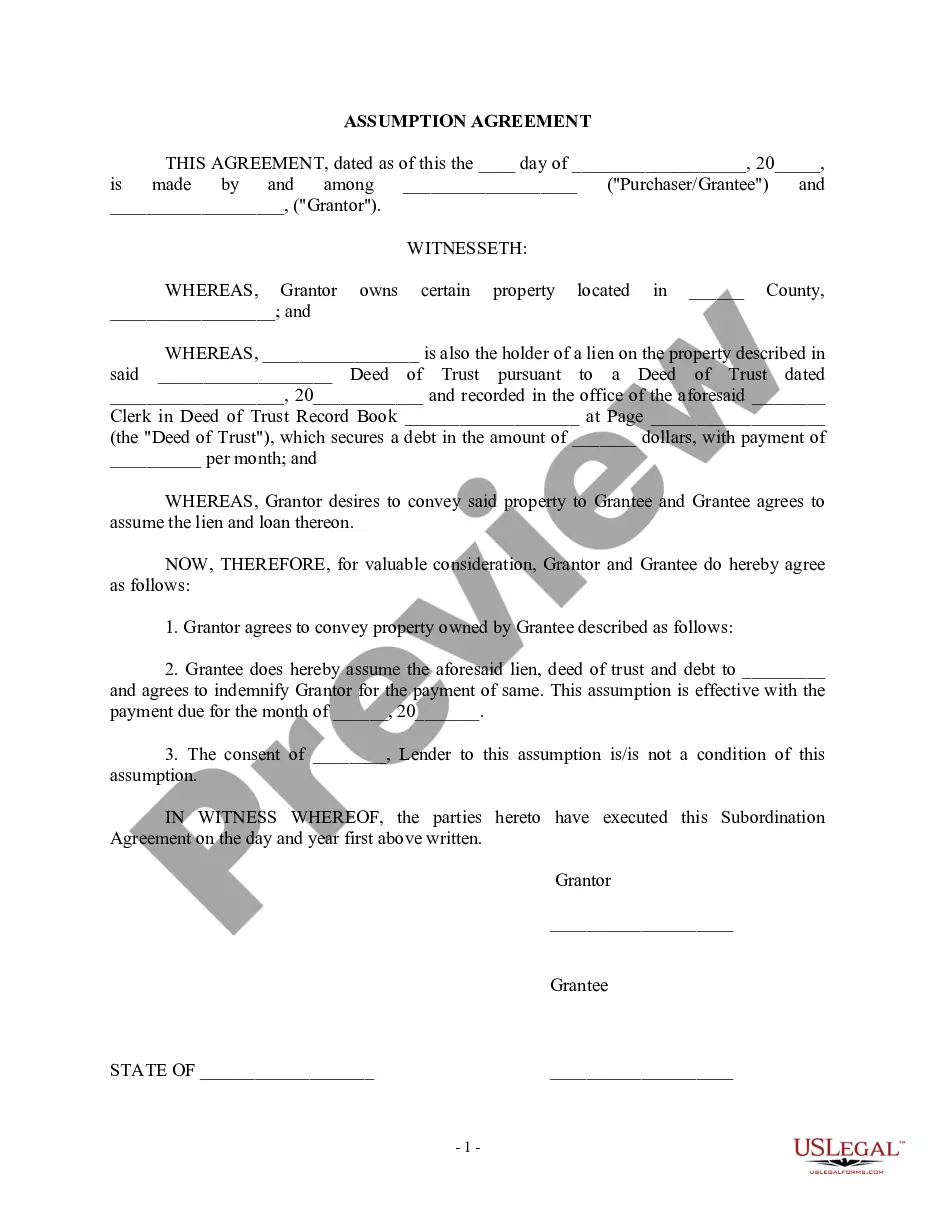
How to fill out Assumption Agreement Of SBA Loan?
There’s no longer a requirement to squander time looking for legal documents to meet your local state obligations.
US Legal Forms has gathered all of them in one location and enhanced their availability.
Our platform provides over 85k templates for any business and individual legal situations organized by state and purpose of use.
Quickly and easily prepare legal documentation in accordance with federal and state regulations with our platform. Experience US Legal Forms today to keep your paperwork organized!
- All forms are expertly written and confirmed for authenticity, so you can feel confident in acquiring a current Sba 7a Loan Agreement Form.
- If you are acquainted with our platform and already possess an account, you must ensure your subscription is active before accessing any templates.
- Log In to your account, select the document, and click Download.
- You can also revisit all saved documents at any time by accessing the My documents tab in your profile.
- If you've never interacted with our platform previously, the process will demand a few more steps to finalize.
- Here’s how new users can discover the Sba 7a Loan Agreement Form in our catalog.
- Examine the page content carefully to confirm it includes the sample you need.
- To do so, utilize the form description and preview options if available.
Form popularity
FAQ
Standard 7(a)Lenders are not required to take collateral for loans up to $25,000. For loans in excess of $350,000, the SBA requires that the lender collateralize the loan to the maximum extent possible up to the loan amount.
Under this model, the lender submits a complete application package and requests an SBA guarantee. The SBA reviews the package and will usually confirm the lender's decision about whether to approve the loan. This process generally takes between seven and 10 business days.
When you apply for an SBA loan, you will be subject to an ABA (All Business Assets) lien, or blanket lien. Essentially, this means everything your business owns is collateral required for your SBA loan. Your primary collateral is usually assets purchased through the SBA loan.
How to fill out SBA Form 413Step 1: Fill in basic business information.Step 2: Add information about your assets.Step 3: Add information about your liabilities.Step 4: Complete section 1 for your source of income and contingent liabilities.Step 5: Complete section 2 with your notes payable to banks and others.More items...
Although the guarantee incentives lenders to work with small businesses, it can still be hard to qualify for SBA 7(a) loans. Lenders generally require a good personal credit score (690+), two or more years in business, and strong annual revenue for 7(a) loan applications.
