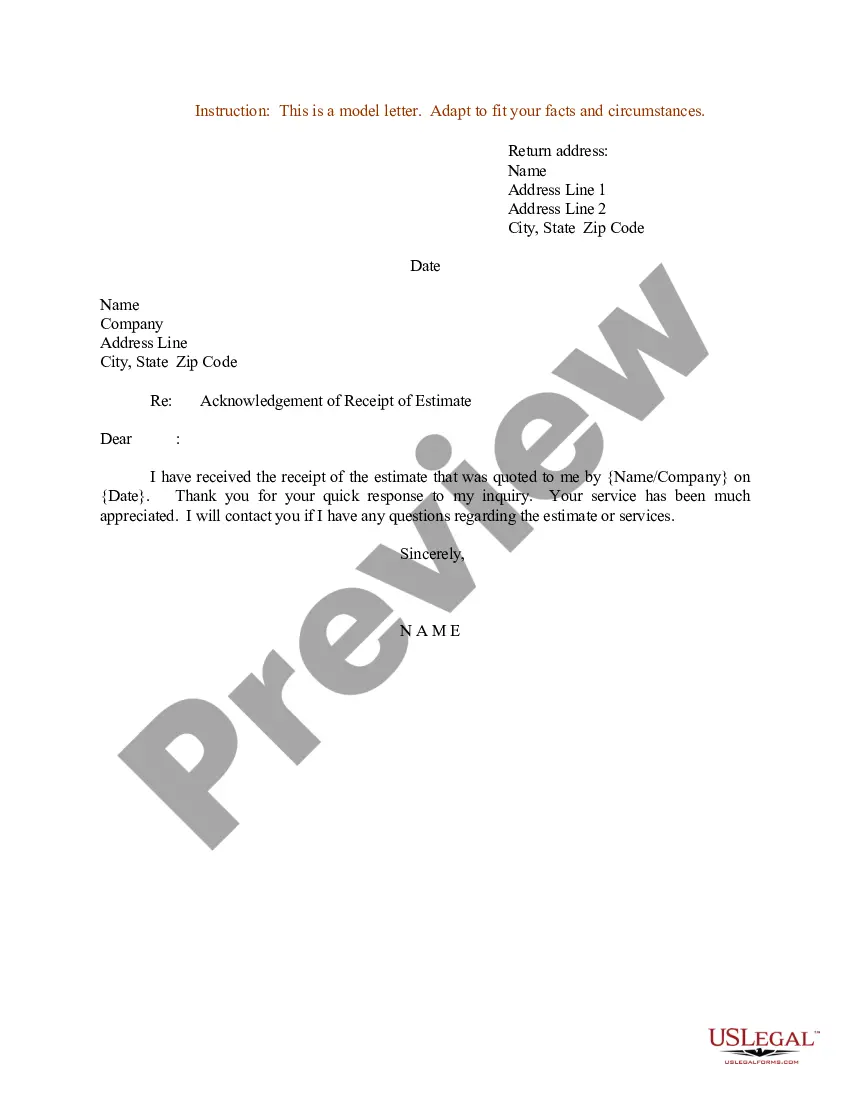
Registered Letter With Acknowledgment Of Receipt In Alameda
Description



Get your form ready online
Our built-in tools help you complete, sign, share, and store your documents in one place.
Make edits, fill in missing information, and update formatting in US Legal Forms—just like you would in MS Word.
Download a copy, print it, send it by email, or mail it via USPS—whatever works best for your next step.
Sign and collect signatures with our SignNow integration. Send to multiple recipients, set reminders, and more. Go Premium to unlock E-Sign.
If this form requires notarization, complete it online through a secure video call—no need to meet a notary in person or wait for an appointment.
We protect your documents and personal data by following strict security and privacy standards.

Make edits, fill in missing information, and update formatting in US Legal Forms—just like you would in MS Word.

Download a copy, print it, send it by email, or mail it via USPS—whatever works best for your next step.

Sign and collect signatures with our SignNow integration. Send to multiple recipients, set reminders, and more. Go Premium to unlock E-Sign.

If this form requires notarization, complete it online through a secure video call—no need to meet a notary in person or wait for an appointment.

We protect your documents and personal data by following strict security and privacy standards.
Looking for another form?
Form popularity
FAQ
How to serve by mail with Notice of Acknowledgment and Receipt Choose a server. Figure out when to serve. Fill out and copy Notice and Acknowledgement of Receipt. Prepare a return envelope. Have your server mail the papers and envelope. Wait for server to get signed Notice in the mail. Fill out the Proof of Service forms.
The person who serves the papers will have to fill out a Proof of Service form telling what they gave (served) to the other parties. There is a slight chance the person who served the papers would have to appear in court and tell how he or she served the papers.
The process server must fill out and sign the proof of service form, which shows how, when, and where the papers were served, and who received them. The server then gives you the proof of service. Make a copy of the proof of service. Take both the original and the copy to the court clerk to file.
Mailing a copy of the summons and complaint, two copies of a notice and acknowledgement of receipt, and a self-addressed, stamped envelope to the person to be served; and. Having the person to be served complete, sign, and return one of the notice and acknowledgements of receipt.
The summons and complaint in the case are deemed “served” on the Defendant (i.e. the Defendant's 30-day clock to file an answer under CCP section 412.20 starts) on the date they put on the Acknowledgment. In addition to signing the Acknowledgment form, the Defendant also has to date their signature.
(2) Proof of electronic service may be in electronic form and may be filed electronically with the court. (3) Under rule 3.1300(c), proof of service of the moving papers must be filed at least five court days before the hearing.
If proof of service of the summons has not been filed within 60 days of the complaint's filing, the court may dismiss the action without prejudice.
The Proof of Service should be typed or printed. If you have Internet access, a fillable version of this proof of service form is available at urts.ca/forms.htm. Second box, left side: Print the name of the county in which the legal action is filed and the court's address in this box.
Conclusion: Going to small claims court may be worth it for $500, but it will determine how you weigh your costs versus benefits. At a minimum, it is worth it to send a demand letter.
Each electronic document must include an electronic bookmark to each heading, subheading, and the first page of any component of the document, including any table of contents, table of authorities, petition, verification, memorandum, declaration, certificate of word count, certificate of interested entities or persons, ...