360 Degree Feedback Form For Doctors In Chicago
Description

Get your form ready online
Our built-in tools help you complete, sign, share, and store your documents in one place.
Make edits, fill in missing information, and update formatting in US Legal Forms—just like you would in MS Word.
Download a copy, print it, send it by email, or mail it via USPS—whatever works best for your next step.
Sign and collect signatures with our SignNow integration. Send to multiple recipients, set reminders, and more. Go Premium to unlock E-Sign.
If this form requires notarization, complete it online through a secure video call—no need to meet a notary in person or wait for an appointment.
We protect your documents and personal data by following strict security and privacy standards.

Make edits, fill in missing information, and update formatting in US Legal Forms—just like you would in MS Word.

Download a copy, print it, send it by email, or mail it via USPS—whatever works best for your next step.

Sign and collect signatures with our SignNow integration. Send to multiple recipients, set reminders, and more. Go Premium to unlock E-Sign.

If this form requires notarization, complete it online through a secure video call—no need to meet a notary in person or wait for an appointment.

We protect your documents and personal data by following strict security and privacy standards.
Looking for another form?










Form popularity
FAQ
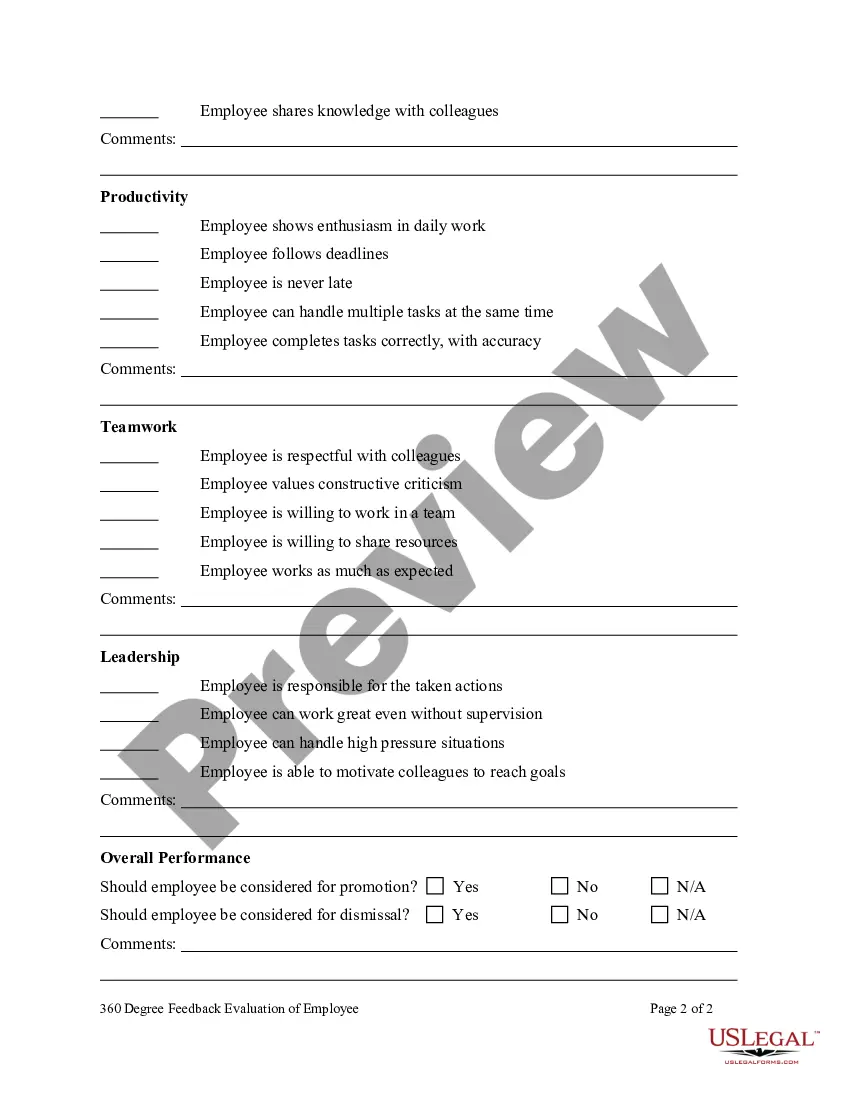
360 Degree Feedback is an assessment system or process in which employees receive confidential, anonymous evaluations from the people who work around them. This typically includes manager, peers, and direct reports.
A 360 review typically consists of managers receiving and analyzing employee feedback to look for notable patterns of behavior and positive/negative feedback and then creating a report. This can provide employees with constructive criticism without overwhelming them.
Positive feedback is associated with better performance and higher productivity. Sadly, 360-degree feedback often focuses excessively on the negative, with employees typically ignoring their strengths. This usually comes from a place of good intention—employees want to address their weaknesses.
Here are the steps the process: Develop an employee questionnaire. Ensure the confidentiality of participants. Provide training and orientations. Start to elicit feedback from the survey. Analyse the data. Develop and distribute results.
7 steps for designing an effective 360 degree feedback review program Set clear goals. Train raters. Focus on natural strengths. Involve managers and leaders. Create buy-in and trust in the 360 development program. Know what to ask and how to ask it. Personalise the 360 degree feedback program to your organisation.
Who can give an employee 360 degree feedback? 360 feedback is multi rater feedback. This means it should be given by those colleagues who work directly with the person who's receiving the feedback. This can include supervisors, colleagues, direct reports, customers, and vendors.
Managers. It is a manager's responsibility to help their employees grow as professionals. They are tasked to provide feedback to their team members to support them in their learning process. Furthermore, a lot of 360 degree psychology is developed around a manager's ability to offer feedback.
Participants in the 360 Review process can include peers, managers, direct reports, and even external parties such as customers or partners. The participants would then provide their reviews and the data will be combined into one complete form.
360 Degree Feedback is an assessment system or process in which employees receive confidential, anonymous evaluations from the people who work around them. This typically includes manager, peers, and direct reports.
