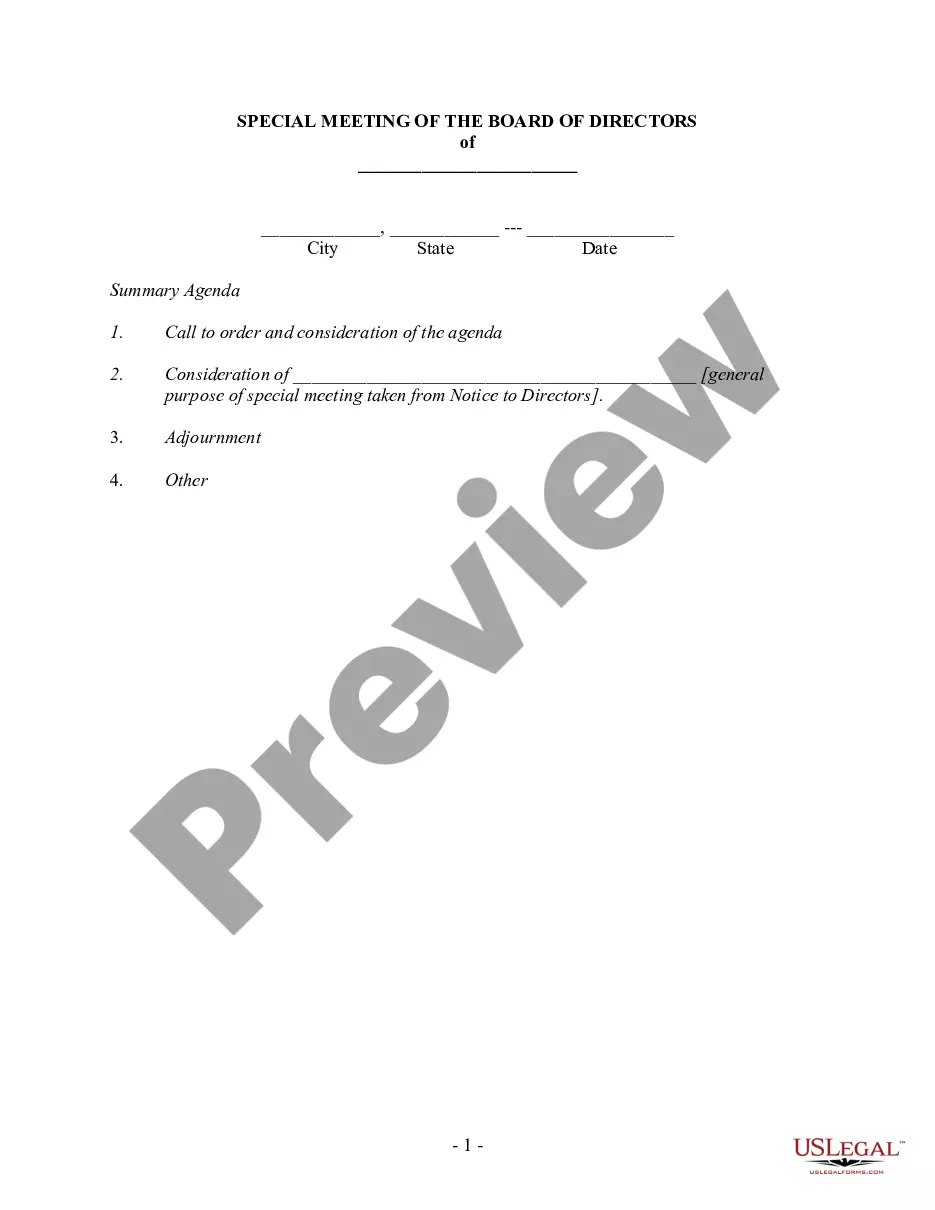
Annual Board Directors Template With Members In Franklin
Description



Get your form ready online
Our built-in tools help you complete, sign, share, and store your documents in one place.
Make edits, fill in missing information, and update formatting in US Legal Forms—just like you would in MS Word.
Download a copy, print it, send it by email, or mail it via USPS—whatever works best for your next step.
Sign and collect signatures with our SignNow integration. Send to multiple recipients, set reminders, and more. Go Premium to unlock E-Sign.
If this form requires notarization, complete it online through a secure video call—no need to meet a notary in person or wait for an appointment.
We protect your documents and personal data by following strict security and privacy standards.

Make edits, fill in missing information, and update formatting in US Legal Forms—just like you would in MS Word.

Download a copy, print it, send it by email, or mail it via USPS—whatever works best for your next step.

Sign and collect signatures with our SignNow integration. Send to multiple recipients, set reminders, and more. Go Premium to unlock E-Sign.

If this form requires notarization, complete it online through a secure video call—no need to meet a notary in person or wait for an appointment.

We protect your documents and personal data by following strict security and privacy standards.
Looking for another form?






Form popularity
FAQ
An annual general meeting (AGM) is a yearly gathering between the shareholders of a company and its board of directors. Generally, this is the only time that the directors and shareholders will meet throughout the year, so it is a chance for the directors to present the company's annual report.
A general meeting is a meeting of a company's shareholders. This is different to a board meeting, which is a meeting of the company's directors. General meetings are used to consider company matters and to make decisions (ie to vote on company resolutions) on these matters.
The discussion helps to inform board members and shareholders of the company's latest developments. AGMs also allow shareholders to express their concerns and have their questions answered by the board. Shareholders can also vote for or against measures such as director remuneration.
Information captured in an LLC's annual meeting minutes usually includes: The meeting's date, time, and location. Who wrote the minutes. The names of the members in attendance. Brief description of the meeting agenda. Details about what the members discussed. Decisions made or voting actions taken.
The annual board of directors meeting is held to go over the details of the past year and decide on actions and strategies for the corporation for the next year. Keeping meeting minutes helps to ensure all these actions are documented in the corporate record.
The terms “Annual General Meeting” and “annual meeting” are frequently used interchangeably, though they can have distinct meanings. An AGM specifically refers to a formal meeting held by organizations, such as corporations or nonprofits, where key issues are discussed.
In most states the laws dictate the minimum size for nonprofit boards. Usually it is three, but in some states only one board member is required. Some boards function under a representational mandate; their composition needs to reflect the constituency, and this creates an upward pressure on the size.
The answer to this question is a resounding yes! In fact, ing to business Insider, "There's no law that says a board of directors has to be made up of more than one person, and plenty of companies are run by a single director."
How to build a board of directors that actually helps Step 1: Establish the board's role within your organization. Step 2: Determine the board's powers. Step 3: Figure out the nitty gritty. Step 4: Decide who should be on your board and ask them. Step 5: Onboard your board. Step 6: Engage!
“Between seven and 10 directors is where you want to be,” he says. That's enough directors to staff major oversight committees without overtaxing them, ing to Elson, yet small enough to have relationships among directors and between individual directors and the CEO.

