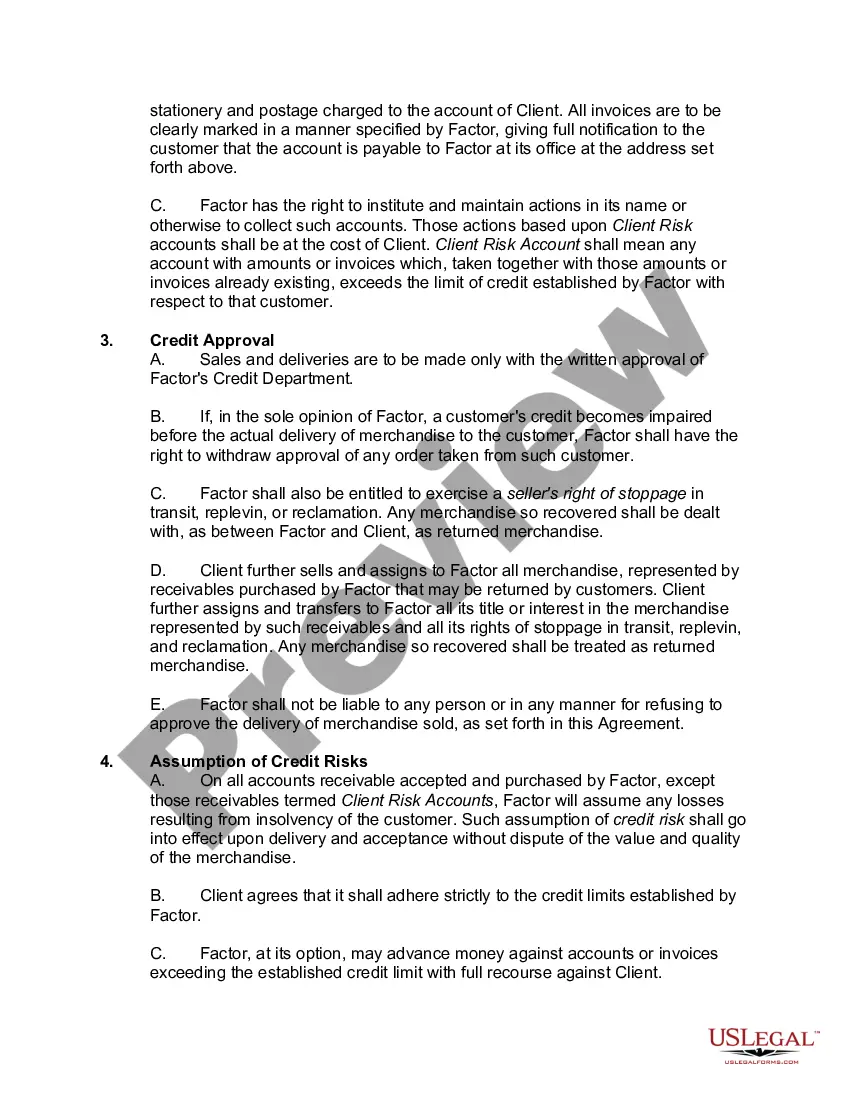
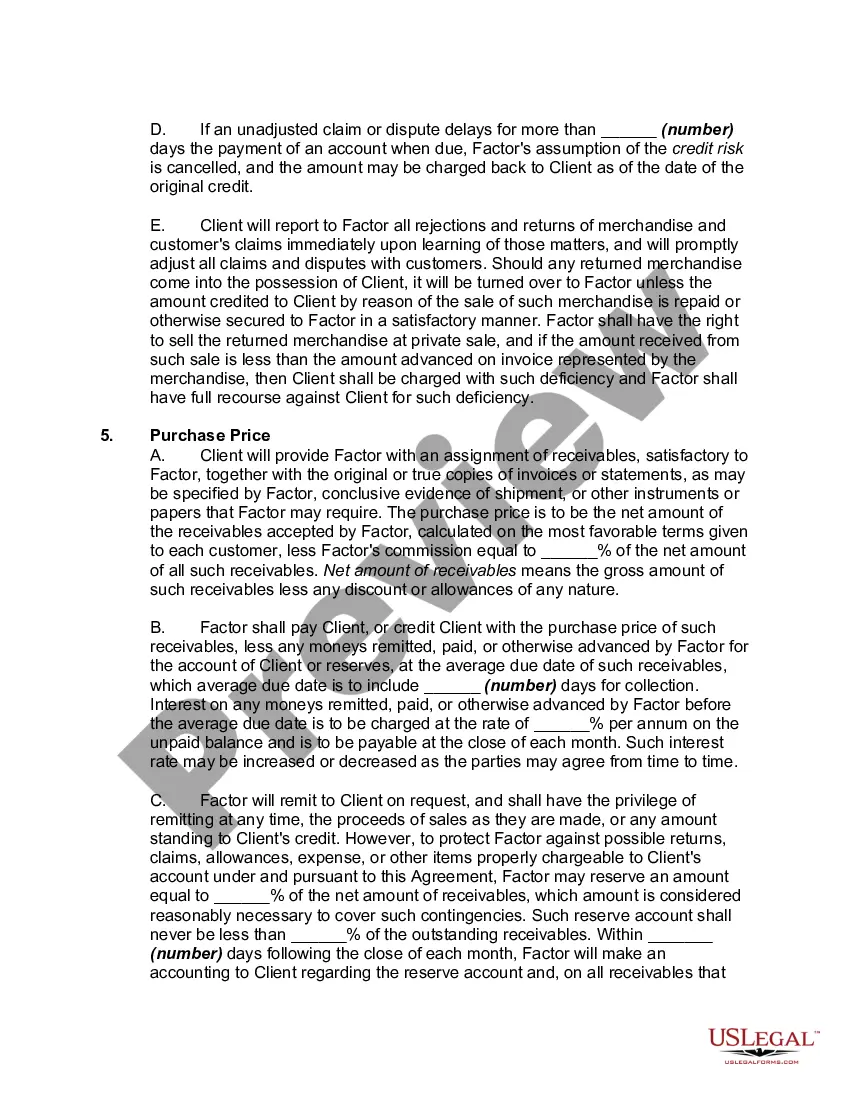
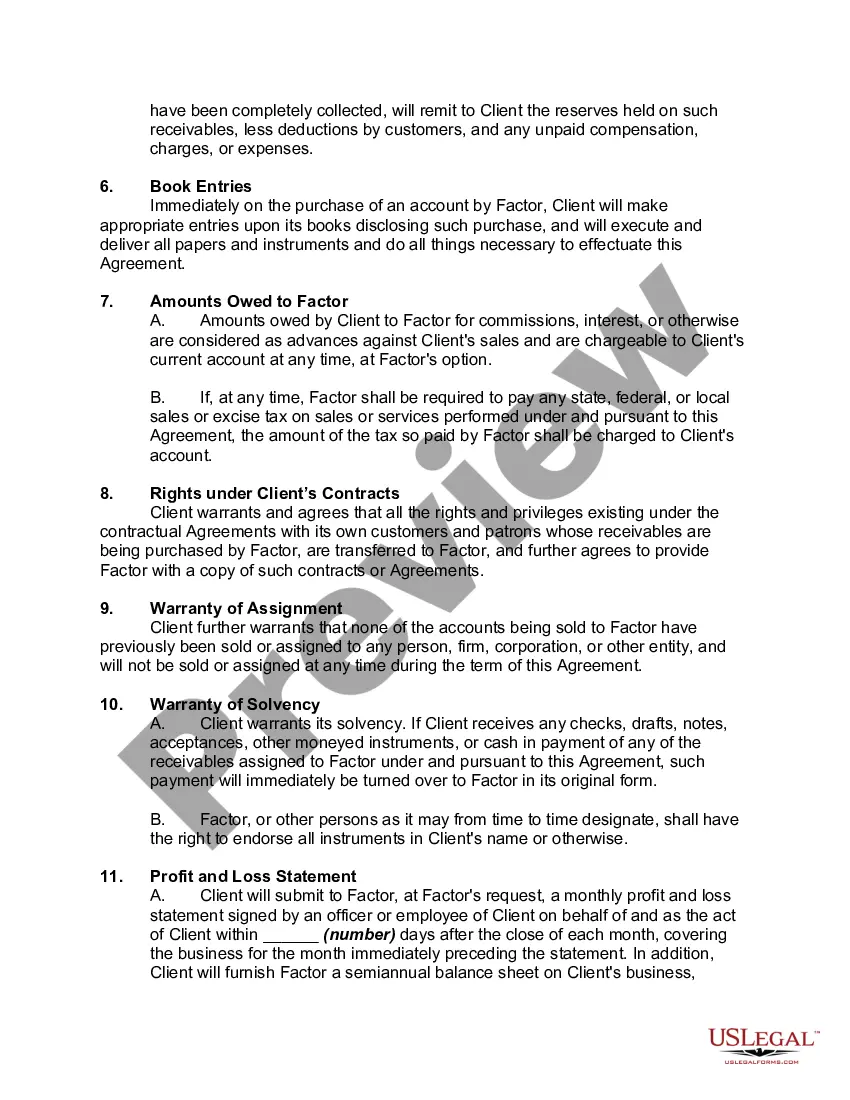
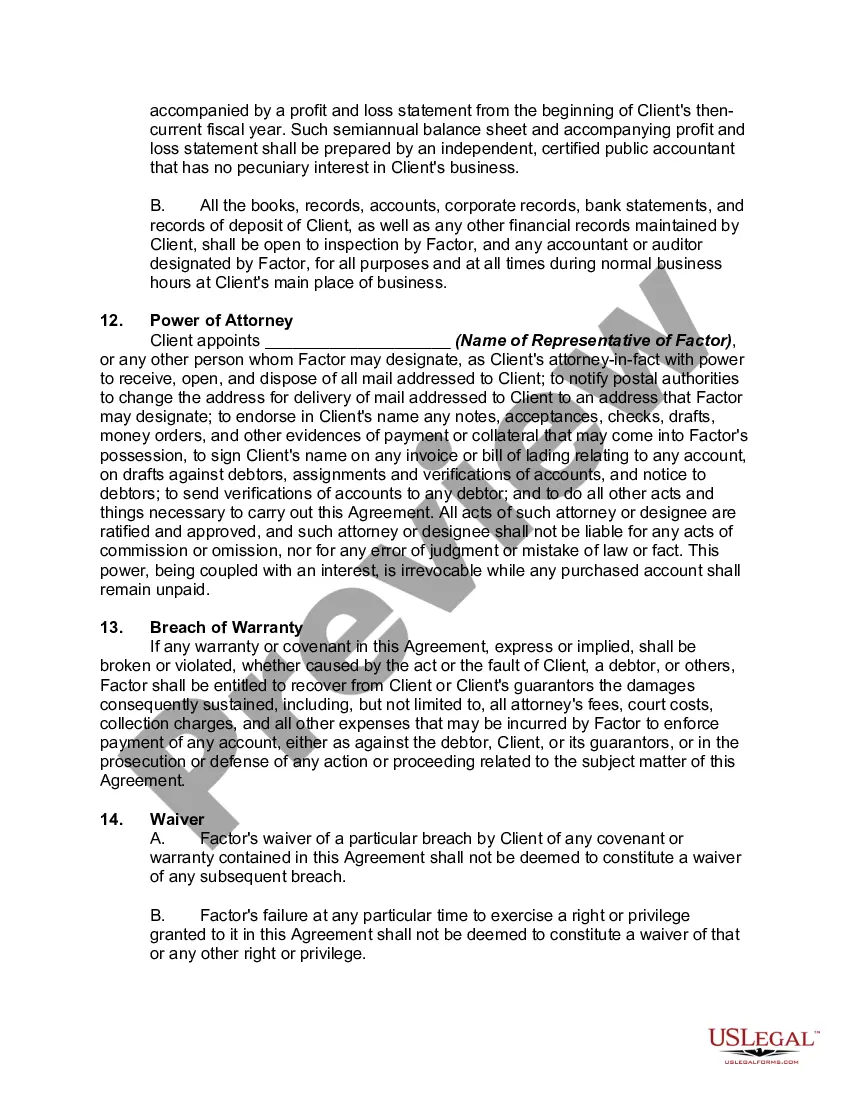
Factoring Agreement Document For Business In Fairfax
Description



Get your form ready online
Our built-in tools help you complete, sign, share, and store your documents in one place.
Make edits, fill in missing information, and update formatting in US Legal Forms—just like you would in MS Word.
Download a copy, print it, send it by email, or mail it via USPS—whatever works best for your next step.
Sign and collect signatures with our SignNow integration. Send to multiple recipients, set reminders, and more. Go Premium to unlock E-Sign.
If this form requires notarization, complete it online through a secure video call—no need to meet a notary in person or wait for an appointment.
We protect your documents and personal data by following strict security and privacy standards.

Make edits, fill in missing information, and update formatting in US Legal Forms—just like you would in MS Word.

Download a copy, print it, send it by email, or mail it via USPS—whatever works best for your next step.

Sign and collect signatures with our SignNow integration. Send to multiple recipients, set reminders, and more. Go Premium to unlock E-Sign.

If this form requires notarization, complete it online through a secure video call—no need to meet a notary in person or wait for an appointment.

We protect your documents and personal data by following strict security and privacy standards.
Looking for another form?









Form popularity
FAQ
Broadly, debt factoring is a finance arrangement whereby a business sells its accounts receivable to a third party (factor) at a discount to obtain working capital. The factor then collects the receivables from the business's customers. Debt factoring agreements can either be recourse or non-recourse arrangements.
Invoice factoring is an agreement to assign your accounts receivable (A/R) to a factoring company. So the letter communicates that a third party (factoring company) is managing and collecting your A/R.
Factor expressions, also known as factoring, mean rewriting the expression as the product of factors. For example, 3x + 12y can be factored into a simple expression of 3 (x + 4y). In this way, the calculations become easier. The terms 3 and (x + 4y) are known as factors.
The factoring company assesses the creditworthiness of the customers and the overall financial stability of the business. Typically, the factoring rates range from 1% to 5% of the invoice value, but they can be higher or lower depending on the specific circumstances.
Factoring is a financial transaction in which a business sells its accounts receivable (invoices) to a third party, called a factor, at a discount.
Fairfax County sales tax details The minimum combined 2025 sales tax rate for Fairfax County, Virginia is 6.0%. This is the total of state, county, and city sales tax rates. The Virginia sales tax rate is currently 4.3%. The Fairfax County sales tax rate is 1.0%.
Sales and Use tax General Sales: Virginia - 4.3%; Fairfax County - 1%; plus an additional 0.7% state tax for transportation. Learn more about Virginia Motor Vehicle Sales and Use Tax. Food purchased for home consumption: Fairfax County - 1%.
Virginia sales tax rates by city. CityMinimum combined rate Norfolk 6% Petersburg 5.3% Portsmouth 6% Richmond 6%11 more rows
Section 4-7.2-1. (B) Gross receipts do not include revenues that are attributable to taxable business activity conducted in another jurisdiction within the Commonwealth of Virginia and the volume attributable to that business activity is deductible pursuant to Code of Virginia Sections 58.1-3708 and 58.1-3709.
Most businesses operating in Fairfax County must possess a Business, Professional and Occupational License (BPOL).