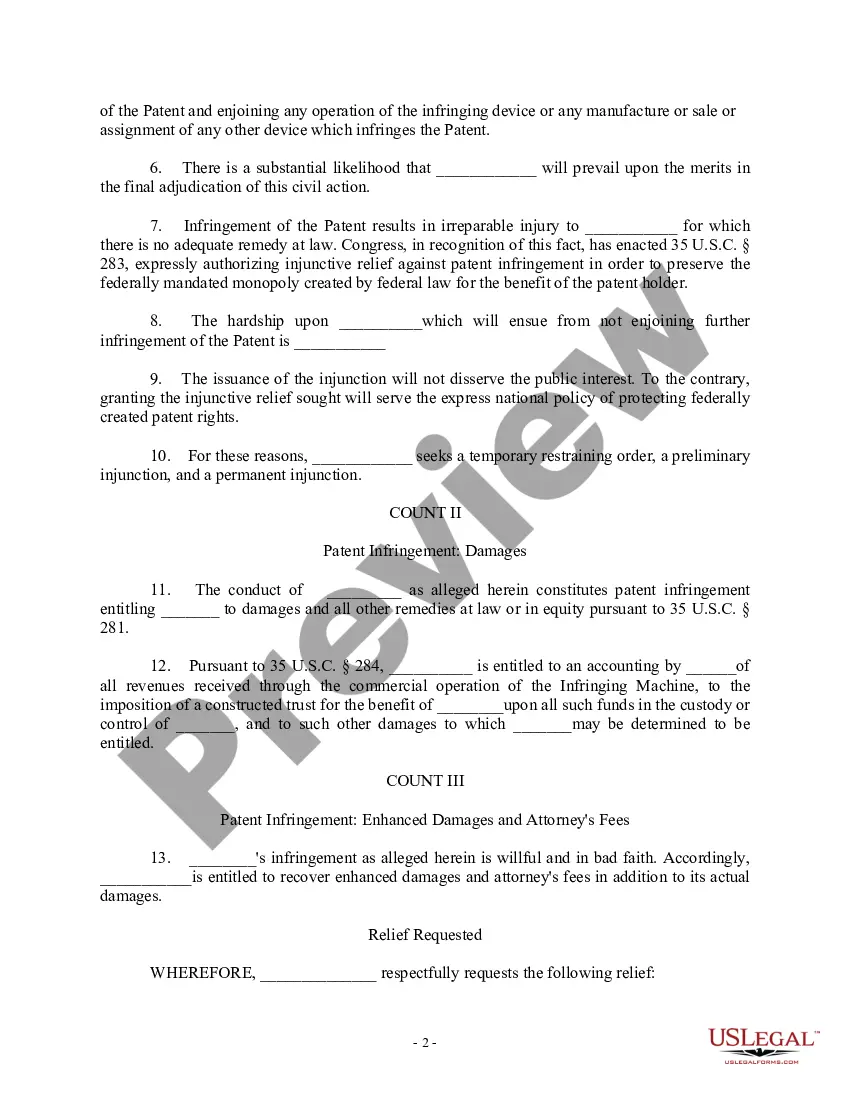
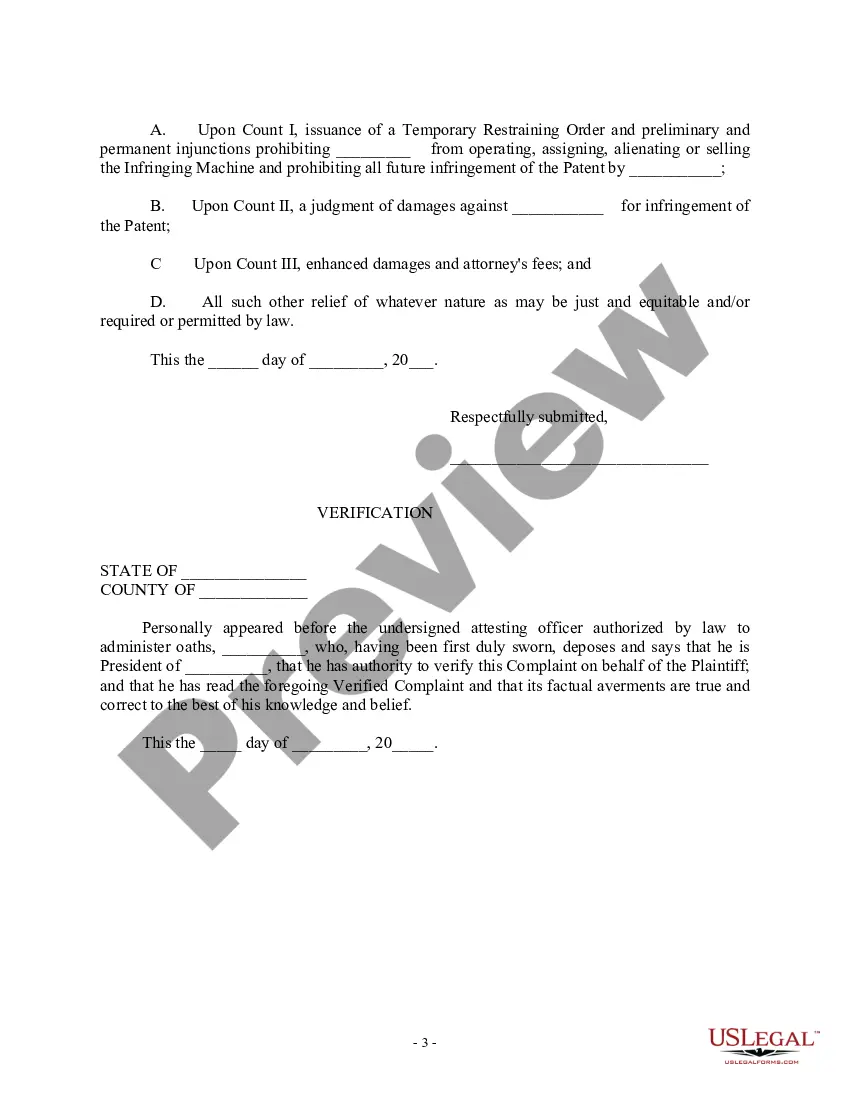
Patent Infringement In Pharmaceutical Industry In King
Description

Get your form ready online
Our built-in tools help you complete, sign, share, and store your documents in one place.
Make edits, fill in missing information, and update formatting in US Legal Forms—just like you would in MS Word.
Download a copy, print it, send it by email, or mail it via USPS—whatever works best for your next step.
Sign and collect signatures with our SignNow integration. Send to multiple recipients, set reminders, and more. Go Premium to unlock E-Sign.
If this form requires notarization, complete it online through a secure video call—no need to meet a notary in person or wait for an appointment.
We protect your documents and personal data by following strict security and privacy standards.

Make edits, fill in missing information, and update formatting in US Legal Forms—just like you would in MS Word.

Download a copy, print it, send it by email, or mail it via USPS—whatever works best for your next step.

Sign and collect signatures with our SignNow integration. Send to multiple recipients, set reminders, and more. Go Premium to unlock E-Sign.

If this form requires notarization, complete it online through a secure video call—no need to meet a notary in person or wait for an appointment.

We protect your documents and personal data by following strict security and privacy standards.
Looking for another form?



Form popularity
FAQ
A patent owner can file a civil lawsuit to recover damages for past infringement and obtain injunctions against further infringing activities. Proving patent infringement in court requires a plaintiff to prove two broad elements: ownership and validity of the patent, and infringement of the patent by the defendant.
This probably will require hiring a patent attorney. You should make sure to find an attorney who has handled patent infringement cases previously and who is familiar with your industry. Your attorney will file a formal complaint in federal court, explaining how the defendant has infringed on your patent.
The IPR Center encourages victims to visit its website at .IPRCenter to obtain more information about the IPR Center and to report violations of intellectual property rights online or by emailing IPRCenter@dhs. You can also report IP crime by clicking on The IRP Center's “Report IP Theft” button.
Patent cases use a "preponderance of the evidence" standard of proof, unless the validity of a patent is in question, in which case the standard is "clear and convincing evidence." The comment examines the meaning of the standards in their application to United States patent practice.
If a decision is reversed by the Supreme Court, the case file is referred to the Court of First Instance or the Regional Court of Appeal (whichever decision is reversed). Available remedies for patent infringement include monetary damages, preliminary and permanent injunctions.
The technical nature of patent litigation means that experiments are often an essential (and sometimes the only) way to prove key aspects of infringement (or, more unusually, invalidity), particularly in life sciences-related cases.
To enforce a patent against a competitor, you'll need to show three things: That you own a valid patent. That the alleged infringer has engaged in an act of infringement. That the infringing product or process incorporates all the features of at least one independent claim.
However, the following acts are deemed to be infringements ing to the Patent Act: Mechanical equivalents; Carrying essential features of the invention; Immaterial variation in the invention; and. The colorable imitation of the invention.
Patents grant pharmaceutical corporations exclusive rights to market pharmaceuticals and ban others from manufacturing, selling, or manufacturing these drugs for 20 years. IPR is required for pharmaceutical businesses to identify, plan, commercialize, and protect their inventions.
Protection Against Competition: Patents provide protection against competitors who might try to create similar drugs or therapies. This protection is especially valuable when the pharmaceutical industry is characterised by high levels of competition and innovation.