Register Property With Land Registry
Description



Get your form ready online
Our built-in tools help you complete, sign, share, and store your documents in one place.
Make edits, fill in missing information, and update formatting in US Legal Forms—just like you would in MS Word.
Download a copy, print it, send it by email, or mail it via USPS—whatever works best for your next step.
Sign and collect signatures with our SignNow integration. Send to multiple recipients, set reminders, and more. Go Premium to unlock E-Sign.
If this form requires notarization, complete it online through a secure video call—no need to meet a notary in person or wait for an appointment.
We protect your documents and personal data by following strict security and privacy standards.

Make edits, fill in missing information, and update formatting in US Legal Forms—just like you would in MS Word.

Download a copy, print it, send it by email, or mail it via USPS—whatever works best for your next step.

Sign and collect signatures with our SignNow integration. Send to multiple recipients, set reminders, and more. Go Premium to unlock E-Sign.

If this form requires notarization, complete it online through a secure video call—no need to meet a notary in person or wait for an appointment.

We protect your documents and personal data by following strict security and privacy standards.
Looking for another form?
How to fill out Ohio Registered Land - Trustees Deed?
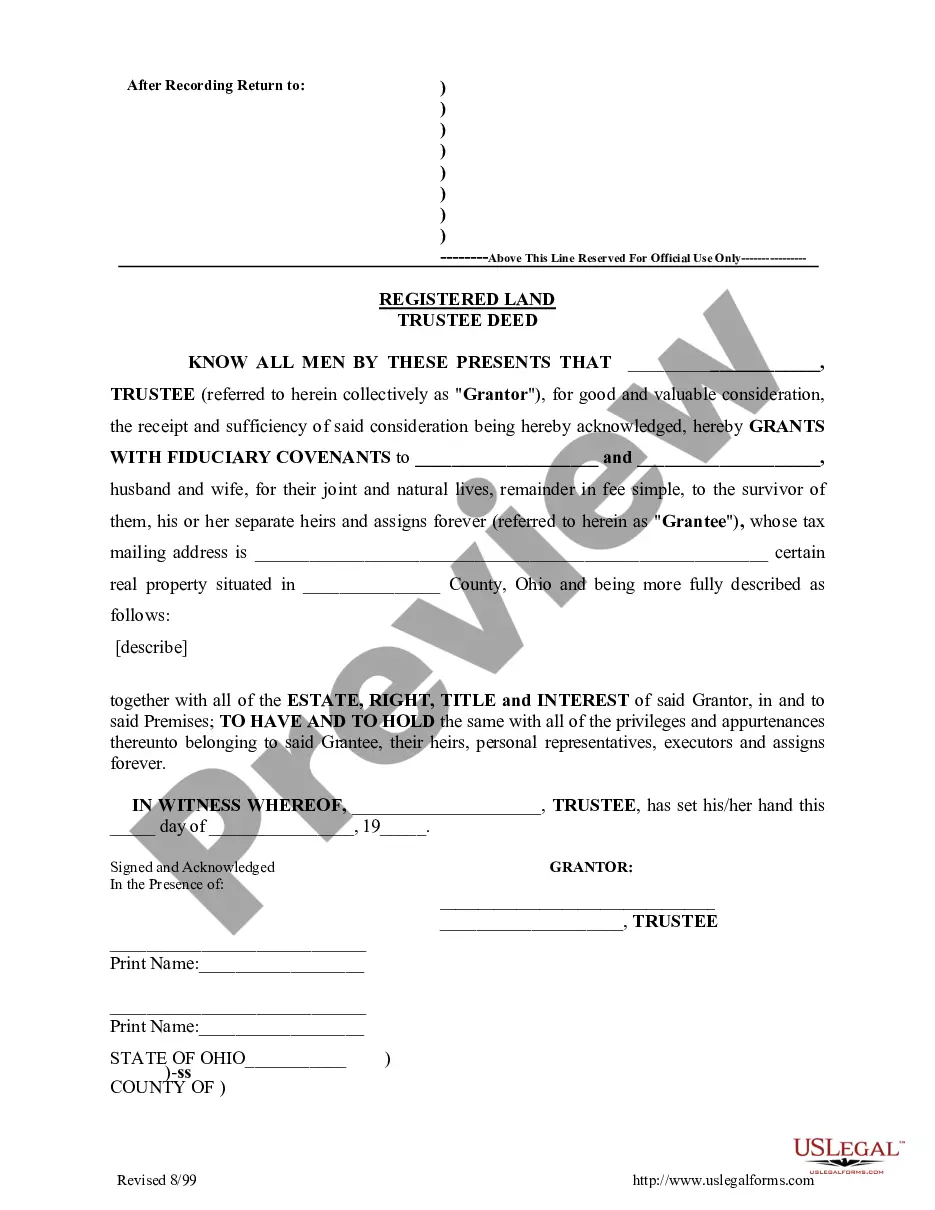
The Register Property With Land Registry featured on this page is a reusable legal document prepared by professional attorneys in line with federal and local regulations.
For over 25 years, US Legal Forms has offered individuals, businesses, and lawyers more than 85,000 verified, state-specific forms for any business and personal circumstance. It’s the quickest, easiest, and most dependable method to acquire the paperwork you require, as the service ensures bank-level data security and anti-malware measures.
Subscribe to US Legal Forms to have verified legal templates for all of life’s situations readily available.
- Search for the document you require and review it.
- Browse through the file you searched and preview it or verify its description to confirm it meets your needs. If it doesn’t, utilize the search bar to locate the correct one. Click Buy Now when you find the template you need.
- Register and Log In.
- Choose the pricing plan that fits you and create an account. Use PayPal or a credit card to make a swift payment. If you have an account already, Log In and check your subscription to continue.
- Obtain the fillable template.
- Choose the format you desire for your Register Property With Land Registry (PDF, Word, RTF) and save the document on your device.
- Complete and sign the documentation.
- Print the template to fill it out manually. Alternatively, use an online multi-functional PDF editor to quickly and accurately complete and sign your form with an eSignature.
- Download your documentation again.
- Reuse the same document whenever necessary. Access the My documents tab in your profile to redownload any previously purchased forms.
Form popularity
FAQ
The land registration system in the US consists of a network of local county offices where property ownership and transaction records are maintained. Each state has its own regulations and procedures for registering property with land registry. By using tools like uslegalforms, you can navigate these processes more smoothly, ensuring your property is registered correctly and efficiently.
Conducting a title search in Kentucky requires checking the land records at the local county clerk's office or their website. You'll need to gather information on the property, such as the owner's name and the parcel number. Utilizing uslegalforms can help guide you through the necessary steps and documents needed to register property with land registry, making sure you have a clear title.
To look up deeds in Kentucky, you can visit the county clerk's office where the property is located. Many counties also provide online access to their land records, which allows you to search for deeds conveniently from home. Additionally, using the uslegalforms platform can simplify your process to register property with land registry, ensuring you find all relevant documents without hassle.
To put your wife's name on the house deeds, you'll need to follow specific steps that usually involve completing a property transfer form. Start by contacting your local land registry office for guidance on how to properly register property with land registry in both names. Typically, you'll need relevant documentation, including proof of ownership and identification. Platforms like US Legal Forms can streamline the process by offering templates and guidance for this transaction, ensuring everything is done correctly.
A property's land registration number is a unique identifier assigned to each property by the land registry. This number helps in efficiently tracking ownership records and facilitates easy reference when you register property with land registry. It is crucial for conducting any legal transactions related to the property, such as sales or transfers. You can find this number on your property registration document or by consulting the land registry.
A property registration document is an official record that confirms ownership of real estate. It serves as proof that you have registered property with land registry, providing legal recognition of your claim. This document includes vital information such as the property's location, dimensions, and ownership details. By obtaining this document, you secure your interest in the property and protect your rights as an owner.
To record a deed in Texas, you first need to draft the deed accurately, including details such as the property description and the names of the parties involved. Next, take the completed deed to the county clerk's office in the county where the property is located. Once recorded, the deed becomes part of the public record, confirming your ownership. Remember, when you register property with the land registry, you protect your investment and ensure a clear title.
Anyone who holds title to a property can register a deed. This usually includes property owners or their legal representatives. It is essential to ensure that the property is accurately described in the deed. By choosing to register property with the land registry, you secure your ownership and contribute to the public record.