Landlord Tenant To Court
Description



Get your form ready online
Our built-in tools help you complete, sign, share, and store your documents in one place.
Make edits, fill in missing information, and update formatting in US Legal Forms—just like you would in MS Word.
Download a copy, print it, send it by email, or mail it via USPS—whatever works best for your next step.
Sign and collect signatures with our SignNow integration. Send to multiple recipients, set reminders, and more. Go Premium to unlock E-Sign.
If this form requires notarization, complete it online through a secure video call—no need to meet a notary in person or wait for an appointment.
We protect your documents and personal data by following strict security and privacy standards.

Make edits, fill in missing information, and update formatting in US Legal Forms—just like you would in MS Word.

Download a copy, print it, send it by email, or mail it via USPS—whatever works best for your next step.

Sign and collect signatures with our SignNow integration. Send to multiple recipients, set reminders, and more. Go Premium to unlock E-Sign.

If this form requires notarization, complete it online through a secure video call—no need to meet a notary in person or wait for an appointment.

We protect your documents and personal data by following strict security and privacy standards.
Looking for another form?



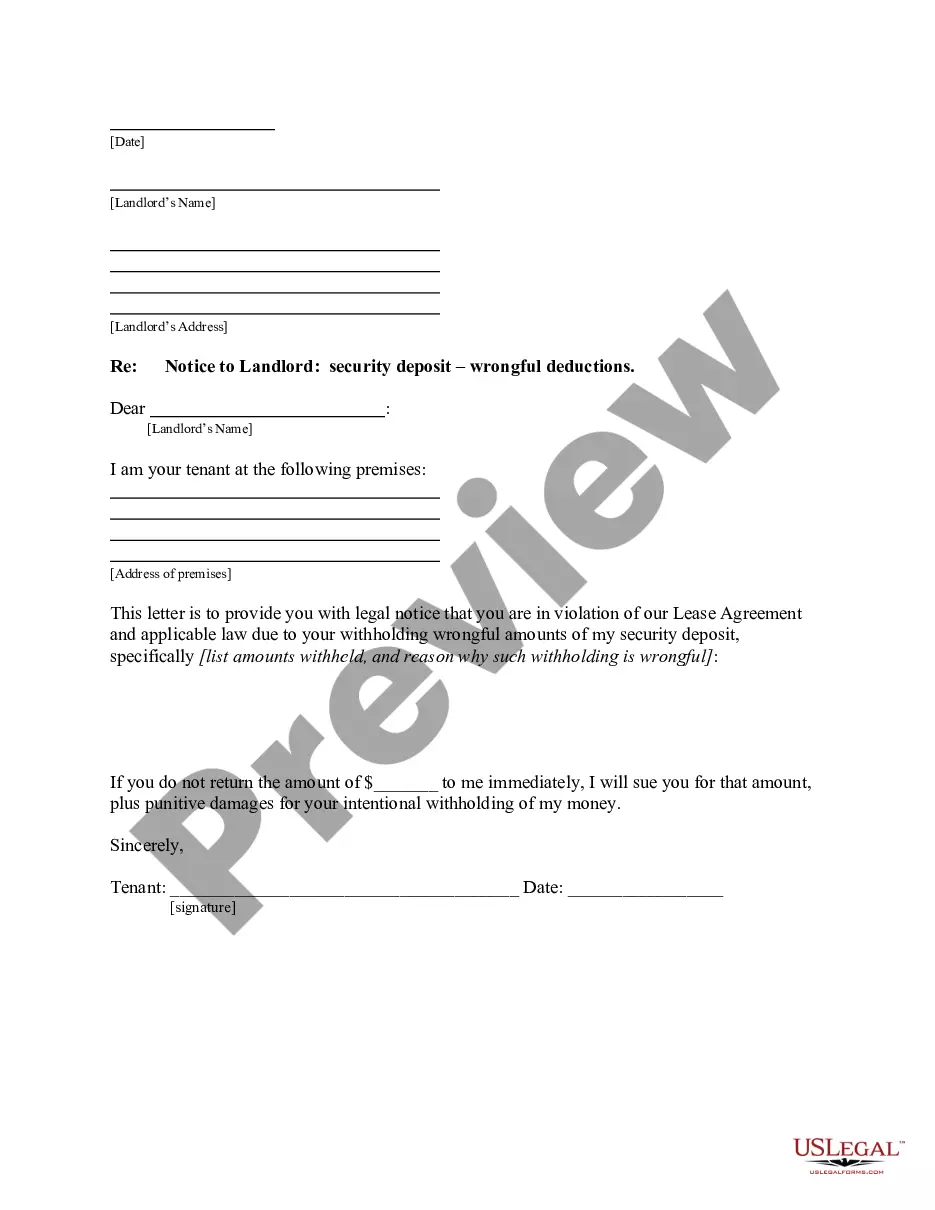
How to fill out Delaware Letter From Tenant To Landlord Containing Notice Of Wrongful Deductions From Security Deposit And Demand For Return?
Well-prepared official documents are one of the essential safeguards for preventing issues and legal disputes, but acquiring them without an attorney’s assistance may require considerable time.
Whether you need to promptly locate an up-to-date Landlord Tenant To Court form or any other documents for employment, family, or business situations, US Legal Forms is always ready to assist.
The procedure is even more straightforward for current users of the US Legal Forms library. If your subscription is active, you simply need to Log In to your account and click the Download button next to the chosen file. Furthermore, you can access the Landlord Tenant To Court at any later date, as all the documents ever acquired on the platform can be found within the My documents section of your profile. Conserve time and money on preparing official documents. Experience US Legal Forms today!
- Confirm that the document is appropriate for your situation and area by reviewing the description and preview.
- Search for an alternative sample (if necessary) using the Search bar in the header of the page.
- Press Buy Now when you find the relevant template.
- Select a pricing plan, Log In to your account, or create a new one.
- Choose the payment method you prefer to purchase the subscription plan (using a credit card or PayPal).
- Pick either PDF or DOCX format for your Landlord Tenant To Court document.
- Click Download, then print the template to complete it or upload it to an online editing tool.
Form popularity
FAQ
If you live in a New Jersey household with income below 120% of your county's Area Median Income, you are permanently protected from eviction or removal at any time for nonpayment of rent, habitual late payment of rent, or failure to accept a rent increase that accrued from March 1, 2020 to August 31, 2021.
Eviction Protection All renter households with incomes below 120% of their county's Area Median Income are permanently protected against eviction or removal at any time for nonpayment of rent, habitual late payment of rent, or failure to accept a rent increase that accrued from March 1, 2020 through August 31, 2021.
If the amount of any damage caused by a tenant plus any unpaid rent is more than the security deposit, the landlord may sue for the additional money.
Yes! Your landlord can still sue you in court to collect the rent you did not pay during these periods, but your landlord cannot evict you because of your rental debt.
New Jersey's moratorium on evictions is scheduled to lift Saturday after the state prevented most families from being displaced for the past year and nine months with some of the strongest protections in the country as a public health measure to contain the spread of COVID-19.