Ca Tenant Increase For 2018
Description
Get your form ready online
Our built-in tools help you complete, sign, share, and store your documents in one place.
Make edits, fill in missing information, and update formatting in US Legal Forms—just like you would in MS Word.
Download a copy, print it, send it by email, or mail it via USPS—whatever works best for your next step.
Sign and collect signatures with our SignNow integration. Send to multiple recipients, set reminders, and more. Go Premium to unlock E-Sign.
If this form requires notarization, complete it online through a secure video call—no need to meet a notary in person or wait for an appointment.
We protect your documents and personal data by following strict security and privacy standards.

Make edits, fill in missing information, and update formatting in US Legal Forms—just like you would in MS Word.

Download a copy, print it, send it by email, or mail it via USPS—whatever works best for your next step.

Sign and collect signatures with our SignNow integration. Send to multiple recipients, set reminders, and more. Go Premium to unlock E-Sign.

If this form requires notarization, complete it online through a secure video call—no need to meet a notary in person or wait for an appointment.

We protect your documents and personal data by following strict security and privacy standards.
Looking for another form?




How to fill out California Letter From Landlord To Tenant About Intent To Increase Rent And Effective Date Of Rental Increase?
Managing legal paperwork and processes can be an arduous addition to your schedule.
Documents like Ca Tenant Increase For 2018 typically require you to locate them and figure out how to fill them out accurately.
Thus, if you are handling financial, legal, or personal affairs, utilizing a detailed and user-friendly online directory of forms when necessary will be extremely beneficial.
US Legal Forms is the leading online platform for legal documents, providing over 85,000 state-specific templates along with various resources to help you complete your paperwork with ease.
Just Log In to your account, find Ca Tenant Increase For 2018, and obtain it directly from the My documents section. You can also retrieve previously stored forms.
- Browse the collection of pertinent documents accessible to you with merely one click.
- US Legal Forms offers you state- and county-specific templates available anytime for download.
- Protect your document management processes with a quality service that allows you to create any form in minutes with no extra or hidden fees.
Form popularity
FAQ
California's Tenant Protection Act There is a maximum increase of 10% allowed in any given year, thus the Act's provision is often referred to as a ?rent cap.? To calculate the cost of living increase that is applicable to your market, use the Consumer Price Index (CPI) published by the Bureau of Labor Statistics.
Landlords must also give tenants sufficient warning before increasing rent. If the rent increase is less than 10%, landlords must provide notice 30 days before the increase can take effect. If the rent increase is more than 10%, the landlord must provide notice 90 days before it can take effect.
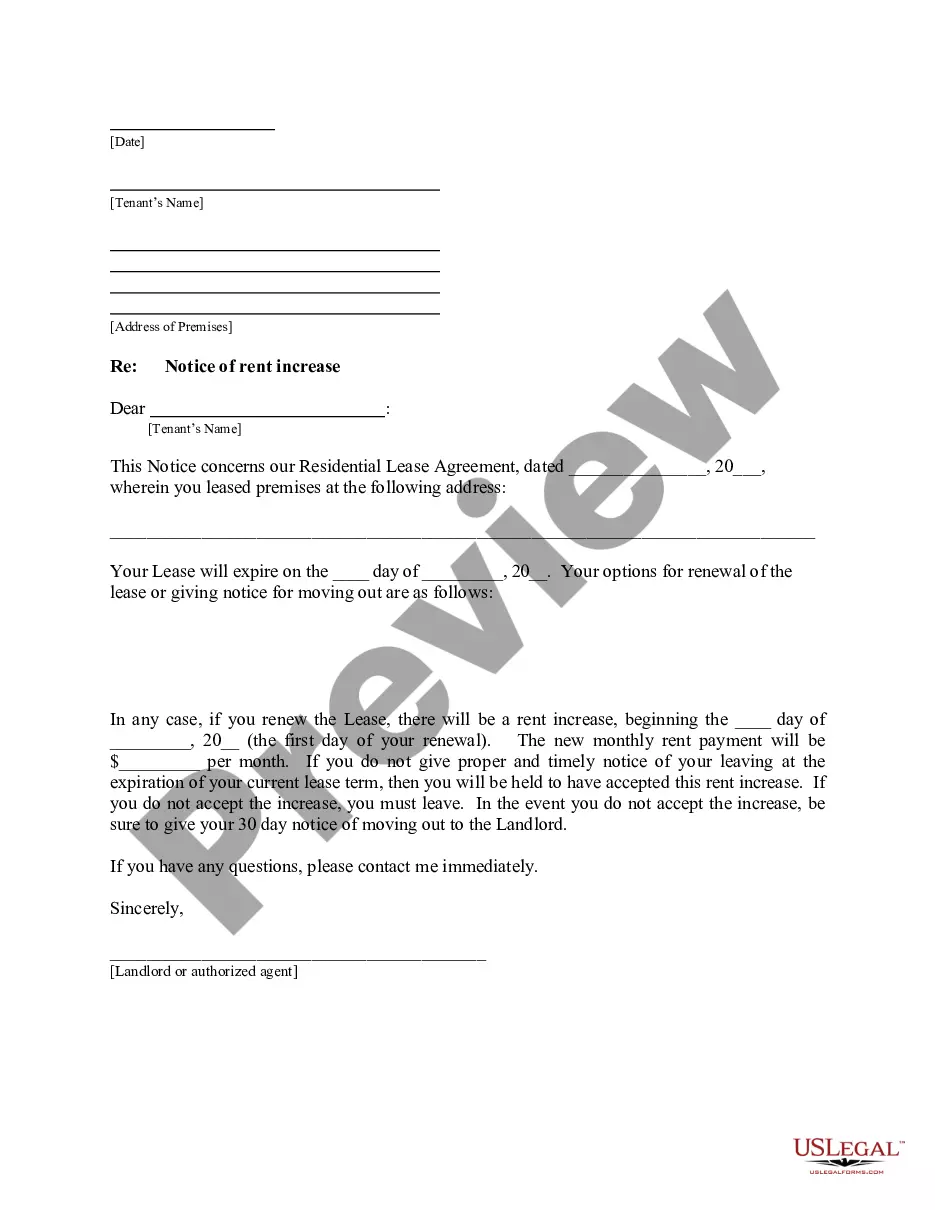
Dear [TENANT NAME(S)], As indicated in your lease, your lease at [PROPERTY ADDRESS] will end on [LEASE EXPIRATION DATE ? write in full]. Please note that the monthly rent for the above [PROPERTY ADDRESS] will increase from [OLD RENT AMOUNT] to [NEW RENT AMOUNT] effective [DATE OF NEW LEASE ? write in full].
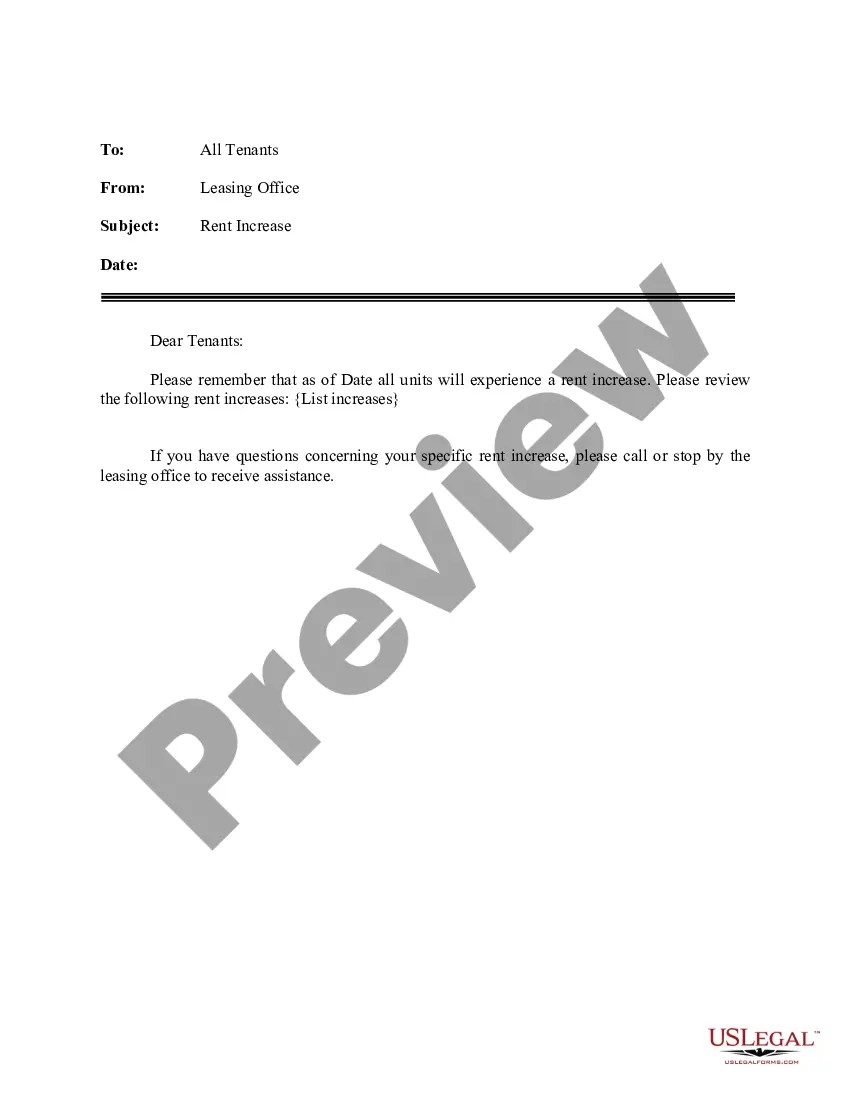
What to include in a rent increase letter Date of the rent increase letter. Name and information of the tenant and landlord. Property address and unit number (if applicable). Reference to the expiration date of the existing lease. Current rent amount. Amount of rent increase. Date the rent increase will go into effect.
AB 1482 is a statewide law that went into effect on January 1, 2020 and expires on January 1, 2030. It does two main things: Requires a landlord to have a ?just cause? in order to terminate a tenancy. Limits annual rent increases to no more than 5% + local CPI, or 10% whichever is lower.