Request for Qualifications
What is this form?
A Request for Qualifications (RFQ) is a formal document used to invite qualified vendors to submit their qualifications for a specific project. This form serves as the pre-qualification stage before issuing a Request for Proposals (RFP). The RFQ process helps organizations establish a pre-qualified list of firms that can efficiently provide services for current and future opportunities. It is especially useful when a project involves complex skills and specific services, allowing for quicker selection of qualified contractors.
Key components of this form
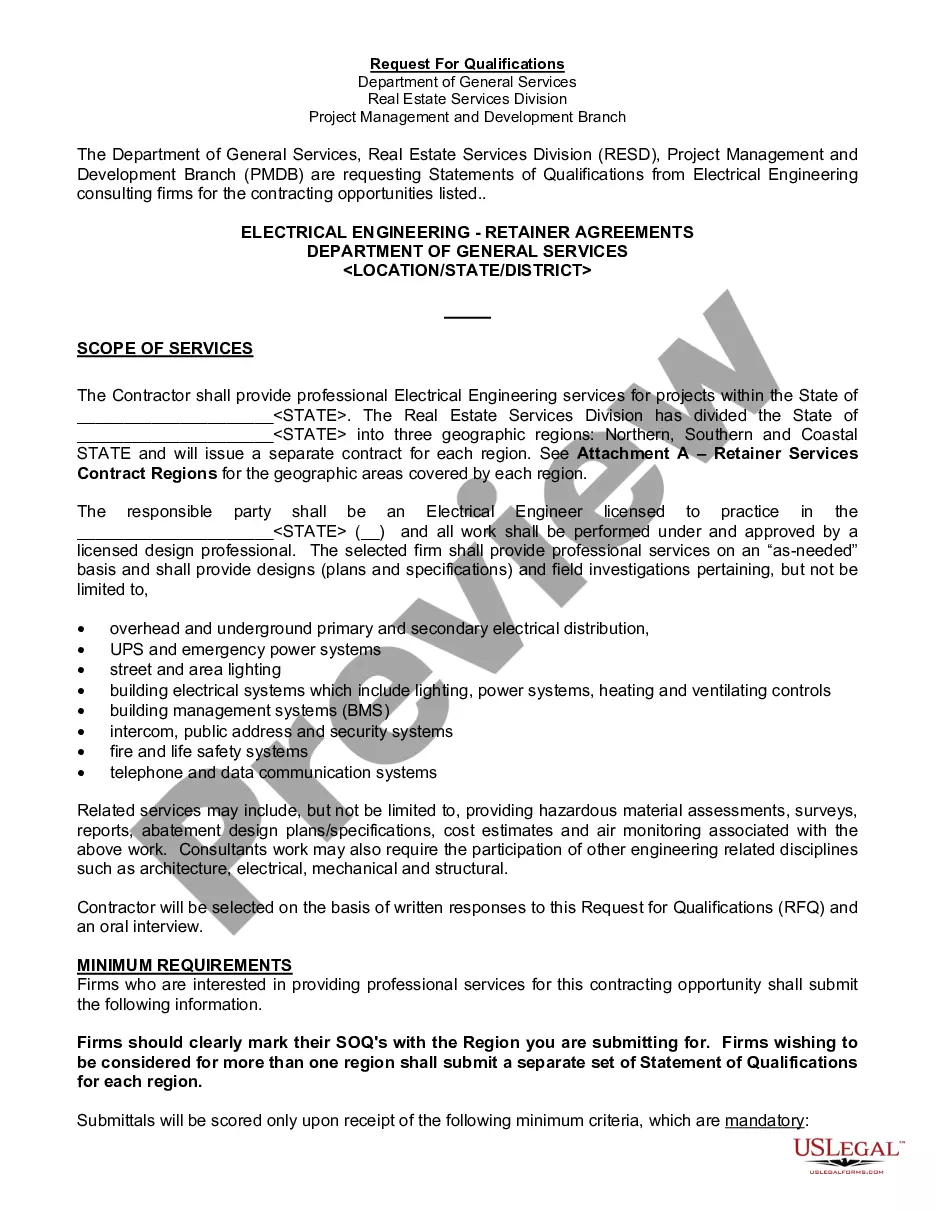
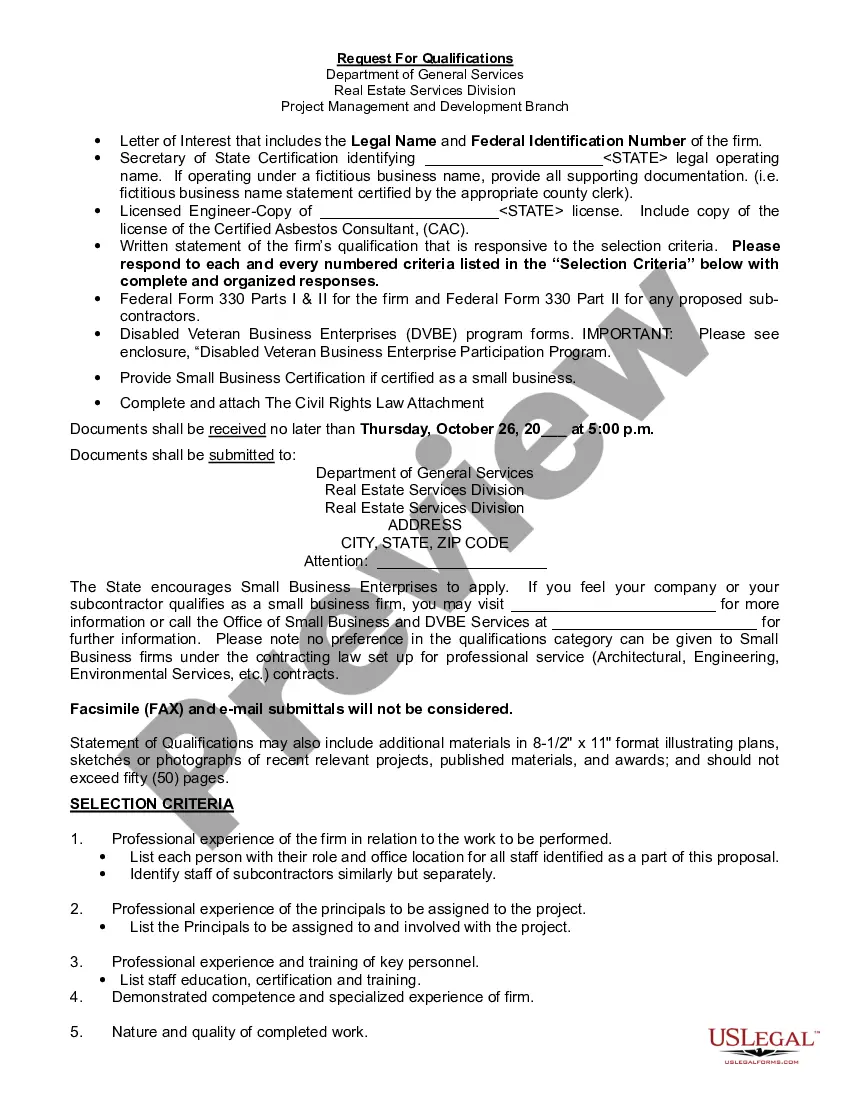
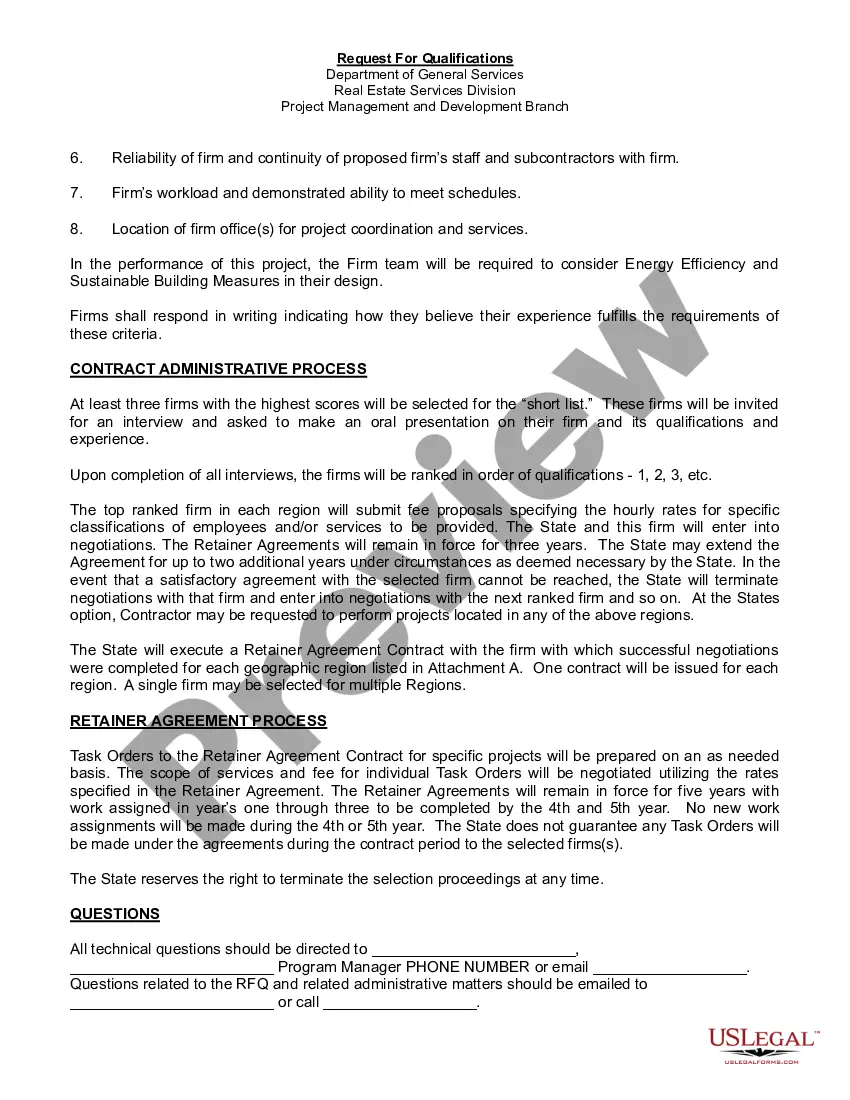
- Legal name and Federal Identification Number of the firm.
- Secretary of State Certification for legal operating name.
- Copy of the licensed engineer's state license.
- Written statement of qualifications responding to selection criteria.
- Federal Form 330 Parts I and II for firm and sub-contractors.
- Disabled Veteran Business Enterprises (DVBE) program forms.



Common use cases
This form should be used when an organization is seeking to hire specialized contractors for specific projects, particularly in fields such as engineering or architecture. It is advisable to use this RFQ when the organization requires a pre-qualified list of potential contractors to streamline selection processes for current or future projects, ensuring that only suitably qualified firms are considered for contract opportunities.
Who this form is for
- Government agencies seeking to procure professional services for projects.
- Private organizations requiring specialized contractors for specific tasks.
- Consultants and firms looking to establish their credentials for upcoming projects.
- Contractors wanting to present their qualifications to potential clients.
Completing this form step by step
- Identify the issuing organization and the project for which qualifications are being sought.
- Gather the required documentation, including licenses and certification statements.
- Prepare a detailed statement of qualifications that addresses all selection criteria outlined in the RFQ.
- Complete the Federal Form 330 as required for your firm and any proposed subcontractors.
- Submit all materials before the indicated deadline to the appropriate department.
Is notarization required?
This form does not typically require notarization unless specified by local law. Ensure to check the local requirements regarding notarization before finalizing your submission.
Get your form ready online
Our built-in tools help you complete, sign, share, and store your documents in one place.
Make edits, fill in missing information, and update formatting in US Legal Forms—just like you would in MS Word.
Download a copy, print it, send it by email, or mail it via USPS—whatever works best for your next step.
Sign and collect signatures with our SignNow integration. Send to multiple recipients, set reminders, and more. Go Premium to unlock E-Sign.
If this form requires notarization, complete it online through a secure video call—no need to meet a notary in person or wait for an appointment.
We protect your documents and personal data by following strict security and privacy standards.

Make edits, fill in missing information, and update formatting in US Legal Forms—just like you would in MS Word.

Download a copy, print it, send it by email, or mail it via USPS—whatever works best for your next step.

Sign and collect signatures with our SignNow integration. Send to multiple recipients, set reminders, and more. Go Premium to unlock E-Sign.

If this form requires notarization, complete it online through a secure video call—no need to meet a notary in person or wait for an appointment.

We protect your documents and personal data by following strict security and privacy standards.
Avoid these common issues
- Failing to meet the submission deadline.
- Not including all required documentation and forms.
- Inadequately addressing the selection criteria in the qualifications statement.
- Submissions sent via fax or email if not permitted by the RFQ.
Benefits of using this form online
- Convenience of downloading and submitting the form at any time.
- Editability allows firms to tailor their qualifications effectively.
- Access to templates drafted by licensed attorneys ensures reliability.
Legal use & context
- This RFQ can be used to establish a pre-qualified list for future contracting opportunities.
- It is important to follow local government procurement regulations when using this form.
- Legal enforceability relies on compliance with submission guidelines and criteria specified in the RFQ.
Main things to remember
- RFQ is crucial for pre-qualifying firms for specialized projects.
- Submission must include all necessary legal documents and qualifications.
- Ensure compliance with state-specific requirements for licensing and certification.
Looking for another form?
Form popularity
FAQ
In construction, the term RFQ is used to mean both request for qualifications and request for quote. Project owners use a request for qualifications (RFQ) to narrow down a list of contractors to find those who meet the criteria to bid on a specific project.
The RFP and RFC are both methods for match-making among buyers and sellers. With the RFP, the buyer requests proposals from sellers. The RFC takes the opposite approach and turns the RFP process inside out. With the RFC, sellers request consideration from the buyer.
A typical RFQ timeline Naturally, the RFQ timeline varies based on the complexity of the challenge and length of the request as well as the number of vendors and evaluators involved. Generally though, from beginning to end, an RFQ typically takes five to eight weeks.
A Request for Qualifications (RFQ) usually refers to the pre-qualification stage of the procurement process. Only those proponents who successfully respond to the RFQ and meet the qualification criteria will be included in the subsequent Request for Proposals (RFP) solicitation process.
Overall, the complete RFP process should be expected to take anywhere between 9 months to 3 years to complete. Budget cycles, grants, and other factors will likely impact the length of time to develop and release an RFP, as well as collect and evaluate responses and award a contract.
The main difference between RFP and RFQ is that an RFQ is sent when a business already knows what they want to purchase and only needs more information about the price, and an RFP is sent when a business needs more detailed information about the product or service itself.
The RFP process begins with drafting a request for proposal. Bidders review the solicitation and submit suggestions for improvement. After implementing feedback, the final request for proposal is issued. Bidders then submit their proposals.