Handout for Grief, Mourning and Guilt
About this form
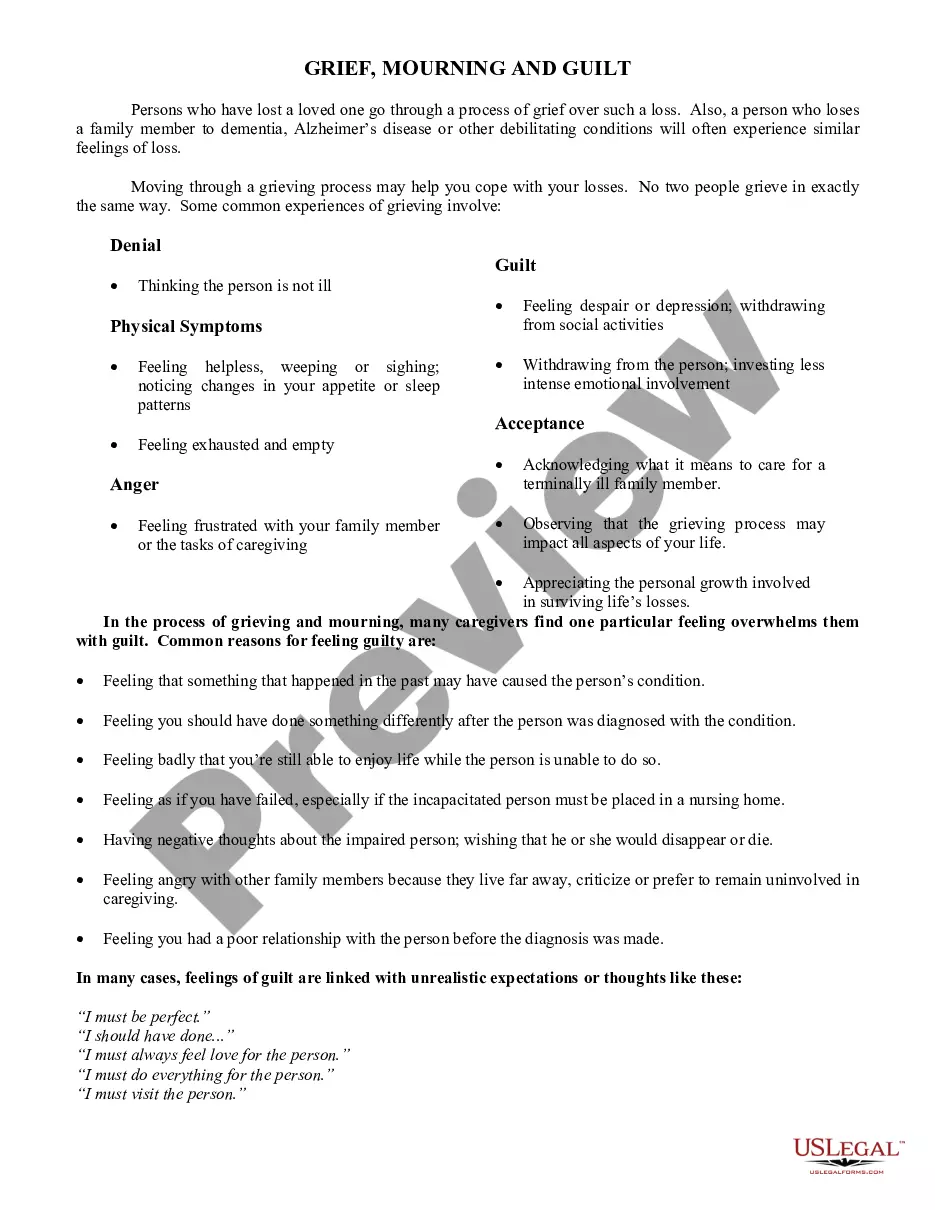
The Handout for Grief, Mourning and Guilt is a supportive resource designed to assist individuals navigating the complex emotions surrounding loss. This handout outlines common experiences associated with grief, including feelings of guilt that often accompany caring for a terminally ill loved one. Unlike other legal forms, this document aims to provide emotional guidance rather than serve a legal function, making it a valuable tool for those in need of comfort during difficult times.
Form components explained
- Description of the grieving process and its emotional phases.
- Common feelings experienced during grief, such as denial, anger, guilt, and acceptance.
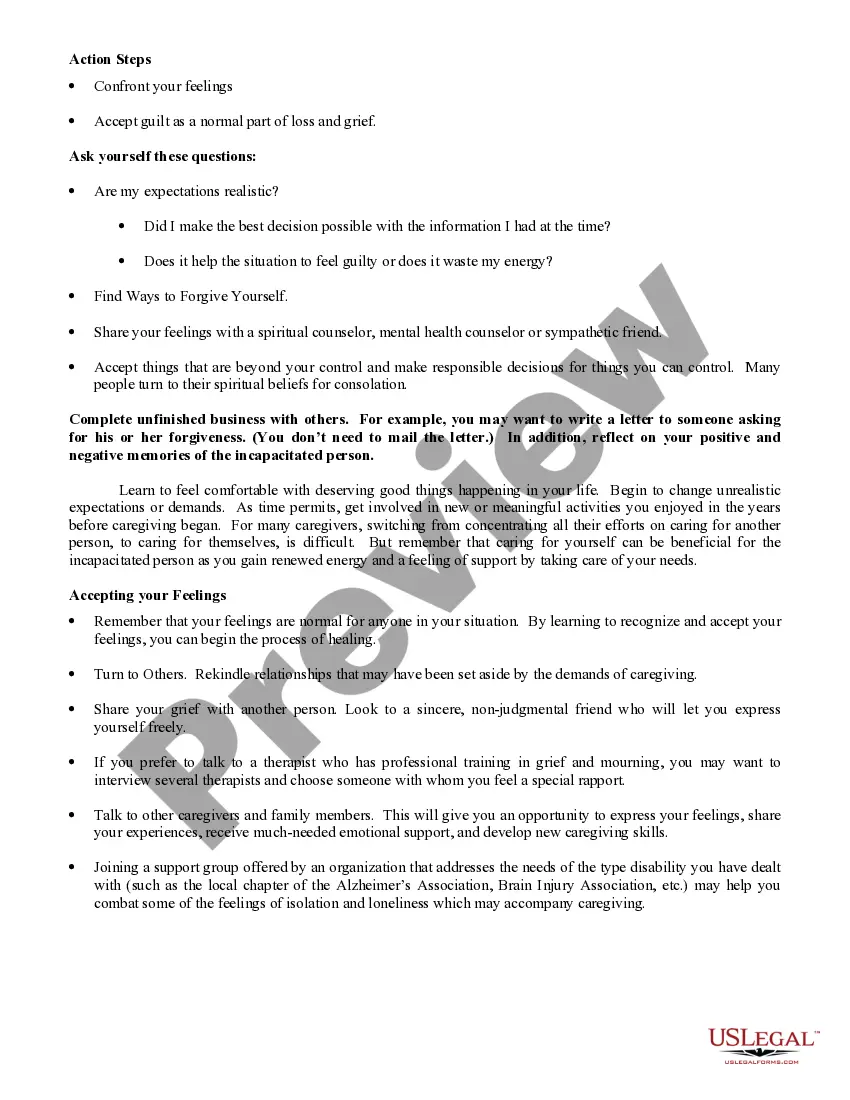
- Guidance on confronting feelings of guilt and fostering self-forgiveness.
- Suggestions for seeking support from others, including professionals and support groups.
- Action steps for personal growth and emotional healing after loss.


When to use this form
This handout is useful for individuals who are grieving the loss of a loved one, whether through death or a decline due to conditions such as dementia or Alzheimer's disease. It can serve as a helpful guide for caregivers and family members who may be struggling with feelings of guilt during the grieving process. Use this handout to understand your emotions better and find ways to cope with your loss.
Who can use this document
- Individuals who have lost a loved one and are experiencing grief.
- Caregivers of terminally ill patients grappling with guilt and emotional distress.
- Family and friends who want to support someone undergoing the grieving process.
- Anyone seeking information on the emotional impacts of caregiving and loss.
Instructions for completing this form
- Review the handout and identify personal feelings related to grief and guilt.
- Reflect on the emotional phases of grief outlined in the document.
- Utilize the action steps to confront feelings of guilt and work toward self-forgiveness.
- Consider sharing the handout with a supportive friend or family member for discussion.
- Engage in meaningful activities and connect with others to help heal from loss.
Notarization guidance
Notarization is not commonly needed for this form. However, certain documents or local rules may make it necessary. Our notarization service, powered by Notarize, allows you to finalize it securely online anytime, day or night.
Get your form ready online
Our built-in tools help you complete, sign, share, and store your documents in one place.
Make edits, fill in missing information, and update formatting in US Legal Forms—just like you would in MS Word.
Download a copy, print it, send it by email, or mail it via USPS—whatever works best for your next step.
Sign and collect signatures with our SignNow integration. Send to multiple recipients, set reminders, and more. Go Premium to unlock E-Sign.
If this form requires notarization, complete it online through a secure video call—no need to meet a notary in person or wait for an appointment.
We protect your documents and personal data by following strict security and privacy standards.

Make edits, fill in missing information, and update formatting in US Legal Forms—just like you would in MS Word.

Download a copy, print it, send it by email, or mail it via USPS—whatever works best for your next step.

Sign and collect signatures with our SignNow integration. Send to multiple recipients, set reminders, and more. Go Premium to unlock E-Sign.

If this form requires notarization, complete it online through a secure video call—no need to meet a notary in person or wait for an appointment.

We protect your documents and personal data by following strict security and privacy standards.
Common mistakes
- Ignoring feelings of guilt rather than acknowledging and confronting them.
- Believing that one must grieve in a specific way or timeframe.
- Neglecting personal well-being while focusing only on caregiving.
- Isolating oneself from supportive networks or resources.
Advantages of online completion
- Easy access to vital emotional support information from the comfort of home.
- Printable format allows for personal reflection and sharing with others.
- Reliability of professionally crafted content by licensed attorneys.
Summary of main points
- Grief is a unique and personal process; feelings of guilt are common.
- Recognizing and accepting your feelings is an essential step in healing.
- Seeking support from friends, family, and professionals can provide significant relief.
Looking for another form?
Form popularity
FAQ
7 Signs that Death May Be Near Loss of Appetite. This is perhaps the most culturally aware sign of impending passing.Discolored Skin. Mottled skin is a late sign of death, especially when present in the upper half of the body.Mental Confusion.Labored Breath.Kidney Failure.Cool Extremities.
10 Tips for Dealing With Regret After a Loved One Dies WRITE DOWN YOUR REGRETS.WRITE A LETTER TO THE DECEASED.THINK ABOUT WHAT YOUR DECEASED LOVED ONE WOULD SAY.LET YOURSELF BE FORGIVEN.LIVE A BETTER LIFE.REASSESS YOUR SITUATION.FIND COMFORT IN A HIGHER POWER.FIND A COUNSELOR OR SUPPORT GROUP.
The five stages, denial, anger, bargaining, depression and acceptance are a part of the framework that makes up our learning to live with the one we lost.
Depression is usually the longest and most difficult stage of grief. Depression can be a long and difficult stage in the grieving process, but it's also when people feel their deepest sadness.
There is no set length or duration for grief, and it may come and go in waves. However, ing to 2020 research , people who experience common grief may experience improvements in symptoms after about 6 months, but the symptoms largely resolve in about 1 to 2 years.
The stages in her model were: Denial, Anger, Bargaining, Depression, and Acceptance. The seven stages of grief include the five stages Dr. Kubler-Ross outlined but also include guilt, an upward turn, and reconstruction.
In order to help you navigate what you might be experiencing right now, I want to talk to you about the three R's to loss and grief. So the three R's are recognition, remembering and rebuilding, and I want to go through those each in turn.
What are the 7 steps of grief? shock and denial. pain and guilt. anger and bargaining. depression. the upward turn. reconstruction and working through. acceptance and hope.