South Dakota Affidavit of Occupancy and Financial Status
What this document covers
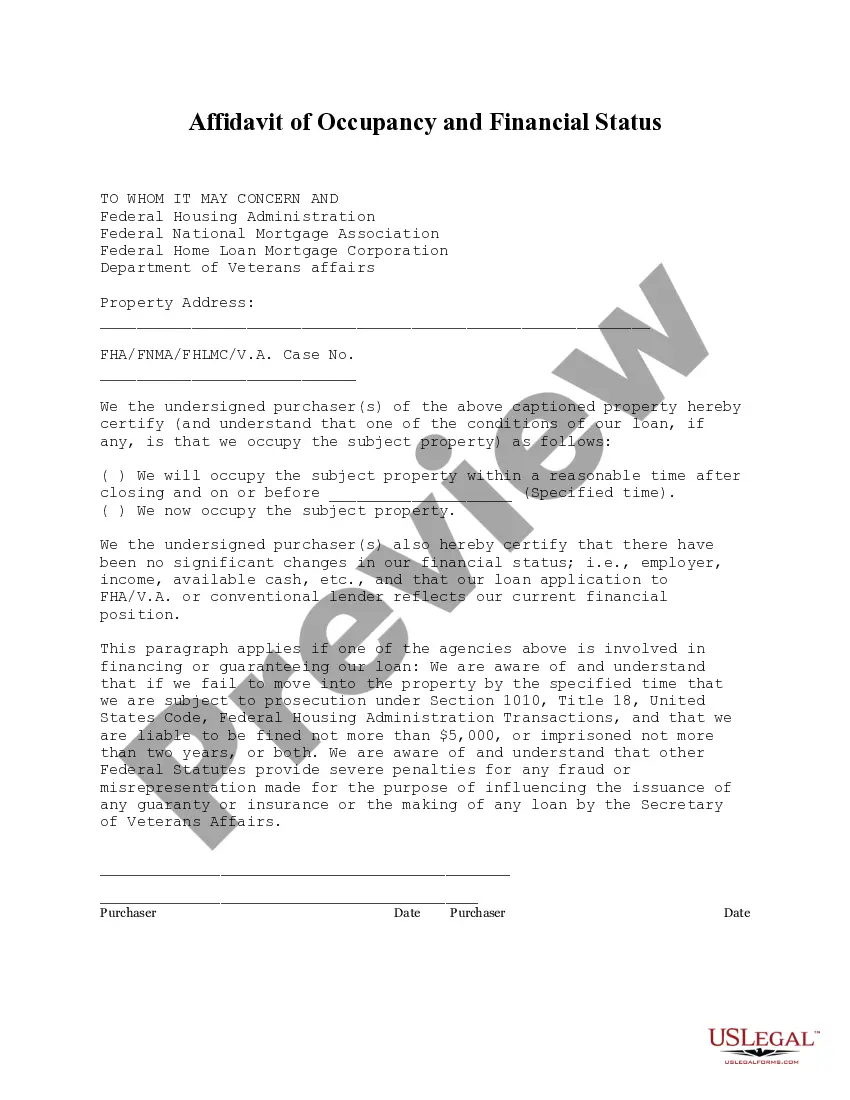
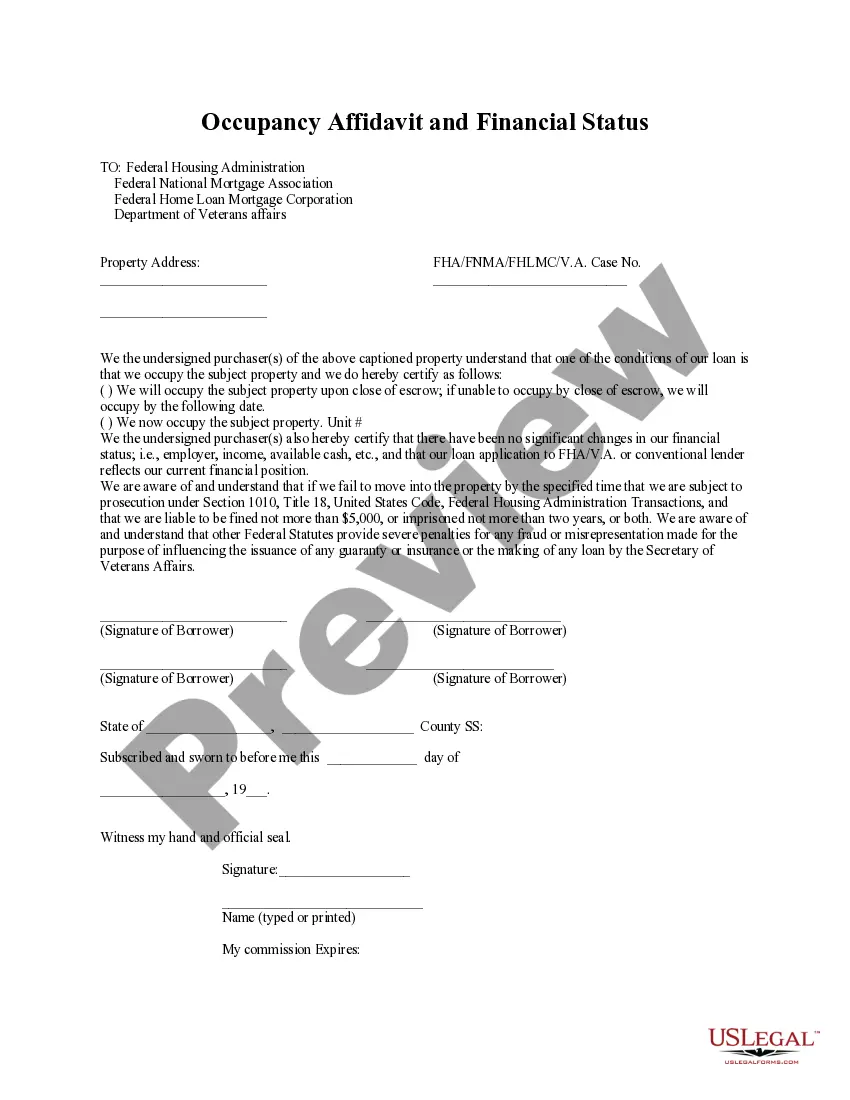
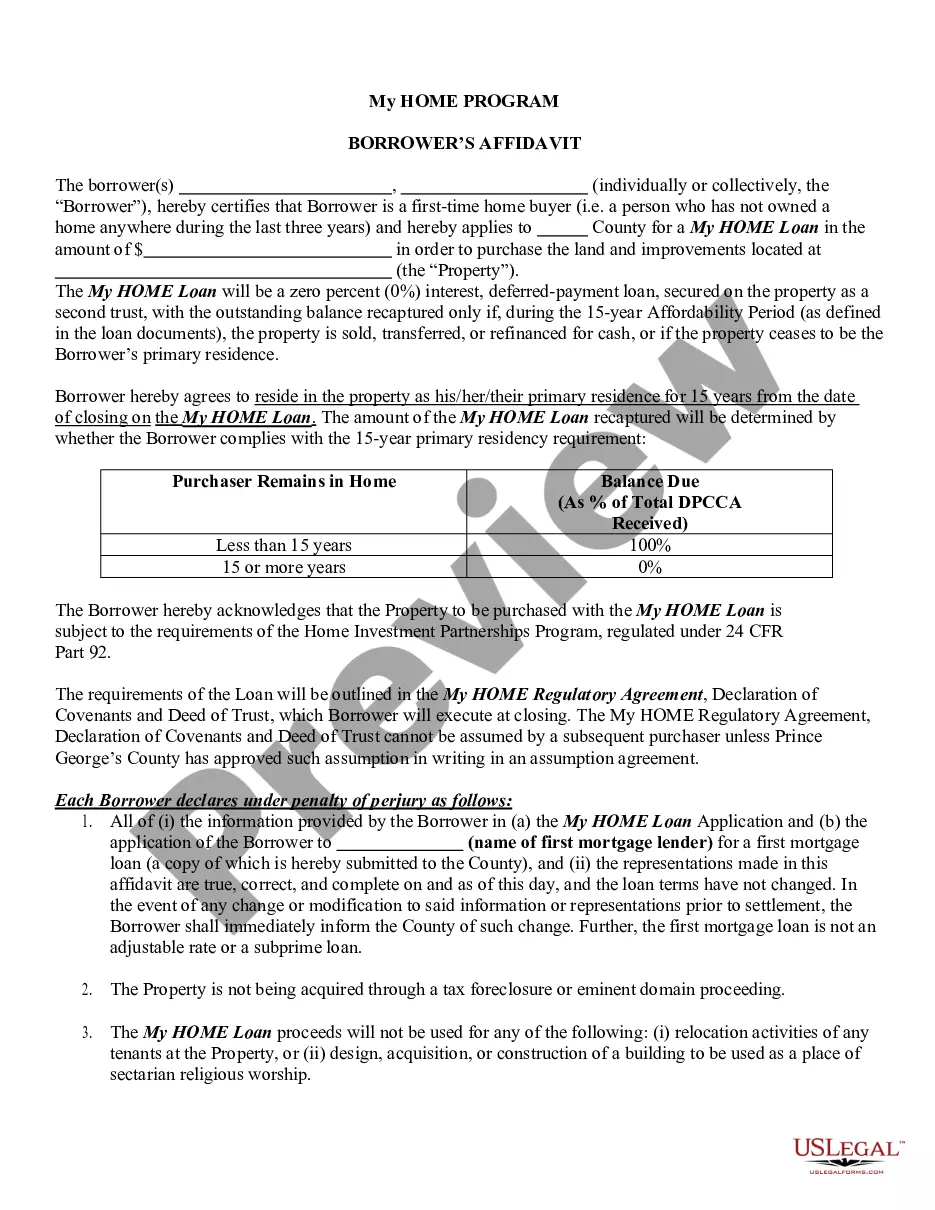
The Affidavit of Occupancy and Financial Status is a legal document that buyers use to declare their intent to occupy a property as their primary residence at the time of closing. This form is essential for confirming that there have been no significant changes in the buyer's financial situation since submitting their loan application. It serves to assure lenders of the buyer's commitment to residency and financial stability, differing from other forms that may not address occupancy or financial status directly.
Key components of this form
- Property address and case number for referencing the specific loan.
- Statement confirming the buyer's intention to occupy the property within a specified timeframe.
- Certification regarding the current financial status of the buyer(s).
- Legal acknowledgment of consequences for failing to comply with stated occupancy.
- Signature lines for the purchaser(s) and the date of agreement.

When to use this form
This form should be used during the closing process of a real estate transaction when a buyer is securing a loan that requires them to occupy the purchased property as their primary residence. It is essential when dealing with lenders such as the Federal Housing Administration or the Department of Veterans Affairs, as they often require such declarations to finalize the loan.
Who can use this document
- Homebuyers who are applying for a mortgage.
- Individuals purchasing property with the intent to make it their primary residence.
- Buyers involved in transactions requiring loan guarantees from government agencies.
Completing this form step by step
- Identify the property by entering the full address and FHA/FNMA/FHLMC/V.A. case number.
- Mark the appropriate checkbox indicating whether you plan to occupy the property or are already residing there.
- Specify the date by which you intend to move in, if applicable.
- Declare that there have been no significant changes in your financial status since your loan application.
- Sign and date the affidavit to acknowledge your understanding and agreement to the terms outlined.
Notarization requirements for this form
This form does not typically require notarization unless specified by local law. However, it is good practice to have it notarized to ensure legal validity and reduce the risk of disputes in the future.
Get your form ready online
Our built-in tools help you complete, sign, share, and store your documents in one place.
Make edits, fill in missing information, and update formatting in US Legal Forms—just like you would in MS Word.
Download a copy, print it, send it by email, or mail it via USPS—whatever works best for your next step.
Sign and collect signatures with our SignNow integration. Send to multiple recipients, set reminders, and more. Go Premium to unlock E-Sign.
If this form requires notarization, complete it online through a secure video call—no need to meet a notary in person or wait for an appointment.
We protect your documents and personal data by following strict security and privacy standards.

Make edits, fill in missing information, and update formatting in US Legal Forms—just like you would in MS Word.

Download a copy, print it, send it by email, or mail it via USPS—whatever works best for your next step.

Sign and collect signatures with our SignNow integration. Send to multiple recipients, set reminders, and more. Go Premium to unlock E-Sign.

If this form requires notarization, complete it online through a secure video call—no need to meet a notary in person or wait for an appointment.

We protect your documents and personal data by following strict security and privacy standards.
Common mistakes
- Not marking the occupancy intention box correctly.
- Failing to specify a move-in date if not currently occupying the property.
- Omitting signatures or dates from the document.
Why use this form online
- Immediate access to a legally compliant form tailored to your needs.
- Ability to easily edit and complete the form as needed before printing.
- Convenience of obtaining the form without the need for office visits or delays.
Legal use & context
- This affidavit serves as a sworn statement to help protect the lender's interests regarding occupancy requirements.
- False statements can lead to serious legal consequences, including fines and potential imprisonment.
Quick recap
- The Affidavit of Occupancy and Financial Status confirms the intention to occupy the property and the financial stability of the buyer.
- Completing this form accurately is crucial for the successful closing of a real estate transaction.
- Being aware of the legal implications of misrepresentation is essential for both buyers and lenders.
Looking for another form?

Form popularity
FAQ
Annual license renewals can be done online through the Vehicle Registration & Plates portal at mysdcars.sd.gov. Drivers can also visit a license renewal kiosk to renew their vehicle registration in less than five minutes.
Complete a bill of sale with the buyer, and make sure both you sign it. Get a lien release. If the car is less than 10 years old, complete the odometer disclosure section on the Application for Motor Vehicle Title and Registration. Complete the Seller's Report of Sale from and file it with the county treasurer.
No, a South Dakota bill of sale is not required to register a vehicle. However, South Dakota does provide a Bill of Sale (Form MV-16) for your personal use for motor vehicle sales. You should also complete a South Dakota Application for Motor Vehicle Title & Registration (Form-0864 V 21).
You will need your original out of state titles, a copy of your state driver license, social security number, and a Motor Vehicle and Boat Title & Registration Application. Take this paperwork to your local county treasurer's office to complete registration process.
South Dakota allows residents to renew their registrations online 90 days before the registration is set to expire and up to 30 days after it has expired.
Your license plates must be purchased from the Brule County Treasurer's office. You will be required to provide either a Social Security number or a South Dakota driver's license number in order to purchase license plates in South Dakota.
The fees that you will have to pay are as follows: Non-commercial vehicles that are below nine years old will cost $75.60 to register. Non-commercial vehicles that are older than nine years will cost $50.40 to register. Motorcycles that are below nine years old will cost $18 to register.
A Completed Application for Title or Registration (Form REG 343). The Vehicle's Out-of-State Title. The Vehicle's Out-of-State Registration. Proof of Insurance. A Valid Smog Certificate. Payment for Fees (see "Fees" below).
A title-holding state is one where the lienholder (your lender) keeps the title until you've paid off the auto loan.The nine non-title holding states are: Michigan, Minnesota, New York, Arizona, Kentucky, Oklahoma, Wisconsin, Maryland, and South Dakota.