Release of Operator's Lien
Understanding this form
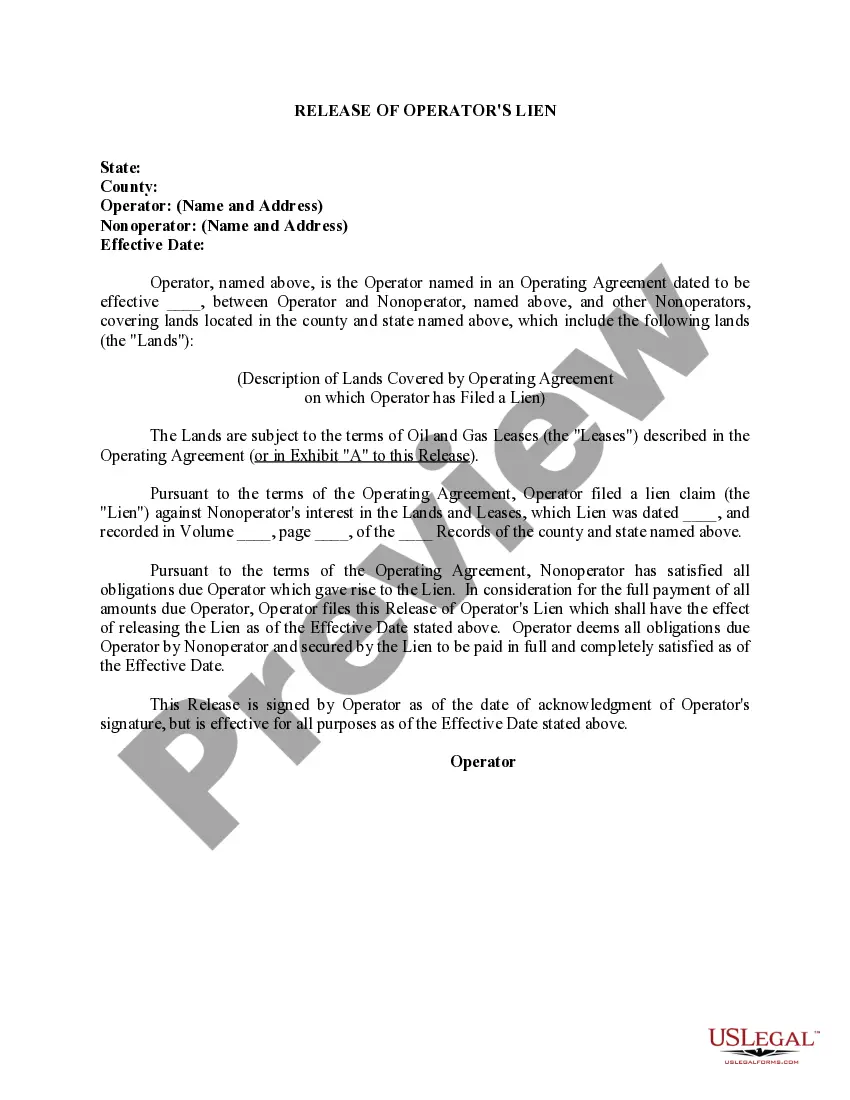
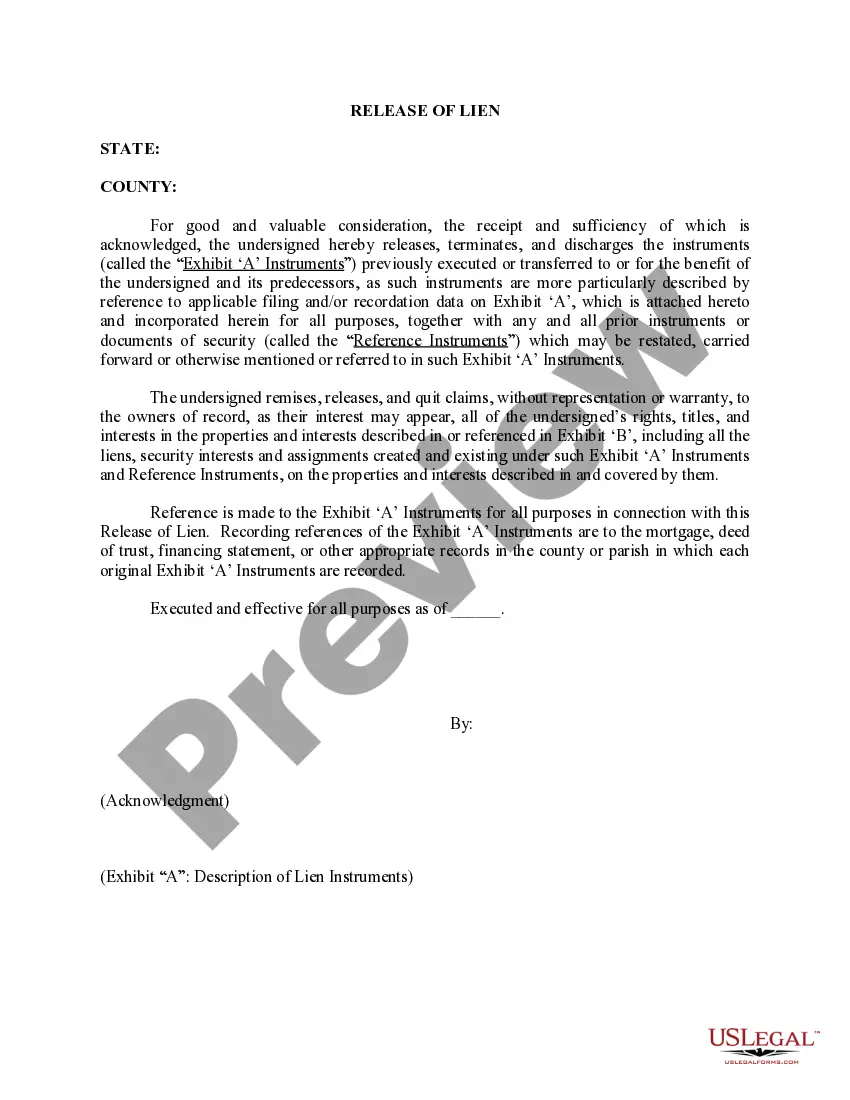
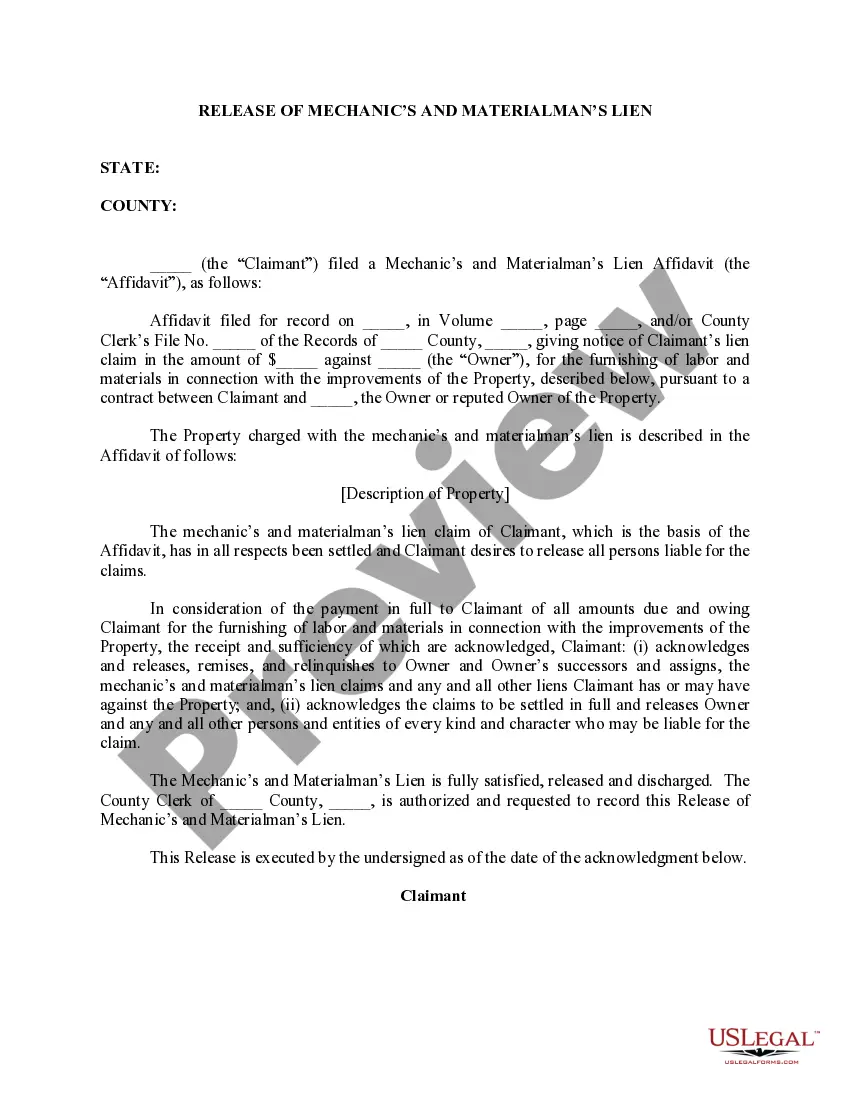
The Release of Operator's Lien is a legal document used to formally acknowledge that all obligations owed from a nonoperator to an operator have been completely satisfied. By utilizing this form, operators can release their lien claim against a nonoperator's interest in specific lands or leases. This form is crucial in clarifying that debts are settled, differentiating it from other forms related to liens or financial obligations in the oil and gas sector.
Key components of this form
- Identification of the Operator and Nonoperator with their names and addresses.
- Effective date of the release.
- Description of lands covered by the operating agreement on which the lien was filed.
- Information about the lien, including its date and recording details.
- Statement confirming satisfaction of obligations by the Nonoperator.
- Operator's signature for acknowledgment.
When to use this form
This form should be used when a nonoperator has paid all debts owed to the operator, which were previously secured by a lien. It is essential in scenarios where the operator wants to officially release the lien to clear the nonoperator's title to the property, often necessary before additional transactions or dealings can occur regarding the lands or leases involved.
Who this form is for
This release form is primarily intended for:
- Operators who have provided services or materials and wish to release a lien once payments are received.
- Nonoperators who have fulfilled their obligations and need to clear their title to facilitate future real estate transactions.
- Professionals in the oil and gas industry managing operating agreements and lien claims.
How to complete this form
- Identify and enter the Operator's name and address, as well as the Nonoperator's details.
- Specify the effective date of the release.
- Provide a detailed description of the lands covered by the operating agreement and the lien.
- Include the lien's recording information, including date and location.
- Confirm that all obligations have been fulfilled and complete the signature of the Operator.
Does this form need to be notarized?
This form does not typically require notarization unless specified by local law, making it easier to complete. However, it is advisable to check local regulations to ensure compliance.
Get your form ready online
Our built-in tools help you complete, sign, share, and store your documents in one place.
Make edits, fill in missing information, and update formatting in US Legal Forms—just like you would in MS Word.
Download a copy, print it, send it by email, or mail it via USPS—whatever works best for your next step.
Sign and collect signatures with our SignNow integration. Send to multiple recipients, set reminders, and more. Go Premium to unlock E-Sign.
If this form requires notarization, complete it online through a secure video call—no need to meet a notary in person or wait for an appointment.
We protect your documents and personal data by following strict security and privacy standards.

Make edits, fill in missing information, and update formatting in US Legal Forms—just like you would in MS Word.

Download a copy, print it, send it by email, or mail it via USPS—whatever works best for your next step.

Sign and collect signatures with our SignNow integration. Send to multiple recipients, set reminders, and more. Go Premium to unlock E-Sign.

If this form requires notarization, complete it online through a secure video call—no need to meet a notary in person or wait for an appointment.

We protect your documents and personal data by following strict security and privacy standards.
Common mistakes to avoid
- Failing to accurately describe the lands involved, which can lead to legal disputes.
- Not including the effective date, making the release unclear.
- Incomplete signatures or incorrect acknowledgment that may invalidate the release.
Benefits of completing this form online
- Convenience of downloading and completing the form at your own pace.
- Editability allows for adjustments to meet individual needs.
- Reliable templates drafted by licensed attorneys ensure compliance with legal standards.
Looking for another form?

Form popularity
FAQ
A lien is a legal right or claim against a property by a creditor. Liens are commonly placed against property, such as homes and cars, so creditors, such as banks and credit unions, can collect what is owed to them. Liens can also be removed, giving the owner full and clear title to the property.
If you owe money to a creditor and don't pay, that party may sue you for the balance. If the court rules against you, the creditor can file a judgment lien against you.In a few states, if a court enters a judgment against a debtor, a lien is automatically created on any real estate the debtor owns in that county.
A lien is a claim or legal right against assets that are typically used as collateral to satisfy a debt.If the underlying obligation is not satisfied, the creditor may be able to seize the asset that is the subject of the lien.
A lien is a claim on property to ensure payment of a debt. When you borrow money to purchase a car, the lender files a lien on the vehicle with the state to insure that if the loan defaults, the lender can take the car. When the debt is fully repaid, a release of the lien is provided by the lender.
How Liens Work. A lien provides a creditor with the legal right to seize and sell the collateral property or asset of a borrower who fails to meet the obligations of a loan or contract. The property that is the subject of a lien cannot be sold by the owner without the consent of the lien holder.
When a person pays off a loan in full, the lien is removed. The asset is no longer pledged to the creditor when the balance is completely paid. When this happens, the creditor acknowledges the release of the lien by signing a Mortgage Release of Lien Certificate.
In a lien theory state, the buyer holds the deed to the property during the mortgage term The buyer promises to make all payments to the lender and the mortgage becomes a lien on the property, but title remains with the buyer.The Deed of Reconveyance removes the lender's interest in the property.
It basically states that you've paid the subcontractor what is owed, they accept the payment in full, and they waive the right to put a lien on your property. Simply present this form to the subcontractor with your payment and ask them to sign it. Make sure you get their signature!
The lien release must be filed with the same clerk with whom the original construction lien was filed. If the lien claimant is filing it, the lien release should be provided to the owner and to whomever you have a contract so that they are aware that it has been recorded.