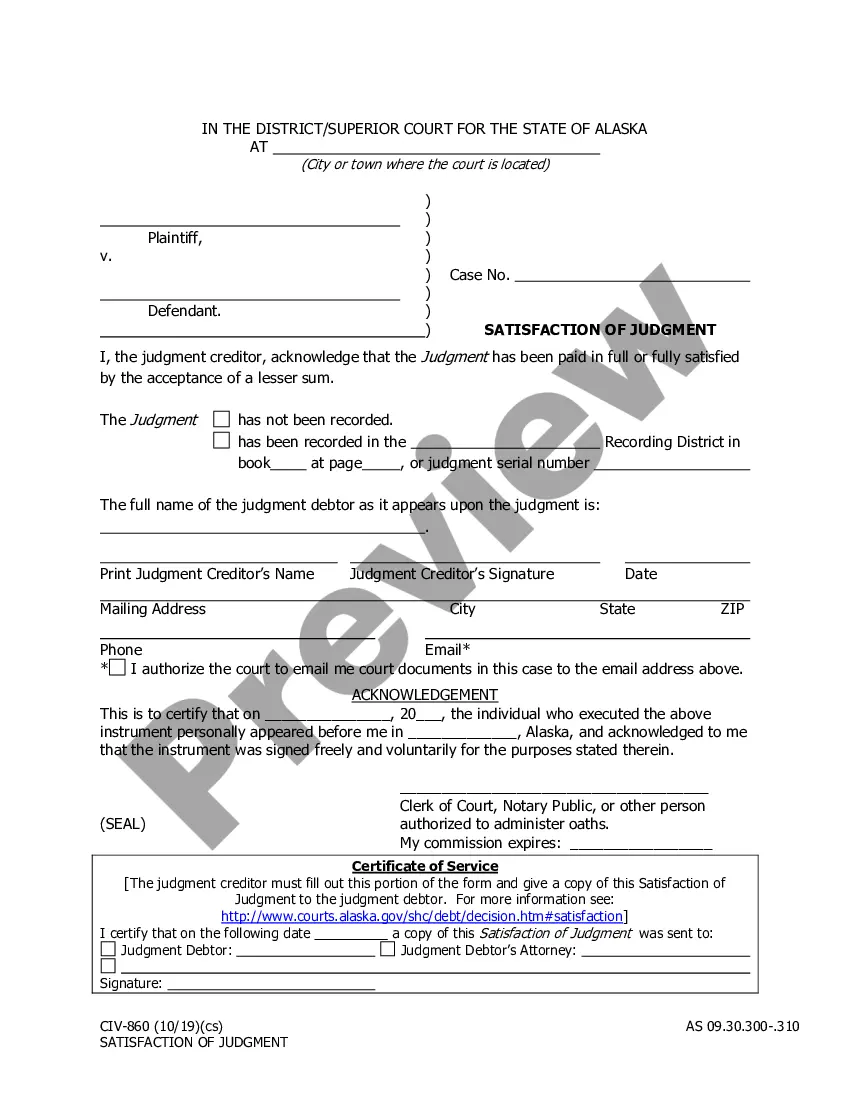
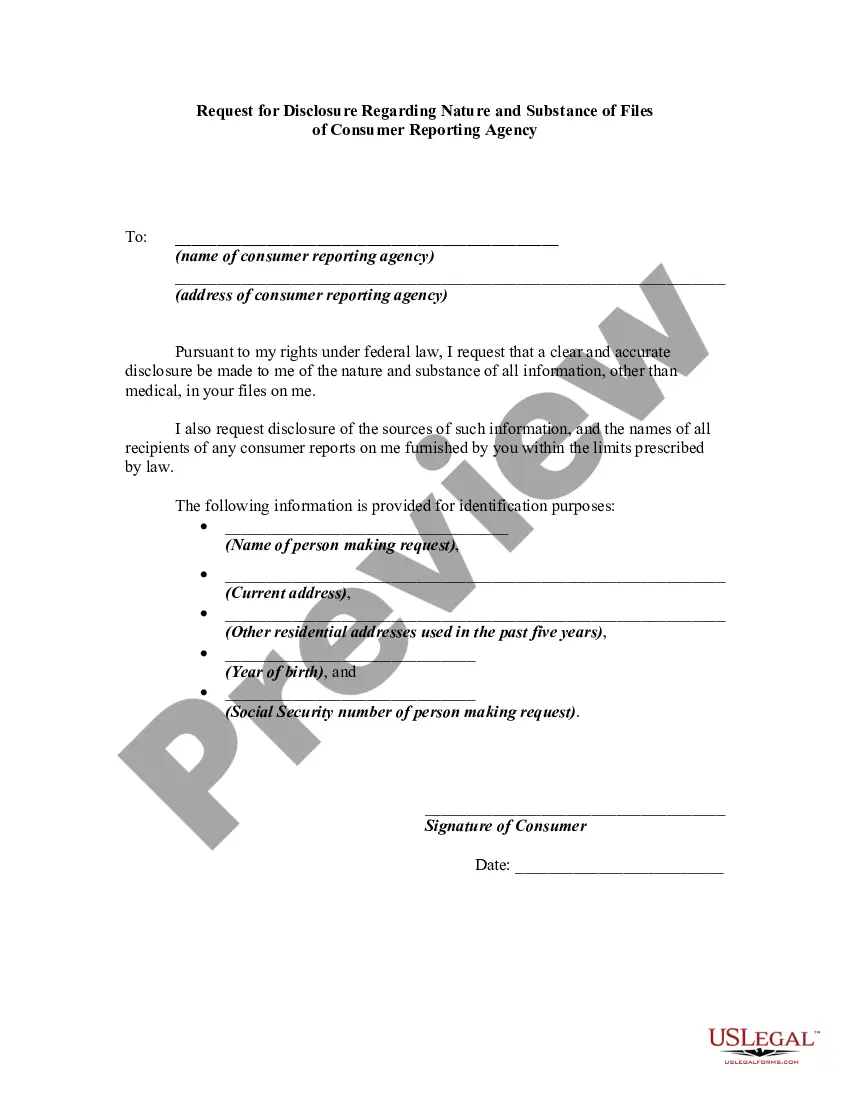
Request for Disclosure Regarding Nature and Substance of Files of Consumer Reporting Agency
What is this form?
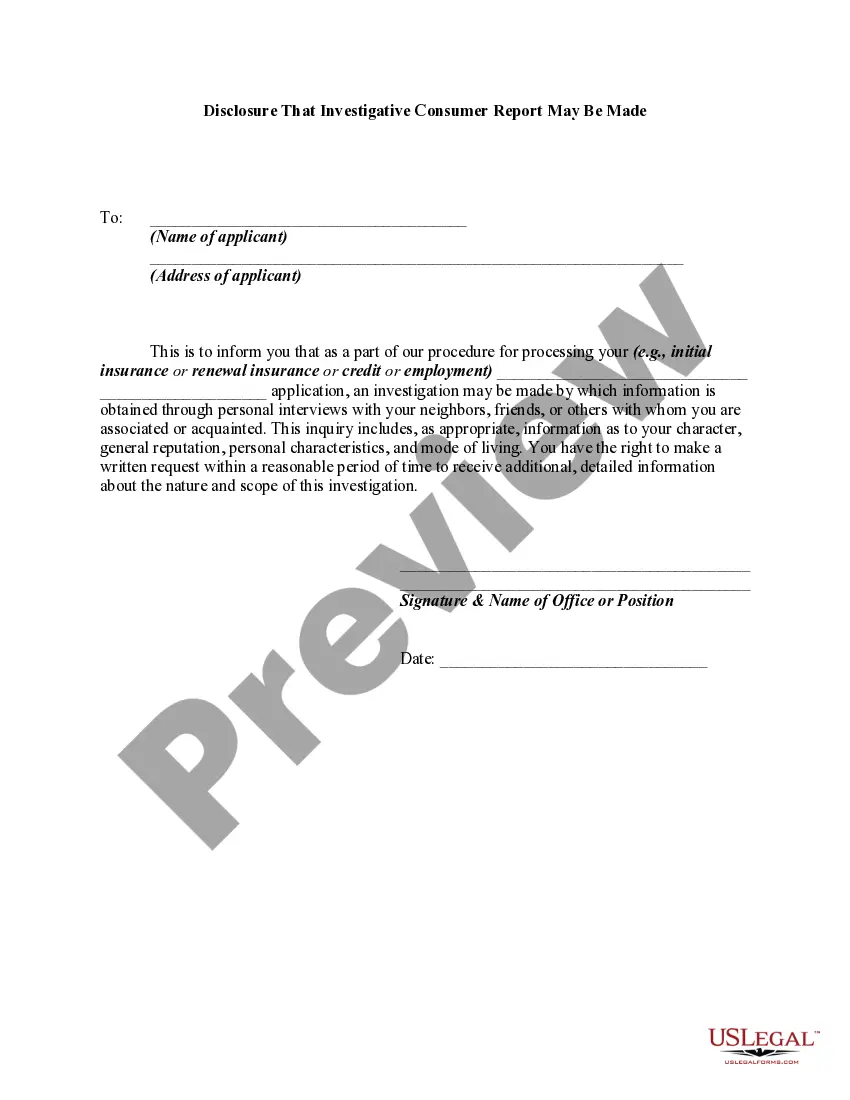
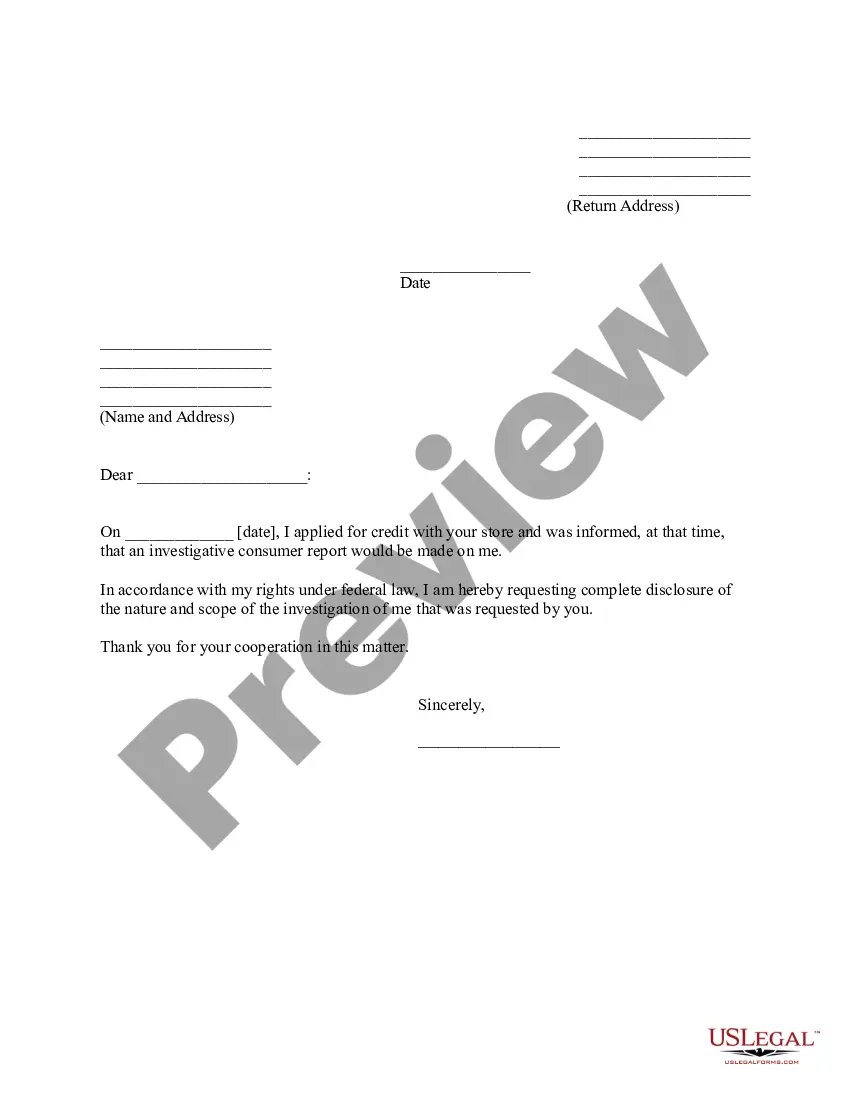
The Request for Disclosure Regarding Nature and Substance of Files of Consumer Reporting Agency is a legal document that allows consumers to obtain vital information about their credit reports from consumer reporting agencies. Under the Fair Credit Reporting Act, this form specifically ensures that consumers can request access to specific details about their credit history, including the sources of information, disclosures made to third parties, and any adverse information that may affect their credit report. This form differs from other credit-related requests by focusing on a detailed account of the consumer's file, rather than merely disputing inaccuracies or making a general inquiry.
Key components of this form
- Identification of the consumer reporting agency to which the request is addressed.
- Personal information of the consumer, including current and past addresses, date of birth, and Social Security number.
- Request for detailed disclosure regarding non-medical information in the consumer's file.
- Request for sources of information and recipients who received credit reports related to the consumer.
- Signature and date to validate the request.
When to use this form
This form should be used when you want to understand the information that a consumer reporting agency has on file about you. It is particularly useful in situations where you have experienced denied credit, believe there may be errors in your credit report, or are curious about which companies have accessed your credit information for employment or other purposes. It is a proactive step to arm yourself with critical information regarding your credit standing.
Who can use this document
This form is intended for:
- Consumers seeking transparency regarding their credit files.
- Individuals who wish to identify errors or discrepancies in their credit reports.
- Consumers who want to know which entities have accessed their credit information.
- Anyone interested in protecting their personal financial health and credit status.
Steps to complete this form
- Identify the consumer reporting agency by including its name and address at the top of the form.
- Enter your personal identification details, including full name, current address, and previous addresses used in the last five years.
- Provide your date of birth and Social Security number to verify your identity.
- Clearly state your request for disclosure regarding the nature and substance of your information as noted in the template.
- Sign and date the form to complete your request.
Does this form need to be notarized?
Notarization is generally not required for this form. However, certain states or situations might demand it. You can complete notarization online through US Legal Forms, powered by Notarize, using a verified video call available anytime.
Get your form ready online
Our built-in tools help you complete, sign, share, and store your documents in one place.
Make edits, fill in missing information, and update formatting in US Legal Forms—just like you would in MS Word.
Download a copy, print it, send it by email, or mail it via USPS—whatever works best for your next step.
Sign and collect signatures with our SignNow integration. Send to multiple recipients, set reminders, and more. Go Premium to unlock E-Sign.
If this form requires notarization, complete it online through a secure video call—no need to meet a notary in person or wait for an appointment.
We protect your documents and personal data by following strict security and privacy standards.

Make edits, fill in missing information, and update formatting in US Legal Forms—just like you would in MS Word.

Download a copy, print it, send it by email, or mail it via USPS—whatever works best for your next step.

Sign and collect signatures with our SignNow integration. Send to multiple recipients, set reminders, and more. Go Premium to unlock E-Sign.

If this form requires notarization, complete it online through a secure video call—no need to meet a notary in person or wait for an appointment.

We protect your documents and personal data by following strict security and privacy standards.
Avoid these common issues
- Failing to include accurate identification information, which can delay processing.
- Not providing the name and address of the consumer reporting agency correctly.
- Forgetting to sign and date the form before submission.
- Omitting details about previous addresses, which may be necessary for verification.
Why complete this form online
- Convenient access to a structured legal form that simplifies the disclosure request process.
- Editable format, allowing you to customize and save the information needed for your request.
- Reliability in ensuring that your request complies with legal standards under the Fair Credit Reporting Act.
Legal use & context
- This form empowers consumers to access their credit information per the Fair Credit Reporting Act.
- Consumers are entitled to research and challenge any inaccuracies found in their files.
- The request must be clear and should include all necessary identification details to be valid.
What to keep in mind
- The form requests detailed consumer information from credit reporting agencies.
- Be thorough in providing identification details to ensure a smooth process.
- This form supports consumer rights related to credit reporting and privacy.
Looking for another form?


Form popularity
FAQ
Under this new rule, lenders must provide consumers with a Risk-Based Pricing notice when a company grants credit on material terms that are materially less favorable than the most favorable terms available to a substantial proportion of the consumers. Lenders include banks, credit unions, mortgage lenders, auto
(f) The term "consumer reporting agency" means any person which, for monetary fees, dues, or on a cooperative nonprofit basis, regularly engages in whole or in part in the practice of assembling or evaluating consumer credit information or other information on consumers for the purpose of furnishing consumer reports to
Common violations of the FCRA include: Creditors give reporting agencies inaccurate financial information about you. Reporting agencies mixing up one person's information with another's because of similar (or same) last name or social security number. Agencies fail to follow guidelines for handling disputes.
A creditor must disclose a consumer's credit score and information relating to a credit score on a risk-based pricing notice when the score of the consumer to whom the creditor extends credit or whose extension of credit is under review is used in setting the material terms of credit.
Background. Under section 609 of the FCRA, a consumer reporting agency must, upon a consumer's request, disclose to the consumer information in the consumer's file.
A consumer disclosure is the long version of your credit report that contains all credit inquiries and suppressed information not found in your standard credit report, as well as the normal credit report records of balances, payment history, personal information, etc.
A statement of action taken by the creditor. Either a statement of the specific reasons for the action taken or a disclosure of the applicant's right to a statement of specific reasons and the name, address, and telephone number of the person or office from which this information can be obtained.
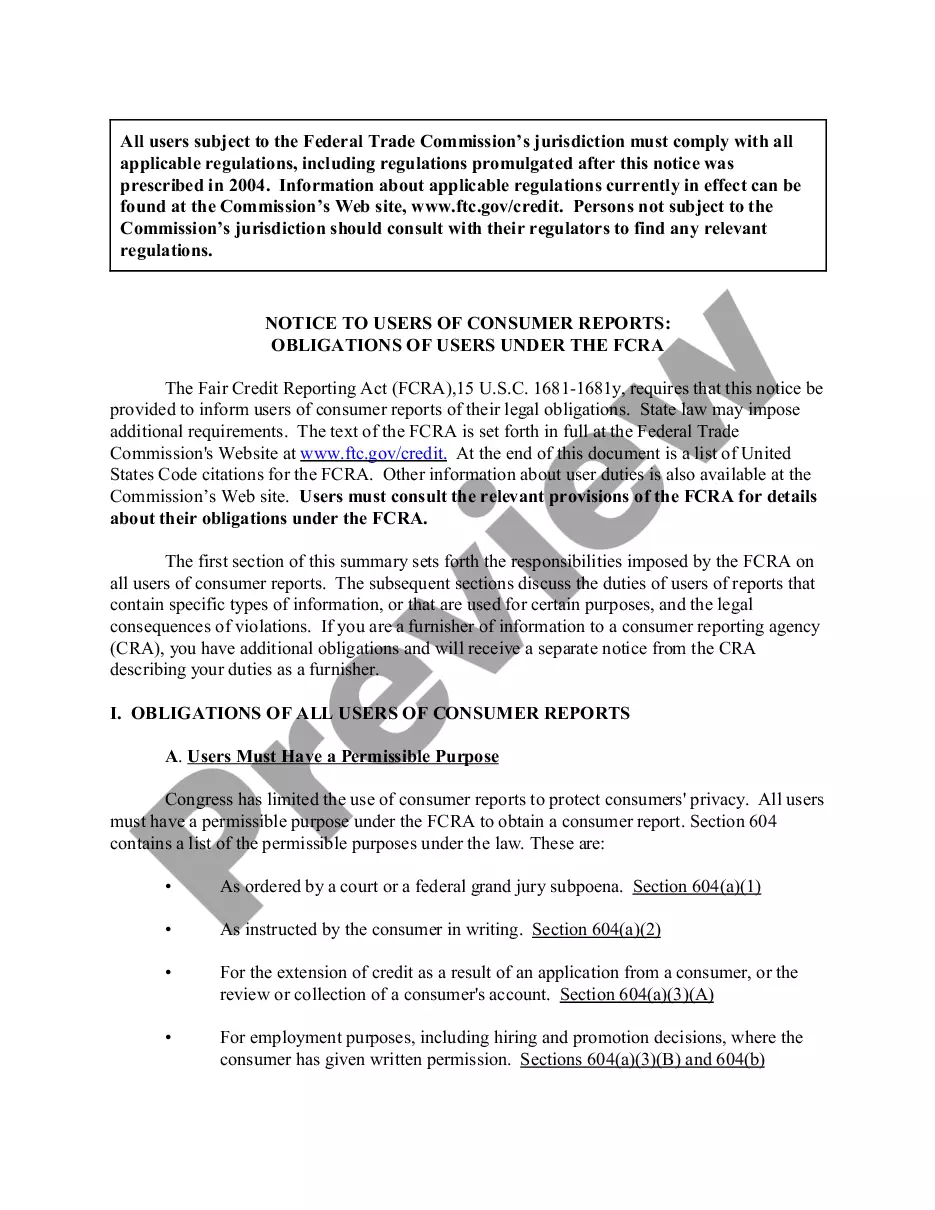
The federal Fair Credit Reporting Act (FCRA) promotes the accuracy, fairness, and privacy of information in the files of. consumer reporting agencies.
Notified the applicant or employee and got their permission to get a consumer report; complied with all of the FCRA requirements; and.