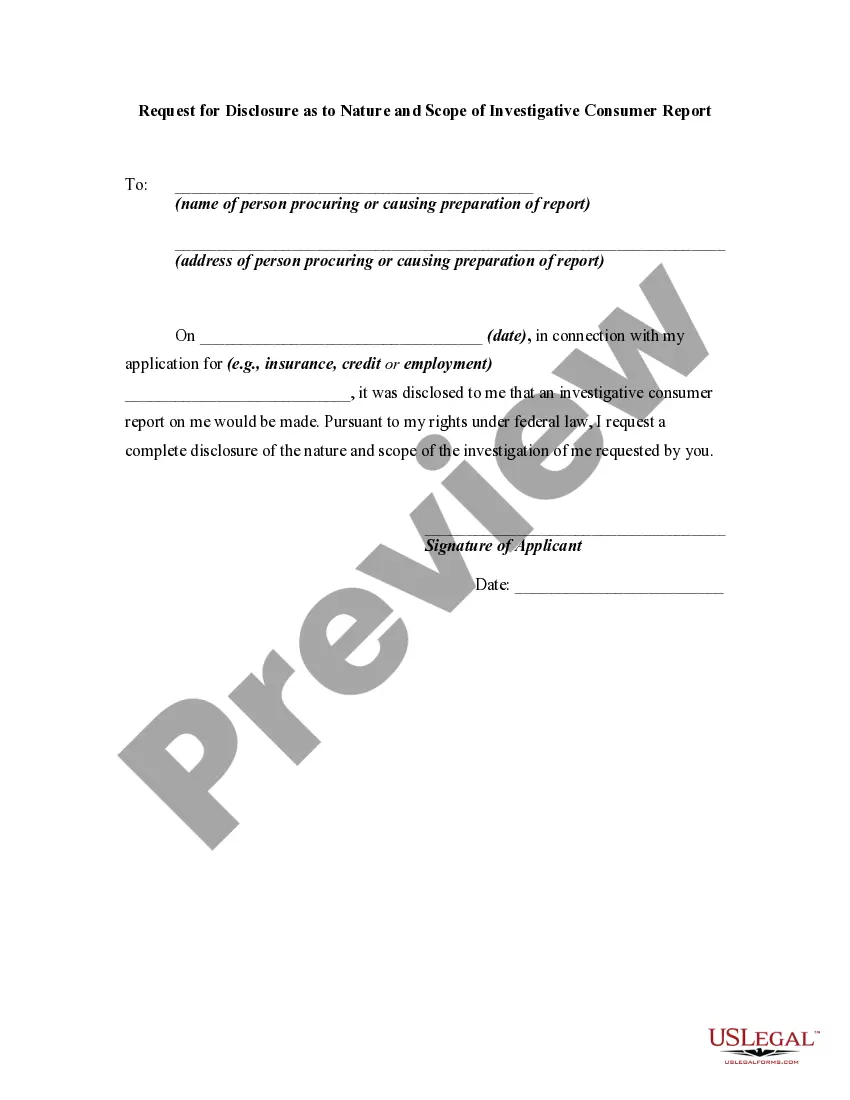
Request for Disclosure as to Nature and Scope of Investigative Consumer Report
What this document covers
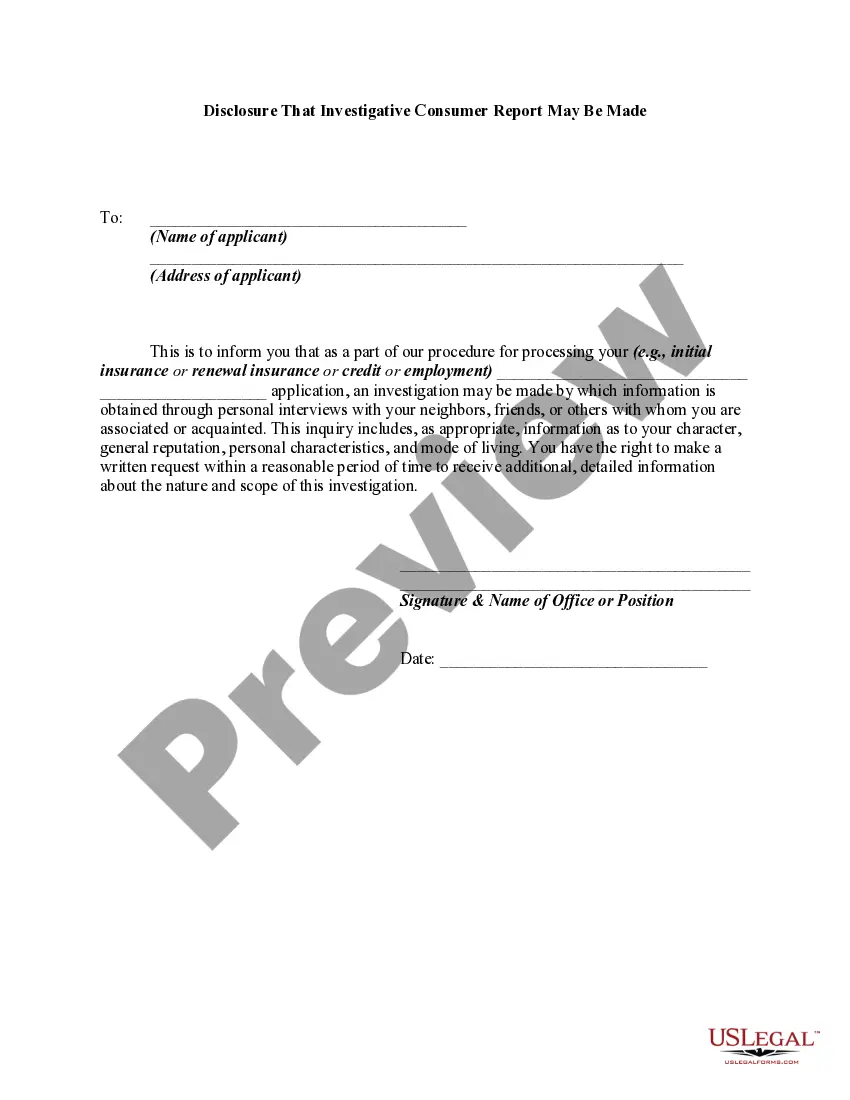
The Request for Disclosure as to Nature and Scope of Investigative Consumer Report is a legal document that allows consumers to request detailed information about the investigative consumer report supplied on them. This form is crucial under the Fair Credit Reporting Act, enabling consumers to understand the information gathered about them, when it was collected, the sources of that information, and its recipients. Unlike other consumer reporting requests, this form specifically focuses on reports used for employment or other purposes, ensuring transparency and accountability from consumer reporting agencies.
Main sections of this form
- Identification of the person procuring the report
- Date of the request
- Purpose of the report, such as insurance, credit, or employment
- Applicant's signature and date of signing
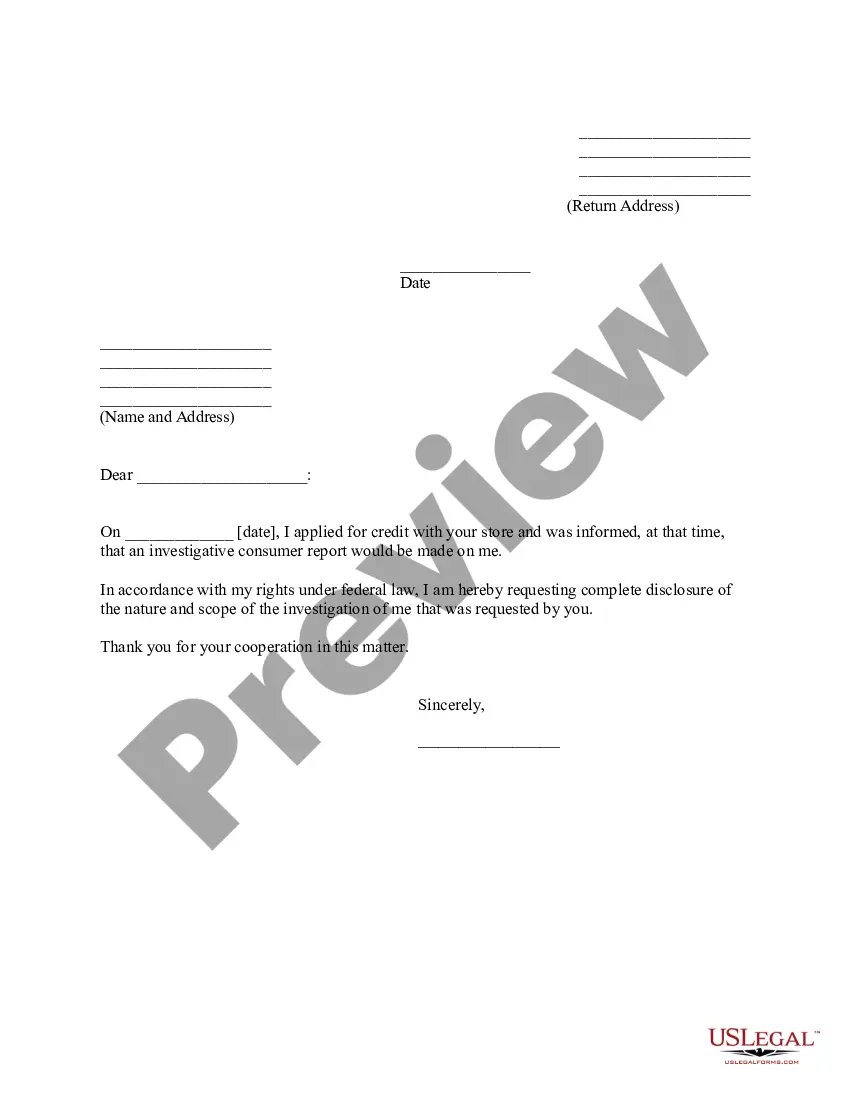
- Request for a complete disclosure regarding the report
When this form is needed
This form should be used when a consumer has been informed that an investigative consumer report will be obtained as part of their application for a job, insurance, or credit. It is essential to complete this form if you want to formally request access to details about the nature and scope of the report that affects your creditworthiness or employment eligibility.
Who can use this document
- Individuals applying for jobs where an investigative consumer report is necessary
- Consumers seeking clarity on their credit reports and how they may be used
- Anyone who wishes to dispute or understand the contents of an investigative consumer report
Steps to complete this form
- Identify the person or agency procuring the investigative consumer report by filling in their name and address.
- Enter the date of the request at the designated field.
- Specify the purpose of the report, such as "employment" or "credit application."
- Sign the form to validate the request for disclosure.
- Date your signature to mark when the request was made.
Does this form need to be notarized?
This form does not typically require notarization unless specified by local law. Users should consult their state's regulations or legal guidelines to confirm its requirements.
Get your form ready online
Our built-in tools help you complete, sign, share, and store your documents in one place.
Make edits, fill in missing information, and update formatting in US Legal Forms—just like you would in MS Word.
Download a copy, print it, send it by email, or mail it via USPS—whatever works best for your next step.
Sign and collect signatures with our SignNow integration. Send to multiple recipients, set reminders, and more. Go Premium to unlock E-Sign.
If this form requires notarization, complete it online through a secure video call—no need to meet a notary in person or wait for an appointment.
We protect your documents and personal data by following strict security and privacy standards.

Make edits, fill in missing information, and update formatting in US Legal Forms—just like you would in MS Word.

Download a copy, print it, send it by email, or mail it via USPS—whatever works best for your next step.

Sign and collect signatures with our SignNow integration. Send to multiple recipients, set reminders, and more. Go Premium to unlock E-Sign.

If this form requires notarization, complete it online through a secure video call—no need to meet a notary in person or wait for an appointment.

We protect your documents and personal data by following strict security and privacy standards.
Typical mistakes to avoid
- Forgetting to provide full identification details of the person or agency requesting the report.
- Neglecting to sign and date the form, which can render the request invalid.
- Providing an unclear purpose for the report, which may delay processing.
Why use this form online
- Convenient access to a standard form that complies with legal requirements.
- Editable fields ensure that all necessary information is captured accurately.
- Reliable source of legal forms drafted by licensed attorneys, enhancing legal clarity.
Legal Use & Context
- The form is created in accordance with the Fair Credit Reporting Act, which grants consumers rights regarding their personal information.
- Each request must be honored by the consumer reporting agency, providing transparency into how reports are generated.
- Failure to properly disclose information may result in legal consequences for the reporting agency.
What to keep in mind
- The form ensures consumers can access information about investigative consumer reports.
- It is essential for understanding potential impacts on employment, credit, or insurance applications.
- Filling it out correctly helps protect consumer rights under the Fair Credit Reporting Act.
Looking for another form?
Form popularity
FAQ
Employers should be aware that California law generally limits an investigative consumer report inquiry regarding public records to the past seven years (10 years for bankruptcy filings).
Background. Under section 609 of the FCRA, a consumer reporting agency must, upon a consumer's request, disclose to the consumer information in the consumer's file.
SEVEN-YEAR STATES: California, Colorado, Kansas, Maryland, Massachusetts, Montana, Nevada, New Hampshire, New Mexico, New York, Texas, and Washington. In some of these states, the 7-year reporting restriction for convictions only applies if the applicant does not meet a certain salary threshold.
11. How far back does an employment background check go? Typically, employers requesting an employment background screening on an applicant will request a seven-year history, although some states allow reporting information of up to 10 years.
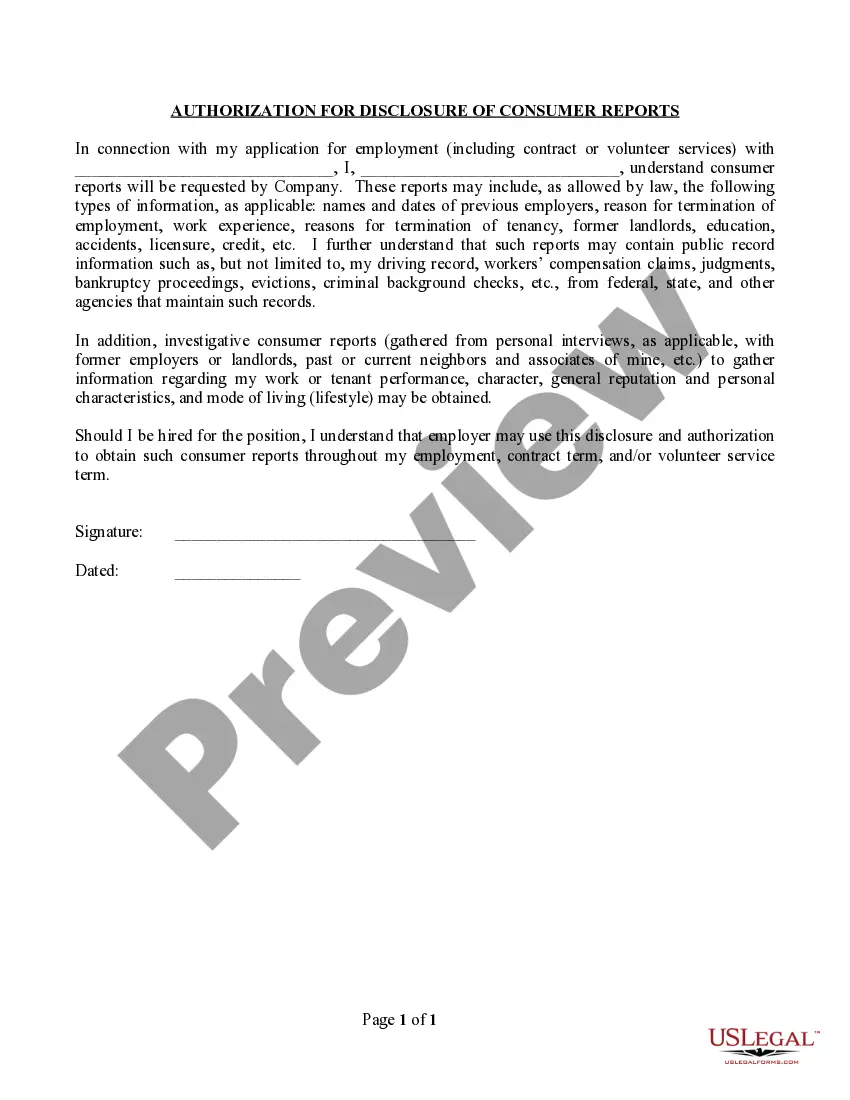
(e) The term "investigative consumer report" means a consumer report or portion thereof in which information on a consumer's character, general reputation, personal characteristics, or mode of living is obtained through personal interviews with neighbors, friends, or associates of the consumer reported on or with
California, Colorado, Kansas, Maryland, Massachusetts, Montana, Nevada, New Hampshire, New York, Texas, and Washington. However, there are some salary limitations that can change this rule. In California, if the salary is over $125,000, an employer can look as far as 10 years.
A consumer report is a collection of documents that may include credit reports, criminal and other public records such as bankruptcy filings, and records of civil court procedures and judgments. Increasingly, these records also include your activity on social media, such as Twitter and Facebook.
Nearly all background checks include a criminal-history check, based on information supplied by the candidate, including their Social Security number. Criminal background checks will reveal felony and misdemeanor criminal convictions, any pending criminal cases, and any history of incarceration as an adult.
California law follows the FCRA's general seven-year rule as the limit for reporting most negative information on an employment background check. In California, criminal convictions can only be reported for seven years unless another law requires employers to look deeper into your background.