Noise Control Study and Recommendations
What this document covers
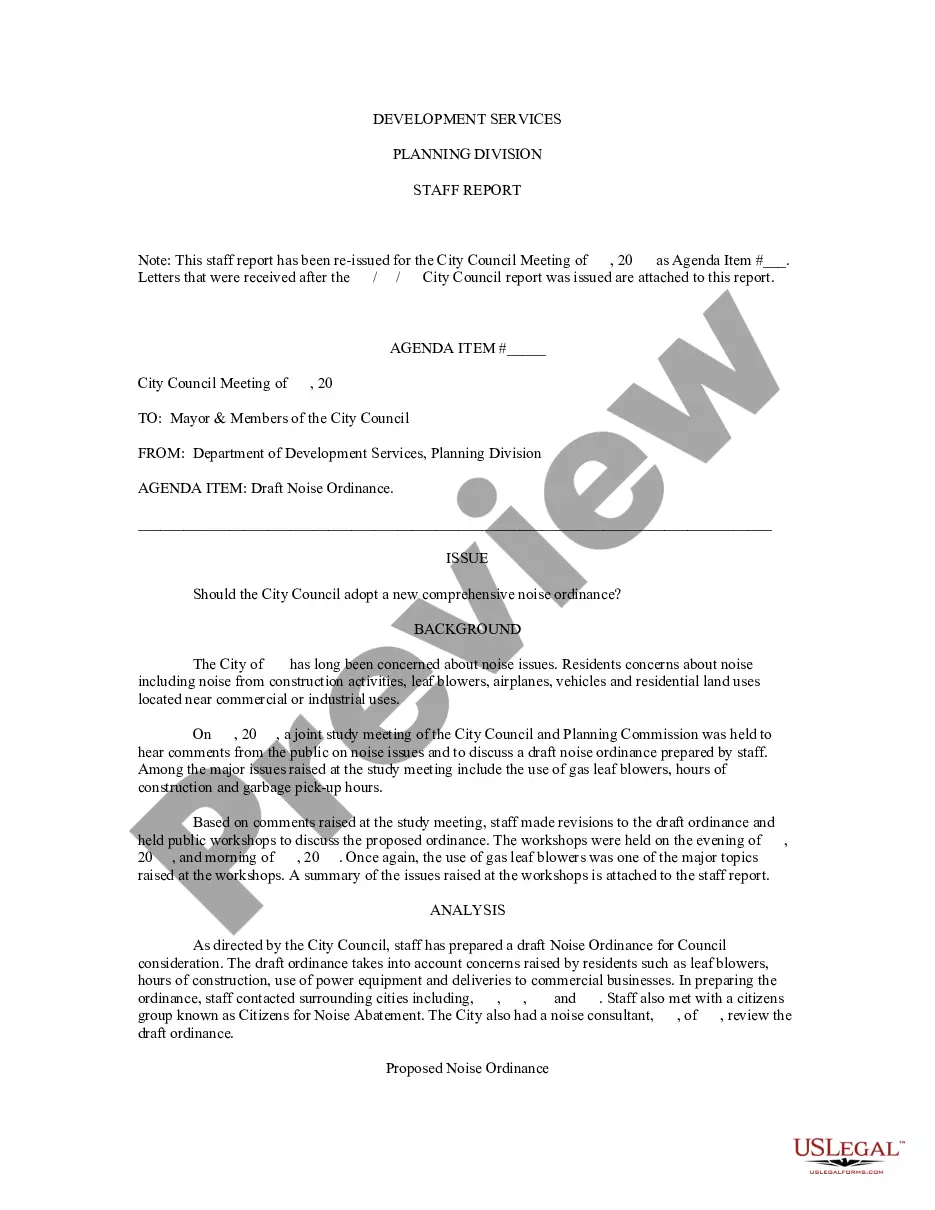
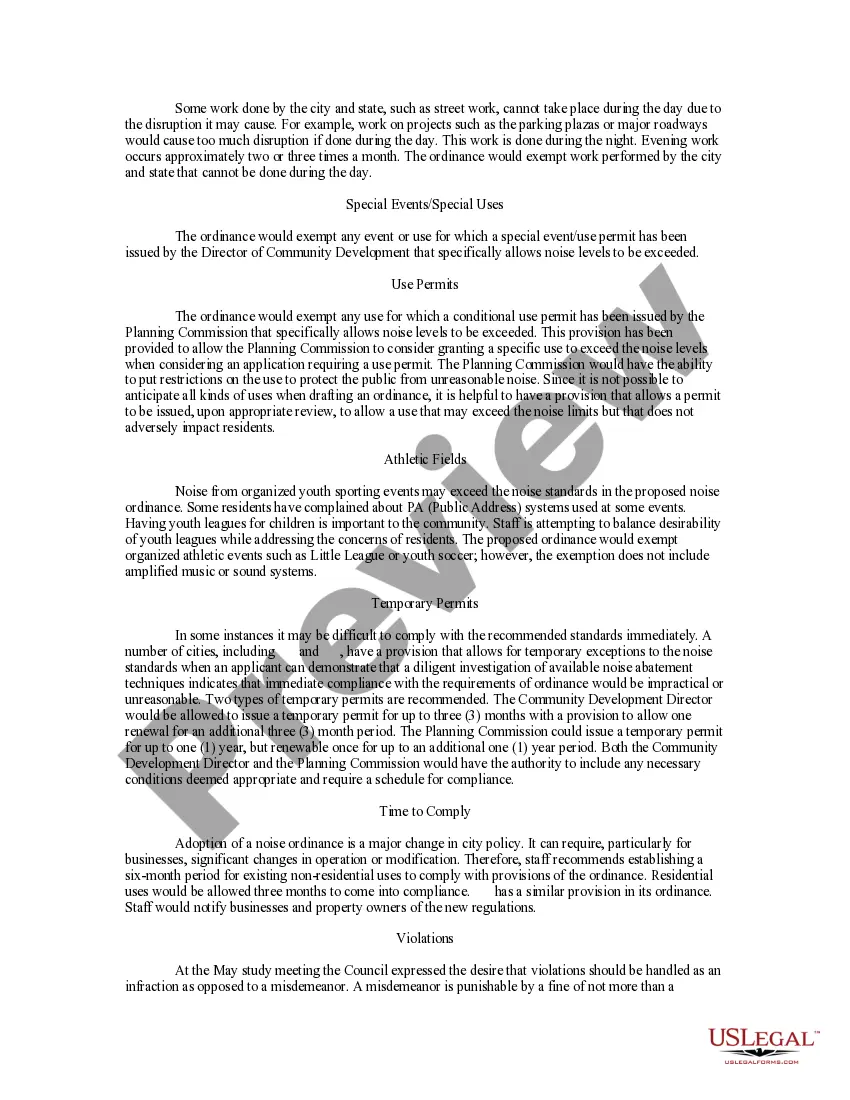
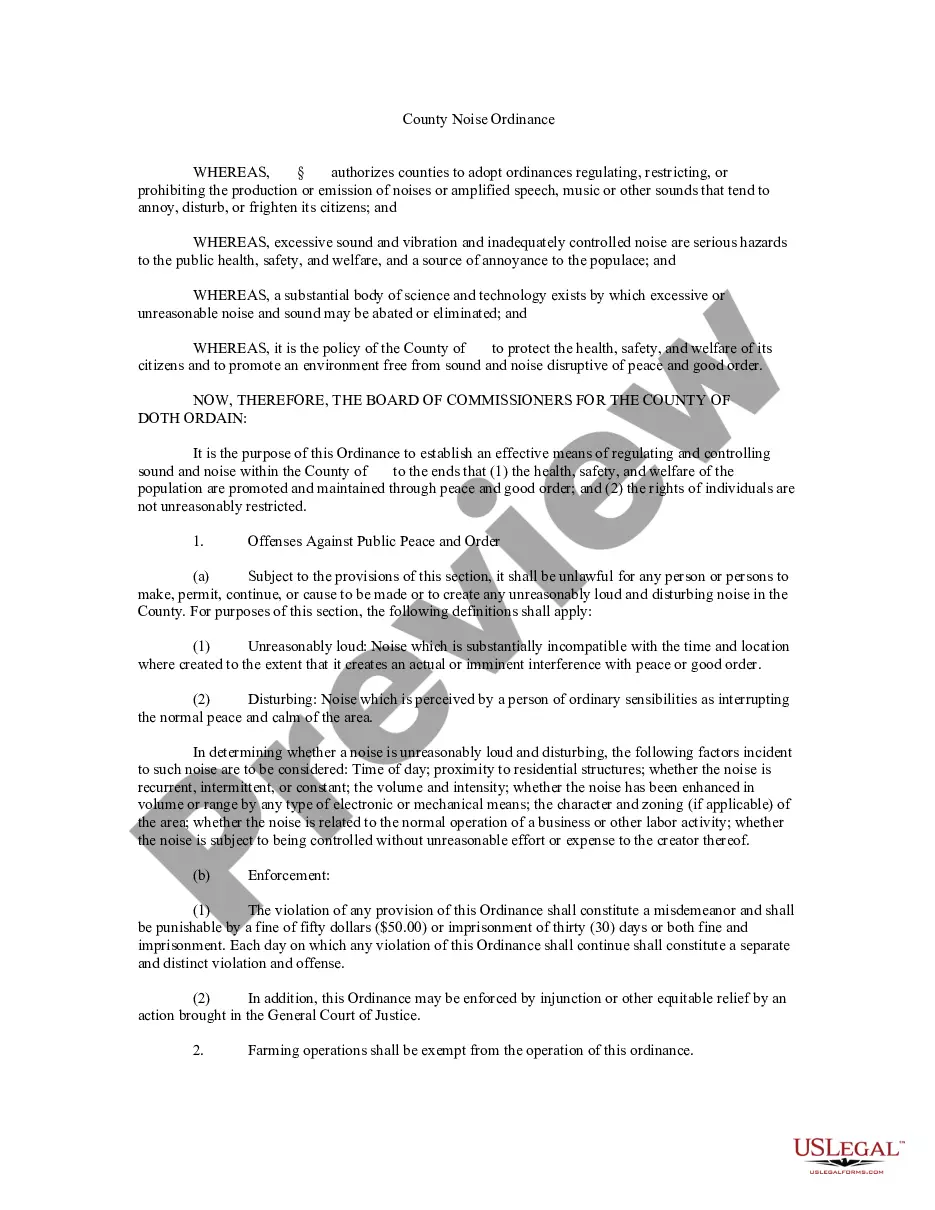
The Noise Control Study and Recommendations form is a legal document used by municipalities to draft a comprehensive noise ordinance. This form helps local governments assess noise-related issues and implement specific regulations aimed at controlling sound disturbances within their communities. Unlike general noise complaint forms, this document provides structured guidance for creating an enforceable noise control ordinance that reflects the unique needs of a jurisdiction.
What’s included in this form
- Planning Division Staff Report: A section summarizing relevant community concerns and public engagement efforts.
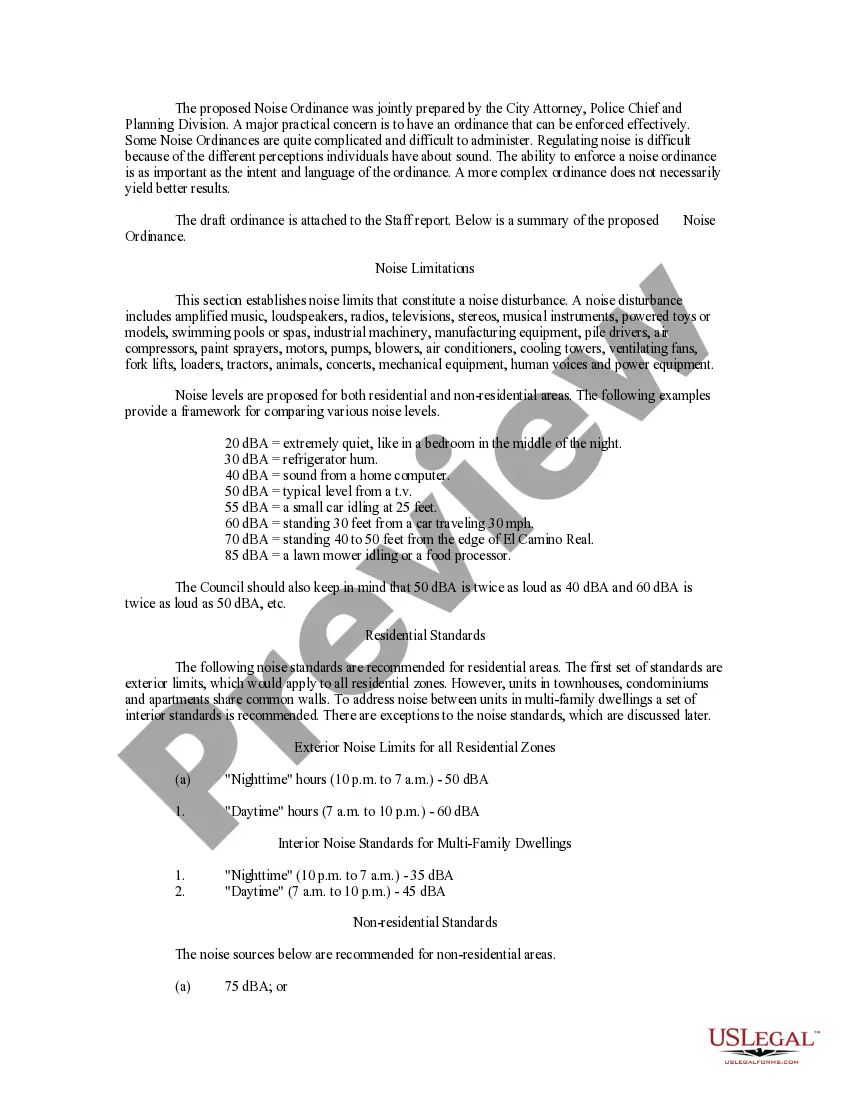
- Proposed Noise Ordinance: A detailed draft of the ordinance including noise limits and regulatory measures.
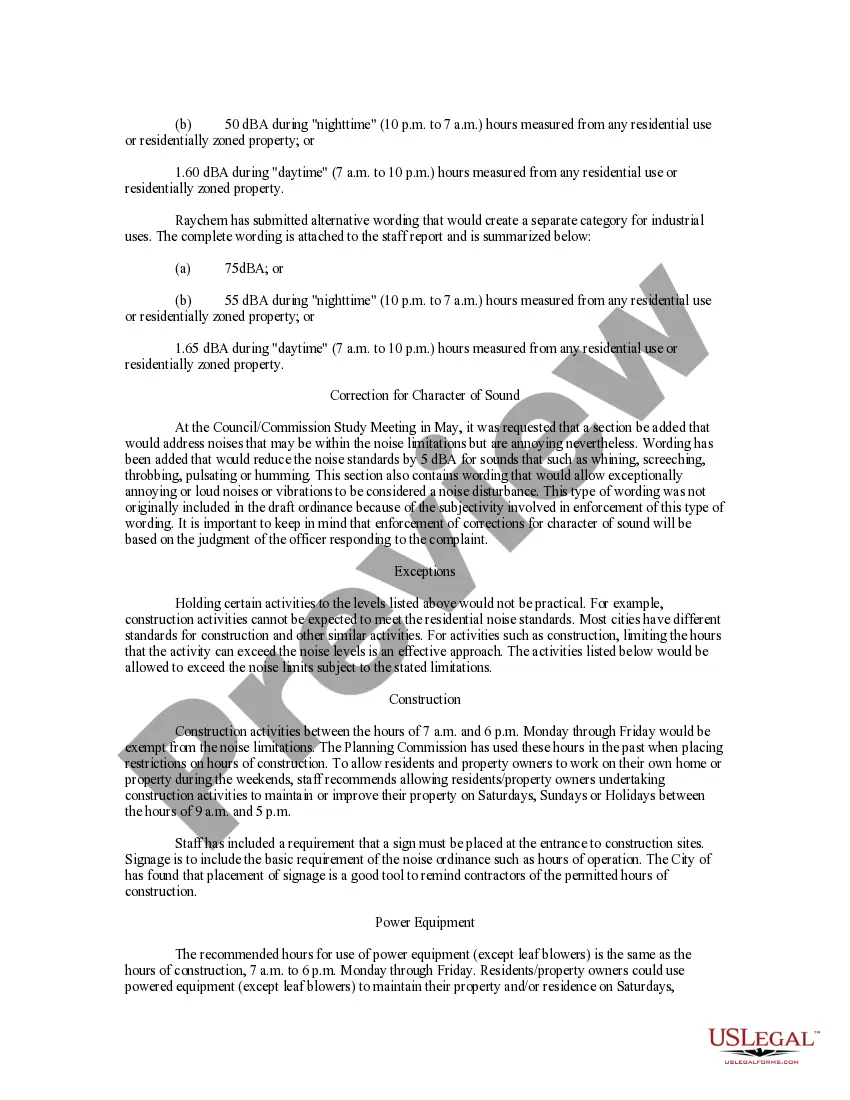
- Noise Limitations: Specific noise levels defined for residential and non-residential areas.
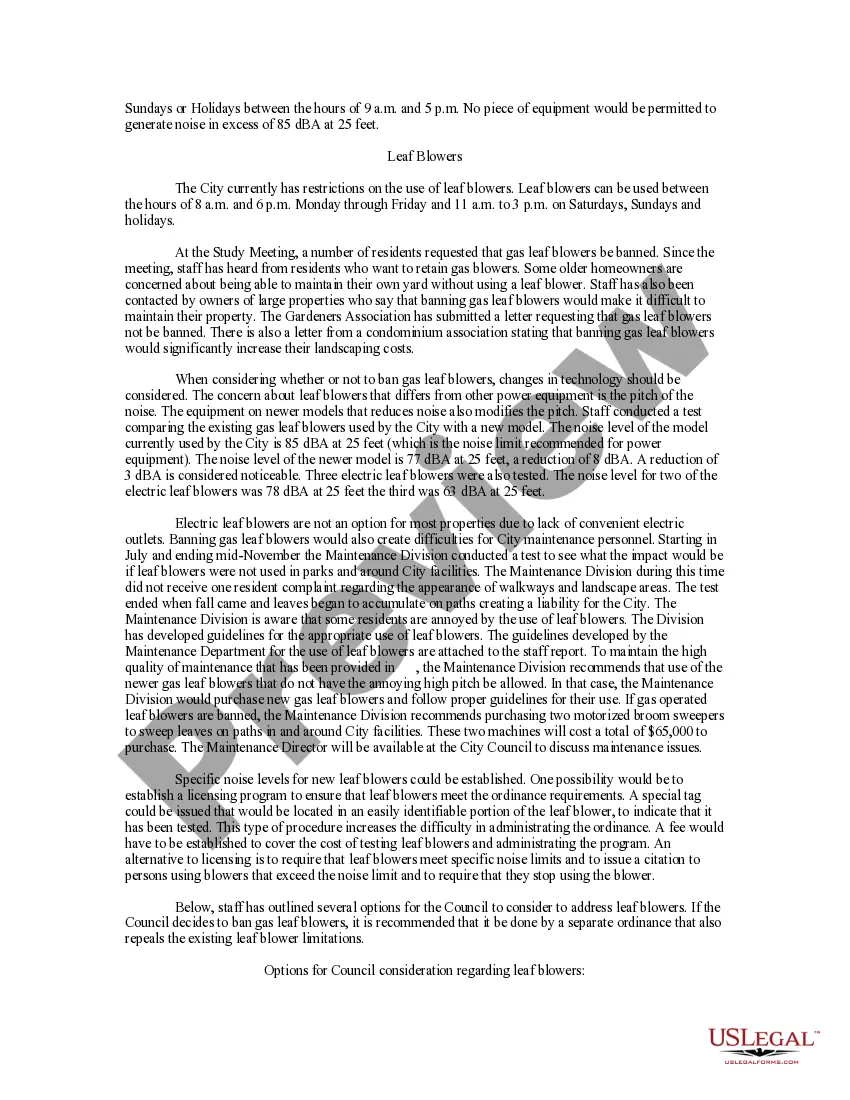
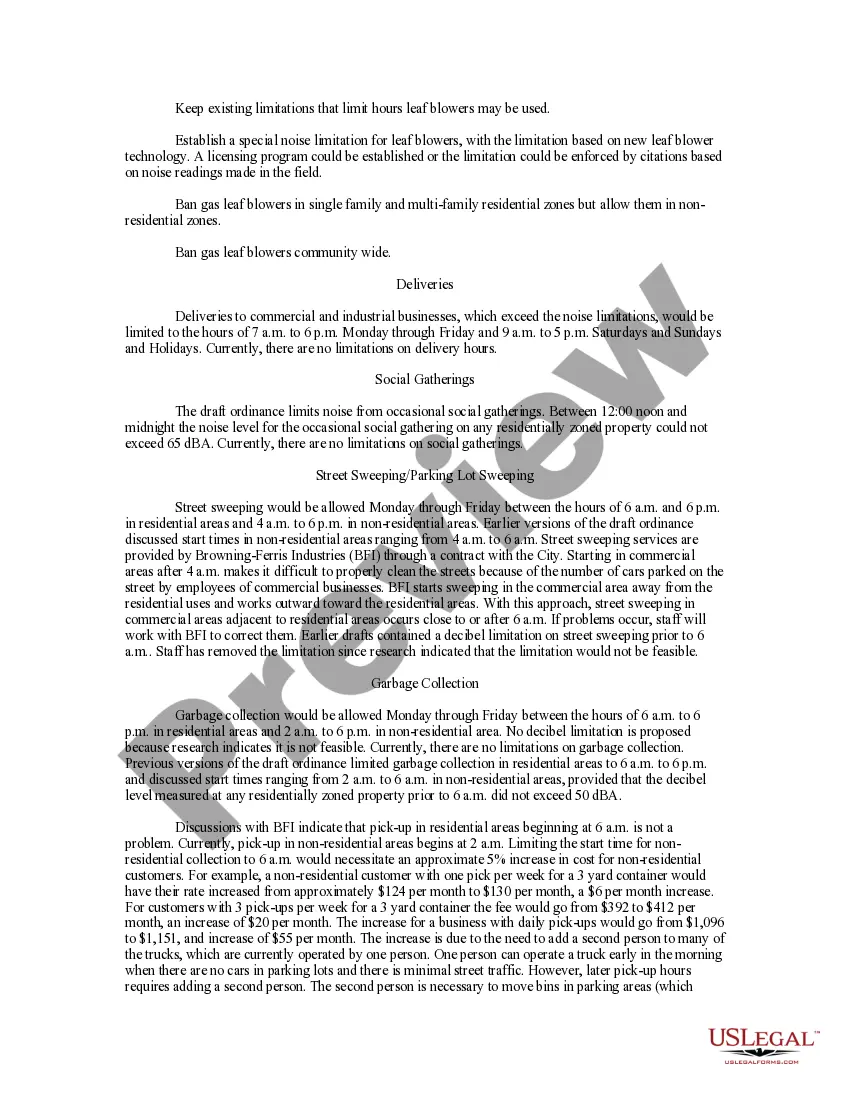
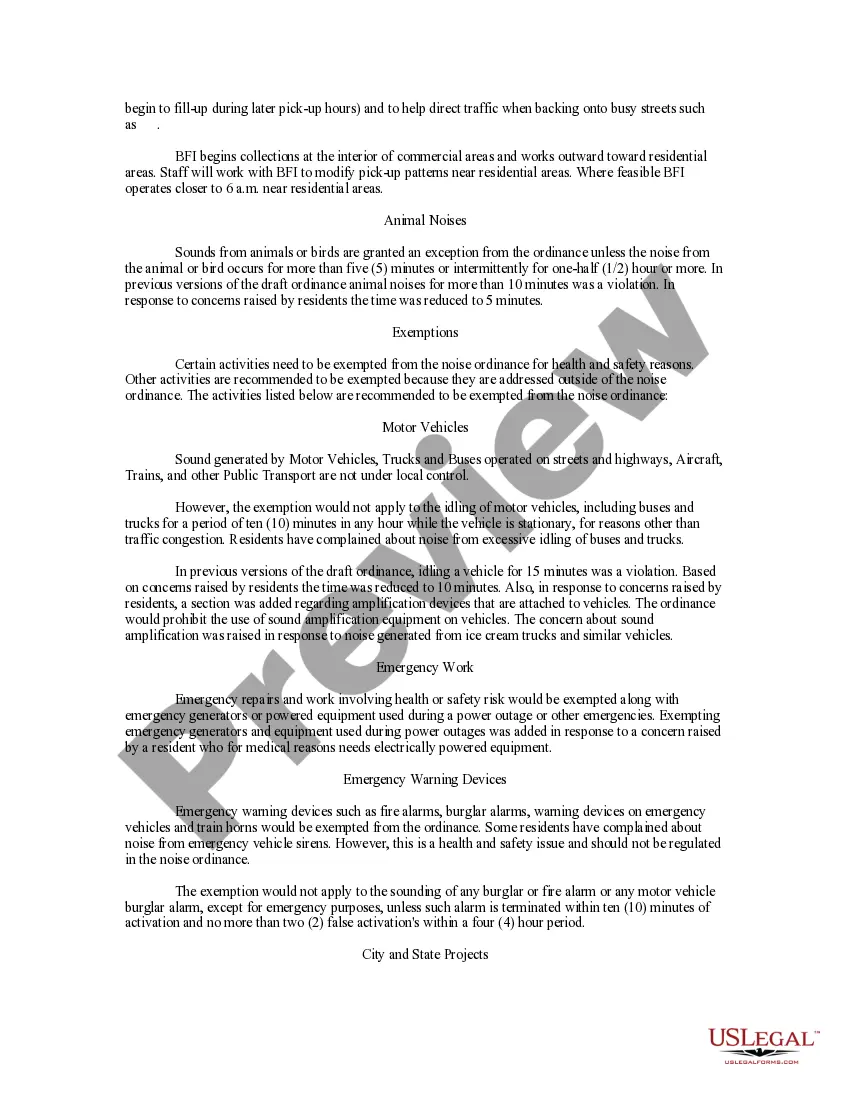
- Exemptions and Exceptions: Clear guidelines indicating activities exempt from noise regulations.
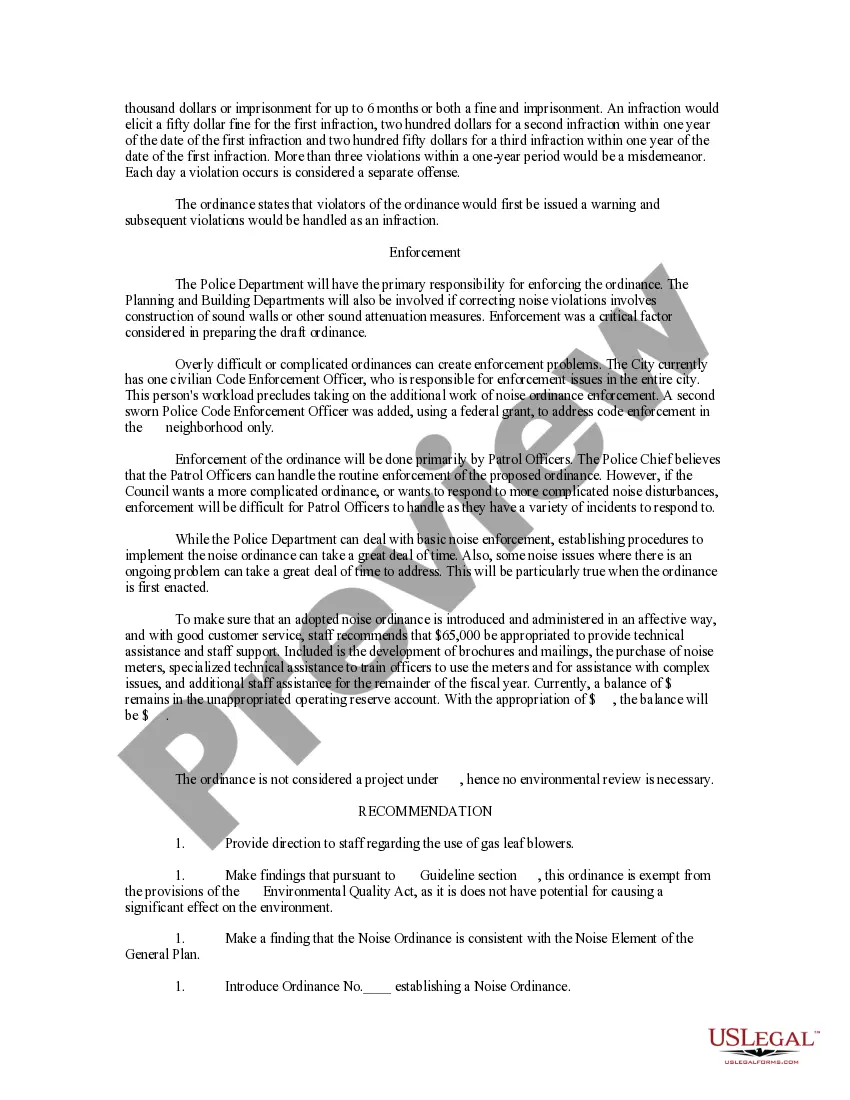
- Enforcement and Violations: Procedures for enforcing the ordinance and penalties for non-compliance.
Common use cases
This form is essential when a city or municipality needs to establish a formal noise ordinance in response to resident complaints about sound disturbances. Local governments may use it when addressing issues such as construction noise, loud music, and other sources of noise that impact the quality of life for residents. It is applicable in situations where public workshops and hearings have revealed community concerns regarding excessive noise levels.
Who can use this document
- City planners and municipal development staff responsible for drafting local noise ordinances.
- Local government officials, including city council members, interested in addressing noise issues.
- Community organizations advocating for noise control and resident quality of life.
- Legal advisors and attorneys involved in municipal law who assist jurisdictions in creating noise regulations.
Instructions for completing this form
- Review the community's noise concerns and compile public feedback received from meetings and workshops.
- Draft the proposed noise ordinance, incorporating specific noise limits and exceptions based on collected data.
- Ensure clarity in definitions of noise disturbances and set forth measurable limits for different areas.
- Outline enforcement procedures, including penalties for violations and the roles of local law enforcement.
- Present the draft ordinance to the city council for approval and make revisions as needed based on council feedback.
Notarization requirements for this form
This form does not typically require notarization to be legally valid. However, some jurisdictions or document types may still require it. US Legal Forms provides secure online notarization powered by Notarize, available 24/7 for added convenience.
Get your form ready online
Our built-in tools help you complete, sign, share, and store your documents in one place.
Make edits, fill in missing information, and update formatting in US Legal Forms—just like you would in MS Word.
Download a copy, print it, send it by email, or mail it via USPS—whatever works best for your next step.
Sign and collect signatures with our SignNow integration. Send to multiple recipients, set reminders, and more. Go Premium to unlock E-Sign.
If this form requires notarization, complete it online through a secure video call—no need to meet a notary in person or wait for an appointment.
We protect your documents and personal data by following strict security and privacy standards.

Make edits, fill in missing information, and update formatting in US Legal Forms—just like you would in MS Word.

Download a copy, print it, send it by email, or mail it via USPS—whatever works best for your next step.

Sign and collect signatures with our SignNow integration. Send to multiple recipients, set reminders, and more. Go Premium to unlock E-Sign.

If this form requires notarization, complete it online through a secure video call—no need to meet a notary in person or wait for an appointment.

We protect your documents and personal data by following strict security and privacy standards.
Avoid these common issues
- Failing to engage the community adequately before drafting the ordinance.
- Not clearly defining noise disturbances, which can lead to confusion and ineffective enforcement.
- Overcomplicating the ordinance, making it difficult for local authorities to enforce.
- Neglecting to include specific exemptions for necessary community activities.
Benefits of completing this form online
- Convenient access to legally vetted templates tailored for noise control issues.
- Editable documents allow users to customize the ordinance to fit community needs.
- Reliable guidance ensures compliance with local laws and regulations.
- Streamlined process for municipalities to adopt a cohesive noise policy.
Legal use & context
- This form serves as a basis for establishing a legally enforceable noise ordinance.
- Once adopted, the ordinance must be enforced by local authorities according to outlined procedures.
- Compliance with the ordinance is essential for protecting residents' rights and improving community living conditions.
Summary of main points
- The Noise Control Study and Recommendations form is critical for drafting effective noise regulations.
- Community input is essential in tailoring the ordinance to address specific noise-related concerns.
- Clear definitions and guidelines enhance the enforceability of noise ordinances.
- Legal compliance ensures that the ordinance serves its intended purpose without infringing on residents' rights.
Looking for another form?
Form popularity
FAQ
OSHA 1910.95 sets values for noise exposure in the workplace. The limits are based on a worker's weighted average over an eight-hour day. OSHA sets the maximum permissible exposure limit (PEL) to 90 dB(A) for everyone who works eight hours per day.
Therefore, full acoustical enclosures are generally the most common and effective noise control measure in the manufacturing environment. An acoustical enclosure functions by effectively containing the sound and then dissipating it by absorption.
Decibel Level200bSounds at or below 70 dBA are generally considered safe. Any sound at or above 85 dBA is more likely to damage your hearing over time. Researchers have found that people who are exposed over long periods of time to noise levels at 85 dBA or higher are at a much greater risk for hearing loss.
OSHA sets legal limits on noise exposure in the workplace. These limits are based on a worker's time weighted average over an 8 hour day. With noise, OSHA's permissible exposure limit (PEL) is 90 dBA for all workers for an 8 hour day. The OSHA standard uses a 5 dBA exchange rate.
To avoid acute mechanical damage to the inner ear, adults should never be exposed to more than 140 dB peak sound pressure. To account for the vulnerability in children, the peak sound pressure level produced by toys should not surpass 120 dB, measured close to the ears (100 mm).
Decibel Level200b Sounds at or below 70 dBA are generally considered safe. Any sound at or above 85 dBA is more likely to damage your hearing over time. Researchers have found that people who are exposed over long periods of time to noise levels at 85 dBA or higher are at a much greater risk for hearing loss.
The U.S. Environmental Protection Agency (EPA) and the World Health Organization (WHO) recommend maintaining environmental noises below 70 dBA over 24-hours (75 dBA over 8-hours) to prevent noise-induced hearing loss.
Background: The World Health Organization (WHO) recommends sound levels of 35 dB(A) during the day and 30 dB(A) during the night; however, many hospitals exceed these recommended levels.
OSHA sets legal limits on noise exposure in the workplace. These limits are based on a worker's time weighted average over an 8 hour day. With noise, OSHA's permissible exposure limit (PEL) is 90 dBA for all workers for an 8 hour day. The OSHA standard uses a 5 dBA exchange rate.