Risk Evaluation Specialist Report
What is this form?
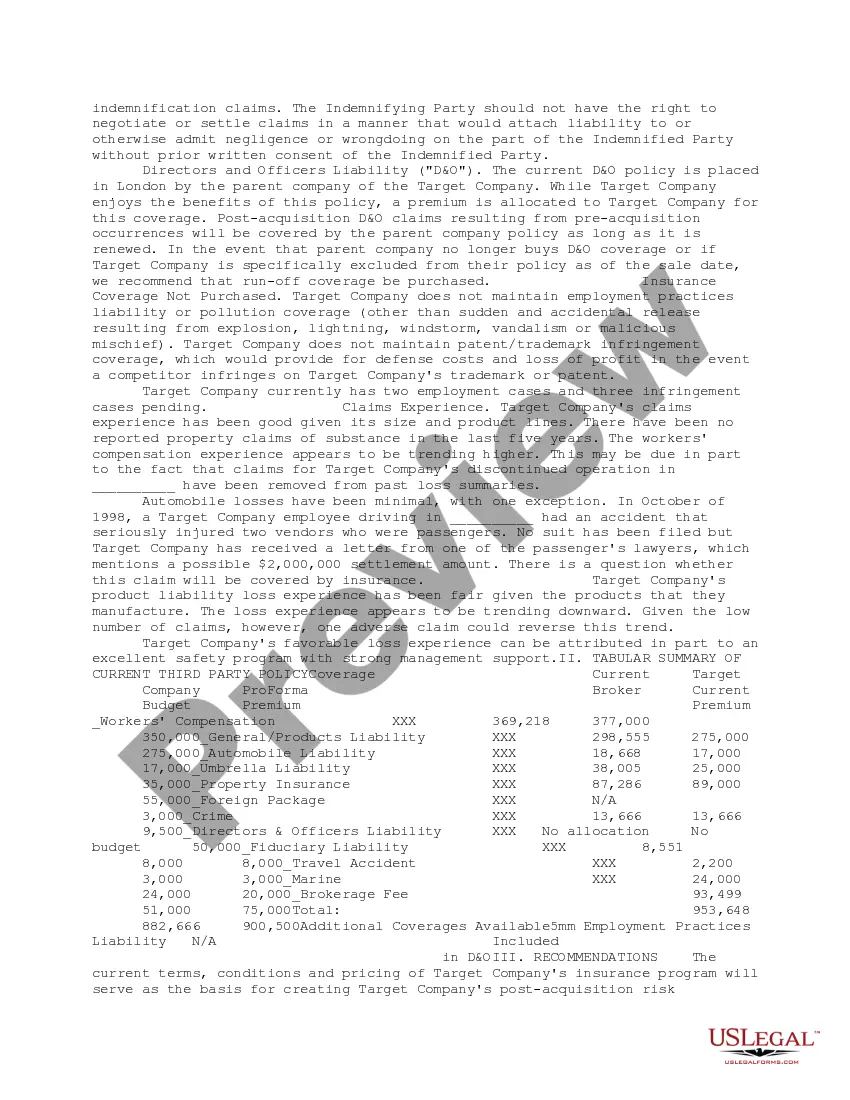
The Risk Evaluation Specialist Report is a comprehensive document that details the preliminary findings regarding an organizationâs risk management procedures in relation to business transactions. This form is designed to assess the likelihood and potential impact of risks, thereby providing a clear picture of a company's insurance needs and other liabilities. It differs from similar forms by including an in-depth review of insurance policies and a specific analysis of risk exposure relevant to the target corporation.
What’s included in this form
- Insurance review of the target corporation
- Summary of findings, including levels of exposure
- Accrual assessment for outstanding liabilities
- Pro forma program and cost comparison
- Current and historical program assessments
- Purchase and sale agreement issues
- Recommendations for structuring an independent insurance program







Common use cases
This form is useful when conducting due diligence during mergers, acquisitions, or other business transactions. It can help identify potential risks and liabilities that may affect the financial health of the acquiring entity. Additionally, it is warranted when there are significant changes in business operations that may expose the company to new risks.
Who this form is for
- Business owners or executives involved in acquisitions
- Risk evaluation specialists or insurance consultants
- Mergers and acquisitions professionals
- Corporate lawyers advising on business transactions
How to complete this form
- Identify and fill in the basic information about the target corporation, including name and contact details.
- Summarize the findings from the risk management procedures and insurance review.
- Detail any unacceptable levels of exposure identified during the assessment.
- Include all recommendations for modifying the current insurance programs.
- Ensure all parties involved review and sign the document, if necessary.
Does this document require notarization?
This form does not typically require notarization unless specified by local law. Users should check jurisdictional rules to ensure compliance.
Get your form ready online
Our built-in tools help you complete, sign, share, and store your documents in one place.
Make edits, fill in missing information, and update formatting in US Legal Forms—just like you would in MS Word.
Download a copy, print it, send it by email, or mail it via USPS—whatever works best for your next step.
Sign and collect signatures with our SignNow integration. Send to multiple recipients, set reminders, and more. Go Premium to unlock E-Sign.
If this form requires notarization, complete it online through a secure video call—no need to meet a notary in person or wait for an appointment.
We protect your documents and personal data by following strict security and privacy standards.

Make edits, fill in missing information, and update formatting in US Legal Forms—just like you would in MS Word.

Download a copy, print it, send it by email, or mail it via USPS—whatever works best for your next step.

Sign and collect signatures with our SignNow integration. Send to multiple recipients, set reminders, and more. Go Premium to unlock E-Sign.

If this form requires notarization, complete it online through a secure video call—no need to meet a notary in person or wait for an appointment.

We protect your documents and personal data by following strict security and privacy standards.
Common mistakes to avoid
- Failing to review all pertinent insurance policies thoroughly.
- Neglecting to include all necessary signatures and dates.
- Omitting critical liabilities or exposures during the assessment.
- Not consulting with a qualified legal professional when finalizing the document.
Benefits of using this form online
- Convenient access to customizable templates that can be tailored to specific needs.
- Immediate downloads allow for quick initiation of due diligence processes.
- Enhanced reliability through attorney-drafted forms ensuring legal soundness.
- This report can serve as a legal document in negotiations and transactions involving the target corporation.
- It aids in establishing due diligence to protect against potential liabilities in business deals.
- It's essential for ensuring that all identified risks are appropriately communicated to stakeholders.
What to keep in mind
- The Risk Evaluation Specialist Report provides critical insights into risk management and insurance needs during business transactions.
- It is essential for parties involved in M&A to understand potential liabilities for informed decision-making.
- Proper completion and review of the form can mitigate future financial risks.
Looking for another form?


Form popularity
FAQ
Step 1: List down the Risks. The first step in the process begins with the listing down of all the risks that the participants can think of. Step 2: Rate for Probability and Impact. Step 3: Classify the Risks. Step 4: Decide on Mitigation Planning.
Identify the hazards. Decide who might be harmed and how. Evaluate the risks and decide on control measures. Record your findings and implement them. Review your assessment and update if necessary.
There are four parts to any good risk assessment and they are Asset identification, Risk Analysis, Risk likelihood & impact, and Cost of Solutions. Asset Identification This is a complete inventory of all of your company's assets, both physical and non-physical.
A risk matrix is a matrix that is used during risk assessment to define the level of risk by considering the category of probability or likelihood against the category of consequence severity. This is a simple mechanism to increase visibility of risks and assist management decision making.
Identify hazards. Determine the likelihood of harm, such as an injury or illness occurring, and its severity. Identify actions necessary to eliminate the hazard, or control the risk using the hierarchy of risk control methods.
Step 1: Identify Hazards. Relating to your scope, brainstorm potential hazards. Step 2: Calculate Likelihood. For each hazard, determine the likelihood it will occur. Step 3: Calculate Consequences. Step 4: Calculate Risk Rating. Step 5: Create an Action Plan. Step 6: Plug Data into Matrix.
Identify hazards in risk assessment. Establish who might be harmed and how in risk assessment. Evaluate and decide on precautions in risk assessment. Record and share key findings of risk assessment. Review risk assessment regularly.
Step 1: Identify the hazards. Step 2: Decide who might be harmed and how. Step 3: Evaluate the risks and decide on precautions. Step 4: Record your findings and implement them. Step 5: Review your risk assessment and update if.
Identify hazards in risk assessment. Establish who might be harmed and how in risk assessment. Evaluate and decide on precautions in risk assessment. Record and share key findings of risk assessment. Review risk assessment regularly.