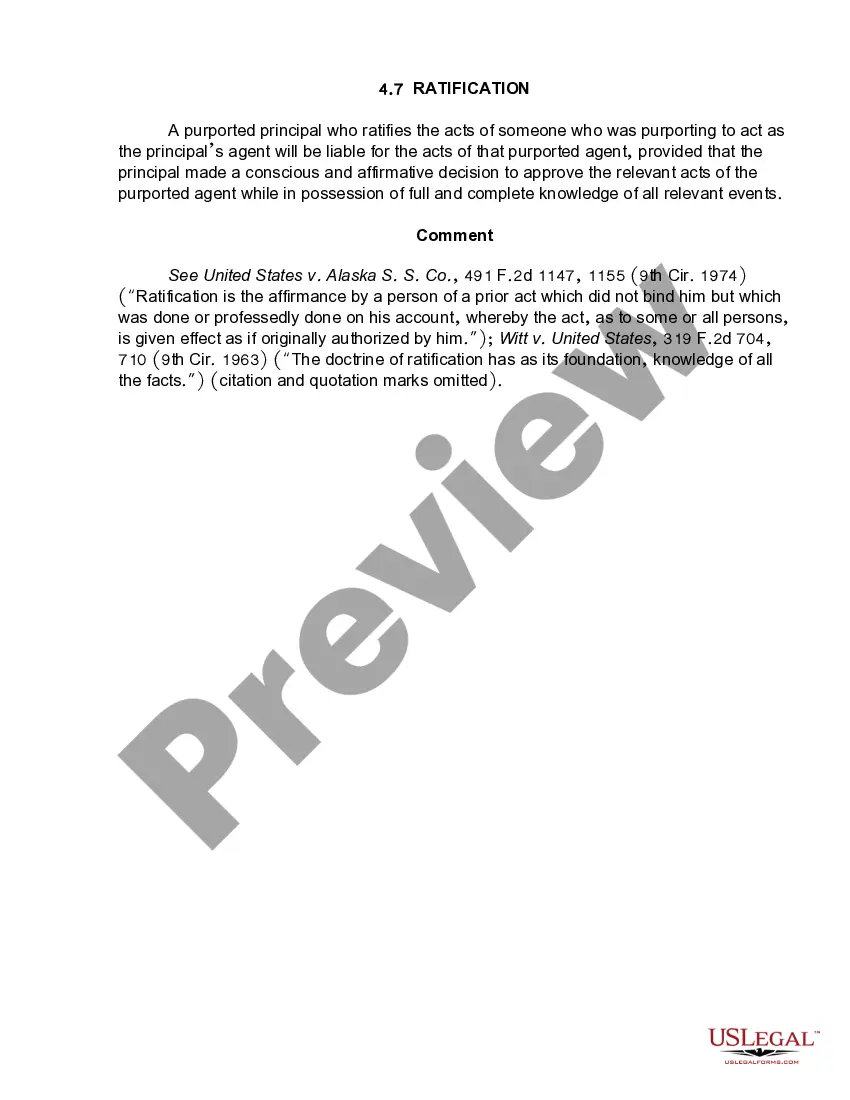
4.7 Ratification
Is notarization required?
This form usually doesn’t need to be notarized. However, local laws or specific transactions may require it. Our online notarization service, powered by Notarize, lets you complete it remotely through a secure video session, available 24/7.
Get your form ready online
Our built-in tools help you complete, sign, share, and store your documents in one place.
Make edits, fill in missing information, and update formatting in US Legal Forms—just like you would in MS Word.
Download a copy, print it, send it by email, or mail it via USPS—whatever works best for your next step.
Sign and collect signatures with our SignNow integration. Send to multiple recipients, set reminders, and more. Go Premium to unlock E-Sign.
If this form requires notarization, complete it online through a secure video call—no need to meet a notary in person or wait for an appointment.
We protect your documents and personal data by following strict security and privacy standards.

Make edits, fill in missing information, and update formatting in US Legal Forms—just like you would in MS Word.

Download a copy, print it, send it by email, or mail it via USPS—whatever works best for your next step.

Sign and collect signatures with our SignNow integration. Send to multiple recipients, set reminders, and more. Go Premium to unlock E-Sign.

If this form requires notarization, complete it online through a secure video call—no need to meet a notary in person or wait for an appointment.

We protect your documents and personal data by following strict security and privacy standards.
Looking for another form?





Form popularity
FAQ
The text of Article VII declares that the Constitution shall become the official law of the ratifying states when nine states ratified the document. When New Hampshire became the ninth state to ratify on June 21, 1788, the Constitution became good law. End of story.
In the spring and summer of 1776, the Second Continental Congress gathered in Philadelphia to debate declaring independence from King George III and the British Parliament.
On June 21, 1788, the Constitution became the official framework of the government of the United States of America when New Hampshire became the ninth of 13 states to ratify it. The journey to ratification, however, was a long and arduous process.
The Continental Congress adopted the Declaration of Independence on July 4, 1776. It was engrossed on parchment and on August 2, 1776, delegates began signing it.
On September 17, 1787, the Constitution of the United States was finally accepted by the delegates. It did not contain any sort of Bill of Rights, even though that question had been heavily debated. Of the 42 delegates still present at the convention when it was finished, 39 signed the Constitution.
Citation: Signed Copy of the Constitution of the United States; Miscellaneous Papers of the Continental Congress, 1774-1789; Records of the Continental and Confederation Congresses and the Constitutional Convention, 1774-1789, Record Group 360; National Archives.
The Continental Congress adopted the Declaration of Independence on July 4, 1776. It was engrossed on parchment and on August 2, 1776, delegates began signing it.
On September 17, 1787, a group of men gathered in a closed meeting room to sign the greatest vision of human freedom in history, the U.S. Constitution. And it was Benjamin Franklin who made the motion to sign the document in his last great speech.