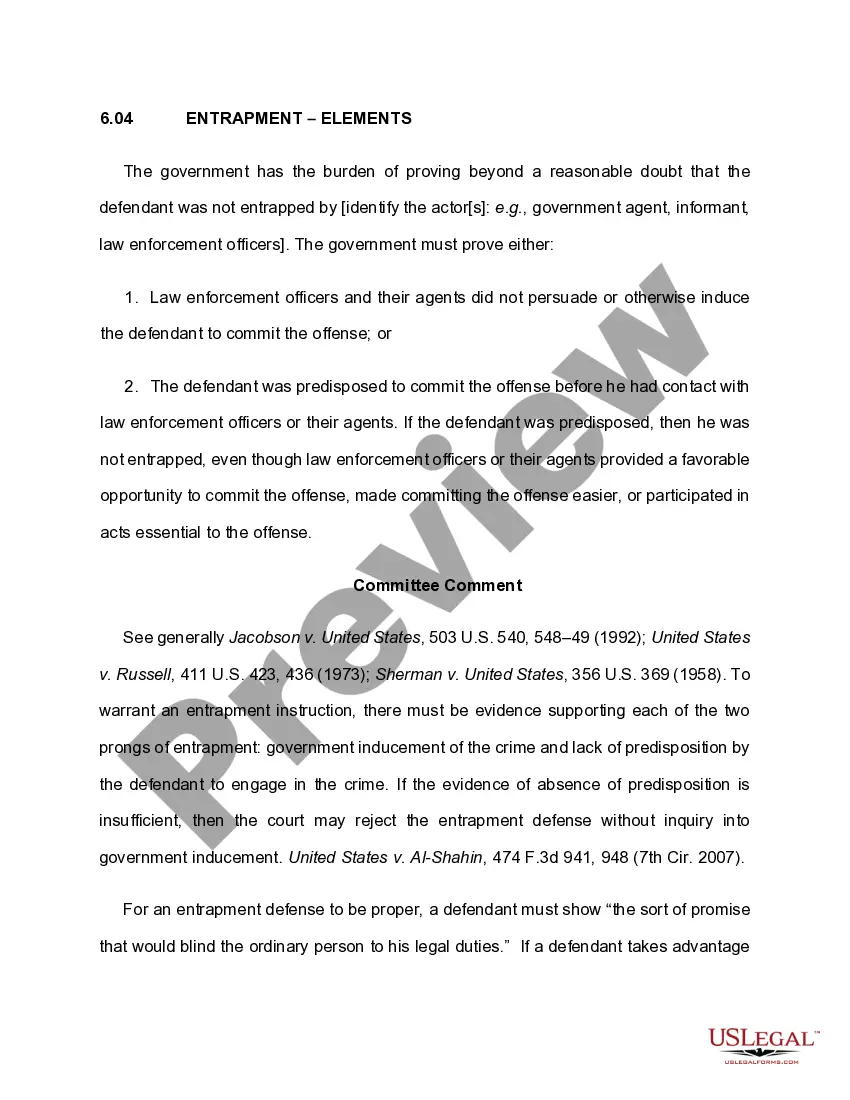
6.04 ENTRAPMENT - ELEMENTS
Overview of this form
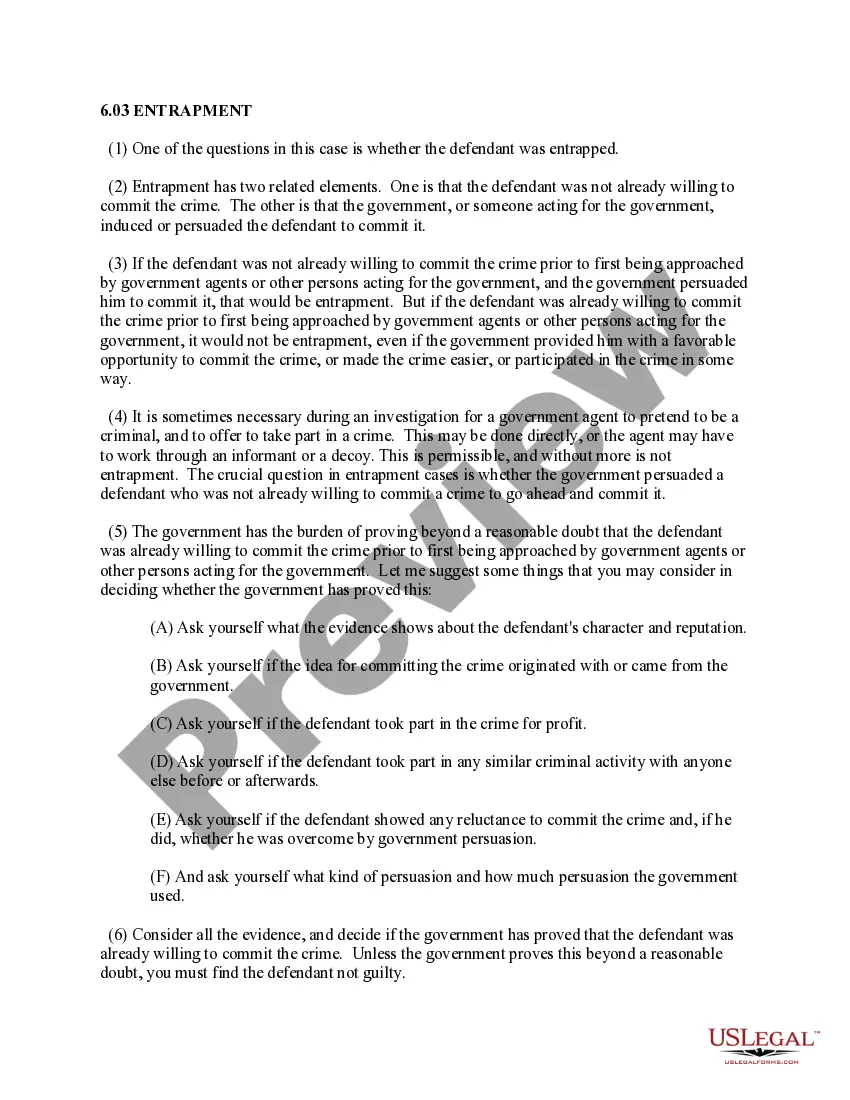
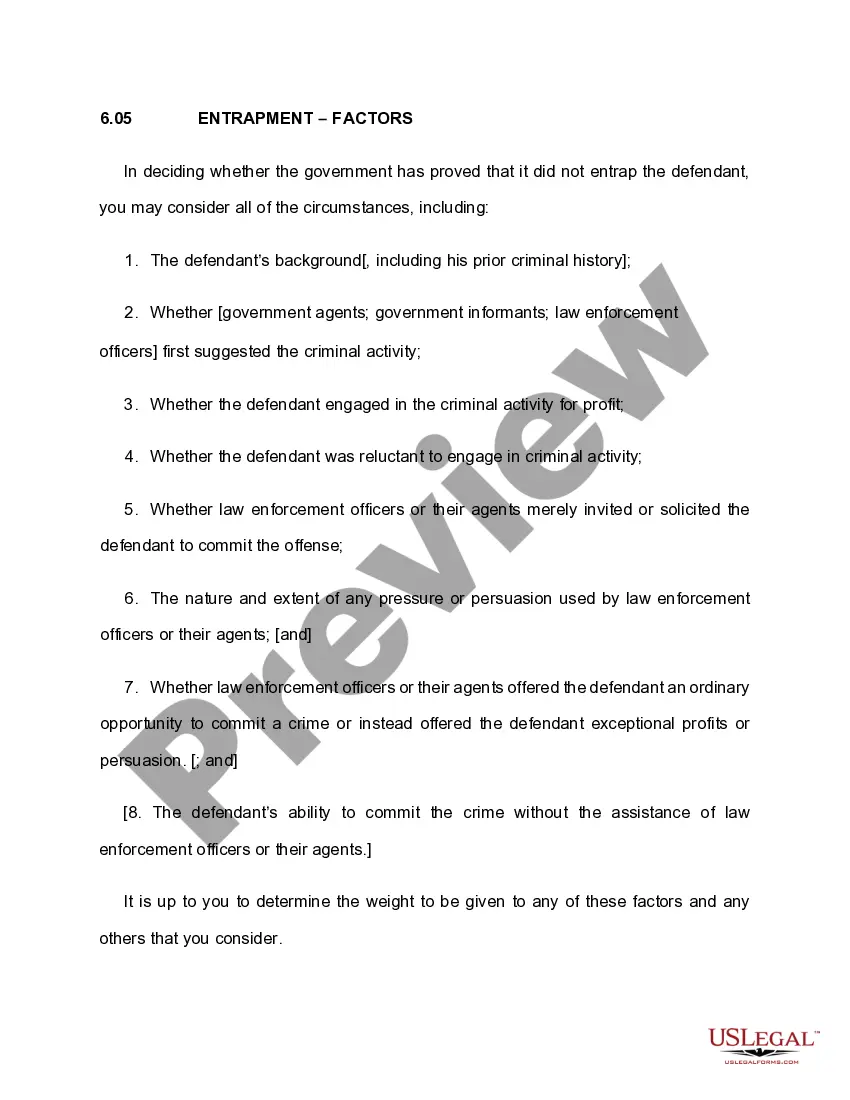
The 6.04 Entrapment - Elements form is a legal instruction used in federal court proceedings, specifically in the context of criminal cases. It outlines the government's burden of proof when a defendant raises an entrapment defense. This instruction is crucial for determining whether law enforcement officers induced the defendant to commit a crime. Unlike other forms, this instruction specifically highlights the two-elements required for proving or disproving entrapment, ensuring a comprehensive understanding of this defense in court.
Main sections of this form
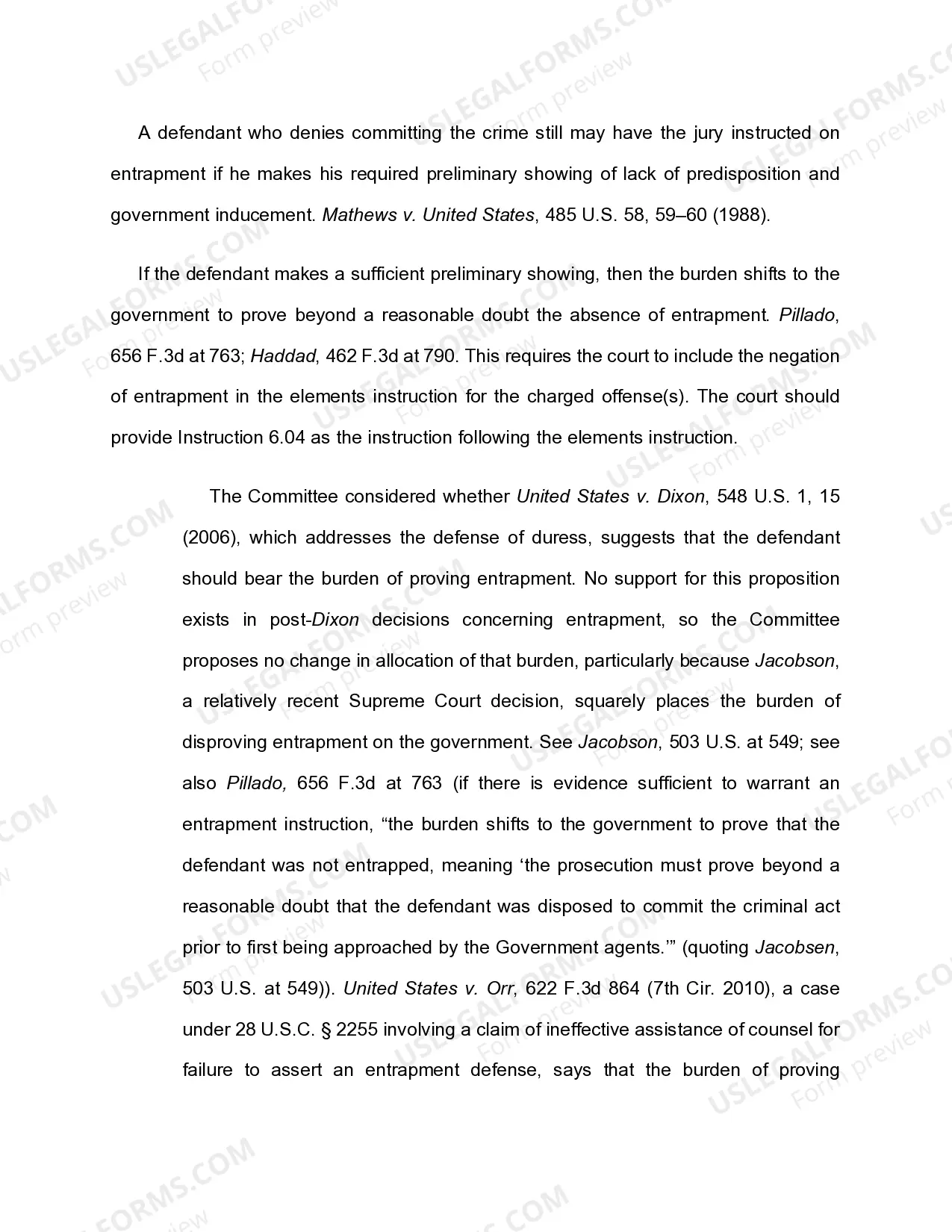
- The government's burden to prove beyond a reasonable doubt that the defendant was not entrapped.
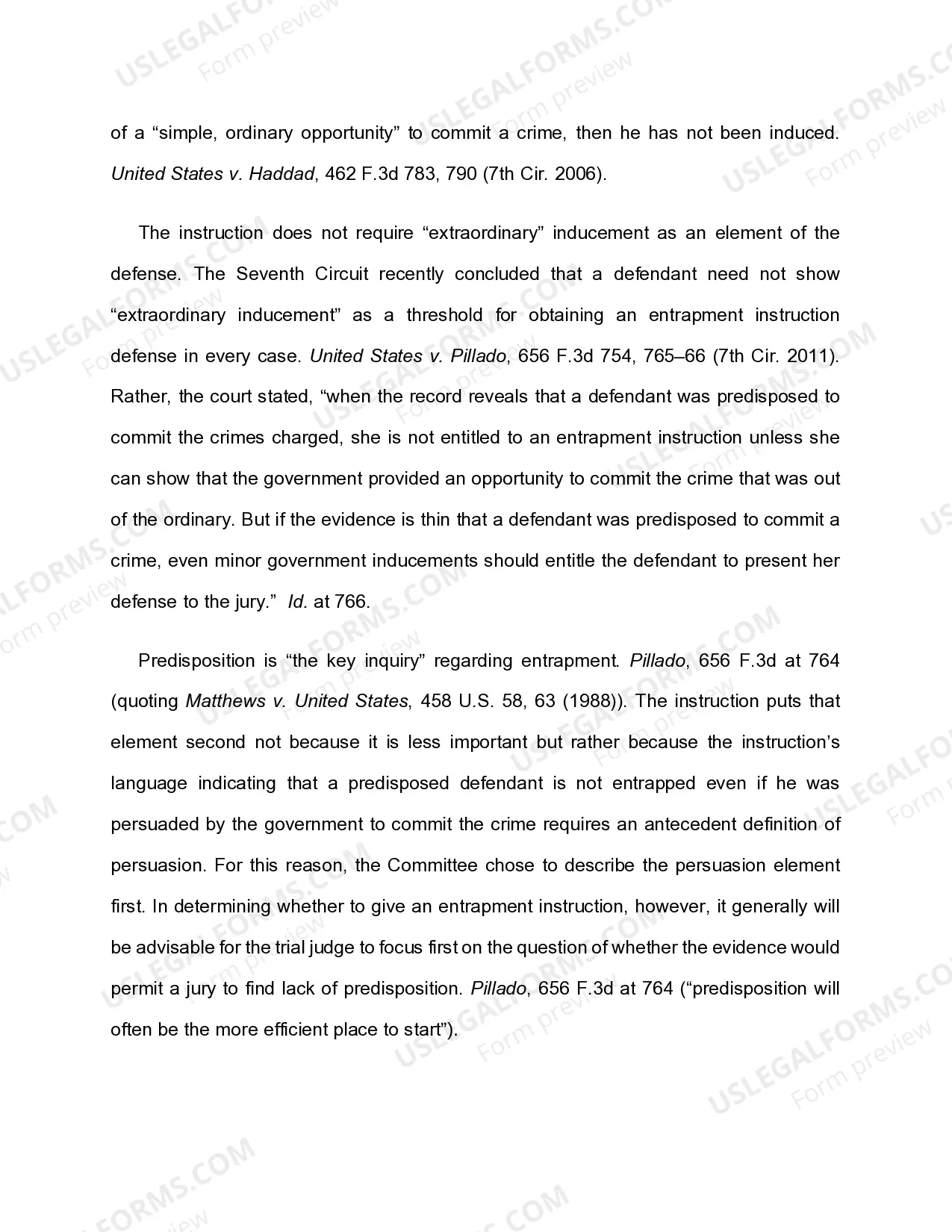
- Two prongs must be established: lack of government inducement and the defendant's predisposition to commit the offense.
- Clarification that even if law enforcement provided opportunities, entrapment defense can still hold if predisposition is absent.
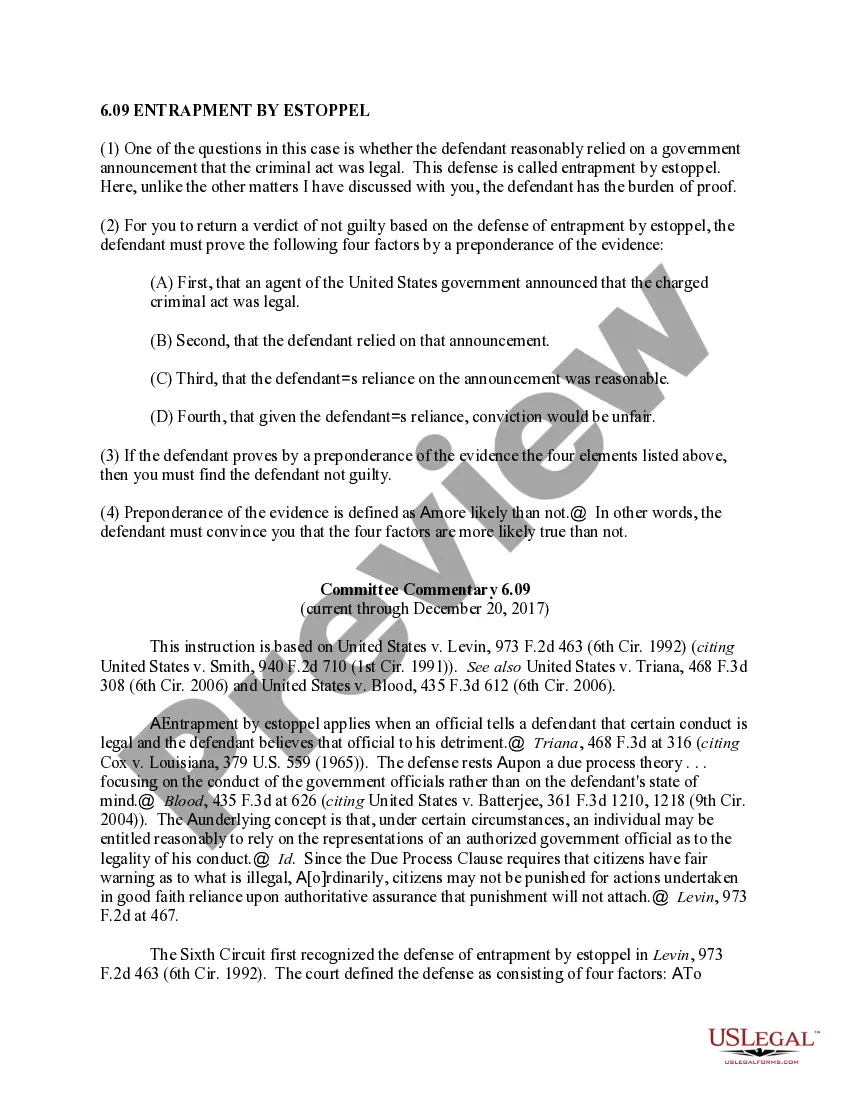
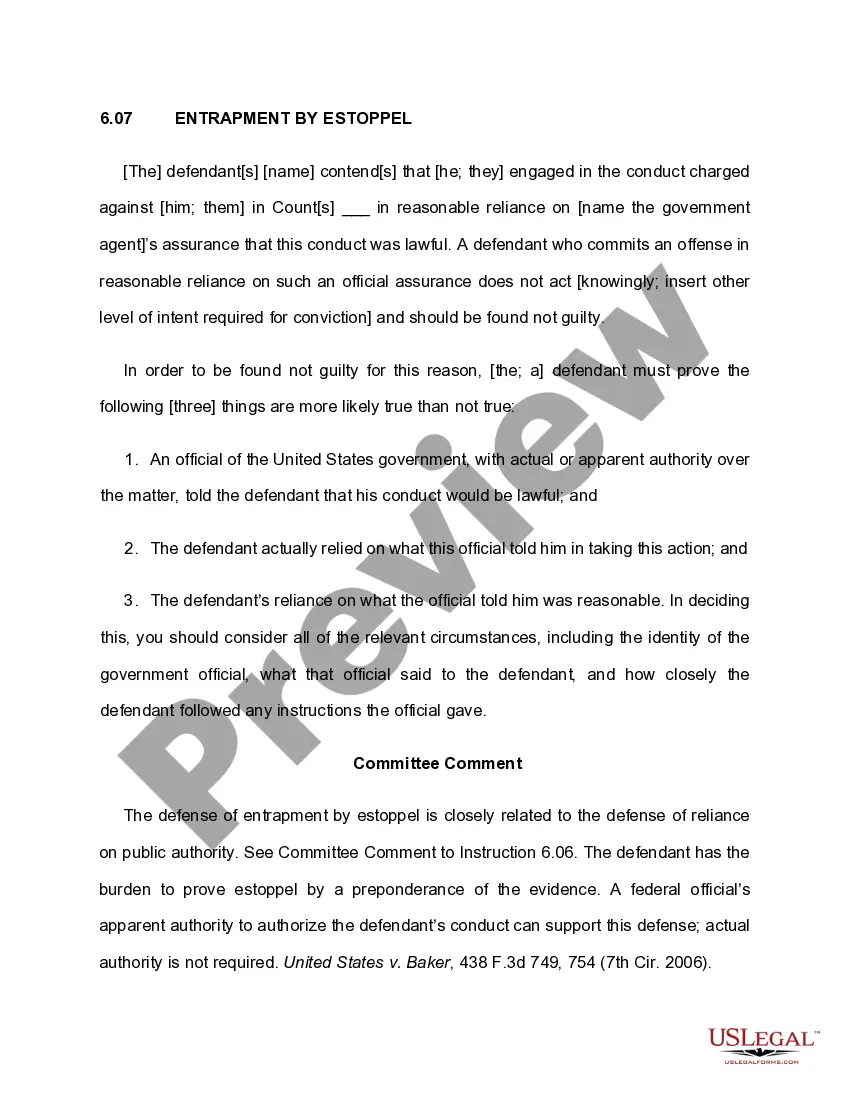
- References to notable court cases that provide context and legal precedent for entrapment defenses.

When to use this form
This form is used in cases where a defendant claims they were entrapped into committing a crime by government agents. It is applicable in federal criminal trials, particularly when the defendant seeks to present an entrapment defense based on evidence of government inducement and their own lack of predisposition to commit the offense. This form should be referenced when preparing jury instructions on entrapment issues during trial.
Who should use this form
- Defendants in criminal trials who believe they were entrapped.
- Defense attorneys preparing jury instructions for a case involving an entrapment claim.
- Legal professionals looking for standardized jury instructions on entrapment in federal courts.
Instructions for completing this form
- Review the allegations against the defendant to establish the context of the entrapment claim.
- Identify the government agent or informant involved in the case.
- Gather evidence to demonstrate the absence of predisposition to commit the offense before contact with law enforcement.
- Include references to relevant case law that supports the entrapment defense.
- Ensure the prosecution's burden of proof is clearly articulated in the instruction.
Notarization requirements for this form
This form usually doesn’t need to be notarized. However, local laws or specific transactions may require it. Our online notarization service, powered by Notarize, lets you complete it remotely through a secure video session, available 24/7.
Get your form ready online
Our built-in tools help you complete, sign, share, and store your documents in one place.
Make edits, fill in missing information, and update formatting in US Legal Forms—just like you would in MS Word.
Download a copy, print it, send it by email, or mail it via USPS—whatever works best for your next step.
Sign and collect signatures with our SignNow integration. Send to multiple recipients, set reminders, and more. Go Premium to unlock E-Sign.
If this form requires notarization, complete it online through a secure video call—no need to meet a notary in person or wait for an appointment.
We protect your documents and personal data by following strict security and privacy standards.

Make edits, fill in missing information, and update formatting in US Legal Forms—just like you would in MS Word.

Download a copy, print it, send it by email, or mail it via USPS—whatever works best for your next step.

Sign and collect signatures with our SignNow integration. Send to multiple recipients, set reminders, and more. Go Premium to unlock E-Sign.

If this form requires notarization, complete it online through a secure video call—no need to meet a notary in person or wait for an appointment.

We protect your documents and personal data by following strict security and privacy standards.
Mistakes to watch out for
- Failing to properly establish evidence of lack of predisposition.
- Not referencing pertinent case law that supports the entrapment defense.
- Assuming government inducement is the primary focus without considering the defendant's predisposition.
Legal use & context
- The form is legally recognized in federal courts for jury instructions regarding entrapment.
- Failure to provide an adequate justification for the entrapment defense can lead to rejection of the claim.
- It is essential that both prongs of the entrapment defense are supported by sufficient evidence to require jury consideration.
Looking for another form?


Form popularity
FAQ
A valid entrapment defense has two related elements: (1) government inducement of the crime, and (2) the defendant's lack of predisposition to engage in the criminal conduct. Mathews v. United States, 485 U.S. 58, 63 (1988). Of the two elements, predisposition is by far the more important.
Opportunity is not Entrapment A sting operation is not inherently entrapment. Unlike creating an opportunity, entrapment occurs when law enforcement officers urge, harass, or otherwise overly encourage an individual to commit a crime when he or she would not otherwise do so.
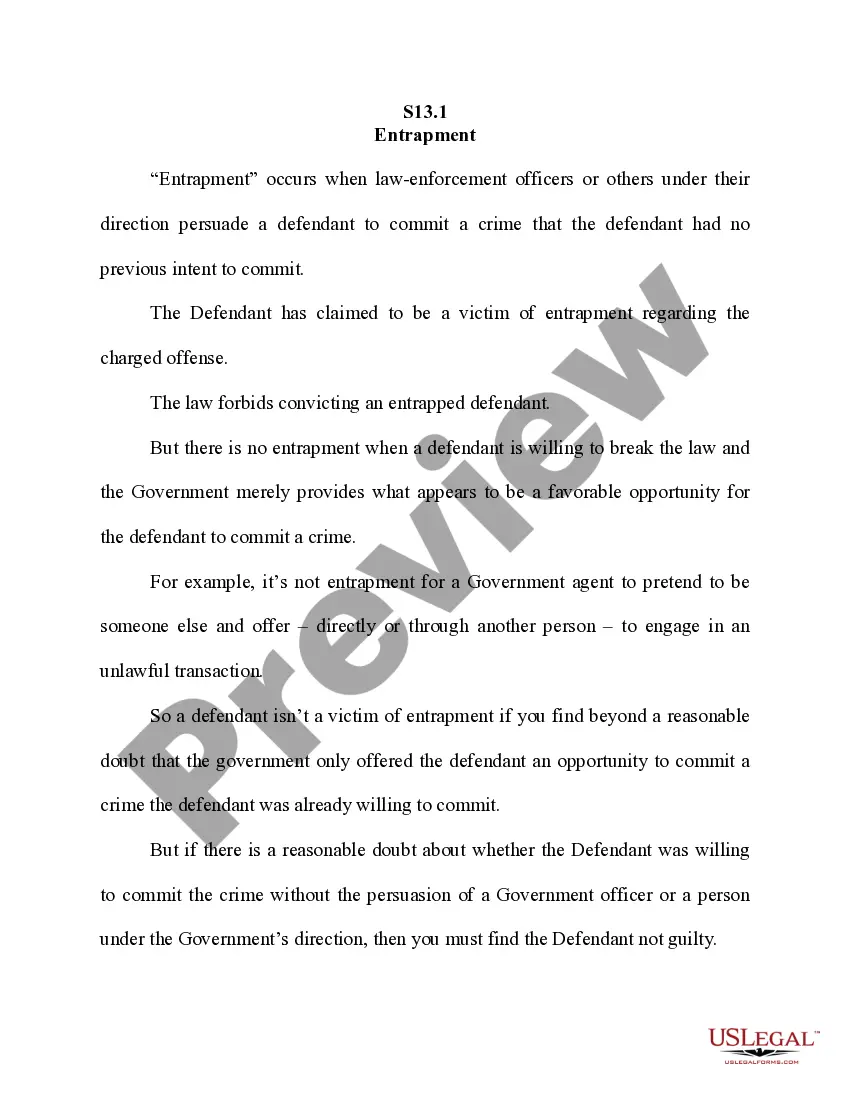
Entrapment occurs when law enforcement officers induce a law-abiding person to commit a criminal act. Entrapment does not occur if a police officer simply gives you the chance to commit a crime. The court expects you to refuse the opportunity to commit a crime in most situations.
If an officer simply gave the defendant an opportunity to commit the crime or merely tried to gain the defendant's confidence through reasonable and restrained steps, that conduct is not entrapment.
Generally, state laws will have either an objective entrapment law or a subjective entrapment law. When following the objective standard law, the court must determine whether a reasonable law-abiding person would commit the crime in light of the police officer's behavior.
What Constitutes Entrapment in California? Pressure an Individual Into Committing a Crime.Threaten Someone Into Committing a Crime.Make False Promises.Drug Crimes: An Example of Entrapment.Prostitution: An Example of Entrapment.
Exceptions to Entrapment So, a person would not be a victim of entrapment if the person was ready, willing, and able to commit the crime charged in the indictment whenever opportunity was afforded, and that government officers or their agents did no more than offer an opportunity.
Entrapment can be difficult to prove in court. However, if the defense can show that the criminal conduct was the result of entrapment, the charges against the defendant may be dropped, or the defendant may be acquitted at trial. Important to note: there is a standard for an entrapment defense.