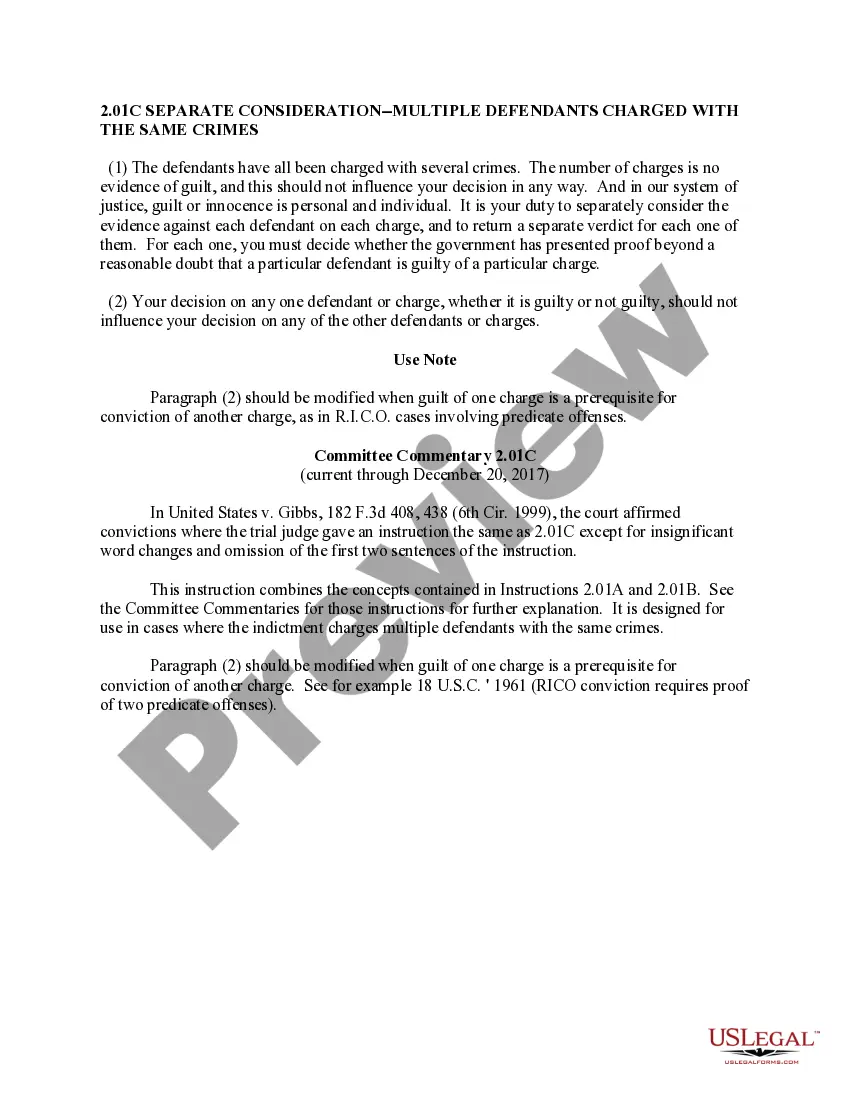
SEPARATE CONSIDERATION--MULTIPLE DEFENDANTS CHARGED WITH THE SAME CRIMES
Understanding this form
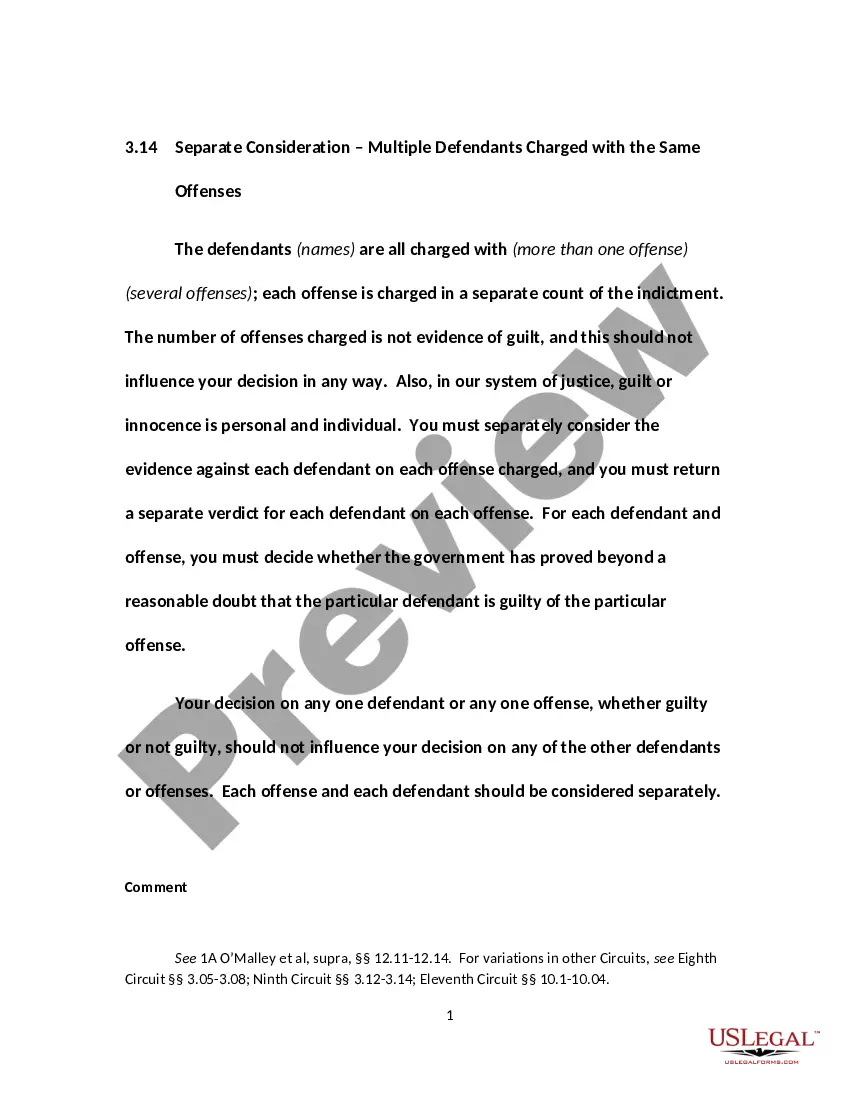
The Separate Consideration for Multiple Defendants Charged with the Same Crimes form is a legal instruction designed for jury members dealing with cases involving multiple defendants facing the same charges. This form emphasizes the importance of individual assessment of each defendant's guilt or innocence, outlining that they must evaluate the evidence presented against each defendant separately. This is crucial to ensure fairness and impartiality in the judicial process, distinguishing it from general jury instructions for single defendants or varied charges.
Form components explained
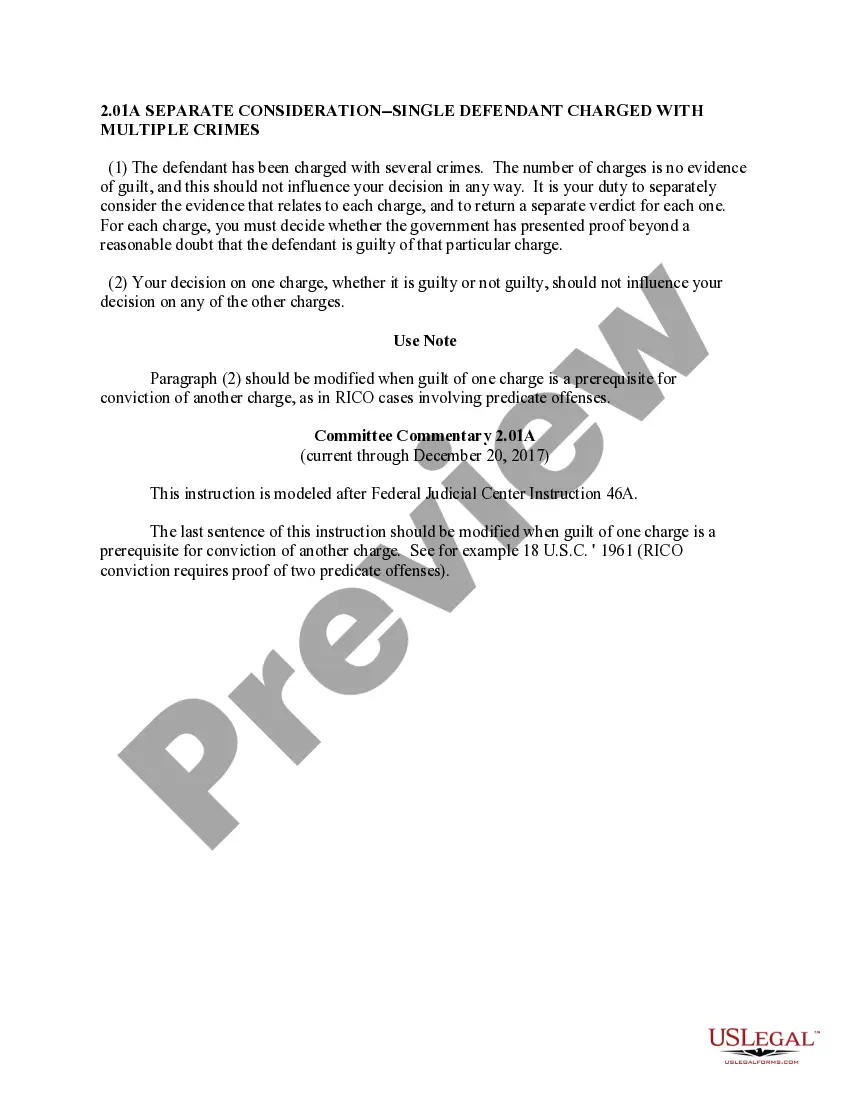
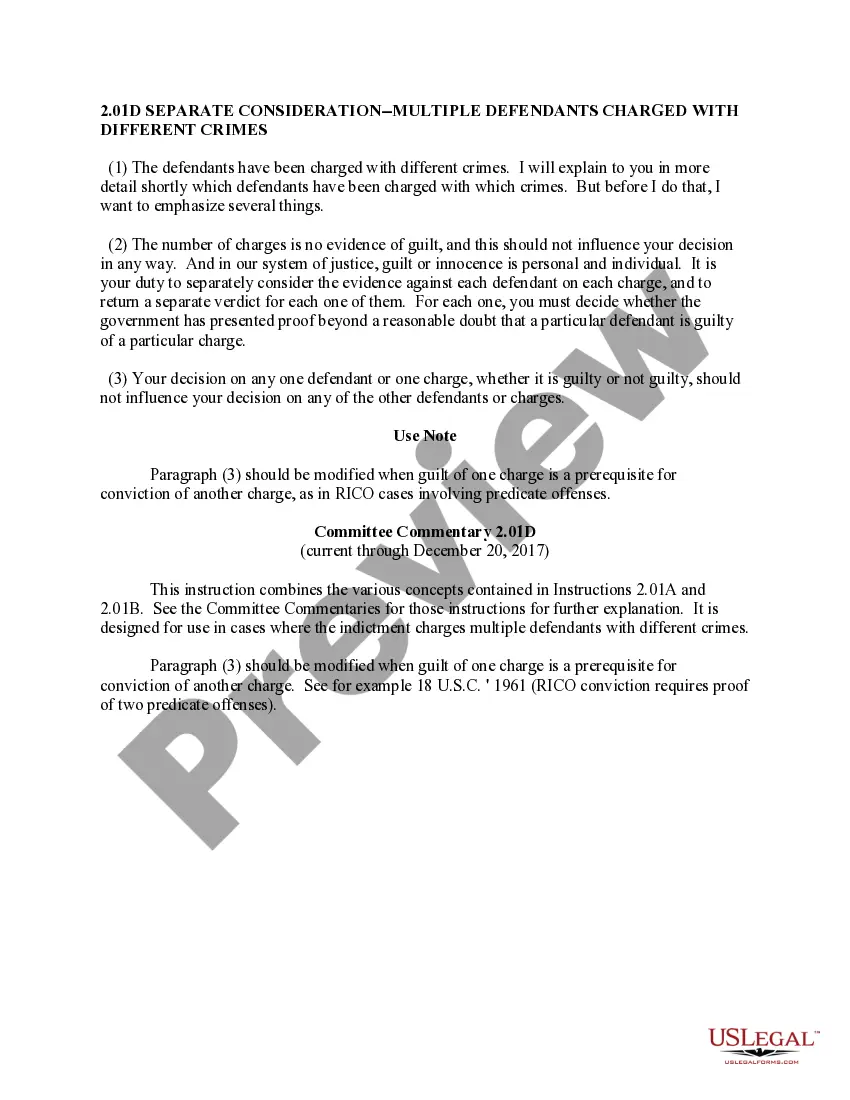
- Clarification that the number of charges does not indicate guilt.
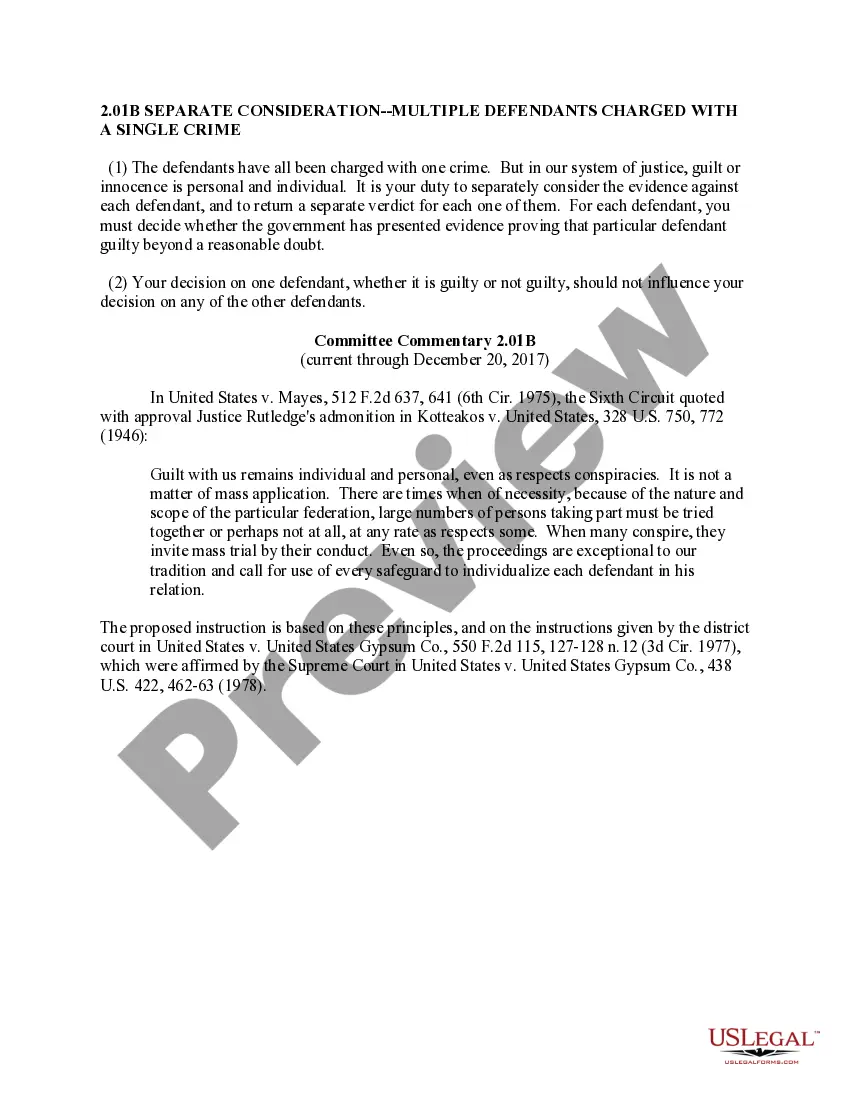
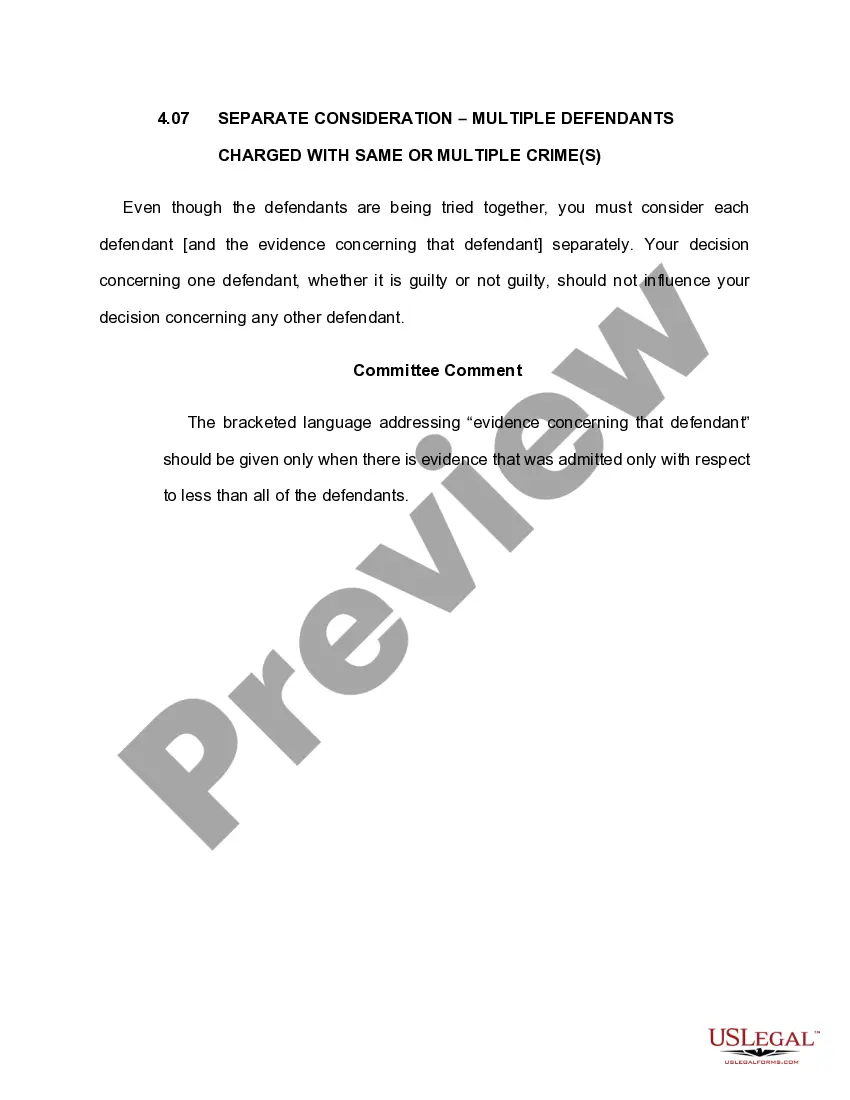
- Instructions for jurors to consider evidence against each defendant individually.
- Emphasis on returning separate verdicts for each defendant on each charge.
- Guidance on how decisions regarding one defendant should not influence others.
- Modification notes for specific circumstances, such as RICO cases.
Common use cases
This form should be used in legal scenarios where multiple defendants are charged with the same crimes. It is relevant in trials where jurors must evaluate the evidence for each defendant independently to ensure that their verdict is based solely on the evidence presented at trial and not on the potential guilt of co-defendants or the number of charges faced.
Who should use this form
- Jurors involved in cases with multiple defendants and similar charges.
- Judges presiding over trials requiring clear jury instructions on separate consideration.
- Attorneys preparing their cases to ensure proper jury instructions are provided.
How to complete this form
- Ensure all jurors understand the importance of individual consideration for each defendant.
- Review the evidence presented against each defendant separately.
- Discuss among jurors without allowing one verdict to influence another.
- Finalize separate verdicts for each defendant as instructed.
- Document each verdict clearly to avoid confusion during deliberations.
Does this document require notarization?
This form does not typically require notarization to be legally valid. However, some jurisdictions or document types may still require it. US Legal Forms provides secure online notarization powered by Notarize, available 24/7 for added convenience.
Get your form ready online
Our built-in tools help you complete, sign, share, and store your documents in one place.
Make edits, fill in missing information, and update formatting in US Legal Forms—just like you would in MS Word.
Download a copy, print it, send it by email, or mail it via USPS—whatever works best for your next step.
Sign and collect signatures with our SignNow integration. Send to multiple recipients, set reminders, and more. Go Premium to unlock E-Sign.
If this form requires notarization, complete it online through a secure video call—no need to meet a notary in person or wait for an appointment.
We protect your documents and personal data by following strict security and privacy standards.

Make edits, fill in missing information, and update formatting in US Legal Forms—just like you would in MS Word.

Download a copy, print it, send it by email, or mail it via USPS—whatever works best for your next step.

Sign and collect signatures with our SignNow integration. Send to multiple recipients, set reminders, and more. Go Premium to unlock E-Sign.

If this form requires notarization, complete it online through a secure video call—no need to meet a notary in person or wait for an appointment.

We protect your documents and personal data by following strict security and privacy standards.
Common mistakes to avoid
- Assuming guilt based on the number of charges rather than evidence.
- Failing to discuss each defendant's case individually.
- Allowing verdicts on one defendant to influence decisions on others.
- Overlooking the need for modification in specific legal circumstances.
Why use this form online
- Easy access to legal instructions eliminates ambiguity.
- Available for download allows for immediate use in ongoing cases.
- Ensures consistency in instructions provided across different jurisdictions.
- Allows for personalization to meet specific legal situations or needs.
Looking for another form?
Form popularity
FAQ
It depends on the details of the incident. But yes, they certainly can?at least in California and some other states.
Criminal Cases with Co-Defendants When going through the legal process, they can either have separate trials or have them together, depending on the case.
A joint trial of codefendants (also known as "joinder") occurs when a judge merges the cases of two or more defendants. Joint trials happen when the issues in the defendants' cases overlap enough to make a single trial both fair and more efficient.
A joint trial of codefendants (also known as "joinder") occurs when a judge merges the cases of two or more defendants. Joint trials happen when the issues in the defendants' cases overlap enough to make a single trial both fair and more efficient.
A judge in a criminal case may feel that it is appropriate to combine the cases of multiple defendants when their charges involve the same set of circumstances. This can help a judge streamline their calendar and resolve a case more efficiently.
The Fifth Amendment to the Constitution provides in part that ?nor shall any person be subject for the same offense to be twice put in jeopardy of life and limb.? This is referred to as the double jeopardy clause, and it protects an individual from being charged with, tried for, or convicted of the same crime twice.
The obvious application of double jeopardy is when law enforcement finds new evidence of the defendant's guilt after the jury has already acquitted them. The prosecution cannot charge them again, even if the evidence shows that they probably are guilty.