Agreement for Psychotherapy Services
About this form
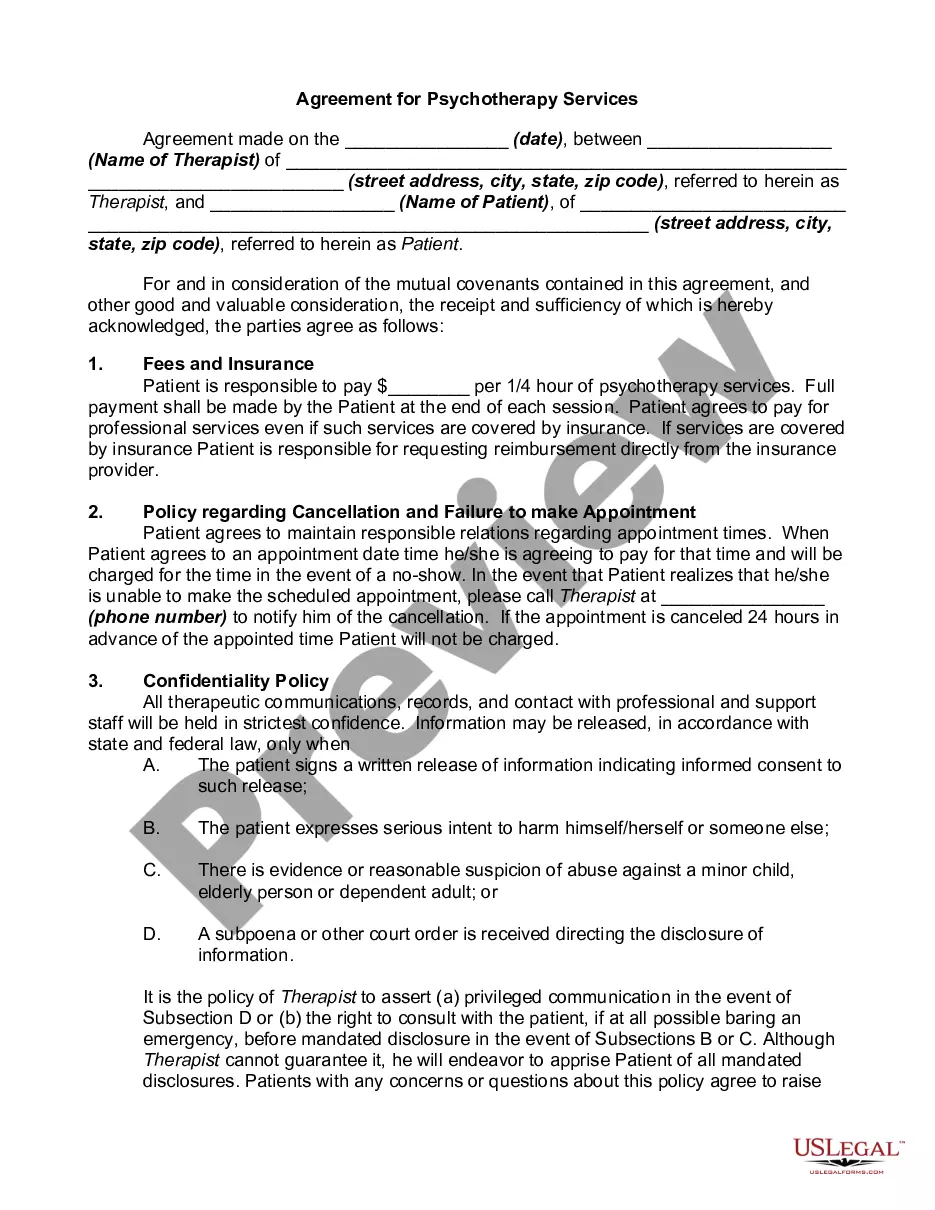
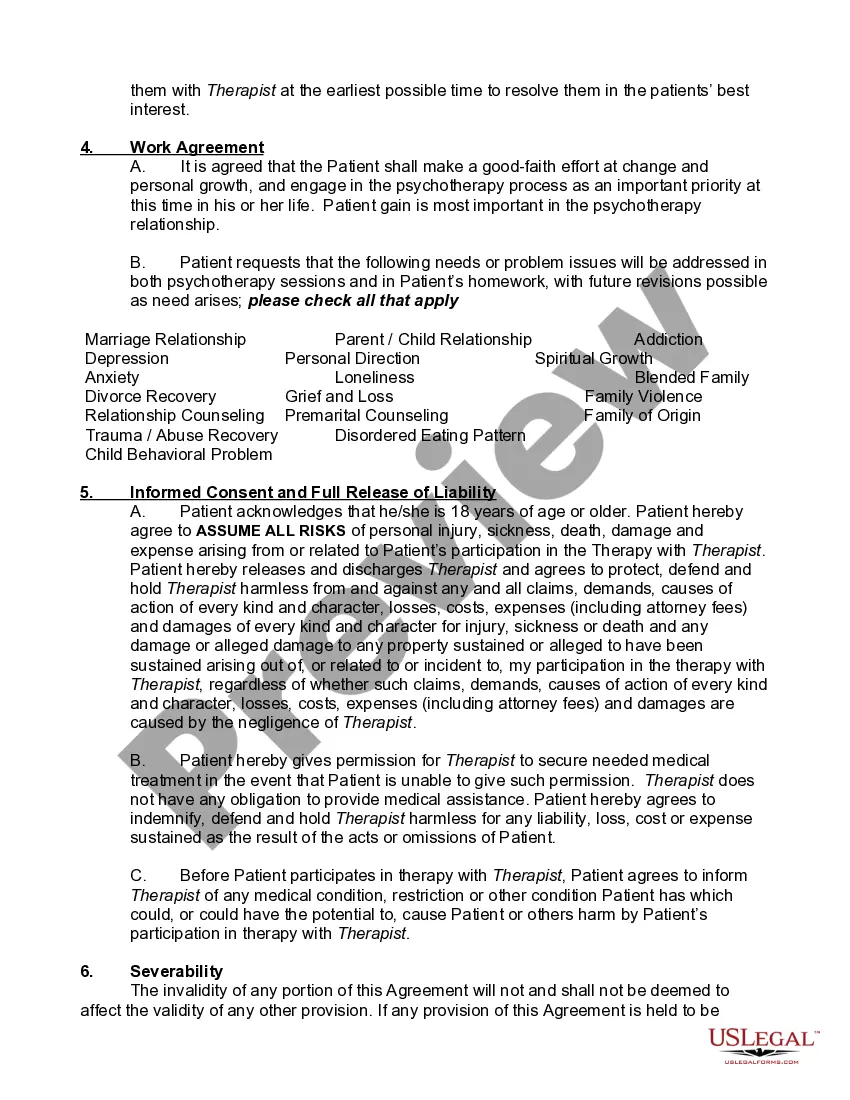
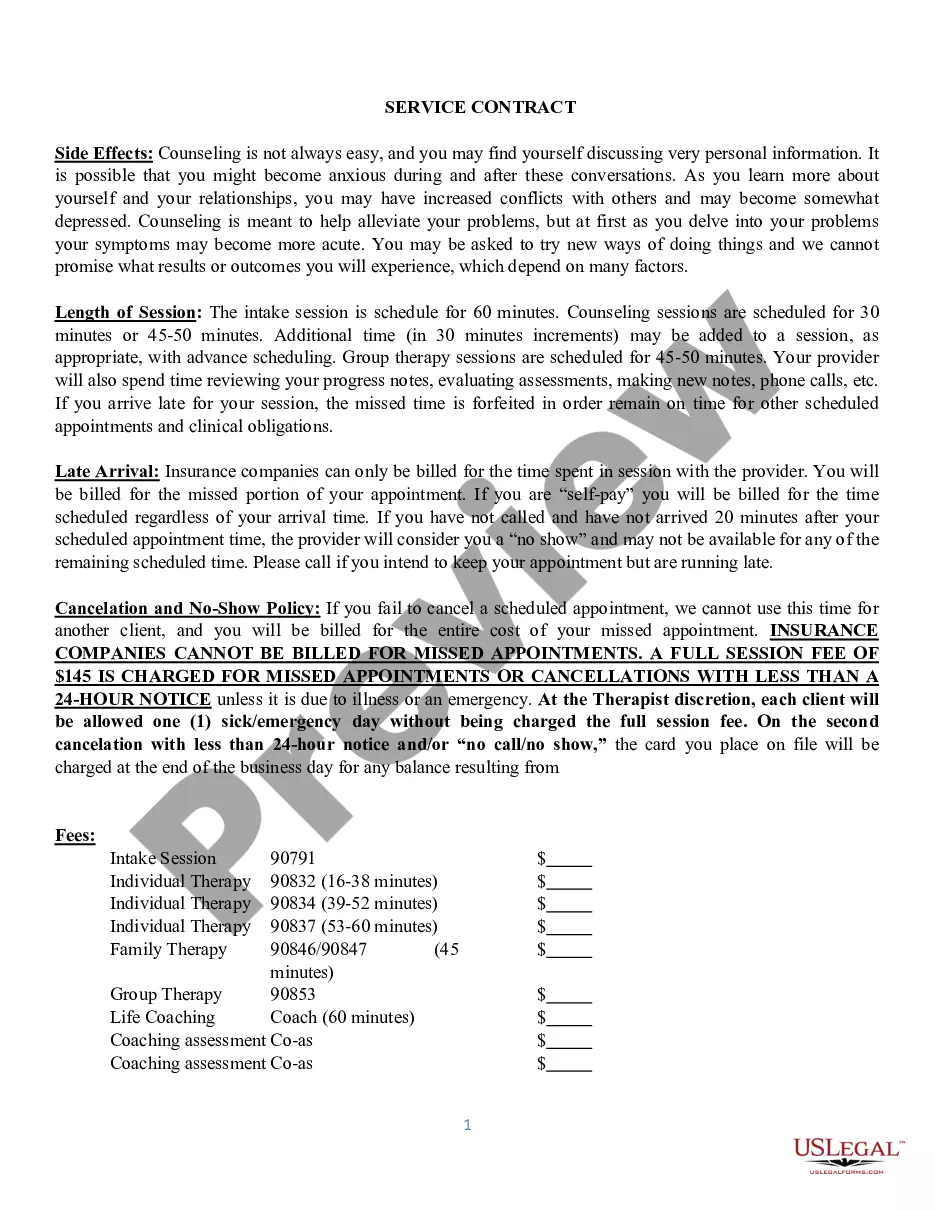
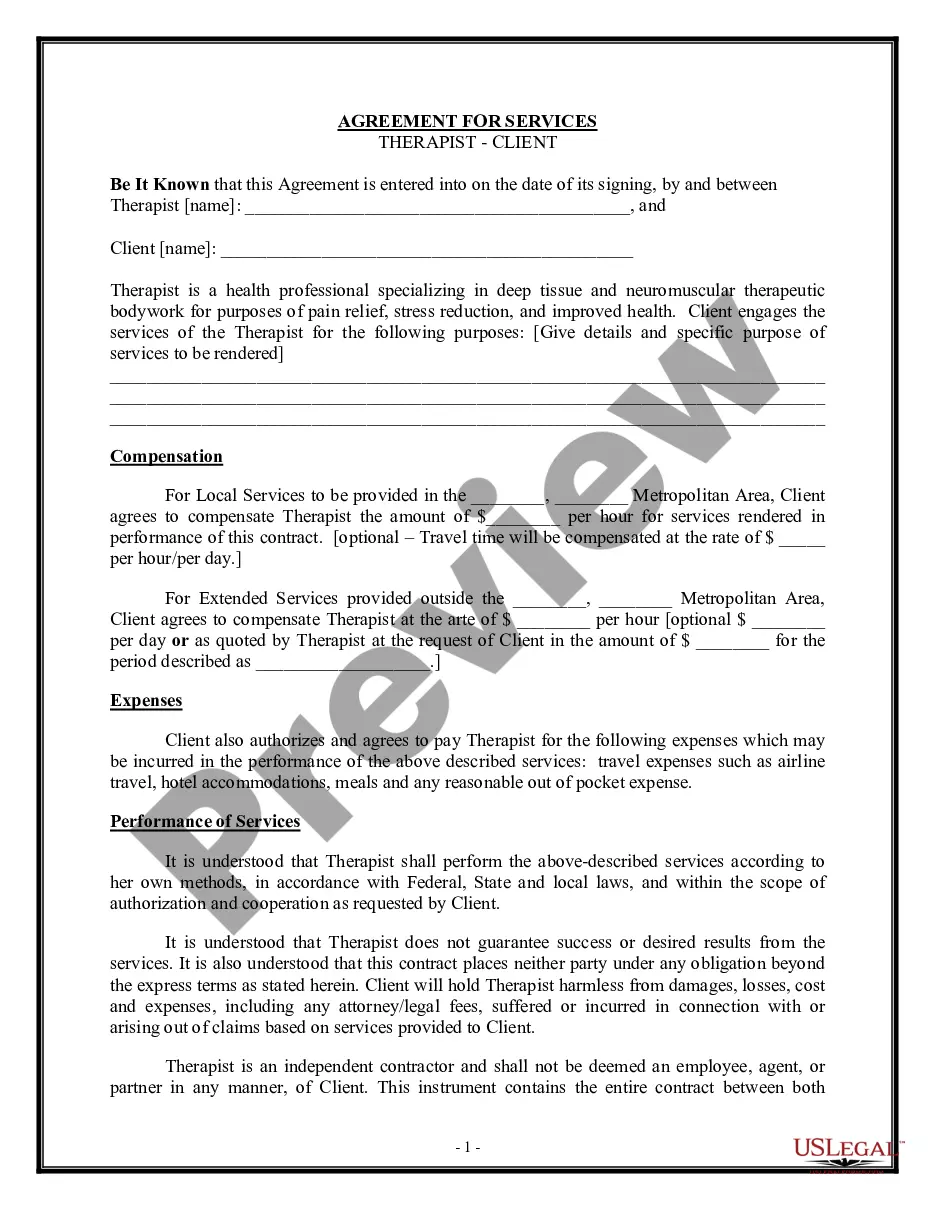
The Agreement for Psychotherapy Services is a legal document that outlines the relationship between a therapist and a patient. Its primary purpose is to establish the terms of the psychotherapy services being provided, including fees, confidentiality, and cancellation policies. This form is essential in ensuring both parties understand their rights and responsibilities, differentiating it from more general counseling agreements by focusing on specific psychotherapy practices and policies.
Form components explained
- Date and identification of the therapist and patient.
- Fee structure and payment obligations.
- Cancellation policy and consequences for missed appointments.
- Confidentiality agreements regarding patient information.
- Informed consent and release of liability.
- Governing laws relevant to the agreement.


Situations where this form applies
This form is needed when a patient is engaging in psychotherapy sessions with a licensed therapist. It is used to clarify the expectations, boundaries, and responsibilities of both the therapist and the patient. Utilize this form when initiating therapy, changing therapists, or when updating existing agreements to reflect changes in terms or services.
Intended users of this form
Eligible users of this form include:
- Patients seeking psychotherapy services.
- Licensed psychotherapists providing services to clients.
- Legal professionals assisting either party in drafting or reviewing the agreement.
How to prepare this document
- Identify the date the agreement is being made.
- Fill in the names and addresses of both the therapist and the patient.
- Specify the fees for the psychotherapy services provided.
- Review and agree upon the cancellation policy detailed in the form.
- Sign and date the agreement, ensuring both parties have a copy for their records.
Is notarization required?
In most cases, this form does not require notarization. However, some jurisdictions or signing circumstances might. US Legal Forms offers online notarization powered by Notarize, accessible 24/7 for a quick, remote process.
Get your form ready online
Our built-in tools help you complete, sign, share, and store your documents in one place.
Make edits, fill in missing information, and update formatting in US Legal Forms—just like you would in MS Word.
Download a copy, print it, send it by email, or mail it via USPS—whatever works best for your next step.
Sign and collect signatures with our SignNow integration. Send to multiple recipients, set reminders, and more. Go Premium to unlock E-Sign.
If this form requires notarization, complete it online through a secure video call—no need to meet a notary in person or wait for an appointment.
We protect your documents and personal data by following strict security and privacy standards.

Make edits, fill in missing information, and update formatting in US Legal Forms—just like you would in MS Word.

Download a copy, print it, send it by email, or mail it via USPS—whatever works best for your next step.

Sign and collect signatures with our SignNow integration. Send to multiple recipients, set reminders, and more. Go Premium to unlock E-Sign.

If this form requires notarization, complete it online through a secure video call—no need to meet a notary in person or wait for an appointment.

We protect your documents and personal data by following strict security and privacy standards.
Common mistakes to avoid
- Not clearly specifying the fee structure.
- Failing to include the cancellation policy, leading to misunderstandings.
- Leaving out important confidentiality clauses.
- Not having both parties sign the document.
Benefits of using this form online
- Convenient access to a customizable agreement template.
- Time-saving by eliminating the need for in-person consultations.
- Ensures compliance with essential therapeutic practices.
- Peace of mind knowing the form has been drafted by legal professionals.
What to keep in mind
- The Agreement for Psychotherapy Services establishes clear expectations between therapist and patient.
- It includes vital components such as payment, cancellation policies, and confidentiality clauses.
- Using this form enhances understanding and professionalism in the therapeutic process.
Looking for another form?


Form popularity
FAQ
They include the fees you pay, the time of your appointments, the frequency of sessions and what you and your counsellor expect from each other. All sessions will be conducted in confidence and may be recorded on audiotape (only with your informed consent).
Empathy. Listening Skills. Social and Communication Skills. Boundary Setting. Critical Thinking. Business Management.
Definition. For purposes of this discussion, a therapeutic contract is defined. as a reciprocal process whereby a social worker and a client, or. client group, in an overt agreement, state: 1) what each expects to. achieve from an agreed-upon exchange; 2) the reasons for coming.
In current clinical practice, these four elements translate into five components that should be included in a discussion seeking to obtain informed consent: the diagnosis, the proposed treatment, the attendant risks and benefits of the treatment, alternative treatments and their risks and benefits, and the risks and
One of the fundamental elements of the therapeutic process is the contract for services between the patient and therapist. This is generally referred to as the therapeutic contract.While verbal, it still contained the basic provisions for the services the therapist would provide to the patient.
The average cost of therapy is $60 to $120 per session, with most American's paying between $20 to $250 per hour depending on the number of sessions booked, and if it's covered by health insurance. With health insurance coverage, rates average $20 to $50 per session, or about equal to your current copay.
It often involves a process, dialogue or discussion between a therapist and a client. Generally, the process of informed consent involves three parts: Providing the client with information, evaluating the client's capacity to understand the information and, finally, obtaining consent from the client.
A 'therapeutic approach' is the lens through which a counsellor addresses their clients' problems. Broadly speaking, the therapeutic approaches of counsellors fall into two categories: behavioural and psychodynamic. Behavioural approaches are usually short-term and address your behaviour and thought patterns.
The average therapy session costs $75-150 an hour, and good luck if you live in a place like New York where the range jumps to $200-300. People who rail against therapy accuse therapists of being greedy, but therapists actually have valid reasons for their high prices.