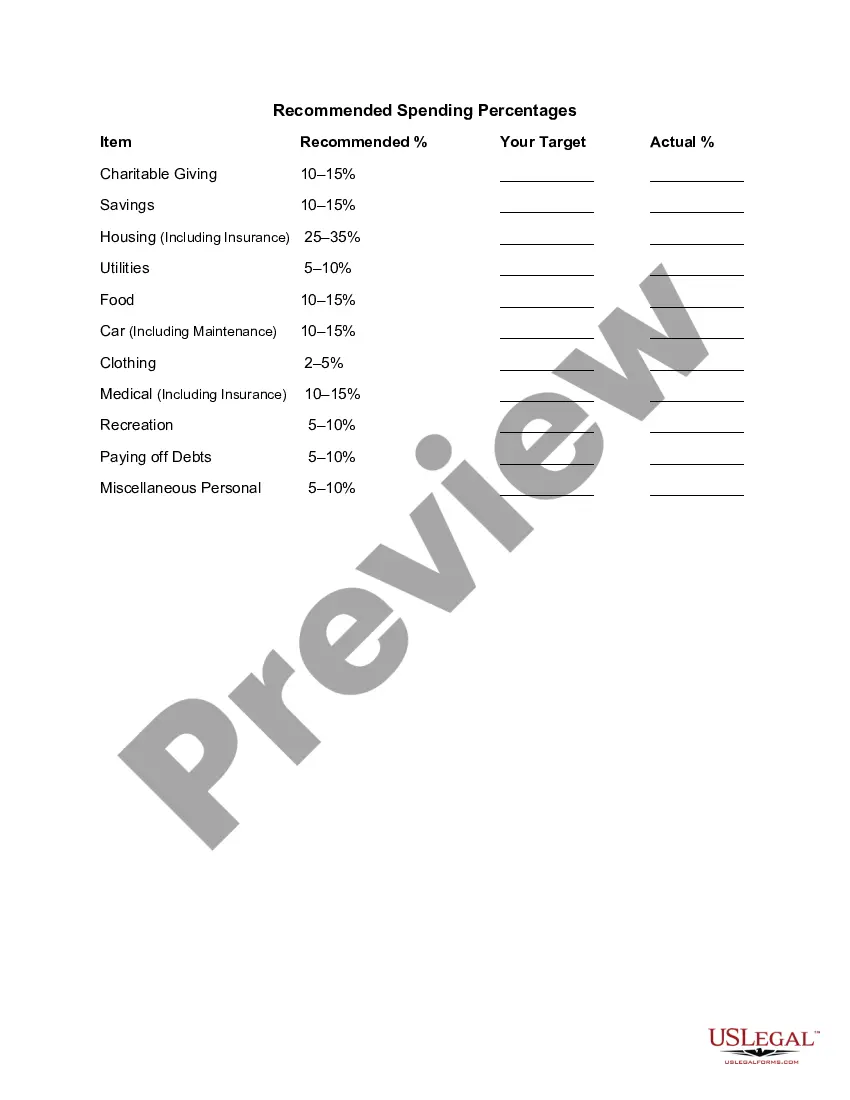
Recommended Spending Percentages
Overview of this form
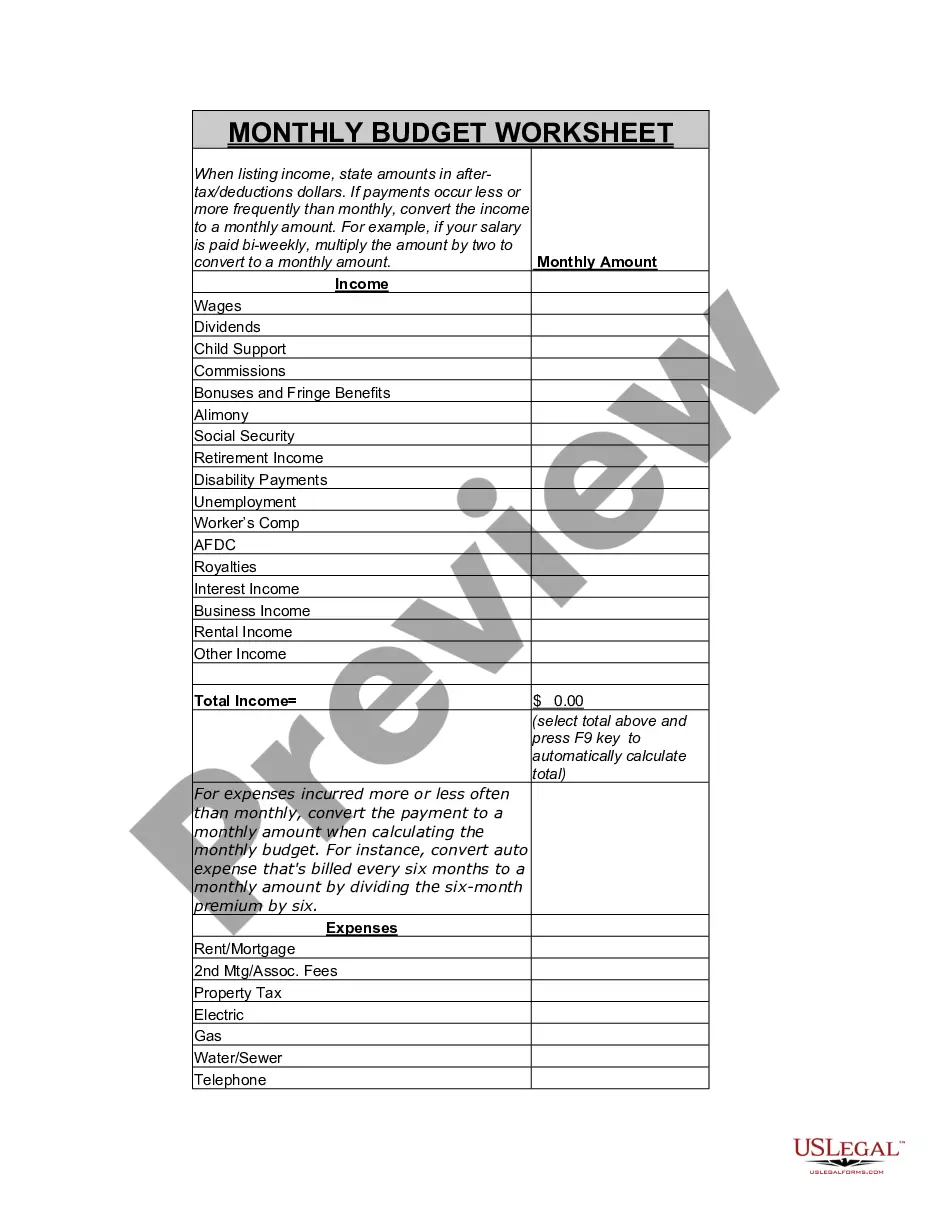
The Recommended Spending Percentages form is a financial planning tool that helps individuals allocate their income across various categories such as housing, savings, and food. This form offers recommended percentage ranges for each category to guide users in creating a realistic budget. Unlike other budgeting tools, this form provides specific percentage guidelines that can simplify the budgeting process for both beginners and more experienced users.
Key components of this form
- Charitable Giving: Recommended at 10â15% of income.
- Savings: Suggested range of 10â15% of income.
- Housing (Including Insurance): 25â35% of income recommended.
- Utilities: Suggested at 5â10% of income.
- Food: Recommended at 10â15% of income.
- Car (Including Maintenance): 10â15% range.
- Clothing: Suggested at 2â5% of income.
- Medical (Including Insurance): 10â15% recommended.
- Recreation: Suggested at 5â10% of income.
- Paying off Debts: Recommended at 5â10% of income.
- Miscellaneous Personal Expenses: Suggested at 5â10% of income.
Common use cases
This form is useful when you want to organize your finances and ensure that your spending aligns with recommended practices. It can be used when creating a budget for the first time, adjusting existing spending habits, or planning for future financial goals. By evaluating your current financial situation against these recommendations, you can make more informed decisions about your spending allocation.
Who can use this document
- Individuals looking to manage their finances effectively.
- People creating a personal budget for the first time.
- Those wanting to align their spending with recommended financial practices.
- Anyone seeking to improve their savings and financial stability.
How to prepare this document
- Review the recommended percentage ranges for each spending category.
- Assess your current income to calculate your target amounts for each category.
- Fill in the "Your Target" column based on your financial goals.
- Track your "Actual" spending in each category over time.
- Adjust as necessary to stay within the recommended ranges.
Is notarization required?
Notarization is not commonly needed for this form. However, certain documents or local rules may make it necessary. Our notarization service, powered by Notarize, allows you to finalize it securely online anytime, day or night.
Get your form ready online
Our built-in tools help you complete, sign, share, and store your documents in one place.
Make edits, fill in missing information, and update formatting in US Legal Forms—just like you would in MS Word.
Download a copy, print it, send it by email, or mail it via USPS—whatever works best for your next step.
Sign and collect signatures with our SignNow integration. Send to multiple recipients, set reminders, and more. Go Premium to unlock E-Sign.
If this form requires notarization, complete it online through a secure video call—no need to meet a notary in person or wait for an appointment.
We protect your documents and personal data by following strict security and privacy standards.

Make edits, fill in missing information, and update formatting in US Legal Forms—just like you would in MS Word.

Download a copy, print it, send it by email, or mail it via USPS—whatever works best for your next step.

Sign and collect signatures with our SignNow integration. Send to multiple recipients, set reminders, and more. Go Premium to unlock E-Sign.

If this form requires notarization, complete it online through a secure video call—no need to meet a notary in person or wait for an appointment.

We protect your documents and personal data by following strict security and privacy standards.
Common mistakes to avoid
- Failing to account for irregular expenses in the budget.
- Ignoring savings in favor of discretionary spending.
- Not revisiting the budget regularly to adjust for changes in income or expenses.
- Using percentages that do not reflect personal financial situations.
Benefits of using this form online
- This form is easily downloadable for quick access and use.
- It allows for easy adjustments based on your unique financial needs.
- Using the form online ensures you have the latest recommendations.
- Online access makes budgeting accessible from any device.
Main things to remember
- Recommended Spending Percentages guide effective budgeting practices.
- Users can adjust their spending to align with suggested percentages.
- This form can help improve financial literacy and stability.
- Proper use of the form can lead to more informed financial decisions.
Looking for another form?
Form popularity
FAQ
The 50-20-30 rule is a money management technique that divides your paycheck into three categories: 50% for the essentials, 20% for savings and 30% for everything else. 50% for essentials: Rent and other housing costs, groceries, gas, etc.
The 20/10 rule of thumb limits consumer debt payments to no more than 20% of your annual take-home income and no more than 10% of your monthly take-home income. This guideline can help you limit the amount of debt you carry, which is important for your financial health and your credit score.
You take your monthly take-home income and divide it by 70%, 20%, and 10%. You divvy up the percentages as so: 70% is for monthly expenses (anything you spend money on). 20% goes into savings, unless you have pressing debt (see below for my definition), in which case it goes toward debt first.
The 70% / 30% rule in finance helps many to spend, save and invest in the long run. The rule is simple - take your monthly take-home income and divide it by 70% for expenses, 20% savings, debt, and 10% charity or investment, retirement.
Senator Elizabeth Warren popularized the so-called "50/20/30 budget rule" (sometimes labeled "50-30-20") in her book, All Your Worth: The Ultimate Lifetime Money Plan. The basic rule is to divide up after-tax income and allocate it to spend: 50% on needs, 30% on wants, and socking away 20% to savings.
50/20/30 Budget Method: What is the 50/30/20 budget rule? In comparison to Dave Ramsey's budgeting percentages, the 50/20/30 rule for budgeting will seem less restrictive and less detailed. This budgeting breakdown suggests that you allocate 50% of your income to needs, 20% to savings, and 30% to wants.
Senator Elizabeth Warren popularized the so-called "50/20/30 budget rule" (sometimes labeled "50-30-20") in her book, All Your Worth: The Ultimate Lifetime Money Plan. The basic rule is to divide up after-tax income and allocate it to spend: 50% on needs, 30% on wants, and socking away 20% to savings.
Here's how to get started. It's the 50-20-30 Rule, i.e., 50 per cent of your income should go towards living expenses, i.e., household expenses, including groceries; 20 per cent towards savings for your short, medium, long-term goals; and 30 per cent towards spending, including outing, food and travel.
The 50-20-30 rule is a money management technique that divides your paycheck into three categories: 50% for the essentials, 20% for savings and 30% for everything else. 50% for essentials: Rent and other housing costs, groceries, gas, etc.