Indemnity Agreement
What this document covers
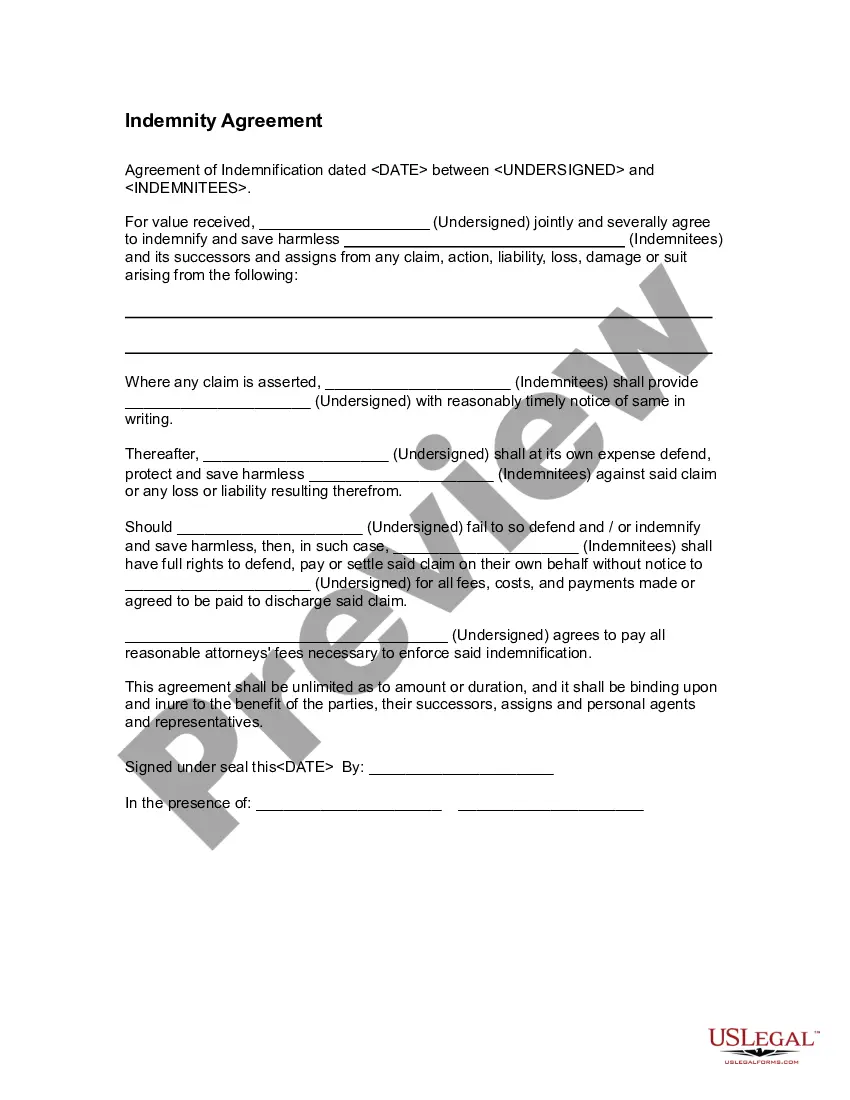
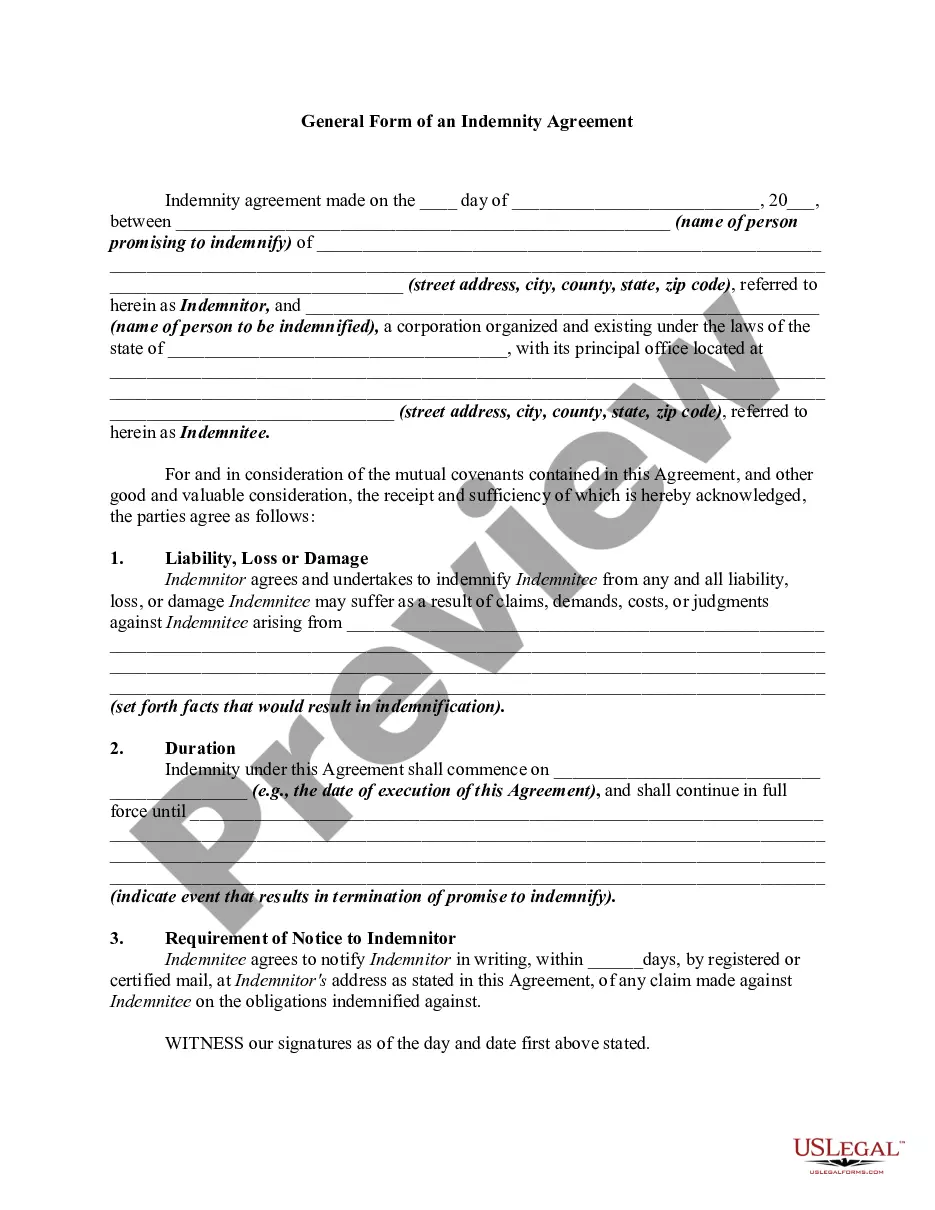
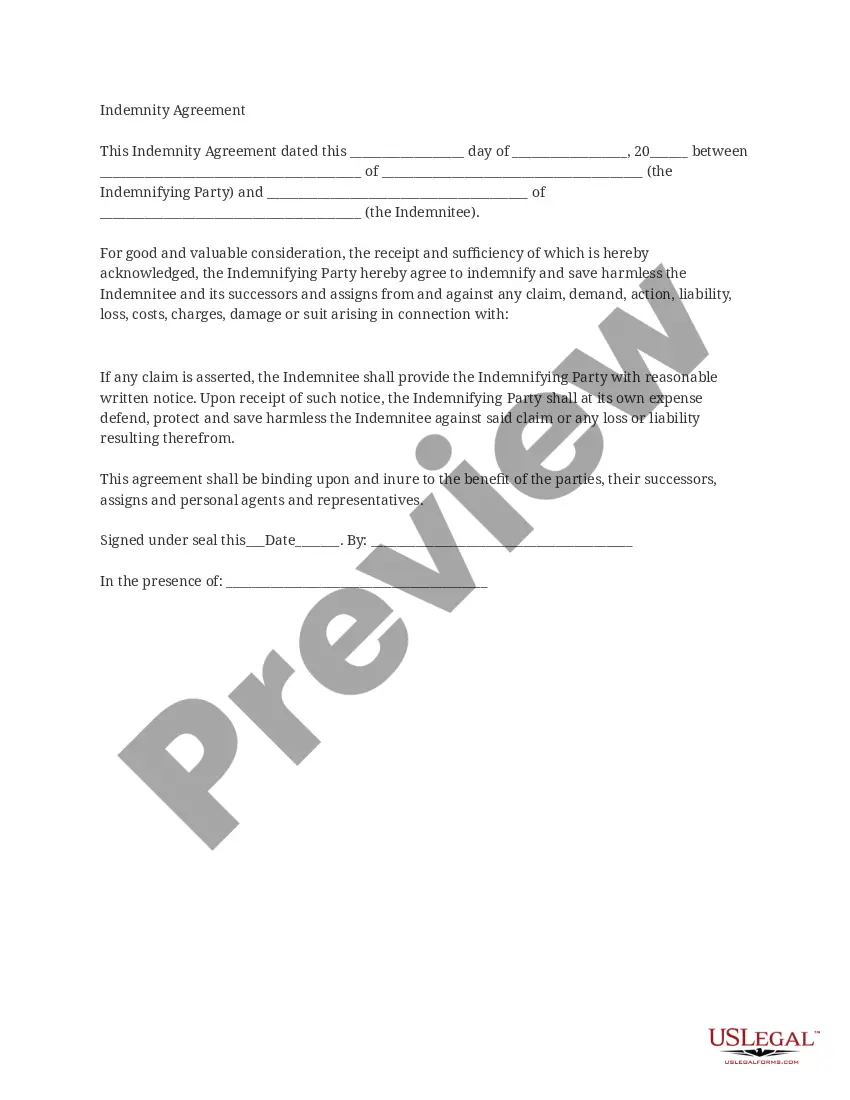
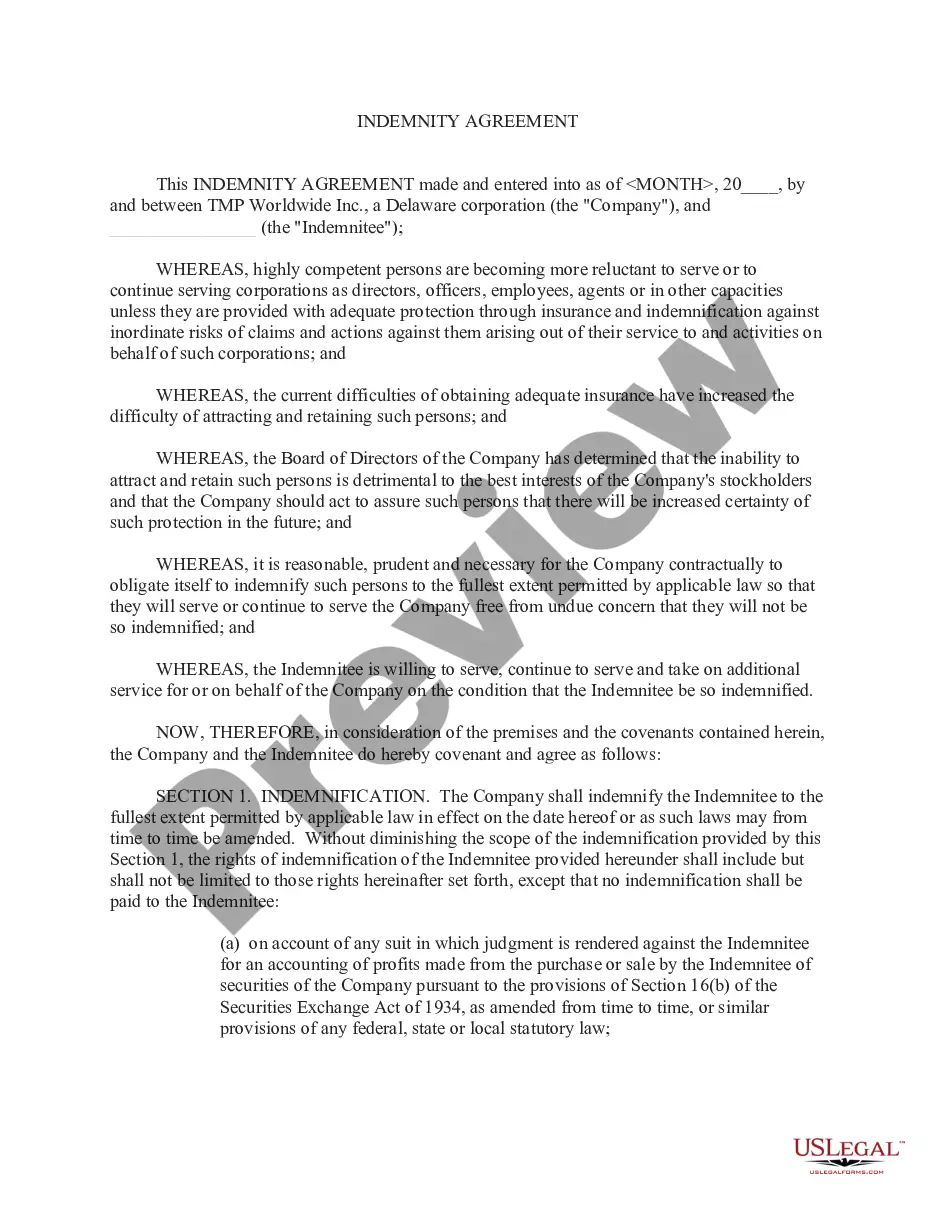
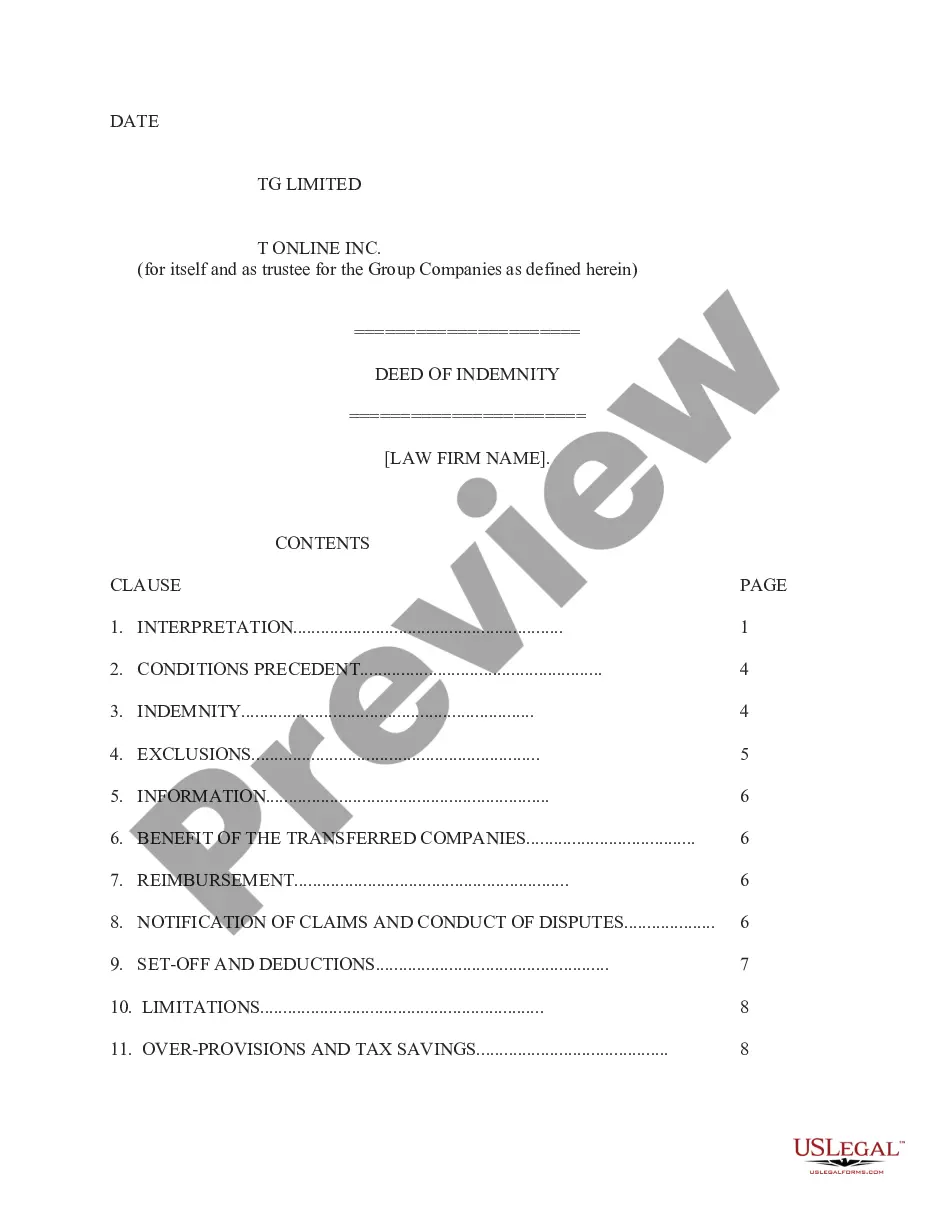
An indemnity agreement is a legal contract that protects one party from the risks and liabilities created by another party in a transaction. This form, also known as a hold harmless agreement or release of liability, is crucial for establishing clear responsibilities and protecting against financial losses. By using this indemnity agreement, parties can ensure they are not held liable for claims arising from actions taken by the other party involved in the transaction.
Key components of this form
- Parties involved: Identifies the undersigned party and the indemnitees.
- Indemnification clause: States the obligation of the undersigned to indemnify the indemnitees against claims.
- Notice requirement: Describes the requirement for the indemnitees to notify the undersigned of any claims.
- Defense obligations: Addresses the defenses the undersigned must provide against claims.
- Costs and fees: Specifies that the undersigned will cover reasonable attorney fees related to enforcement.
- Duration and binding nature: Indicates that the agreement is unlimited in amount and duration and binding on successors.
Situations where this form applies
This indemnity agreement should be used when two parties engage in a transaction where one party may need protection against claims or liabilities caused by the other party. Common scenarios include construction contracts, rental agreements, and service contracts where there is a potential for accidents or disputes. This form ensures the liability of one party does not unfairly impact the other party.
Intended users of this form
- Business owners entering contracts with clients or vendors.
- Individuals engaging in activities that may expose them to liability.
- Contractors and subcontractors working on construction projects.
- Landlords who want to protect themselves from tenant-related issues.
- Service providers needing to limit their liability for issues arising in the course of service.
Instructions for completing this form
- Identify the parties: Clearly state the names of the undersigned and the indemnitees.
- Enter the date: Fill in the date when the agreement is being executed.
- Specify indemnity conditions: Detail the claims or actions that the indemnity covers.
- Include notice requirements: Outline how and when the indemnitees must notify the undersigned of claims.
- Sign the agreement: Have all parties sign the document in the presence of witnesses if required.
Does this form need to be notarized?
This form does not typically require notarization unless specified by local law. However, it may be advisable to have it notarized to ensure added validity, especially in transactions with significant liability exposure.
Get your form ready online
Our built-in tools help you complete, sign, share, and store your documents in one place.
Make edits, fill in missing information, and update formatting in US Legal Forms—just like you would in MS Word.
Download a copy, print it, send it by email, or mail it via USPS—whatever works best for your next step.
Sign and collect signatures with our SignNow integration. Send to multiple recipients, set reminders, and more. Go Premium to unlock E-Sign.
If this form requires notarization, complete it online through a secure video call—no need to meet a notary in person or wait for an appointment.
We protect your documents and personal data by following strict security and privacy standards.

Make edits, fill in missing information, and update formatting in US Legal Forms—just like you would in MS Word.

Download a copy, print it, send it by email, or mail it via USPS—whatever works best for your next step.

Sign and collect signatures with our SignNow integration. Send to multiple recipients, set reminders, and more. Go Premium to unlock E-Sign.

If this form requires notarization, complete it online through a secure video call—no need to meet a notary in person or wait for an appointment.

We protect your documents and personal data by following strict security and privacy standards.
Avoid these common issues
- Not clearly defining the scope of indemnity.
- Failing to include all relevant partiesâ names.
- Using ambiguous language that may lead to misinterpretation.
- Overlooking the necessity for signatures and dates.
Why complete this form online
- Quick access: Download the form instantly without delays.
- Editable templates: Customize the agreement to fit your specific situation easily.
- Legal assurance: The forms are crafted by licensed attorneys to ensure compliance and protection.
- User-friendly: Navigate through the form with straightforward instructions.
Looking for another form?

Form popularity
FAQ
?Company/Business/Individual Name shall fully indemnify, hold harmless and defend and its directors, officers, employees, agents, stockholders and Affiliates from and against all claims, demands, actions, suits, damages, liabilities, losses, settlements, judgments, costs and expenses (including but not
For example, A promises to deliver certain goods to B for Rs. 2,000 every month. C comes in and promises to indemnify B's losses if A fails to so deliver the goods. This is how B and C will enter into contractual obligations of indemnity.
Example 1: A service provider asking their customer to indemnify them to protect against misuse of their work product. Example 2: A rental car company, as the rightful owner of the car, having their customer indemnify them from any damage caused by the customer during the course of the retnal.
Example of Indemnity in Business The owner of a commercial property has been paying an insurance premium to an insurance company so that she can recover the costs for any loss or damage if a future bad event were to happen to the establishment.
Indemnity agreements, also known as indemnity clauses, play an integral role in contracts. That's because they are designed to punish the nonperforming party and reassure the damaged one they will be reimbursed for losses caused by the errant entity.
?To indemnify? means to compensate someone for his/her harm or loss. In most contracts, an indemnification clause serves to compensate a party for harm or loss arising in connection with the other party's actions or failure to act. The intent is to shift liability away from one party, and on to the indemnifying party.
Indemnification clauses allow a contracting party to: Customize the amount of risk it is willing to undertake in each transaction and with every counterparty. Protect itself from damages and lawsuits that are more efficiently borne by the counterparty.