Arbitration Clauses: Contract for Real Property
What this document covers
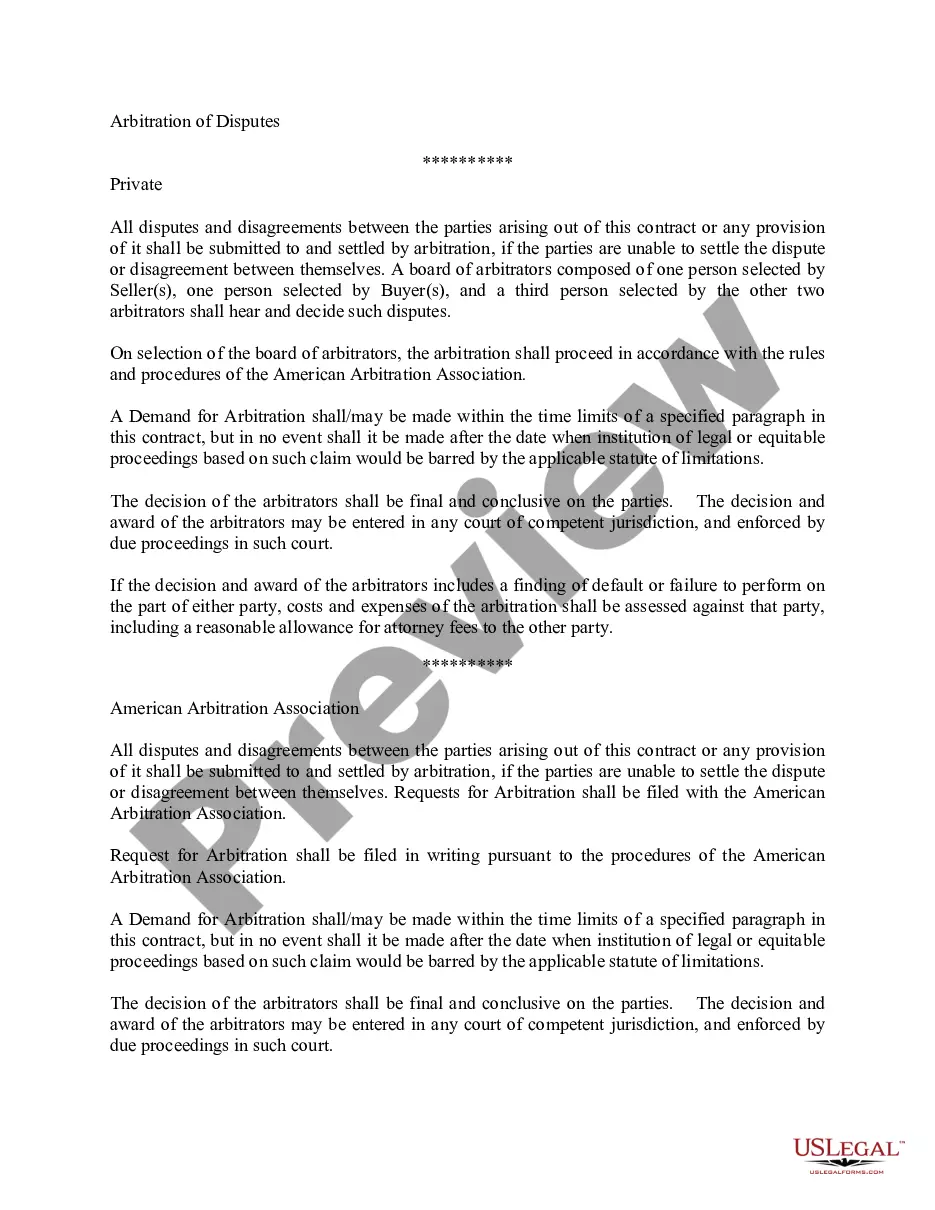
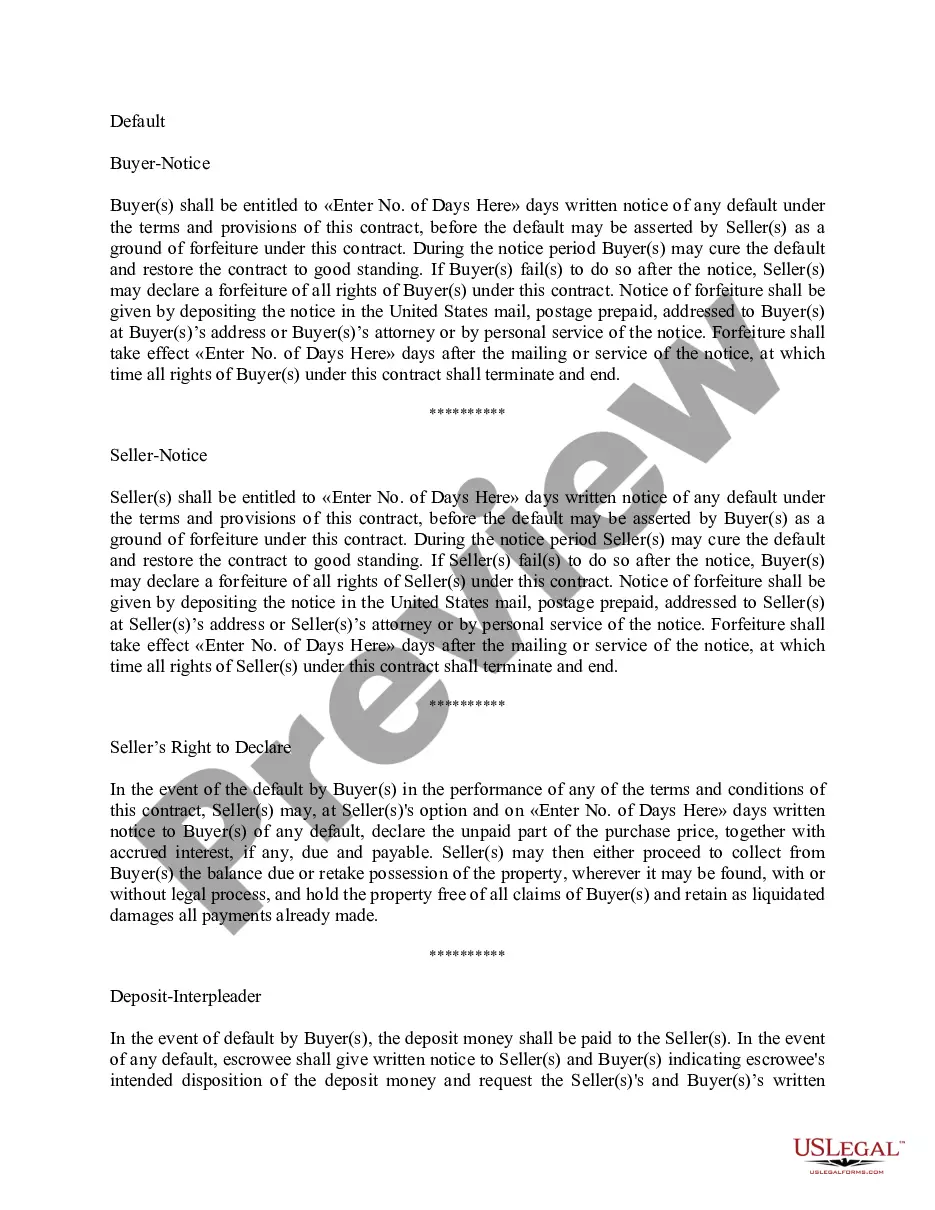
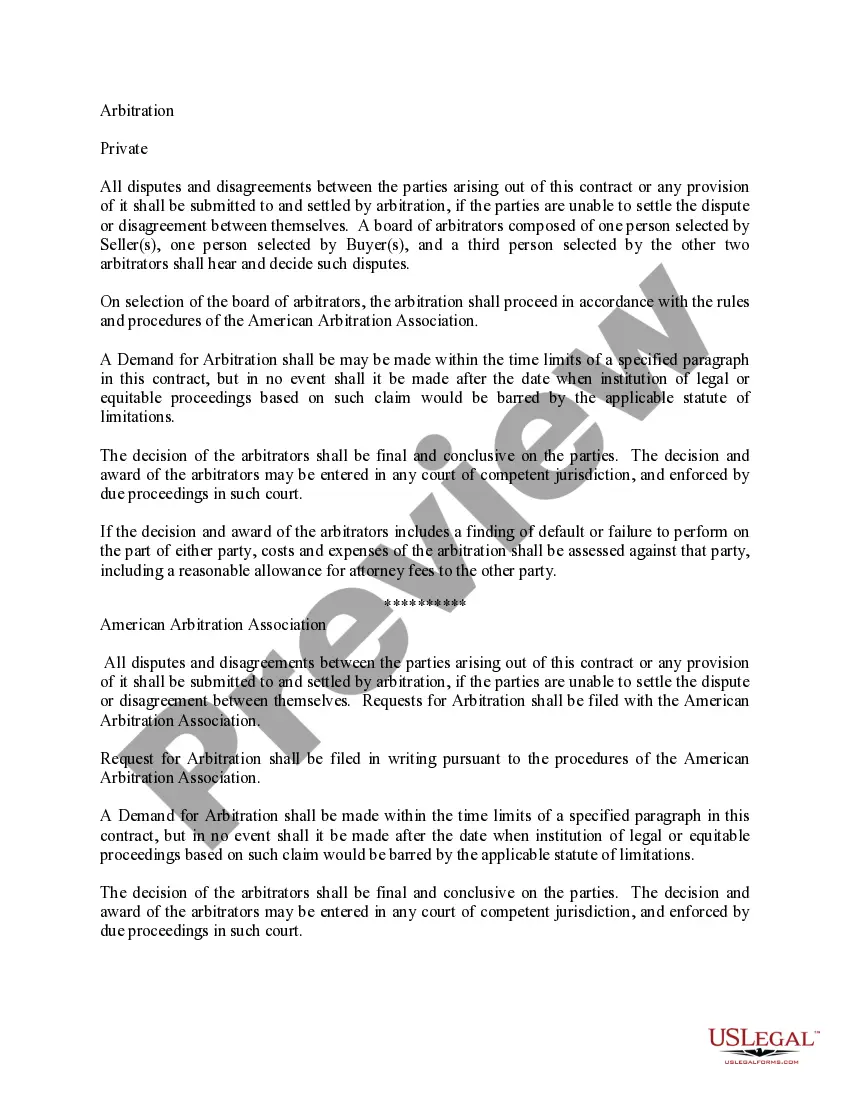
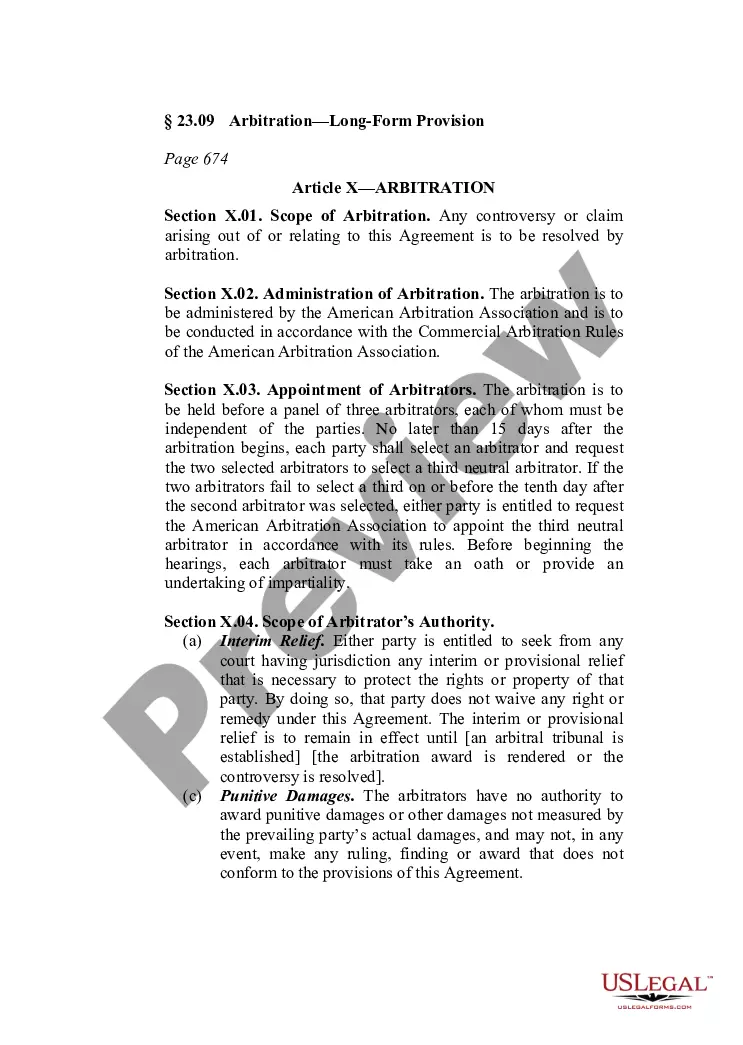
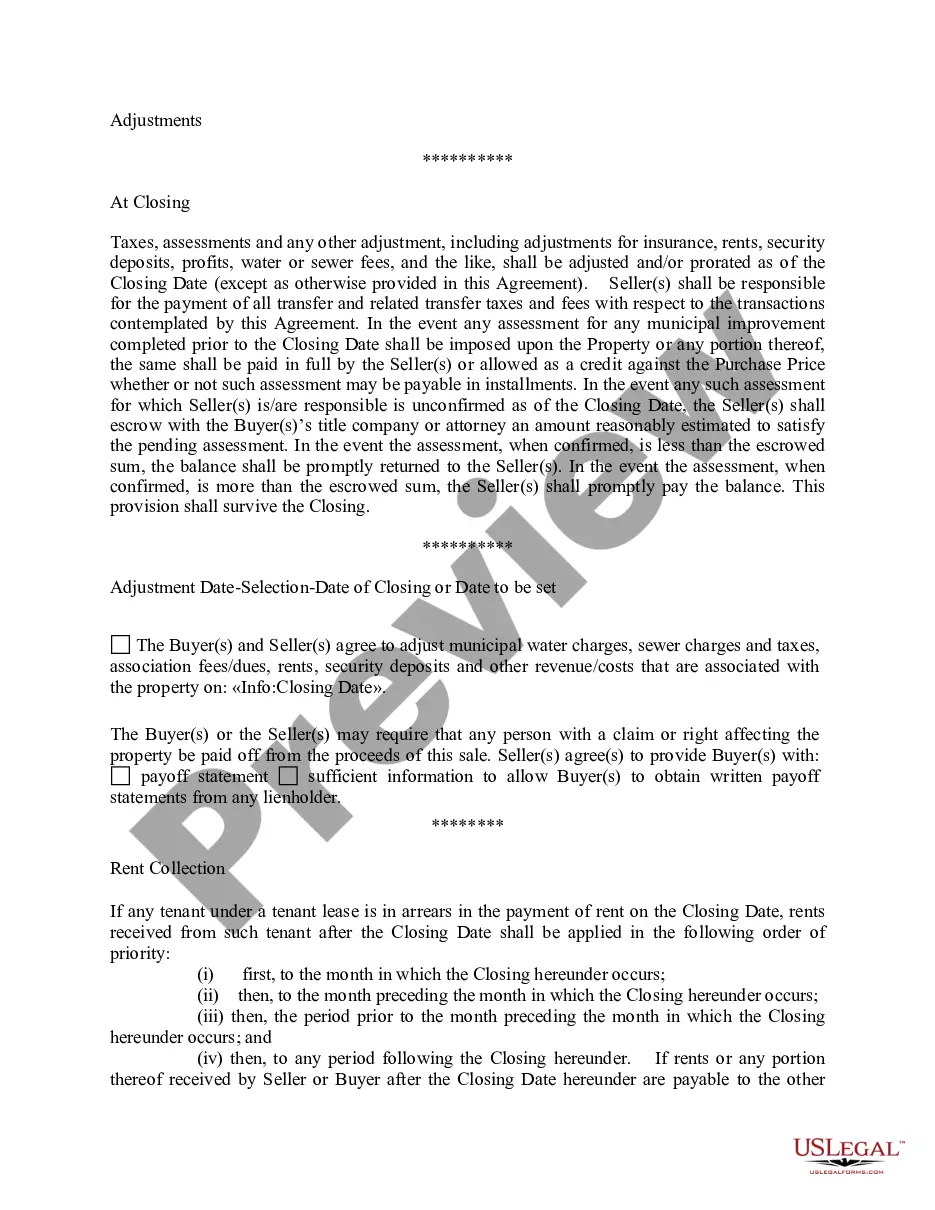
The Arbitration Clauses: Contract for Real Property is a legal document that establishes guidelines for resolving disputes related to real estate transactions through arbitration. This form is distinct from other contracts as it incorporates specific arbitration provisions, ensuring that parties agree to resolve conflicts outside of court. By utilizing this form, both buyers and sellers can avoid lengthy litigation, providing a streamlined approach to dispute resolution.
Key components of this form
- Provision for arbitration of disputes between the parties.
- Details on the selection process for an arbitration panel.
- Reference to the rules and procedures established by the American Arbitration Association.
- Outline of the timeline for filing a Demand for Arbitration.
- Clarification that the arbitration decision is final and can be enforced in court.

Situations where this form applies
This form should be used when parties engaged in a real estate transaction wish to establish clear terms for resolving potential disputes through arbitration. It is particularly beneficial when parties want to minimize the costs and time associated with litigation. Scenarios may include disagreements over contract terms, property condition disputes, or issues related to compliance with the agreement.
Who should use this form
This form is intended for:
- Individuals or entities involved in buying or selling real property.
- Real estate agents and brokers facilitating property transactions.
- Attorneys representing clients in real estate matters.
- Parties interested in a predetermined method for dispute resolution in real estate contracts.
Completing this form step by step
- Identify the parties involved in the real estate transaction.
- Clearly specify the property that is the subject of the contract.
- Include the terms regarding arbitration and how disputes will be managed.
- Have both parties initial the arbitration provision to indicate agreement.
- Ensure all parties sign and date the form to validate the contract.
Notarization guidance
This form does not typically require notarization unless specified by local law. Always verify your jurisdiction's requirements to ensure compliance.
Get your form ready online
Our built-in tools help you complete, sign, share, and store your documents in one place.
Make edits, fill in missing information, and update formatting in US Legal Forms—just like you would in MS Word.
Download a copy, print it, send it by email, or mail it via USPS—whatever works best for your next step.
Sign and collect signatures with our SignNow integration. Send to multiple recipients, set reminders, and more. Go Premium to unlock E-Sign.
If this form requires notarization, complete it online through a secure video call—no need to meet a notary in person or wait for an appointment.
We protect your documents and personal data by following strict security and privacy standards.

Make edits, fill in missing information, and update formatting in US Legal Forms—just like you would in MS Word.

Download a copy, print it, send it by email, or mail it via USPS—whatever works best for your next step.

Sign and collect signatures with our SignNow integration. Send to multiple recipients, set reminders, and more. Go Premium to unlock E-Sign.

If this form requires notarization, complete it online through a secure video call—no need to meet a notary in person or wait for an appointment.

We protect your documents and personal data by following strict security and privacy standards.
Common mistakes
- Failing to initial the arbitration clause, leading to ambiguity regarding enforceability.
- Not specifying a timeline for filing a Demand for Arbitration.
- Overlooking local regulations that may affect the arbitration process.
- Neglecting to define what constitutes a dispute under the agreement.
Benefits of completing this form online
- Convenient access to the form from anywhere, allowing for immediate use.
- Editability enhances the ability to customize the form to specific needs.
- Guaranteed accuracy, as forms are drafted by licensed attorneys.
- Time-saving due to quick downloads, allowing for faster transactions.
Legal use & context
- Arbitration clauses enhance the enforceability of contracts by providing a clear method for dispute resolution.
- This form helps ensure that parties are aware of their rights and obligations regarding arbitration.
- Using arbitration may lead to faster resolutions compared to traditional court proceedings.
Summary of main points
- The Arbitration Clauses: Contract for Real Property creates a binding agreement for dispute resolution through arbitration.
- It is essential for parties involved in real estate transactions to incorporate this clause to avoid costly litigation.
- Both parties must clearly agree to the arbitration process by initialing and signing the form.
Looking for another form?


Form popularity
FAQ
Arbitration clauses are often enforced ing to contract law principles. However, some jurisdictions hold them unenforceable if there has been any fraud, overreaching, or the absence of mutuality with terms such as ?any,? ?all,? or ?every? (as opposed to ?some?) in the arbitration clause.
Arbitration as an Alternative Rather than a judge deciding a case, an arbitrator that the parties select makes the decision. This can be preferable because the parties can select an arbitrator with a background and knowledge of real estate transactions rather than having a randomly selected decision maker.
Arbitration as an Alternative Rather than a judge deciding a case, an arbitrator that the parties select makes the decision. This can be preferable because the parties can select an arbitrator with a background and knowledge of real estate transactions rather than having a randomly selected decision maker.
A binding arbitration clause means that the arbitrator's decision on a specific dispute will be final. The courts will enforce that decision, and neither party can appeal or fail to act ing to the decision.
In the event a dispute shall arise between the parties to this contract, lease, etc., it is hereby agreed that the dispute shall be referred to United States Arbitration & Mediation for arbitration in ance with United States Arbitration & Mediation Rules of Arbitration.
What is an arbitration clause? An arbitration clause is a contract clause that binds signers to handle all disputes with a company through arbitration instead of going through the litigation process. Most importantly, it helps prevent class-action lawsuits.
Alternative Dispute Resolution in Real Estate A neutral mediator will guide the parties through negotiations and into settlements that the parties can agree on. If the parties do not agree, the dispute will move forward into litigation or arbitration. Arbitration is a binding process between the parties.