Seller's Occupany Certification
About this form
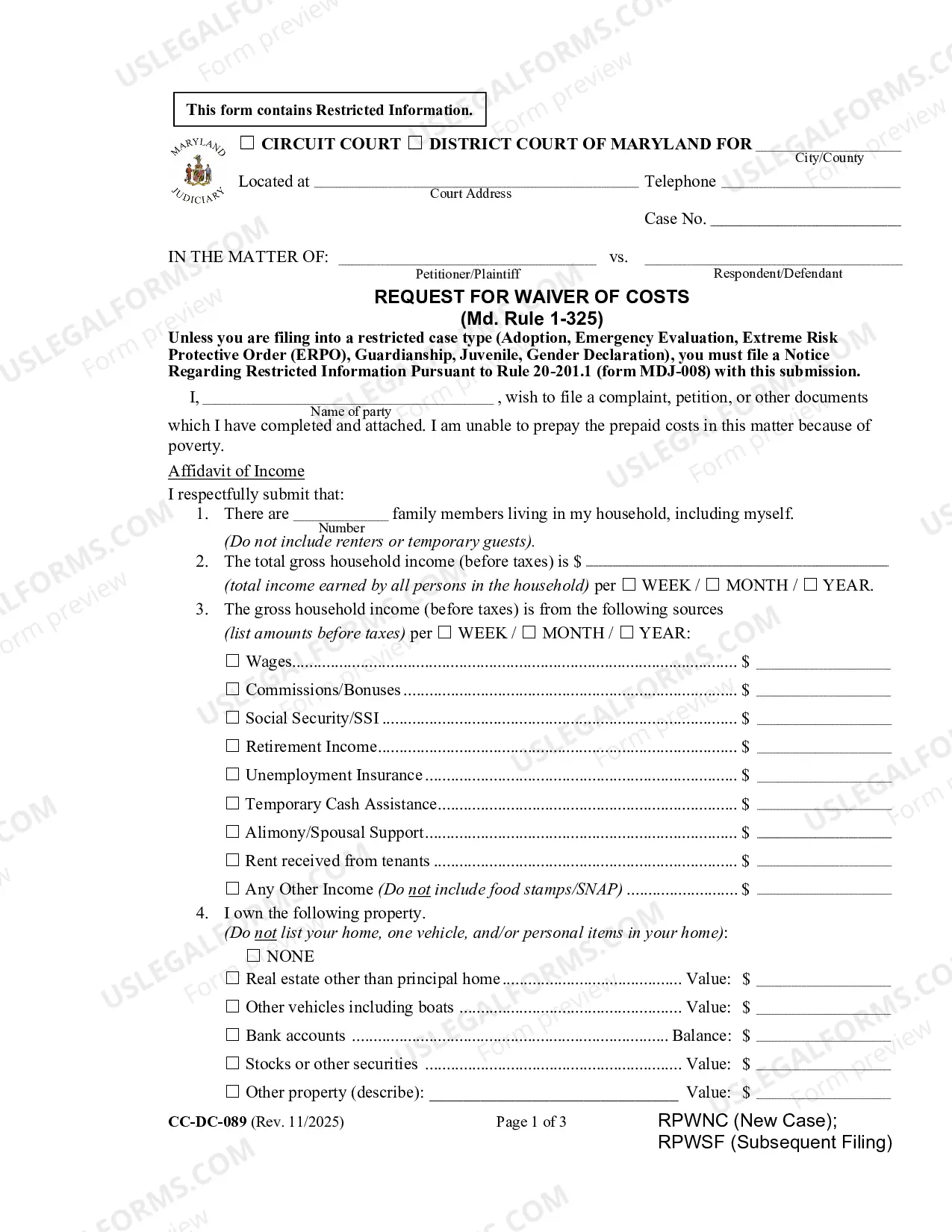
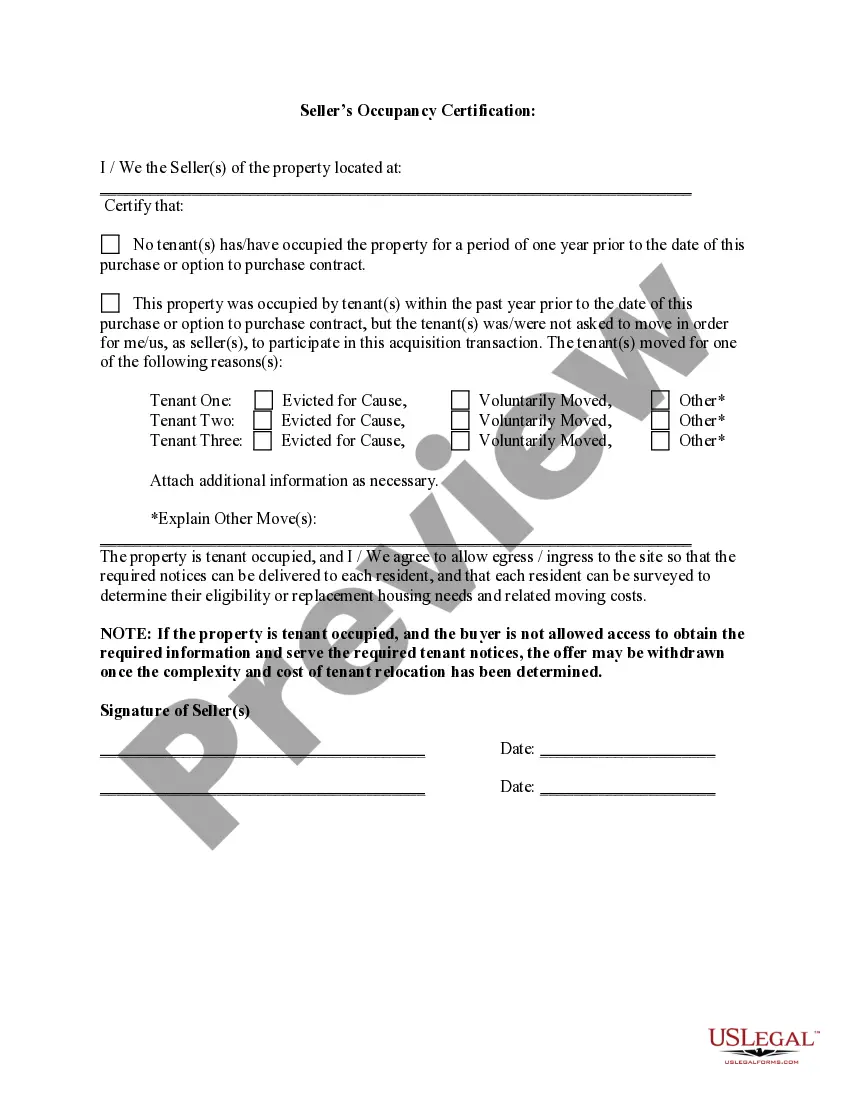
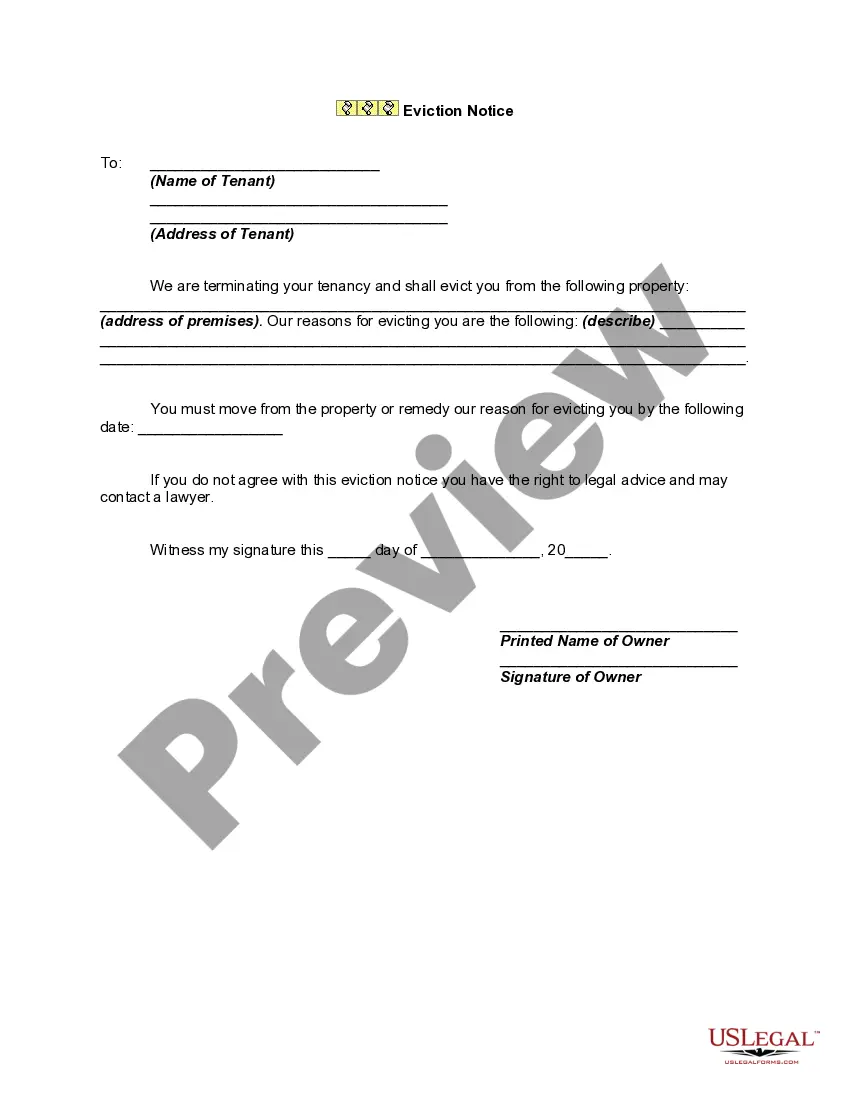
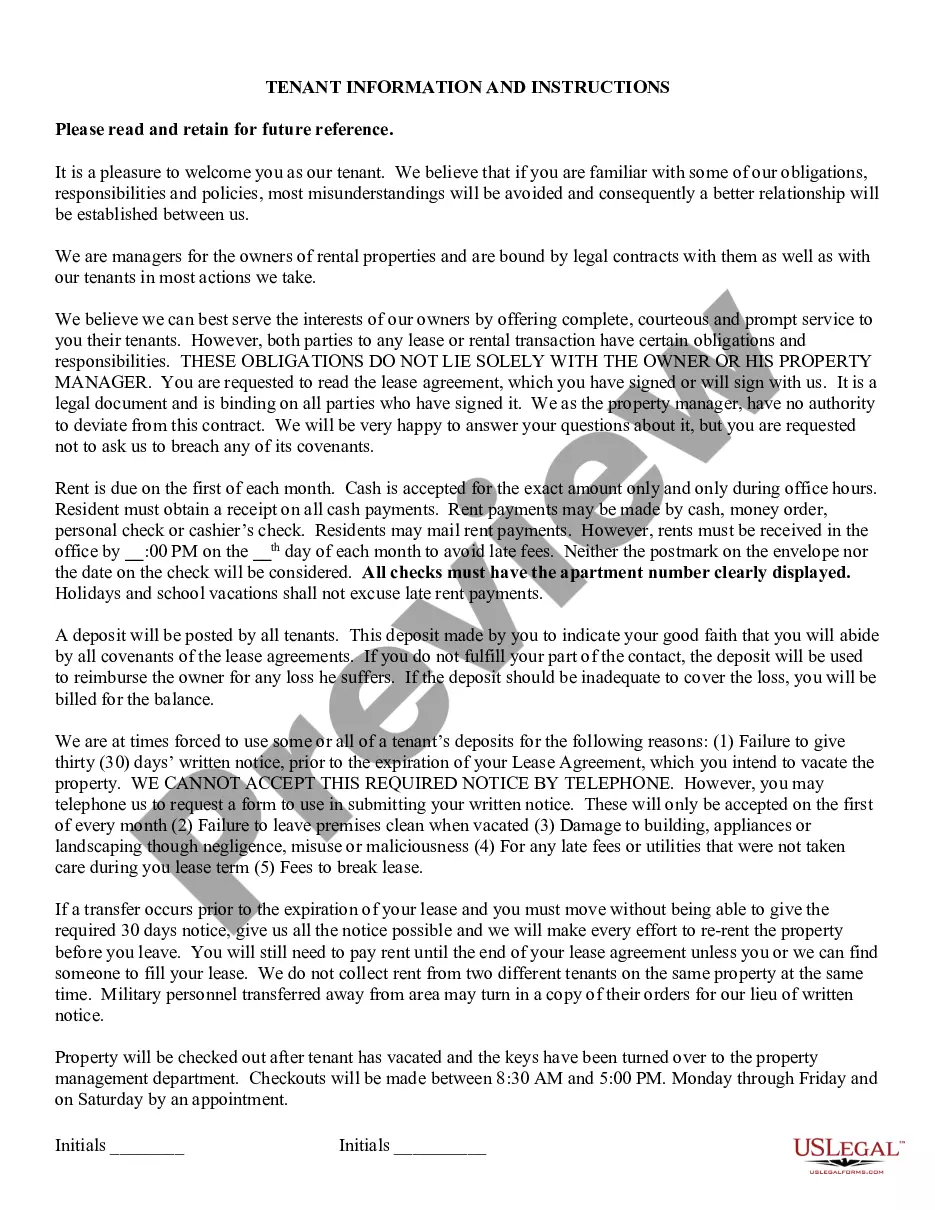
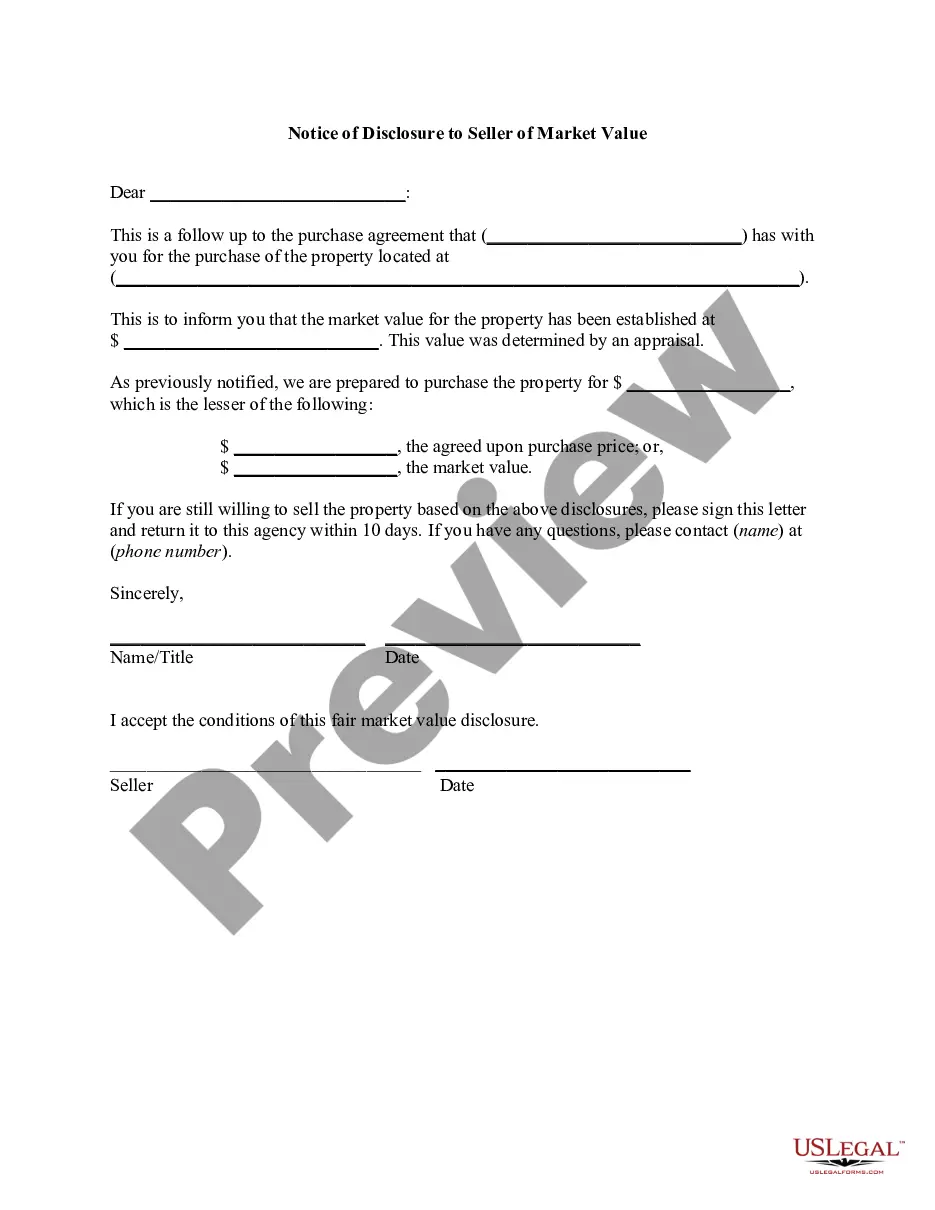
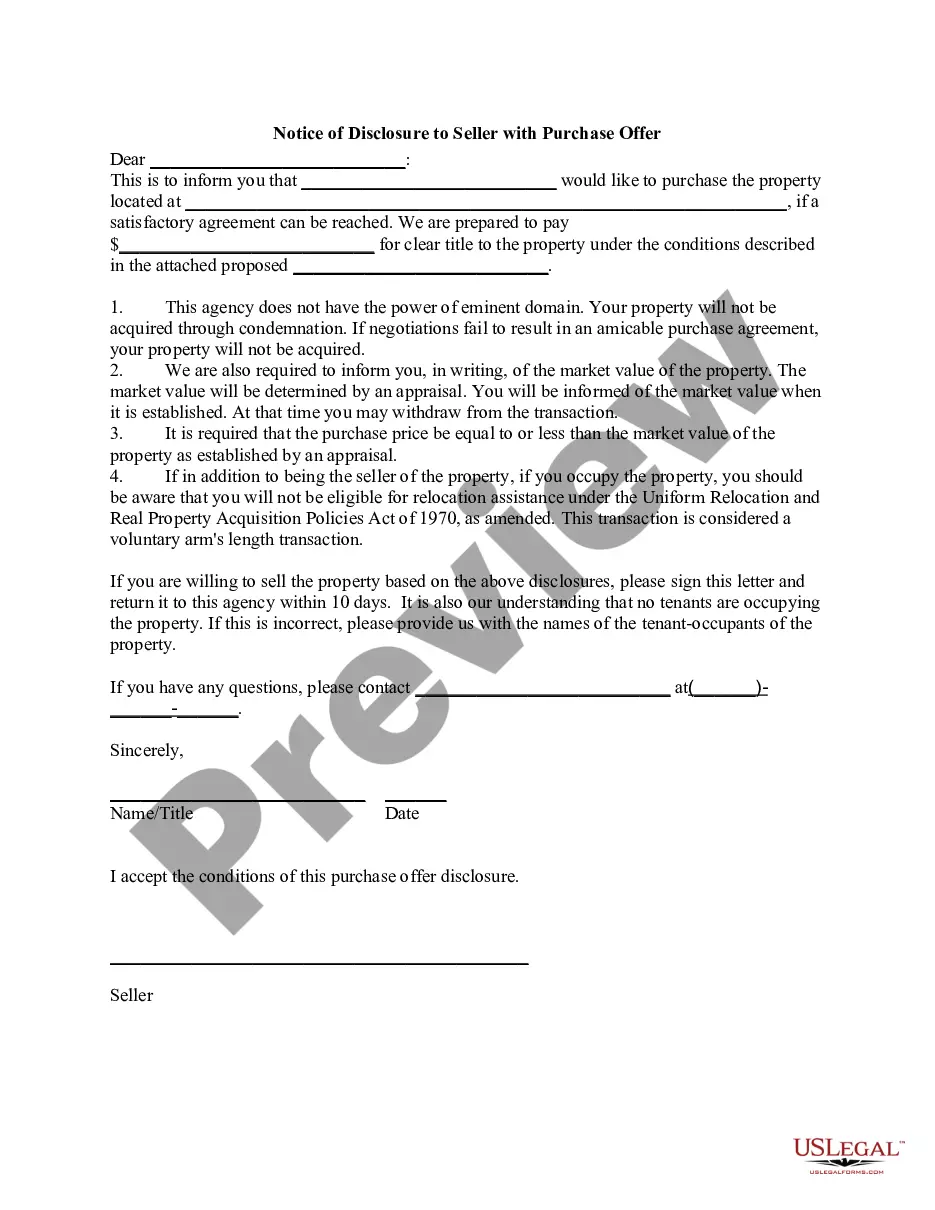
The Seller's Occupancy Certification is a legal document that affirms the occupancy status of a property being sold. It certifies whether the property has been occupied by tenants within the last year and outlines the conditions under which it is currently occupied. This form is crucial for buyers to understand the occupancy status and potential tenant-related considerations before finalizing a property purchase.
Key components of this form
- Certification of occupancy status by the seller.
- Declaration of whether the property was tenant-occupied within the last year.
- Reasons for tenant departure if applicable, including evictions and voluntary moves.
- Agreement to allow access for tenant notices and surveys.
- Signature section for the seller(s).

When to use this document
This form is typically used during real estate transactions when a property is sold and may have had tenants living in it. It protects both the seller and buyer by clarifying the occupancy situation, which can affect the sale process and buyer decisions. It's essential to use this form when there is any uncertainty about the status of current or past tenants.
Who should use this form
- Property sellers who have leased their property to tenants.
- Buyers seeking to understand the occupancy history of a property.
- Real estate agents facilitating the sale of tenant-occupied properties.
Steps to complete this form
- Identify the parties involved by entering the seller's name(s) and property address.
- Certify the occupancy status by selecting the appropriate statement regarding tenant occupancy.
- Detail reasons for tenant moves if applicable, using the provided options.
- Sign and date the form to validate the certification.
- Attach any necessary additional information regarding tenant circumstances.
Notarization requirements for this form
This form does not typically require notarization unless specified by local law. However, verifying with local regulations is advisable to ensure compliance.
Get your form ready online
Our built-in tools help you complete, sign, share, and store your documents in one place.
Make edits, fill in missing information, and update formatting in US Legal Forms—just like you would in MS Word.
Download a copy, print it, send it by email, or mail it via USPS—whatever works best for your next step.
Sign and collect signatures with our SignNow integration. Send to multiple recipients, set reminders, and more. Go Premium to unlock E-Sign.
If this form requires notarization, complete it online through a secure video call—no need to meet a notary in person or wait for an appointment.
We protect your documents and personal data by following strict security and privacy standards.

Make edits, fill in missing information, and update formatting in US Legal Forms—just like you would in MS Word.

Download a copy, print it, send it by email, or mail it via USPS—whatever works best for your next step.

Sign and collect signatures with our SignNow integration. Send to multiple recipients, set reminders, and more. Go Premium to unlock E-Sign.

If this form requires notarization, complete it online through a secure video call—no need to meet a notary in person or wait for an appointment.

We protect your documents and personal data by following strict security and privacy standards.
Mistakes to watch out for
- Failing to accurately report the occupancy status, which can lead to legal issues.
- Not signing or dating the certification, rendering it invalid.
- Providing incomplete information about tenant moves.
Benefits of completing this form online
- Quick and easy access to professionally drafted legal templates.
- Edit and customize the form to fit specific transaction needs.
- Secure storage and access to completed documents.
Looking for another form?
Form popularity
FAQ
In order to receive a CO, the following must exist for the job: All final inspections have been completed with a "pass" disposition, including fire if applicable. All trade sub-permits, as well as other affiliated permits on the job, must be finaled.
A Certificate of Occupancy is required for all rental properties-before a tenant can move in-to ensure the premises are up to code. It is the landlord's responsibility to have a CO each time a tenant changes.
A Temporary Certificate of Occupancy (TCO) may be issued if the work is substantially complete, there are no outstanding health or safety issues and the building or space can be occupied safely. A TCO is issued for a defined period of time during which any remaining items are to be completed.
New Jersey allows you to sell a house as is, but certain steps must be followed to do so. A real estate agent must ensure that any special circumstances on the property are reflected in the purchase contract. The law requires that the transaction contract mention that the buyer accepts the house as is.
Buildings or spaces within buildings are not allowed to be occupied without a current Certificate of Occupancy issued in the name of the tenant occupying that building or space.
New Jersey Sellers Must Disclose Known, Latent, Material Defects. In order to protect buyers from unwittingly purchasing real estate with hidden defects, a New Jersey home seller has a duty under the common law to tell prospective buyers about known, latent (concealed) material defects in the property.
No commercial building is permitted to be occupied without of a Certificate of Occupancy. For any questions about a Certificate of Occupancy, please contact 405-739-1210 or 405-739-1211.
Certificates of occupancy are not required in New Jersey for all sales. A ?temporary certificate of occupancy? may be granted for a set time period to accomplish necessary repairs. A ?certificate of transfer title? is sometimes used to transfer ownership where a property fails the municipal inspection.