Occupancy Affidavit and Financial Status
What is this form?
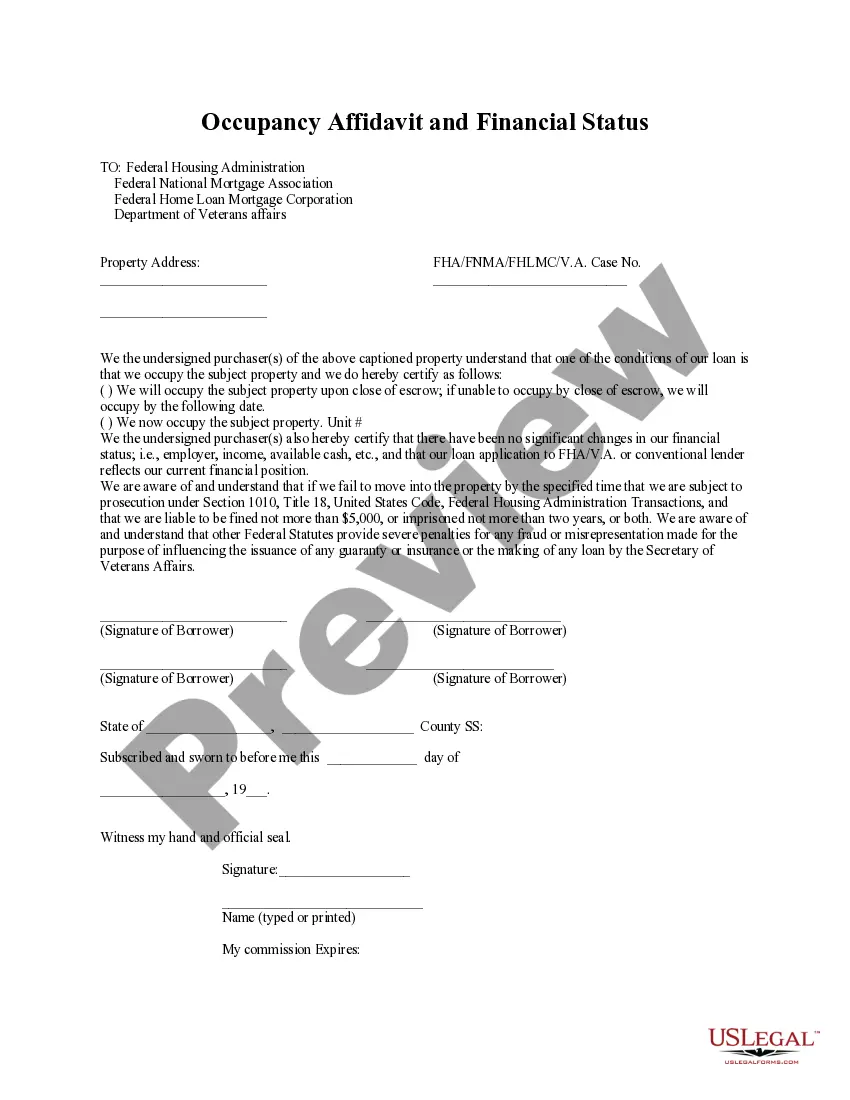
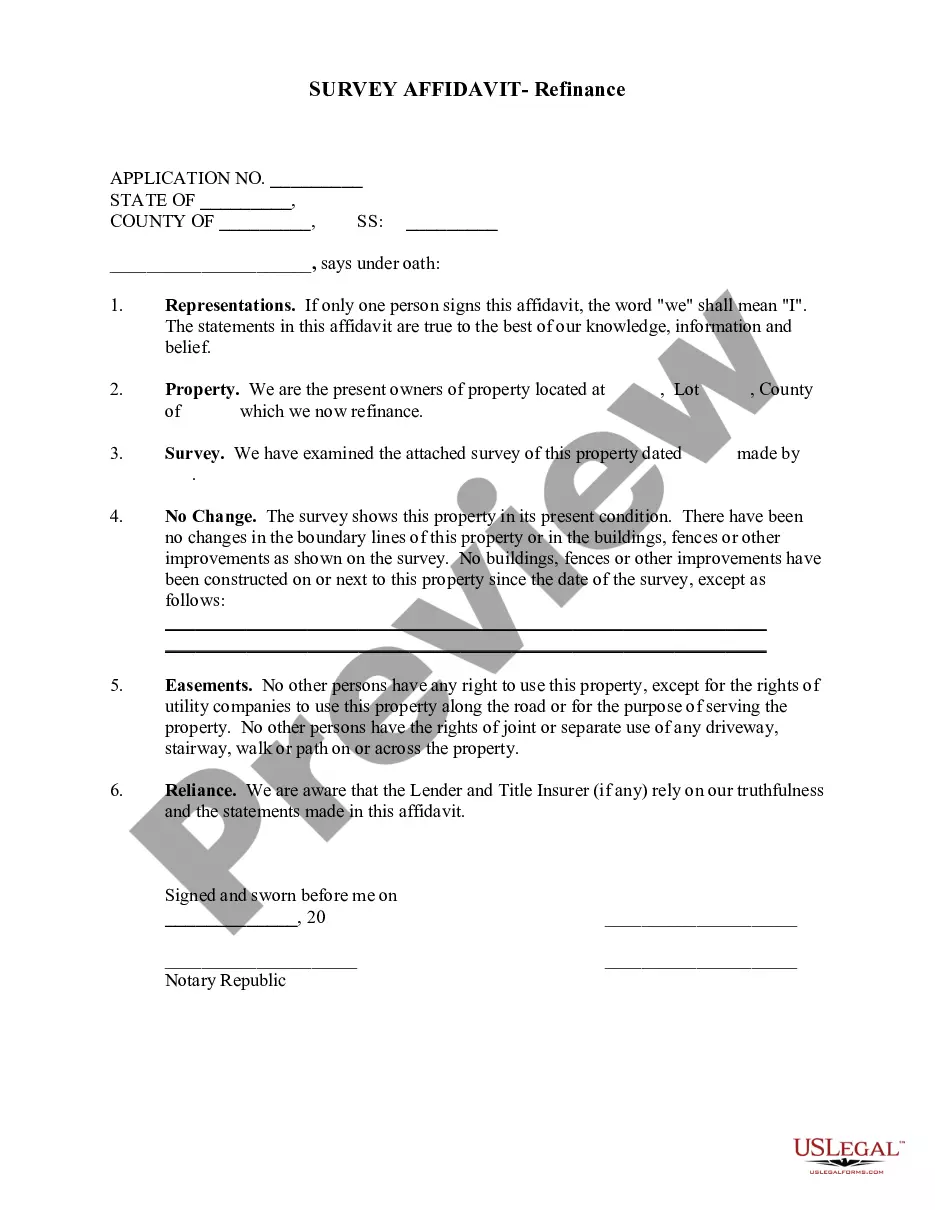
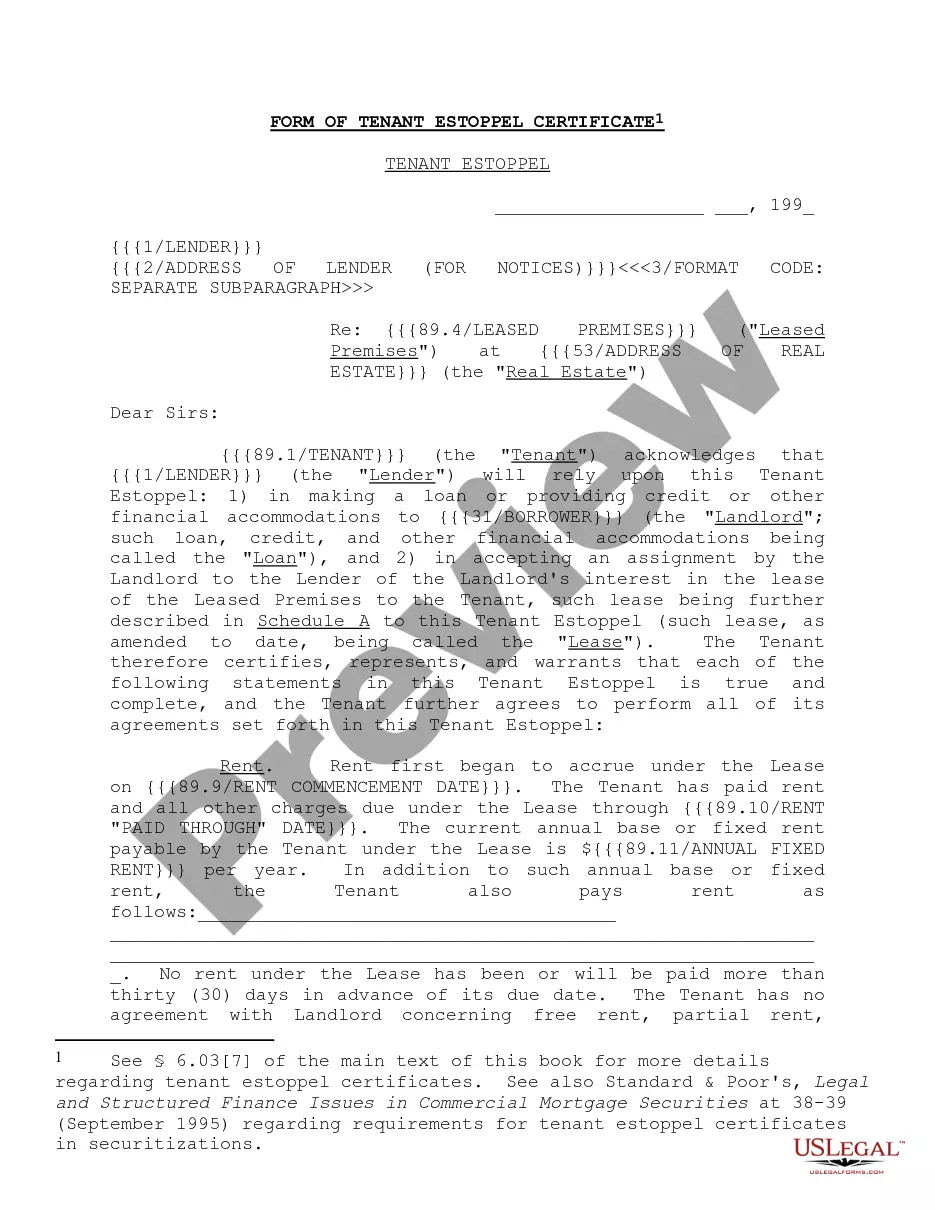
The Occupancy Affidavit and Financial Status is a legal document used by borrowers to confirm their intention to occupy a property for which they are securing a mortgage. This form is essential for compliance with loan conditions set by federal housing agencies. Unlike standard occupancy agreements, this affidavit also captures the borrowers' current financial status, ensuring all information is accurate and up to date.
Form components explained
- Certification of intent to occupy the property upon closing or by a specified date.
- Declaration of current financial status, with emphasis on changes related to employment and income.
- Warning about the consequences of failing to occupy the property as stated.
- Signatures of all borrowers to authenticate the affidavit.
- Notarization section for legal validation of the signatures.

When to use this document
This form should be utilized when finalizing a mortgage loan where occupancy is a condition. It is particularly important when applying for loans through the Federal Housing Administration, Federal National Mortgage Association, or Department of Veterans Affairs. Use this affidavit to ensure compliance with regulatory requirements and avoid potential legal penalties.
Intended users of this form
- Prospective homeowners applying for a government-backed mortgage.
- Borrowers who need to confirm their occupancy status as part of loan conditions.
- Individuals seeking to validate their financial status in relation to a mortgage application.
Steps to complete this form
- Identify the property for which the loan is being secured.
- Check the appropriate box indicating whether you will occupy the property at closing or a later date.
- List any significant changes in your financial status since the loan application.
- All borrowers must sign the affidavit to confirm its accuracy and authenticity.
- Have the document notarized to ensure its legal validity and compliance.
Does this form need to be notarized?
This document requires notarization to meet legal standards. US Legal Forms provides secure online notarization powered by Notarize, allowing you to complete the process through a verified video call, available 24/7.
Get your form ready online
Our built-in tools help you complete, sign, share, and store your documents in one place.
Make edits, fill in missing information, and update formatting in US Legal Forms—just like you would in MS Word.
Download a copy, print it, send it by email, or mail it via USPS—whatever works best for your next step.
Sign and collect signatures with our SignNow integration. Send to multiple recipients, set reminders, and more. Go Premium to unlock E-Sign.
If this form requires notarization, complete it online through a secure video call—no need to meet a notary in person or wait for an appointment.
We protect your documents and personal data by following strict security and privacy standards.

Make edits, fill in missing information, and update formatting in US Legal Forms—just like you would in MS Word.

Download a copy, print it, send it by email, or mail it via USPS—whatever works best for your next step.

Sign and collect signatures with our SignNow integration. Send to multiple recipients, set reminders, and more. Go Premium to unlock E-Sign.

If this form requires notarization, complete it online through a secure video call—no need to meet a notary in person or wait for an appointment.

We protect your documents and personal data by following strict security and privacy standards.
Common mistakes
- Failing to check the appropriate occupancy box.
- Not disclosing changes in financial status, which can lead to legal issues.
- Missing signatures from all borrowers, making the form invalid.
- Neglecting to have the form notarized if required for your jurisdiction.
Advantages of online completion
- Convenience of completing the form from home at any time.
- Editable text fields allowing customization to your specific information.
- Access to forms drafted by licensed attorneys, ensuring legality and relevance.
Looking for another form?


Form popularity
FAQ
Lenders usually stipulate that homeowners have 30 days after closing to occupy a primary residence. To verify the person moving in is actually the owner, the lender may call the house and ask to speak to the homeowner.The lender may also drive past the house looking for a rental sign in the yard.
A mortgage affidavit is a written statement signed by a party in a real estate transaction under penalties of perjury that attests to certain conditions of the property.
Signature Affidavit document is generally combined with the Name Affidavit & is a document in which a person certifies that the signature provided is the true and correct signature used by the person; Name Affidavit allows a person to give a declaration that they are the same person as another name.
Lenders and loan officers confirm that they regularly encounter falsehoods about occupancy.Depending on the lender, buyers might be able to save a half to a full percentage point off the interest rate on the loan by calling their purchase a principal residence.
Lenders will take a variety of things into account when determining whether you intend to live in a house and take occupancy type into consideration because people are much less likely to default on the mortgage of a house they are living in.
Basically, the FHA does require your home to be owner-occupied if you use FHA financing. But, as you can see, there are several exceptions to the rule. Before you decide to do anything, always check with your lender.
In the sentence, the person writing the statement must state that he or she is stating that the information is accurate. (Example: I, Jane Doe, solemnly swear that the contents of this document are true and correct, and that I agree to abide by the terms in this affidavit.)
Owner-occupants are residents that own the property that they live at. Some loans are only available to owner-occupants and not absentee owners or investors. To be considered owner-occupied, residents usually must move into the home within 60 days of closing and live there for at least a year.
The Importance of Being Truthful in an Affidavit Saying something that is not true in an affidavit is technically a violation of the law and you can be fined or even imprisoned for committing perjury. It is just like lying on the stand in a court proceeding.