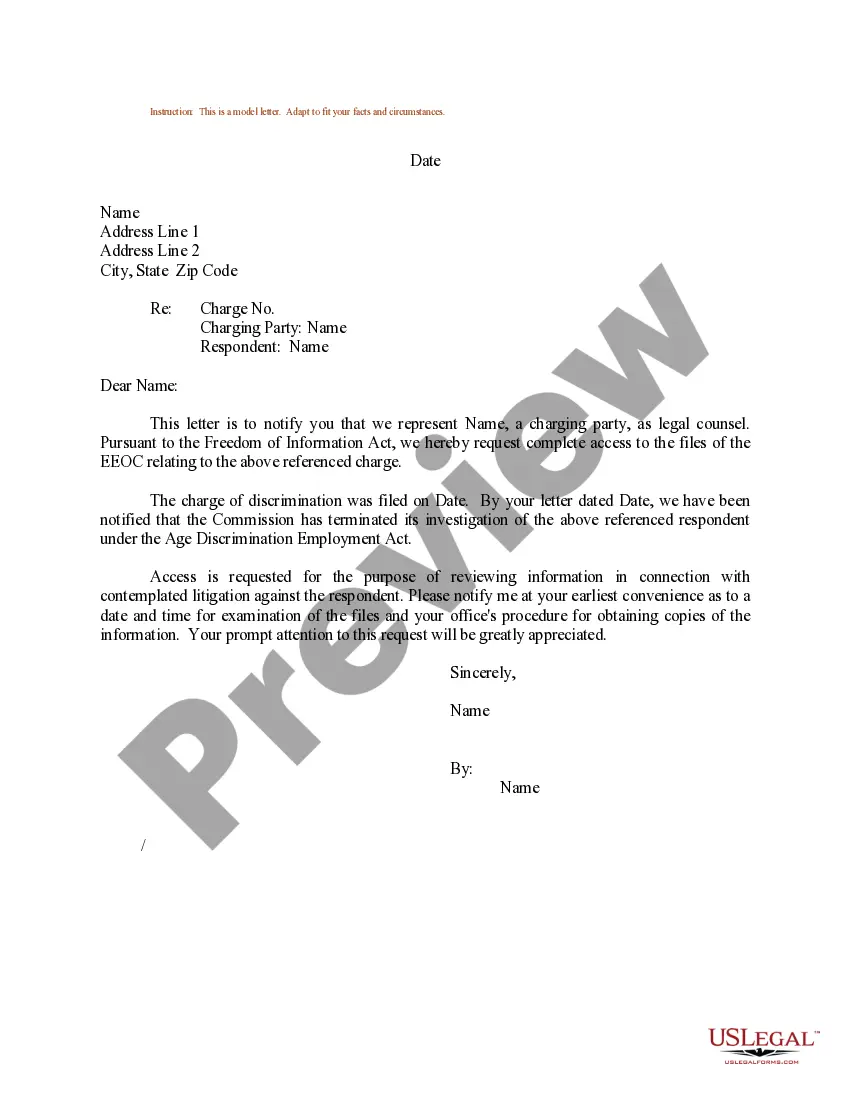
Sample Letter for Request for Access to Information regarding Age Discrimination
Overview of this form
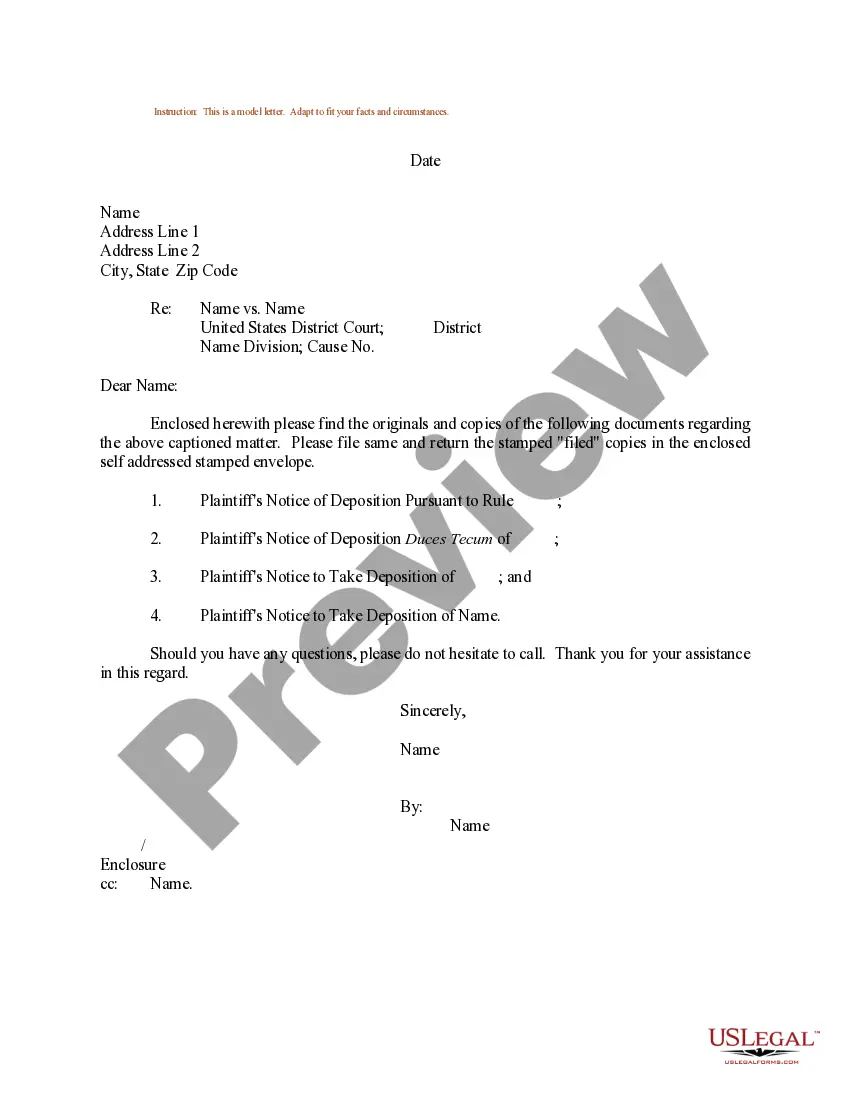
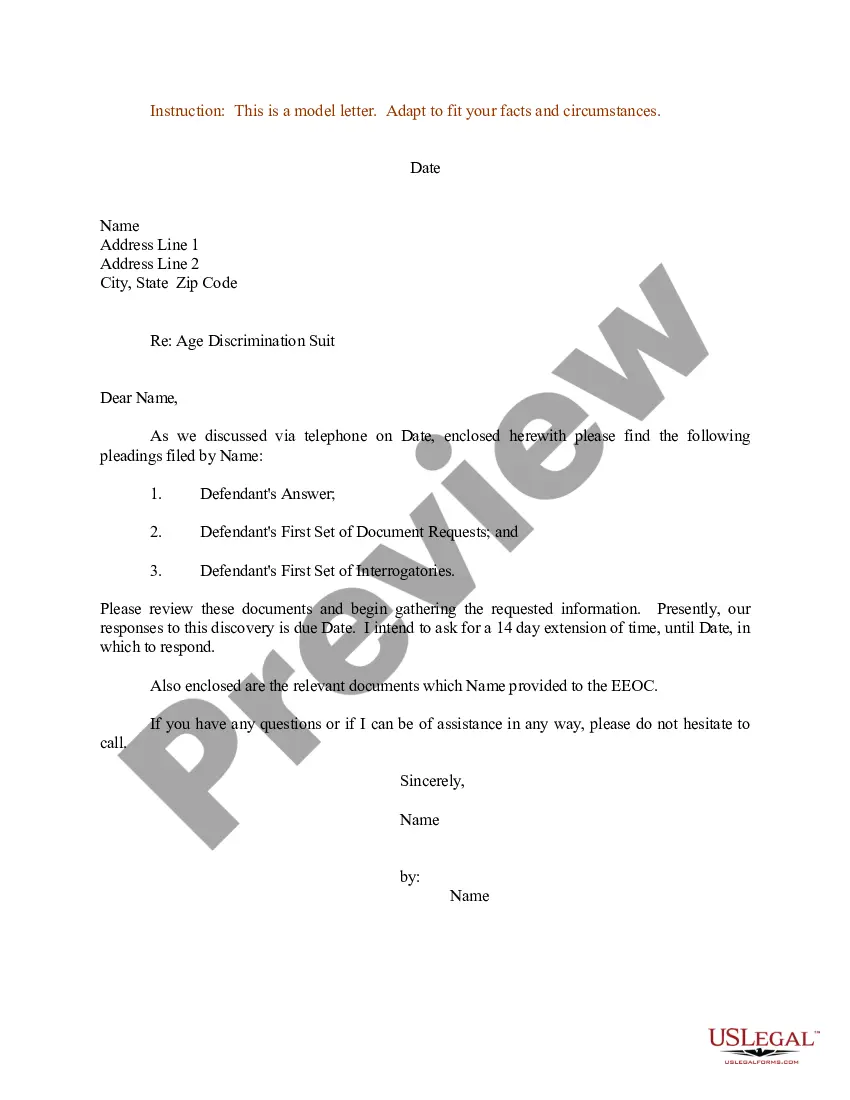
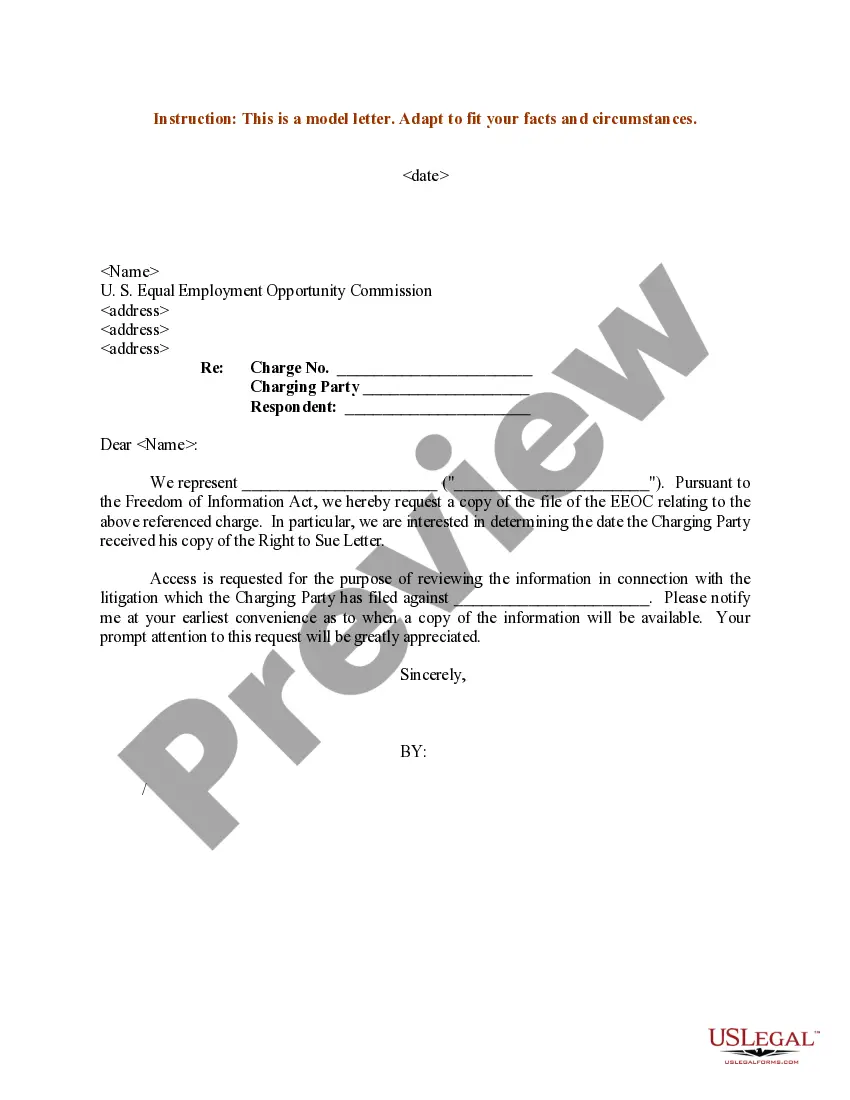
This form is a sample letter for requesting access to information regarding age discrimination claims. It enables individuals to formally ask for the documentation they need for potential litigation under the Age Discrimination in Employment Act. This letter helps clarify the process for obtaining relevant records following the termination of an investigation by the Commission, distinguishing it from general request letters.
Main sections of this form
- Date: The date the letter is drafted.
- Recipient's name and address: The individual or entity to whom the request is directed.
- Charge of discrimination date: The date when the discrimination claim was filed.
- Request for access: A clear statement requesting access to files related to the age discrimination case.
- Response request: A solicitation for a date and time for examination of files and procedures for obtaining copies.
- Signature: The sender's name and signature at the end of the letter.
When to use this document
This form should be used when an individual who has filed an age discrimination charge is seeking access to information from the Commission following the closure of the investigation. It is particularly useful when preparing for legal action against an employer, allowing the individual to review evidence and documentation related to their claim.
Who can use this document
- Individuals who have filed a charge of age discrimination.
- Claimants who have received notification of an investigation's termination.
- Anyone planning to initiate litigation related to age discrimination.
How to prepare this document
- Enter the date at the top of the letter.
- Fill in the recipient's name and address accurately.
- Specify the date when the discrimination charge was filed.
- Clearly state your request for access to specific information.
- Indicate your desire for a prompt response regarding time and procedures for accessing files.
- Sign off with your name and include your signature if required.
Notarization guidance
Notarization is generally not required for this form. However, certain states or situations might demand it. You can complete notarization online through US Legal Forms, powered by Notarize, using a verified video call available anytime.
Get your form ready online
Our built-in tools help you complete, sign, share, and store your documents in one place.
Make edits, fill in missing information, and update formatting in US Legal Forms—just like you would in MS Word.
Download a copy, print it, send it by email, or mail it via USPS—whatever works best for your next step.
Sign and collect signatures with our SignNow integration. Send to multiple recipients, set reminders, and more. Go Premium to unlock E-Sign.
If this form requires notarization, complete it online through a secure video call—no need to meet a notary in person or wait for an appointment.
We protect your documents and personal data by following strict security and privacy standards.

Make edits, fill in missing information, and update formatting in US Legal Forms—just like you would in MS Word.

Download a copy, print it, send it by email, or mail it via USPS—whatever works best for your next step.

Sign and collect signatures with our SignNow integration. Send to multiple recipients, set reminders, and more. Go Premium to unlock E-Sign.

If this form requires notarization, complete it online through a secure video call—no need to meet a notary in person or wait for an appointment.

We protect your documents and personal data by following strict security and privacy standards.
Common mistakes
- Failing to include the necessary dates, which can cause confusion.
- Not addressing the letter to the correct party, leading to delays.
- Leaving out a specific request for information, resulting in a vague inquiry.
Advantages of online completion
- Convenience of downloading and customizing the form at your own pace.
- Editable format allows for easy updates to ensure accuracy.
- Reliability in using a form drafted by licensed attorneys, ensuring compliance with legal standards.
Looking for another form?
Form popularity
FAQ
This happens when someone treats you worse than another person in a similar situation because of your age. For example: your employer refuses to allow you to do a training course because she thinks you are 'too old', but allows younger colleagues to do the training.
Ageism is discrimination or unfair treatment based on a person's age.
Age bias outside of tech. Age discrimination in nonprofits. Age discrimination by older employees. Age discrimination in healthcare. Age bias against younger workers.
The Age Discrimination in Employment Act of 1967 (ADEA) protects certain applicants and employees 40 years of age and older from discrimination on the basis of age in hiring, promotion, discharge, compensation, or terms, conditions or privileges of employment.
The Age Discrimination in Employment Act (ADEA) forbids age discrimination against people who are age 40 or older. It does not protect workers under the age of 40, although some states have laws that protect younger workers from age discrimination.
Age discrimination involves treating an applicant or employee less favorably because of his or her age. The Age Discrimination in Employment Act (ADEA) forbids age discrimination against people who are age 40 or older.
The Age Discrimination in Employment Act of 1967 (ADEA) protects certain applicants and employees 40 years of age and older from discrimination on the basis of age in hiring, promotion, discharge, compensation, or terms, conditions or privileges of employment.
In 1967, Congress enacted the federal Age Discrimination in Employment Act (ADEA) to prohibit age discrimination in the workplace and promote the employment of older workers.
Age Discrimination. Disability Discrimination. Sexual Orientation. Status as a Parent. Religious Discrimination. National Origin. Sexual Harassment. Race, Color, and Sex.