Stock Certificate for Corporation
About this form
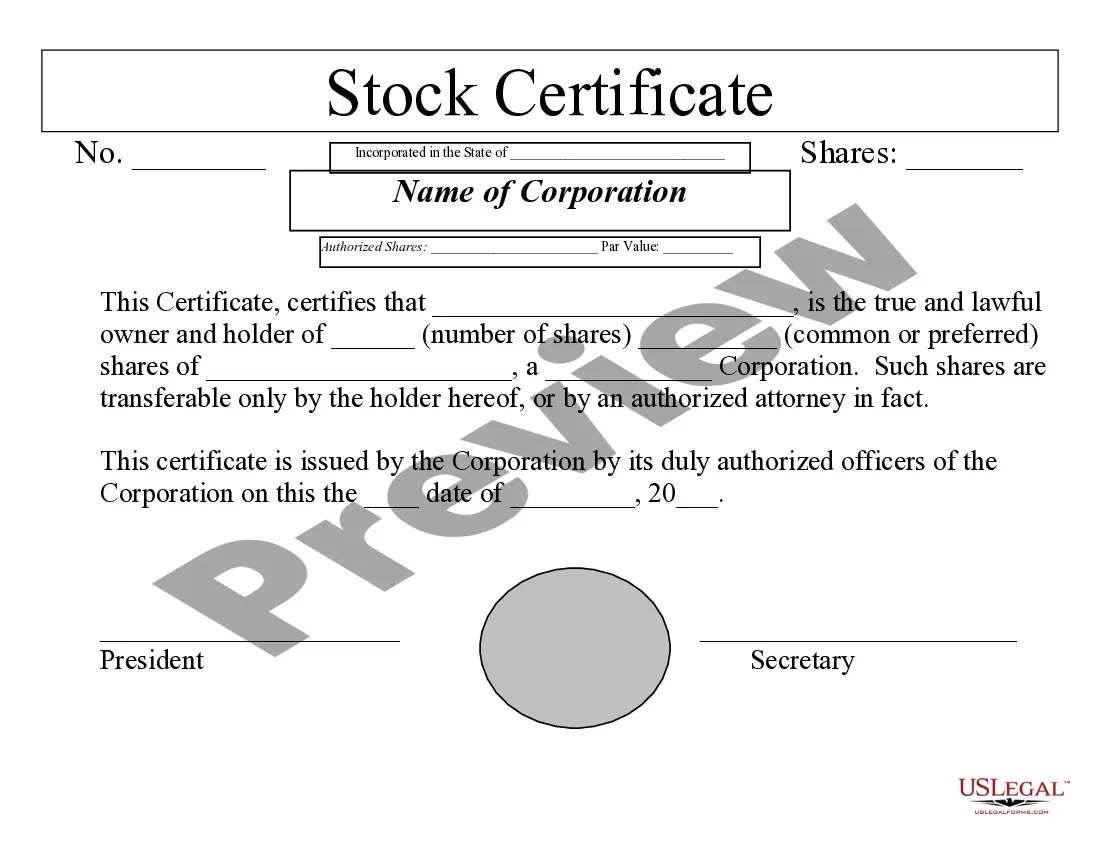
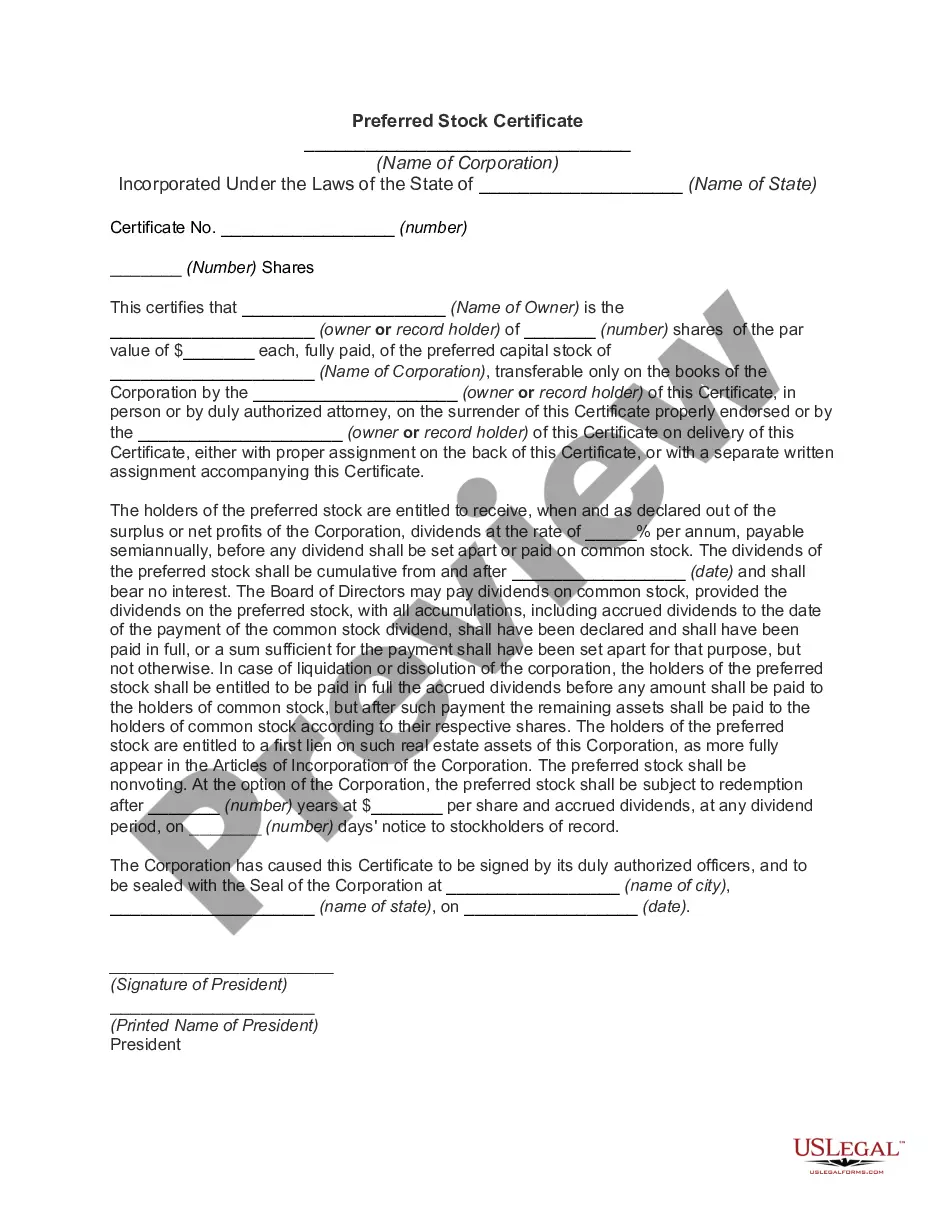
The Stock Certificate for Corporation is a legal document that certifies an individual's ownership of shares in a corporation. This form serves as proof of ownership of common or preferred shares and is essential for establishing and transferring ownership rights. Unlike other legal forms, this certificate is specifically tailored for corporate ownership and includes vital details such as the number of shares and the corporation's name.
Key components of this form
- Certificate number, which uniquely identifies the stock certificate.
- The total number of shares owned by the individual.
- Identification of the type of shares (common or preferred).
- The name of the corporation and its state of incorporation.
- Signatures of the authorized corporate officers (President and Secretary).
- Date of issuance, indicating when the certificate was issued.
Situations where this form applies
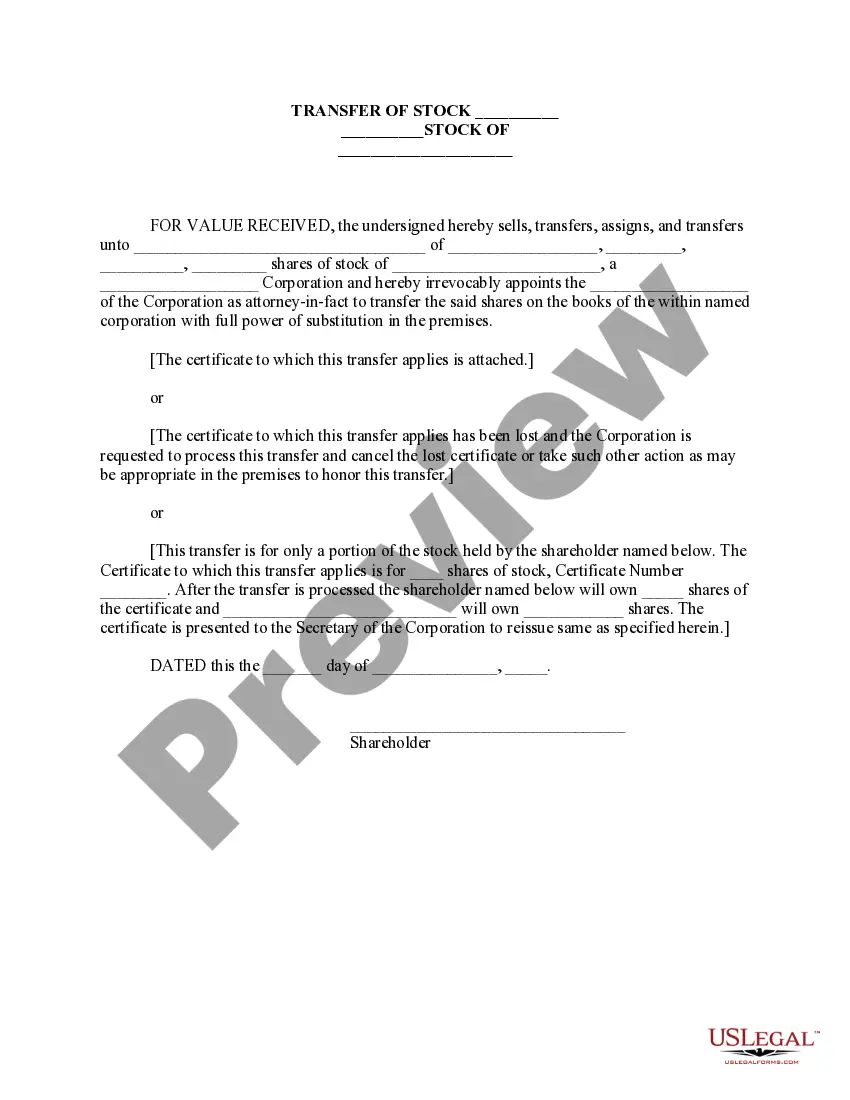
This Stock Certificate should be used when a corporation issues shares to an individual or entity as part of their ownership structure. The form is crucial for new shareholders receiving their shares for the first time or for existing shareholders who require documentation for the transfer of ownership. It may also be useful when shareholders need evidence for financial transactions or legal purposes.
Who can use this document
This form is intended for:
- Corporations issuing shares to shareholders.
- Shareholders who need to establish proof of stock ownership.
- Corporate officers responsible for managing share issuance.
- Attorneys or legal professionals handling corporate transactions.
Instructions for completing this form
- Enter the certificate number in the designated field.
- Specify the total number of shares being issued.
- Indicate whether the shares are common or preferred.
- Fill in the name of the corporation and its state of incorporation.
- Complete the date of issuance and obtain the necessary signatures from the President and Secretary of the corporation.
Is notarization required?
This form does not typically require notarization unless specified by local law. Always check your state regulations to ensure compliance.
Get your form ready online
Our built-in tools help you complete, sign, share, and store your documents in one place.
Make edits, fill in missing information, and update formatting in US Legal Forms—just like you would in MS Word.
Download a copy, print it, send it by email, or mail it via USPS—whatever works best for your next step.
Sign and collect signatures with our SignNow integration. Send to multiple recipients, set reminders, and more. Go Premium to unlock E-Sign.
If this form requires notarization, complete it online through a secure video call—no need to meet a notary in person or wait for an appointment.
We protect your documents and personal data by following strict security and privacy standards.

Make edits, fill in missing information, and update formatting in US Legal Forms—just like you would in MS Word.

Download a copy, print it, send it by email, or mail it via USPS—whatever works best for your next step.

Sign and collect signatures with our SignNow integration. Send to multiple recipients, set reminders, and more. Go Premium to unlock E-Sign.

If this form requires notarization, complete it online through a secure video call—no need to meet a notary in person or wait for an appointment.

We protect your documents and personal data by following strict security and privacy standards.
Avoid these common issues
- Failing to include the correct number of shares issued.
- Not specifying whether the shares are common or preferred.
- Missing signatures from the President or Secretary.
- Omitting the date of issuance.
- Using incorrect corporate names or states of incorporation.
Why use this form online
- Convenience of immediate access to a professionally drafted template.
- Easy customization to fit specific ownership details.
- Ability to download and print in a professional format.
- Time-saving with quick form completion and distribution.
Legal use & context
- This stock certificate serves as a legal evidence of ownership.
- It may be necessary for transfers, sales, or pledges of shares.
- Inaccuracies or omissions may render the certificate unenforceable.
Summary of main points
- The Stock Certificate is essential for documenting ownership in a corporation.
- Completing this form correctly ensures legal recognition of share ownership.
- State-specific guidelines should always be observed.
Looking for another form?


Form popularity
FAQ
Depending on which state you form your corporation in, you may need to issue stock. Some states require corporations to issue stock, while others make it optional. Before filing Articles of Incorporation, you should spend time researching whether the board of directors will need to issue stock.
To fill out a stock certificate, you fill in the name of the shareholder, the name of the corporation, the number of shares represented by the certificate, the date, and possibly an identification number.
If you can track down the issuing company and get its CUSIP number, you can reach out to a transfer agent, complete a transfer form and place a sell order to cash in your old stock certificate. Otherwise, you could simply keep the certificate if the company no longer exists.
Old stock certificates shouldn't be simply thrown away. They can still have value if they represent an existing or merged company, or if they are valued as collectibles. A little bit of research can help you determine the worth, if any, of your old paper stock certificate.
Open the free PDF file you will receive by email. Start inserting the State of formation, name of the company, number of shares, par value and class. You can insert a clause and the text will resize depending on the number of characters you insert. Insert the signature titles.
Stock Certificates Are No Longer Necessary Today, most of the world's exchanges have either done away with or are phasing out paper certificates. Stock ownership is much easier to prove now thanks to electronic records and electronic communication networks (ECN).
A stock certificate is a physical piece of paper that represents a shareholder's ownership in a company. Stock certificates include information such as the number of shares owned, the date of purchase, an identification number, usually a corporate seal, and signatures.
Contact your stockbroker to search the stock's worth via its CUSIP number if the steps given earlier yield no results. This number is printed on the back of the stock certificate. Use a fee-based service to search your stock's history if the earlier steps come up empty. Fees can range from $40 to $85 or more.
A stock certificate represents a shareholder's ownership interest in a corporation. Most states do not require a corporation to issue a paper stock certificate -- that is, the corporation's board can authorize issuance of shares without the need for certificates.