Participate Instruction
What this document covers
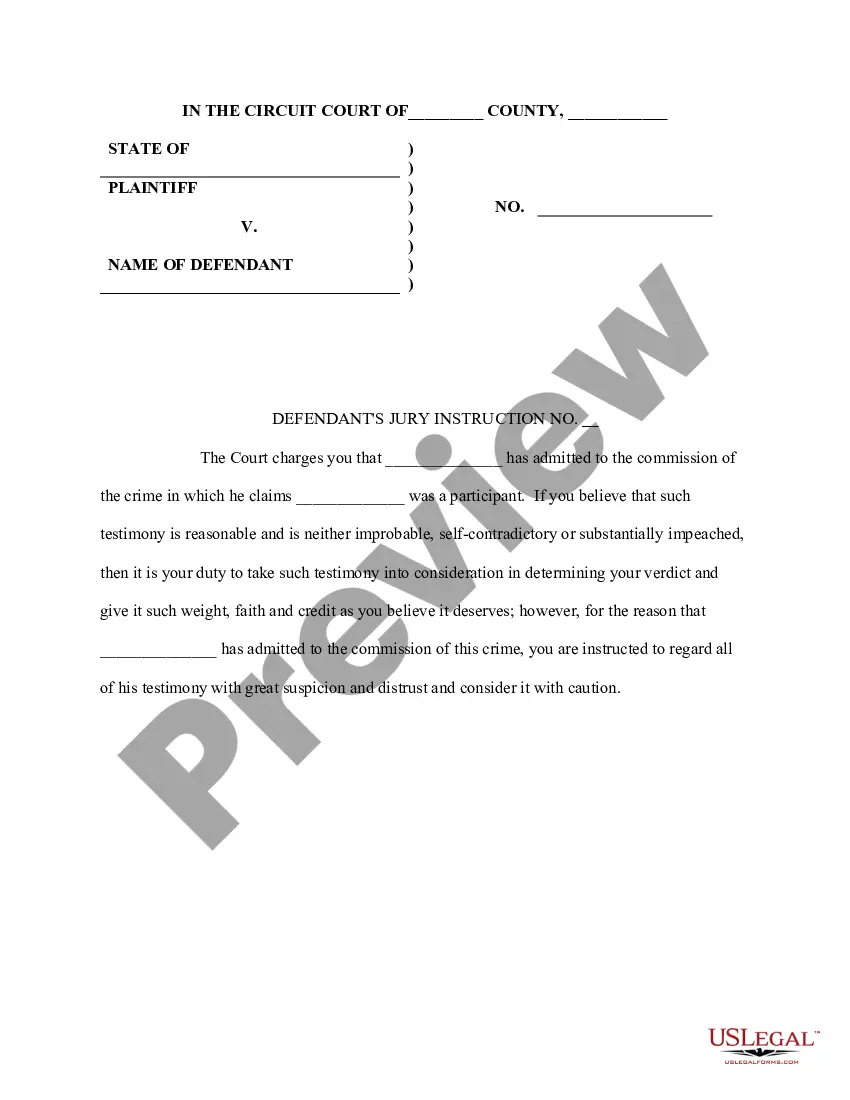
The Participate Instruction is a critical legal document used in jury trials. It instructs jurors regarding how to assess the testimony of a defendant who has admitted to a crime. This form guides jurors to weigh the defendant's statements with caution due to the inherent suspicion surrounding admissions of guilt, distinguishing it from other jury instructions that may address the credibility of witnesses without such admissions.
Main sections of this form
- The instruction notes the defendant's admission of guilt regarding a specific crime.
- It specifies the jurors' duty to consider the defendant's testimony as potentially suspect.
- It outlines the criteria for assessing the reasonableness and credibility of the defendant's claims.
- It emphasizes the need for caution in evaluating any testimony presented by the defendant.
Situations where this form applies
This form is used during the jury deliberation phase of a trial when the defendant has confessed to involvement in a crime. It is crucial for jurors to remember the implications of such admissions and to approach the testimony with necessary skepticism. Situations might include cases where a defendant implicates another party in a crime while admitting their own involvement.
Who needs this form
- Judges presiding over criminal trials.
- Legal teams representing the prosecution or defense.
- Jury consultants and legal educators.
- Defendants in criminal cases who may wish to understand the implications of admissions during trials.
How to prepare this document
- Identify the defendant involved in the crime and fill in the blank space with their name.
- Specify the nature of the crime for which the admission is made.
- Clarify the role of any other parties in the crime as claimed by the defendant.
- Review the instructions to ensure clear communication of the caution required for assessing the testimony.
- Provide a written record for the jury regarding the admission and instruction for deliberation.
Notarization guidance
This form does not typically require notarization unless specified by local law. However, confirmation of its acceptance in specific courts may be prudent for compliance.
Get your form ready online
Our built-in tools help you complete, sign, share, and store your documents in one place.
Make edits, fill in missing information, and update formatting in US Legal Forms—just like you would in MS Word.
Download a copy, print it, send it by email, or mail it via USPS—whatever works best for your next step.
Sign and collect signatures with our SignNow integration. Send to multiple recipients, set reminders, and more. Go Premium to unlock E-Sign.
If this form requires notarization, complete it online through a secure video call—no need to meet a notary in person or wait for an appointment.
We protect your documents and personal data by following strict security and privacy standards.

Make edits, fill in missing information, and update formatting in US Legal Forms—just like you would in MS Word.

Download a copy, print it, send it by email, or mail it via USPS—whatever works best for your next step.

Sign and collect signatures with our SignNow integration. Send to multiple recipients, set reminders, and more. Go Premium to unlock E-Sign.

If this form requires notarization, complete it online through a secure video call—no need to meet a notary in person or wait for an appointment.

We protect your documents and personal data by following strict security and privacy standards.
Common mistakes
- Failing to appropriately clarify the crime involved with the defendant's admission.
- Not instructing the jury to consider the defendant's testimony with caution.
- Leaving out critical criteria that affect how jurors assess testimony.
Why use this form online
- Convenient access to legal templates whenever needed.
- Easy customization to fit specific case requirements.
- Reliability ensured by attorney-drafted content.
Legal use & context
- Helps jurors navigate the complexity of evaluating admissions of guilt.
- Ensures that legal standards for testimony evaluation are upheld in court.
- Contributes to fair trials by guiding jurors to use caution with biased testimony.
Main things to remember
- The Participate Instruction aids juries in understanding the weight of a defendant's admission.
- It specifies the necessity of cautious evaluation of testimonies related to the admission.
- This form applies broadly across various jurisdictions and can be tailored to specific cases.
Looking for another form?
Form popularity
FAQ
Instructional procedures are procedures created, planned, and implemented to keep things running smoothly and efficiently in the classroom. You can implement a procedure for many things in your classroom, including passing out papers, morning arrival, and transitioning.
Set the Stage. Explain How You Evaluate Participation. Help Students Prepare. Ask for Written Responses or Free-Writes. Promote Student Thinking. Avoid Programmed and Yes-or-No Questions. Demonstrate Your Interest. Give Nonverbal Support. Work with Everyone. Be Aware of Who You are Calling On.
Joyce and Weil (1986) identify four models: information processing, behavioral, social interaction, and personal. Within each model several strategies can be used. Strategies determine the approach a teacher may take to achieve learning objectives.
Be respectful. Speak loud enough so everyone can hear. Listen to classmates. Don't interrupt who is speaking. Build on your classmate's comments with your comments. Use participation to not only answer questions but to seek help or ask for clarification.
Foster an ethos of participation. Teach students skills needed to participate. Devise activities that elicit participation. Consider your position in the room. Ask students to assess their own participation. Ensure that everyone's contributions are audible.
Participatory Learning Technique (PLT) is a way of organizing the classroom that motivates learners to participate in the act of teaching, a peer-based learning process. In this way, learning is focused on increased student participation, so it is basically student centered.
Instructional processes describe the instructional activities that provide the means through which students will achieve the stated objectives of a course.Instructional processes must be descriptive of the strategies and methods employed in the course.
Enable Anonymous Questioning. Give Them a Choice. Assess Prior Knowledge. Break up Lectures. Keep Minds Working. Encourage Peer-to-Peer Learning.
There are six interactive components of the learning process: attention, memory, language, processing and organizing, graphomotor (writing) and higher order thinking. These processes interact not only with each other, but also with emotions, classroom climate, behavior, social skills, teachers and family.