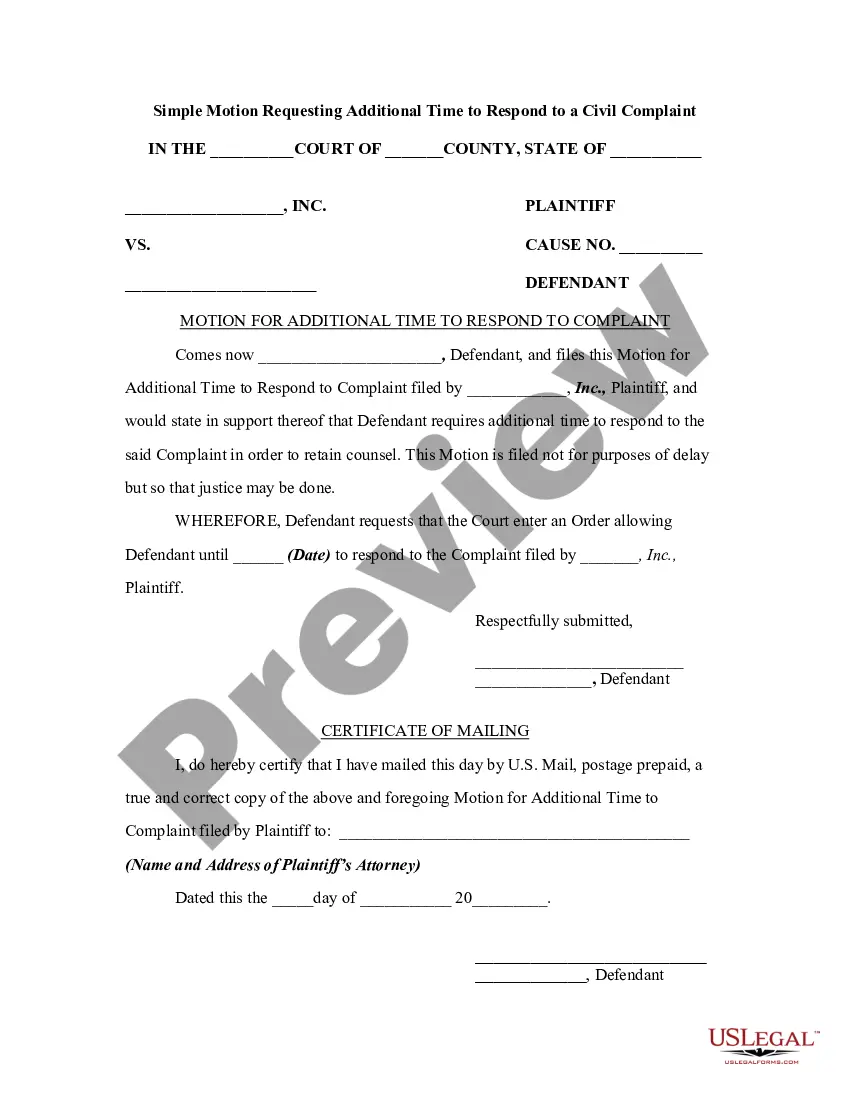
Simple Motion Requesting Additional Time to Respond to a Civil Complaint
About this form
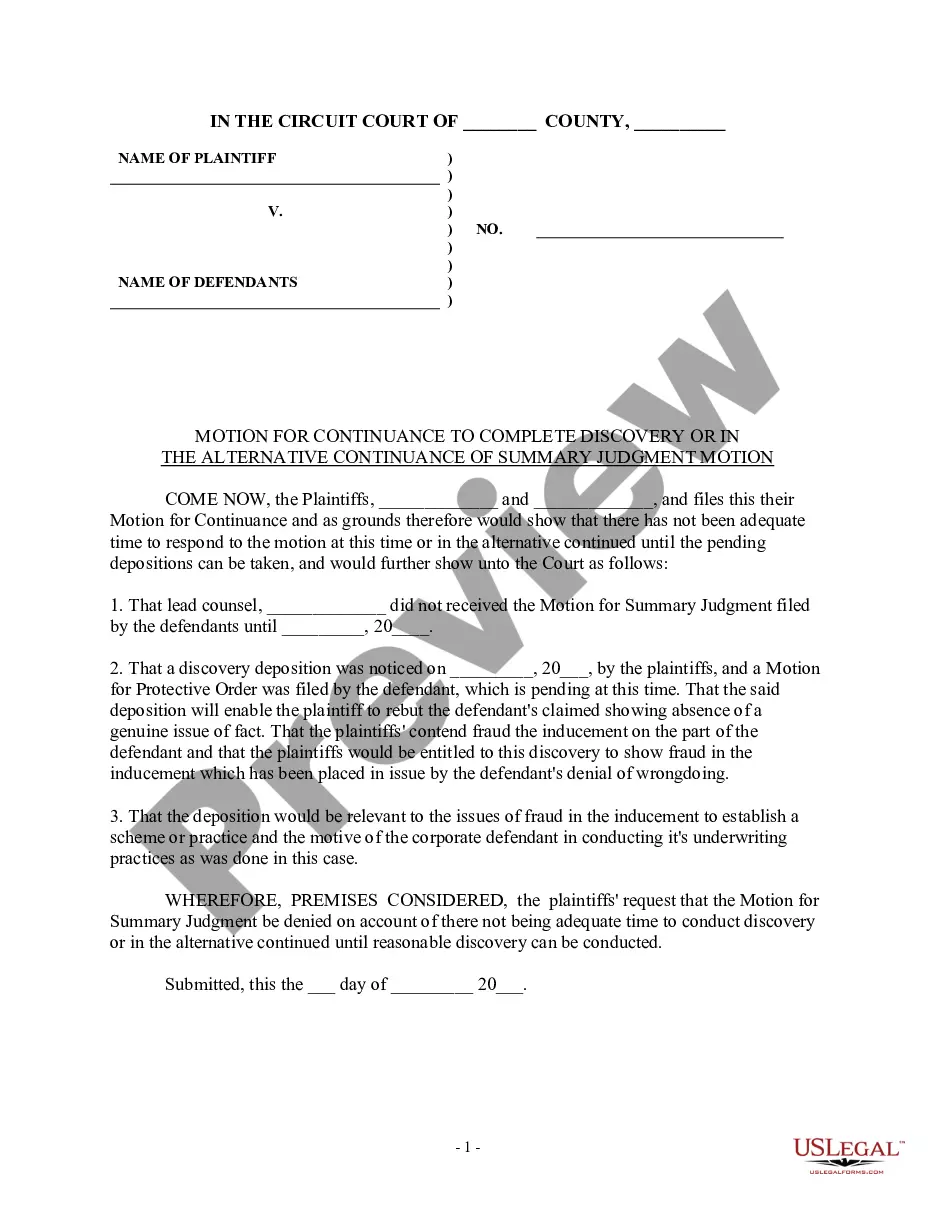
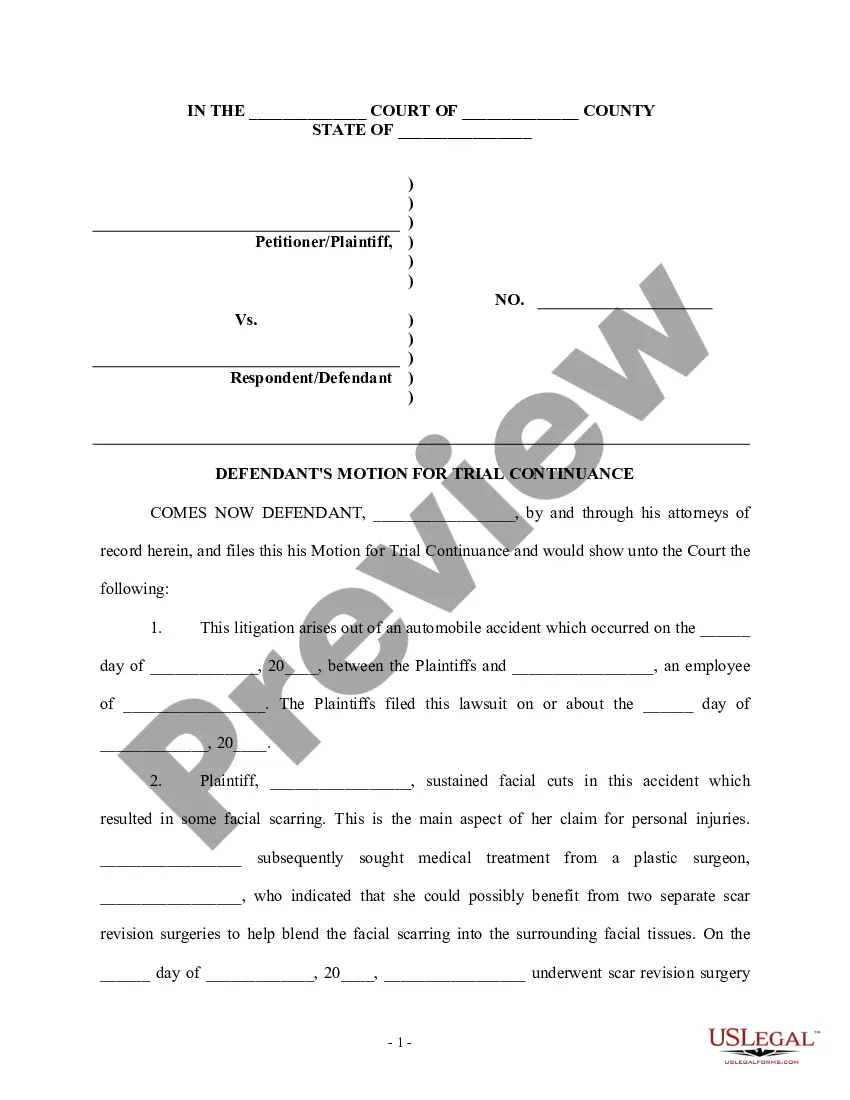
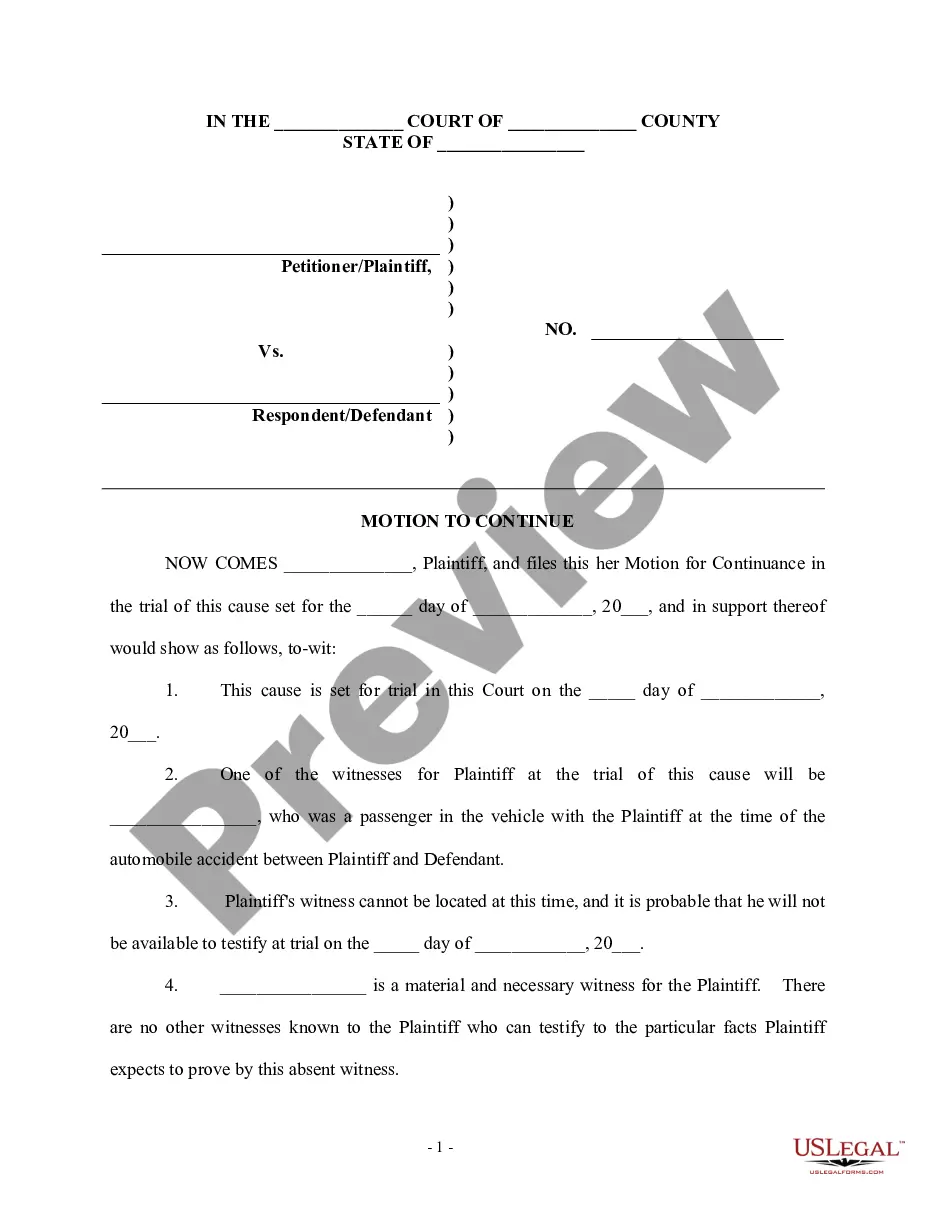
The Simple Motion Requesting Additional Time to Respond to a Civil Complaint is a legal document used by defendants in civil cases to request an extension for responding to a complaint. This form allows defendants to formally ask the court for more time, rather than missing a deadline. Unlike other motions, this one specifically addresses time extensions for responses, ensuring that defendants can adequately prepare their cases.
Main sections of this form
- Caption: Includes the court's name, parties involved, and case number.
- Introduction: States the defendant's identity and the purpose of the motion.
- Reason for extension: Details the need for additional time, often to consult an attorney.
- Requested date: Specifies the new deadline for the response.
- Signature block: Space for the defendant's signature and date of submission.
- Certificate of mailing: Confirms that the motion was sent to the plaintiff's attorney.
When to use this form
This form is necessary when a defendant requires more time to respond to a civil complaint filed against them. Situations where this form might be needed include cases where the defendant is in the process of hiring legal counsel, requires additional time to gather information to respond adequately, or has other legitimate reasons that justify an extension. Filing this motion helps ensure that the defendant does not miss the critical deadline for submitting a response.
Who needs this form
- Defendants in civil lawsuits who need more time to prepare a response.
- Individuals or parties who have been served with a civil complaint.
- Those who are in the process of obtaining legal representation.
Instructions for completing this form
- Identify the parties: Fill in the names of the plaintiff and defendant at the beginning of the form.
- State the motion: Clearly state that you are requesting additional time to respond to the complaint.
- Provide justification: Explain why you need additional time, ensuring it is genuine and reasonable.
- Enter a new deadline: Specify the date by which you plan to respond to the complaint.
- Sign and date the form: Include your signature and the date of filing.
- Mail the motion: Ensure that it is sent to the plaintiff's attorney, and complete the certificate of mailing.
Is notarization required?
Notarization is not commonly needed for this form. However, certain documents or local rules may make it necessary. Our notarization service, powered by Notarize, allows you to finalize it securely online anytime, day or night.
Get your form ready online
Our built-in tools help you complete, sign, share, and store your documents in one place.
Make edits, fill in missing information, and update formatting in US Legal Forms—just like you would in MS Word.
Download a copy, print it, send it by email, or mail it via USPS—whatever works best for your next step.
Sign and collect signatures with our SignNow integration. Send to multiple recipients, set reminders, and more. Go Premium to unlock E-Sign.
If this form requires notarization, complete it online through a secure video call—no need to meet a notary in person or wait for an appointment.
We protect your documents and personal data by following strict security and privacy standards.

Make edits, fill in missing information, and update formatting in US Legal Forms—just like you would in MS Word.

Download a copy, print it, send it by email, or mail it via USPS—whatever works best for your next step.

Sign and collect signatures with our SignNow integration. Send to multiple recipients, set reminders, and more. Go Premium to unlock E-Sign.

If this form requires notarization, complete it online through a secure video call—no need to meet a notary in person or wait for an appointment.

We protect your documents and personal data by following strict security and privacy standards.
Avoid these common issues
- Failing to file the motion before the initial deadline.
- Not providing a valid reason for needing additional time.
- Omitting the required signature or date.
- Not serving the motion to all necessary parties.
- Using incorrect formatting or language per jurisdiction requirements.
Why complete this form online
- Convenient access: Download and complete the form from anywhere.
- Editability: Easily customize the form to meet your specific needs.
- Legal assurance: The form is created by licensed attorneys to ensure compliance with legal standards.
Looking for another form?

Form popularity
FAQ
(A) Time to file. Any party may file a response to a motion; Rule 27(a)(2) governs its contents. The response must be filed within 10 days after service of the motion unless the court shortens or extends the time.
Response or default: Once the case is filed, you generally have 30 days to respond to the lawsuit. If you do not respond, you will be in default.
A defendant may respond in an answer that admits or denies each of the plaintiff's allegations in the complaint. The answer will list defenses and counter-claims or cross-claims against the plaintiff or other defendants. The answer will state whether the defendant wants a jury trial. The case will then continue.
After the judge, or a jury, grants you your award or judgment, you must still pursue or execute on the judgment. Lawsuits typically resolve with one of two different outcomes you receive an order from the court requiring the party to do something (or refrain from doing something) or you receive a monetary award.
Failure to Respond: If a defendant fails to answer the complaint or file a motion to dismiss within the time limit set forth in the summons, the defendant is in default. The plaintiff can ask the court clerk to make a note of that fact in the file, a procedure called entry of default.
Response or default: Once the case is filed, you generally have 30 days to respond to the lawsuit. If you do not respond, you will be in default.
If the defendant disputes your claim, they will send their defence to the court. They usually get 14 days to complete and return the defence but can ask to extend it to 28 days. If this happens, the court will let you know. There are various ways the defendant can dispute your claim.
File an answer. The most common way to respond to a complaint is by filing an answer. Negotiate. Being served with a lawsuit does not automatically mean you need to appear in court. Request more information from the plaintiff. Cross-complain. File a motion to dismiss.
You can file an answer or a general denial. Filing an answer. You can file a motion In certain situations, you can respond to the lawsuit by filing a motion (a request) that usually tells the court that the plaintiff made a mistake in the lawsuit. Talk to a lawyer!